How Sturdy Are Dental Implants?
When you are considering replacing a missing tooth, strength is likely at the top of your list of priorities. You want to be able to eat a steak, bite into an apple, and laugh without worrying that your new tooth is going to break or fall out. You might have heard that dental implants are strong, but just how sturdy are they?
The answer is that dental implants are the strongest tooth replacement option available in modern dentistry. They are designed to withstand the immense forces of human chewing and can last for decades when properly cared for. In many ways, a dental implant is actually stronger than a natural tooth.
This guide will break down the science behind implant strength, compare them to natural teeth, explain the materials used, and look at the rare circumstances where an implant can fail.
The “Superpower” of Dental Implants: Osseointegration
To understand why implants are so sturdy, you need to understand the biological process that makes them work. The strength of an implant does not just come from the titanium screw itself; it comes from the bond between the bone and the implant.
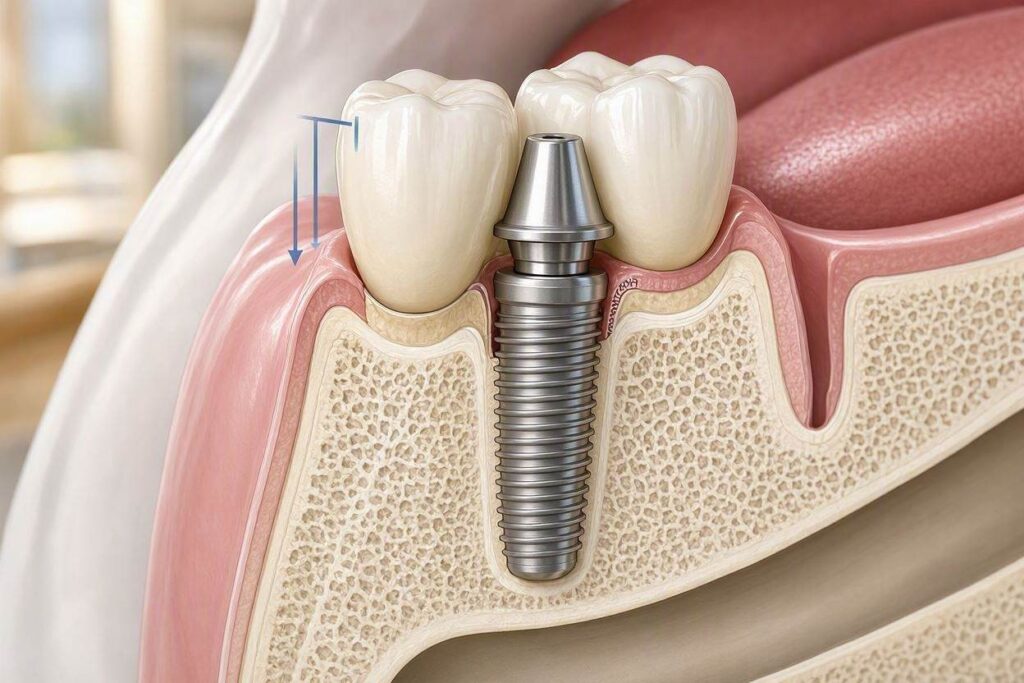
When a titanium implant is placed into the jawbone, the body does not reject it. Instead, the bone cells begin to grow and attach directly to the microscopic surface of the titanium. This process is called osseointegration.
Think of it like pouring concrete around a steel beam. Once the concrete (bone) hardens, the steel beam (implant) is not just sitting in a hole; it is fused to the structure. You cannot pull it out. This biological fusion makes the implant incredibly stable and resistant to movement.
Titanium vs. Natural Teeth: The Strength Comparison
It might surprise you to learn that titanium is much stronger than your natural tooth structure. However, strength in engineering is not just about hardness; it is also about flexibility and shock absorption. This is where the difference between implants and natural teeth lies.
Natural Teeth: The Shock Absorbers
A natural tooth is held in place by the periodontal ligament—a thin, elastic band of tissue that surrounds the root. This ligament acts like a suspension system. When you bite down hard, the tooth sinks slightly into the ligament, absorbing the shock. This prevents the tooth from cracking and the bone from being damaged.
Dental Implants: The Rigid Foundation
A dental implant is fused directly to the bone. There is no ligament. Therefore, there is no shock absorption. When you bite down, the force goes directly through the crown, through the implant, and into the bone.
This means an implant is incredibly rigid and sturdy. It will not flex or wobble. However, because it lacks that natural “suspension,” the crown on top of the implant (usually made of porcelain) can sometimes be more susceptible to chipping if you bite down on a very hard object, simply because the force isn’t dissipated by a ligament.
How Much Force Can an Implant Withstand?
Human chewing generates significant force. In the back molars, the biting force can range from 150 to 250 pounds per square inch (psi) . People who grind their teeth (bruxism) can generate forces exceeding 500 psi.
A standard titanium dental implant is rated to withstand much higher forces than natural chewing. Laboratory tests show that implant systems can fail at forces above 700 to 1,000 psi (depending on the brand and size). This means that under normal circumstances, you cannot bite hard enough to break the titanium post.
The “weak links” in the system are usually not the implant post itself. The two points that are more likely to fail are:
- The Porcelain Crown: The porcelain can chip or fracture if you bite down on a hard object like an olive pit or a bone.
- The Abutment Screw: The tiny screw that holds the crown to the abutment can sometimes loosen or, rarely, fracture under extreme torque.
The Materials Matter: Titanium and Zirconia
The sturdiness of the implant depends heavily on what it is made of. There are two main materials used.
1. Titanium (The Gold Standard)
Most dental implants are made of medical-grade titanium alloy (usually Ti-6Al-4V). This material is used for hip replacements and other orthopedic implants. It is chosen for three reasons:
- Strength: It is incredibly tough and resistant to fracture.
- Biocompatibility: The human body accepts it. It does not rust or corrode.
- Osseointegration: Bone loves to attach to titanium.
2. Zirconia (The Metal-Free Option)
Zirconia is a high-strength ceramic. It is used for patients who have metal allergies or want a “holistic” approach.
- Strength: Zirconia is very hard and strong in compression.
- Brittleness: While strong, zirconia is more brittle than titanium. It is more prone to fracturing if it is placed under extreme bending forces. Titanium can flex slightly; zirconia tends to snap if pushed too far. For this reason, titanium remains the first choice for most dentists, especially for back teeth.
The “Chewing” Test: What Can You Eat?
Patients want to know the practical answer: “What can I actually eat with this thing?”
Once the implant has fully healed and the final crown is placed, you can eat virtually anything you would eat with natural teeth. Steaks, apples, corn on the cob, nuts, and crunchy vegetables are all fine.
However, you should use the same common sense you would use with natural teeth. You wouldn’t chew on ice cubes or use your natural teeth to open a beer bottle. Similarly, you shouldn’t do those things with an implant.
The “Sticky” Foods Caution
The main dietary restriction for an implant has less to do with strength and more to do with the restoration. Very sticky foods (like taffy or caramel) can potentially pull off a cemented crown if the cement is old or weak. This is not a failure of the implant; it is just a failure of the glue holding the cap on. If the crown falls off, the dentist can usually cement it back on.
The Threat of “Lateral” Forces
Dental implants are designed to withstand vertical forces (biting straight down). They handle up-and-down pressure beautifully.
They are slightly less tolerant of lateral forces (forces pushing the implant from the side). This can happen if you grind your teeth side-to-side, or if the bite (occlusion) is not properly balanced.
Excessive lateral force acts like a lever on the implant. It can cause the bone around the implant to resorb (shrink), leading to loosening and eventual failure. This is why dentists emphasize the importance of a night guard for patients who grind their teeth. The night guard protects the implant from these harmful sideways forces.
Dental Implants vs. Bridges vs. Dentures: The Strength Test
To appreciate how sturdy implants are, we must compare them to the alternatives.
Dental Bridge
A bridge is a false tooth held in place by crowns on the adjacent healthy teeth. While a bridge restores your chewing ability, it is only as strong as the teeth holding it. Furthermore, a bridge does not stop bone loss in the jaw. The teeth supporting the bridge are also at higher risk of decay and fracture because they are doing double duty.
Partial or Full Dentures
Dentures rest on the gums. They are the least sturdy option. Patients with dentures often struggle to eat hard or chewy foods because the denture moves. Denture wearers typically have a biting force that is only 10-15% of that of a person with natural teeth or implants.
Dental Implant
An implant restores nearly 100% of your natural chewing function. Because it is anchored in the bone, you can bite with confidence. You do not have to worry about it slipping, clicking, or falling out.
Can an Implant Break?
While the titanium post is incredibly strong, it is not indestructible. Failure is rare, but it can happen.
1. Fracture of the Implant Body
This is extremely rare with modern titanium implants. It usually only happens after years of severe bruxism (grinding) without a night guard, which leads to metal fatigue.
2. Fracture of the Screw
The abutment screw is the most likely part to break. It is a small, thin piece of metal. If the crown is loose for a long time, or if it is overloaded, the screw can snap. The good news is that a broken screw can usually be removed and replaced by a skilled dentist.
3. Failure of the Crown
The porcelain crown can chip or crack. If it is a small chip, it can sometimes be polished. If it is a large fracture, the crown must be replaced.
4. Loss of Bone (The Real Threat)
As mentioned earlier, the most common cause of “implant failure” is not a broken piece of hardware; it is the loss of bone around the implant due to infection (peri-implantitis). If the bone recedes, the implant loses its foundation and becomes loose. This is a biological failure, not a structural one.
Conclusion
Dental implants are extraordinarily sturdy. The titanium post is fused to the bone through osseointegration, creating a foundation that is often stronger than a natural tooth root. While the porcelain crown can chip under extreme force and the abutment screw is a mechanical weak point, the implant post itself is designed to withstand hundreds of pounds of pressure per square inch. With proper care and protection from grinding, an implant provides a lifetime of confident chewing.
Frequently Asked Questions (FAQ)
1. Is an implant stronger than a real tooth?
In terms of resistance to decay, yes. An implant cannot get a cavity. In terms of resistance to fracture, the titanium post is stronger than a natural root. However, the porcelain crown on the implant is similar in strength to a natural tooth crown and can chip if abused. The main difference is that an implant lacks the natural “shock absorber” ligament.
2. Can I play contact sports with a dental implant?
Yes. The implant itself is anchored securely in the bone. It will not be knocked out by a tackle. However, you should wear a custom-fitted sports mouthguard to protect the implant crown (and your remaining natural teeth) from being fractured by a direct blow.
3. Why does my implant feel “too strong” or solid when I chew?
This is because you are missing the periodontal ligament that acts as a shock absorber in natural teeth. With natural teeth, the ligament compresses. With an implant, there is no “give.” It feels rock solid. This sensation usually feels normal after a few weeks as your brain adjusts to the new feedback.
4. Will the implant rust or corrode over time?
No. Dental implants are made of medical-grade titanium alloy. Titanium forms a stable oxide layer on its surface that prevents corrosion. It is the same material used for knee and hip replacements, which are designed to survive in the human body for decades.
5. Can I get an MRI if I have a titanium implant?
Yes. Titanium is non-ferromagnetic. It will not be pulled or heated by the MRI magnet. It is completely safe. The only issue is that if the MRI is of your jaw, the implant might cause some visual distortion (artifact) on the scan, making it harder to see the surrounding tissue.