Are Dental Implants Better Than Dentures?
You are missing teeth, and you face a fork in the road. Down one path lies a removable denture, a solution that has been around for centuries. Down the other path lies a dental implant, a modern marvel of titanium and ceramic. Both will replace your missing teeth. Both will restore your smile. But which is truly better?
The answer, from a purely functional and biological perspective, is emphatically that dental implants are superior to traditional removable dentures. They preserve bone, restore nearly full chewing function, feel and look more natural, and do not require the messy adhesives and embarrassing slippage that denture wearers have endured for generations. However, “better” must be weighed against cost, surgical requirements, and the patient’s overall health. For some, a well-made denture remains the appropriate choice.
This guide will provide a comprehensive, head-to-head comparison of dental implants and dentures across every metric that matters: function, comfort, aesthetics, bone preservation, hygiene, cost, and psychological impact. By the end, you will know which solution aligns with your life.
The Fundamental Difference: Root vs. Platform
To understand the gulf between these two options, you must grasp the one fundamental design difference.
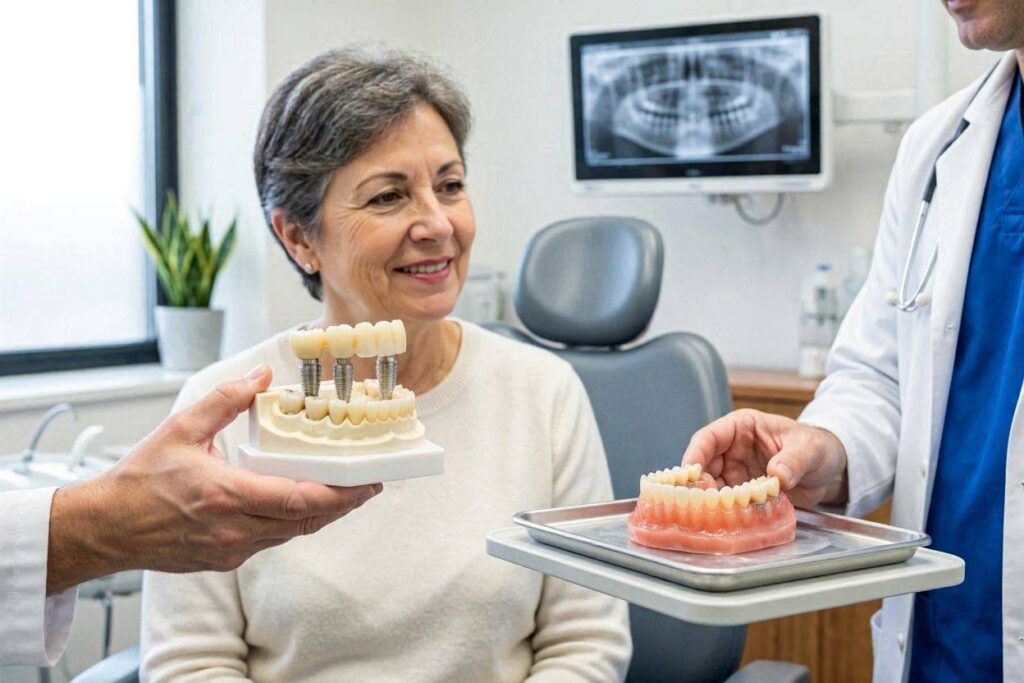
- A dental implant replaces the tooth root. A titanium post is placed into the jawbone. It fuses with the bone and supports a crown, bridge, or full-arch prosthesis. The implant transmits chewing forces into the bone, maintaining its health and density. It is fixed, not removable by the patient.
- A complete or partial denture replaces only the visible teeth. It is a removable acrylic platform that sits on the gum tissue. It is supported by the gums and underlying bone, and in the case of a partial denture, it clasps onto remaining natural teeth. It transmits no functional forces into the bone. It is removed and cleaned outside the mouth daily.
This single difference, replacing the root versus replacing only the crown, creates a cascade of consequences that affect every aspect of the patient’s life.
Chewing Function and Diet: The Most Dramatic Difference
This is where the implant shines brightest and the denture fails most miserably.
The Denture Reality
A traditional complete denture, especially a lower one, is a notoriously inefficient chewing tool. It floats on a sea of saliva and mobile tissue. Studies consistently show that a complete denture wearer has only 20% to 25% of the chewing efficiency of a person with natural teeth. This means the denture wearer must apply seven to eight times more chewing strokes to process the same amount of food.
The consequences are profound. Tough foods like steak, raw vegetables, nuts, and crusty bread become impossible or difficult. Denture wearers often gravitate toward a soft, processed, high-carbohydrate diet. This nutritional compromise can lead to vitamin deficiencies, digestive problems, and a reduced quality of life.
The Implant Reality
A single implant crown or an implant-supported full arch restores chewing efficiency to levels approaching natural dentition. Studies show that implant-supported prostheses restore 85% to 95% of natural chewing function. A patient with a full-arch implant restoration can eat an apple, a steak, a salad, and a crusty baguette without thinking. There is no dietary restriction. Nutrition is not compromised. This is a health-transforming benefit.
Bone Preservation: Use It or Lose It
The jawbone is a tooth-dependent tissue. Its very existence is predicated on the presence of tooth roots. When a tooth is extracted, the body begins to resorb the non-functional alveolar bone.
The Denture Reality
A denture sits on the gum and actually accelerates bone resorption. The pressure of the denture saddle on the underlying bone, combined with the absence of functional stimulation, causes the bone to melt away over the years. This process, residual ridge resorption, leads to the classic “denture face”: a sunken mouth, protruding chin, and deep wrinkles around the lips. The denture becomes progressively looser as the ridge shrinks, requiring frequent relines and eventually a remake. The bone loss is permanent and irreversible.
The Implant Reality
An implant replaces the root. Chewing forces are transmitted through the implant into the bone, just like a natural tooth. This loading stimulates the bone, signaling the body to maintain its density. Wolff’s Law states that bone remodels in response to stress. The implant preserves the bone. The jawbone height and width are maintained. The facial structure is supported. The patient avoids the skeletal deterioration that is the inevitable consequence of long-term denture wear.
Comfort, Stability, and the Elimination of Adhesives
The Denture Reality
Denture wearers live with a constant, low-grade anxiety: will my teeth slip? The lower denture, particularly, can lift during speech, during a laugh, or during a meal. The result is embarrassment and social inhibition. To combat this, patients often rely on denture adhesives, messy pastes and powders that provide a temporary, imperfect seal. Adhesives can alter taste, are difficult to clean, and can contribute to soft tissue inflammation. Dentures can also cause chronic sore spots and ulceration on the underlying gums.
The Implant Reality
An implant is fixed. It does not move. It does not slip. It does not require adhesive. The implant-supported overdenture snaps securely onto two to four implants. It is stable while speaking, laughing, and chewing. The patient never experiences the sudden, mortifying “floating” sensation. The psychological liberation from this constant anxiety is one of the most frequently cited benefits by patients who switch from dentures to implants.
Aesthetics and Speech
The Denture Reality
A well-made denture can look very natural initially. However, as the underlying bone resorbs, the facial support changes. The denture can appear too large, or the teeth can seem to recede. The flanges of a full denture can slightly alter lip contour. Speech can be affected by the bulk of the upper denture covering the palate. Some patients struggle with a lisp or a clicking sound.
The Implant Reality
An implant crown or bridge is fixed and does not cover the palate. The emergence profile from the gum is natural. Lip support is maintained because the bone is preserved. Speech is generally not affected, or the patient adapts rapidly. The aesthetics are stable over time because the foundation (the bone) is stable.
Hygiene and Daily Maintenance
The Denture Reality
Dentures are removed at night and soaked in a cleaning solution. They are brushed with a denture brush. The gums and any remaining teeth are brushed and cleaned. The routine is relatively simple. However, dentures can harbor Candida (fungus) and bacteria if not cleaned properly, leading to denture stomatitis.
The Implant Reality
Implants cannot be removed. They must be cleaned in place, meticulously. As detailed in previous articles, cleaning around an implant, especially under a full-arch prosthesis, requires special tools, time, and diligence. The hygiene burden for an implant is significantly higher and more technically demanding than for a removable denture. This is the one area where dentures have a clear advantage in simplicity.
Cost: The Decisive Factor for Many
The Denture Reality
A complete upper and lower denture is the most economical tooth replacement option. The cost is typically a few thousand dollars. Dental insurance often provides some coverage. This low barrier to entry makes dentures accessible to nearly everyone.
The Implant Reality
Dental implants are a significant investment. A full-arch implant restoration can cost $15,000 to $30,000 per arch. Even a single implant and crown is $3,500 to $6,500. However, when the long-term costs of denture relines, replacements, adhesives, and the nutritional and health consequences of poor chewing are factored in, the lifetime economic picture narrows. Still, the upfront cost is undeniably higher and is a genuine obstacle.
The Comparison Table: Implants vs. Dentures
| Feature | Dental Implants (Single or Full Arch) | Traditional Removable Dentures |
|---|---|---|
| Chewing Efficiency | 85-95% of natural function. | 20-25% of natural function. |
| Bone Preservation | Yes, stimulates and maintains bone. | No, accelerates bone resorption. |
| Stability | Fixed, rock-solid. | Removable, often unstable, especially lower. |
| Comfort | Feels like natural teeth, no bulk. | Can cause sore spots, bulk, covers palate. |
| Aesthetics | Excellent, stable over time. | Good initially, deteriorates as bone resorbs. |
| Speech | Minimal to no impact. | Can be affected by bulk and looseness. |
| Hygiene | Demanding, requires special tools. | Simple, removed and cleaned outside mouth. |
| Taste and Palate Coverage | Palate uncovered, full taste. | Upper denture covers palate, impairs taste. |
| Long-Term Cost | Higher initial, lower long-term maintenance. | Lower initial, ongoing relines, replacements. |
| Surgical Requirement | Yes, with recovery. | No surgery required. |
| Psychological Impact | High confidence, “forget you have them.” | Variable, often anxiety about slippage. |
The Hybrid: Implant-Retained Overdenture
There is a middle ground. For an edentulous patient, placing two to four implants in the lower jaw and fitting the denture with snap attachments creates an implant-retained overdenture. This combines the cost-effectiveness of a denture with the retention and stability of implants. The denture is still removable for cleaning, but it snaps firmly into place. This is a life-changing improvement over a conventional floating lower denture and is much more affordable than a fixed full-arch prosthesis.
Conclusion
From a functional, biological, and psychological standpoint, dental implants are decisively superior to traditional removable dentures. They restore near-natural chewing ability, preserve the jawbone from resorption, provide fixed stability without adhesives, and offer a long-term, durable solution that feels and functions more like real teeth. Dentures, however, remain a viable and economical option, particularly for patients who are not surgical candidates or who prefer a simpler, removable solution. The implant-retained overdenture offers an excellent compromise, providing much of the stability of implants at a lower cost than a fixed full-arch bridge.
FAQ
1. Can I sleep with my dentures in if I have implants?
If you have a fixed implant prosthesis (All-on-4 or full-arch bridge), it is not removable and you sleep with it in place. If you have an implant-retained overdenture, it is generally recommended to remove it at night to allow the gum tissues to rest and to clean the prosthesis.
2. Is it ever too late to switch from dentures to implants?
It is rarely too late. However, if you have been wearing dentures for many years, you will likely have significant bone loss. This may require bone grafting before implants can be placed, adding complexity and cost. A CBCT scan will determine the extent of bone available.
3. Are dentures really that bad?
For some patients, a well-made denture is comfortable, aesthetic, and fully acceptable. The negative experience of dentures is often proportional to the quality of the denture, the skill of the dentist, and the patient’s anatomy. A poorly made denture on a severely resorbed ridge is a misery. A well-made denture on a good ridge can be very satisfactory. However, even the best denture cannot match the chewing efficiency and bone preservation of an implant.
4. Can I get just two implants to hold in my loose lower denture?
Yes. This is the classic and highly successful mandibular two-implant overdenture. Two implants are placed in the front of the lower jaw, and the denture is retrofitted with attachments that snap onto these implants. This provides excellent retention and stability, transforming the lower denture experience, and is a much more affordable option than a full fixed arch.
Additional Resource
For a patient-friendly comparison of tooth replacement options, visit the American College of Prosthodontists: https://www.gotoapro.org/