Are Mini Dental Implants Removable?
You have been researching solutions for your loose, uncomfortable lower denture. It floats, clicks, and makes eating a social minefield. You have heard about a less invasive, more affordable option called mini dental implants. The name itself raises a critical question. Are these miniature posts fixed permanently in your bone, or are they something you take in and out, like a denture? The word “removable” is the source of the confusion.
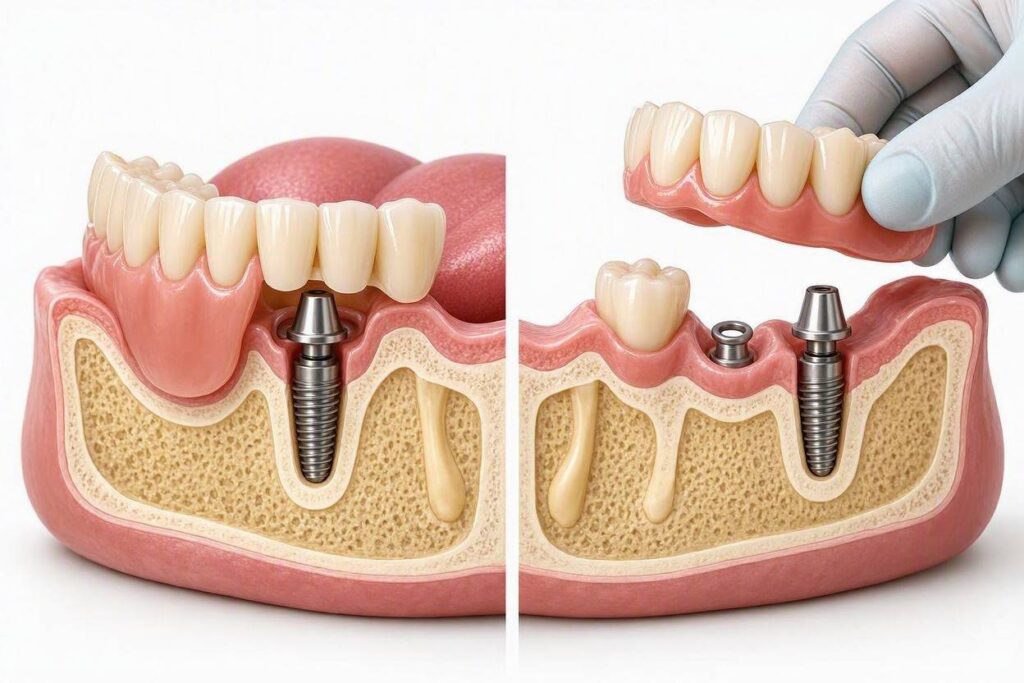
The answer requires a precise distinction. The mini dental implant post itself is not removable. It is a small titanium screw that is surgically placed into the jawbone, where it osseointegrates, or fuses, just like a standard implant. It is fixed. It stays in your mouth permanently. However, the denture that attaches to the mini implants is designed to be removable by you, the patient, for daily cleaning and nighttime removal. The implants are the fixed anchors. The overdenture is the removable prosthesis. This article will clarify this dual nature, explain the design and purpose of mini implants, and compare them to their conventional counterparts.
The Design Difference: What Makes a Mini Implant “Mini”
A mini dental implant is not simply a scaled-down version of a standard implant. It has a fundamentally different structural design. A standard implant is typically a two-piece system: a wider implant post (usually 3.5 to 5.0 millimeters in diameter) and a separate abutment that is screwed into the post after healing. This two-piece, wider design provides immense strength and is the gold standard for replacing a single tooth with a fixed crown.
A mini dental implant is a one-piece, solid device. It is much narrower, with diameters ranging from 1.8 to 2.9 millimeters. It has a solid body with threads that taper down to a narrow apex, like a small wood screw. The top of the implant, which protrudes through the gum into the mouth, is not a separate abutment. It is a single, solid extension of the implant body, typically ending in a ball-shaped (O-ring) or a square-shaped head, designed to snap into a corresponding housing embedded in the denture.
This one-piece, narrow design is the key to its application. Because it is so thin, a mini implant can often be placed directly through the gum and into the bone without making a large surgical incision. The procedure is typically flapless and less invasive, with minimal post-operative discomfort. This makes it an excellent option for patients who have experienced bone resorption and have a thin ridge of bone that is insufficient for a wider standard implant without a bone graft. The mini implant can fit in narrow spaces where a standard implant cannot.
The Fixed Anchor: The Mini Implant in the Bone
Despite their small size, mini dental implants are true implants. They are made of the same medical-grade titanium alloy (Ti-6Al-4V ELI) as standard implants. When they are placed into the jawbone with a precise surgical technique, the bone cells respond in the same way. They migrate to the roughened surface of the mini implant and begin the process of osseointegration. The bone fuses directly to the titanium, locking the mini implant rigidly in place.
The mini implant post is not designed to be removed by the patient or the dentist, except in the case of a specific clinical failure or infection. It is a permanent, fixed fixture. The patient does not turn it, unscrew it, or take it out. It remains submerged in the bone and gum, with only the small ball or square head visible above the gum tissue. This fixed anchor is the stable foundation that transforms a floating denture into a secure, retentive prosthesis. The mini implant is fixed. The stability it provides is palpable.
The Removable Prosthesis: The Snap-On Denture
The removable part of the mini implant system is the denture, which is now accurately called an implant-retained overdenture. The underside of the denture has been fitted with a corresponding housing that contains a rubber or nylon O-ring, or a metal clip mechanism. This housing aligns with the heads of the mini implants in the mouth.
When the patient inserts the denture, they press it down over the implant heads. The O-rings snap over the ball heads, or the clips engage the square heads, with a satisfying and secure click. The denture is now locked onto the implants. It is extremely stable for chewing and speaking. The embarrassing movement and clicking are gone.
When it is time for cleaning or sleep, the patient simply uses their fingers to pry the denture up, disengaging the snaps. The denture comes out of the mouth, leaving the small, polished implant heads exposed on the gum ridge. The patient cleans the denture, brushes around the implant heads just like natural teeth, and stores the denture overnight. In the morning, the denture is snapped back into place. The implants are fixed. The denture is removable. This is the fundamental distinction.
The Removability for Maintenance: A Planned Retrievability
There is another, clinically distinct context in which mini dental implants are considered removable. Some implant systems use a narrow, one-piece mini implant not to retain a denture, but to support a fixed, cementable single crown, particularly for small-diameter spaces like lower incisors. In these cases, the restoration is not intended to be removed by the patient. It is a fixed crown.
However, if a problem develops—infection, bone loss, or mechanical failure of the implant—the narrow mini implant is designed to be removed by the clinician. Because it is a solid, one-piece design, and because its surface area for osseointegration is limited, a skilled surgeon can often remove it with a reverse-torque technique, unscrewing it from the bone with minimal trauma. A standard, wider, two-piece implant is far more difficult and destructive to remove. This clinical retrievability is considered an advantage of some mini implant designs. They can be removed if they fail, preserving the bone and allowing a new implant to be placed in the future.
The Overdenture Maintenance Note: The O-rings in the denture are wear items. They will lose their elasticity and grip over time, typically needing replacement every 12 to 18 months. This is a simple, quick, and inexpensive chairside procedure where the dentist swaps out the old rings for new ones. The snap of a freshly replaced O-ring restores the full retention of the denture.
Mini Implants vs. Standard Implants for Overdentures
The decision between mini and standard implants for a removable overdenture is a clinical and financial one. The classic standard-of-care for a lower overdenture is two standard implants with separate, custom-made abutments (often a Locator attachment). This system is known for its exceptional long-term durability and the versatility of the Locator abutment, which has replaceable nylon inserts with different retention strengths.
Mini implants offer a less invasive, often immediately loaded, and lower-cost alternative. The fee for two mini implants to retain a lower denture is often significantly less than two standard implants with Locator abutments. The surgery is quicker and gentler. The immediate function is appealing: a patient can often have their denture retrofitted and snapped onto the mini implants on the same day as surgery.
The trade-off is long-term durability. The narrow diameter of a mini implant is more susceptible to fracture under heavy, off-axis loads. The long-term survival data for mini implants, while good, is not as extensive as the multi-decade data for standard-diameter implants. A heavy bruxer or a patient with a powerful jaw may be better served by standard implants. The discussion with your implant dentist will weigh the lower initial cost and minimally invasive surgery against the proven, robust long-term track record of the wider implant.
Conclusion
Mini dental implants are fixed titanium posts that osseointegrate with the jawbone, serving as permanent anchors. They are not removed by the patient. The denture that snaps onto them is the removable component, designed for daily hygiene. This combination of fixed anchorage and removable prosthesis provides a transformative improvement in stability and quality of life for denture wearers, using a minimally invasive and cost-effective surgical approach.
Frequently Asked Questions
Can I sleep with my snap-on denture in place?
No. It is strongly recommended that you remove the denture at night. This allows the gum tissue covering the ridge and surrounding the implant heads to rest, breathe, and be cleansed of bacterial plaque by your saliva. Wearing the denture 24/7 creates a warm, dark, stagnant environment that promotes fungal infections and inflammation of the oral mucosa.
How many mini implants do I need for a lower denture?
The most common configuration is four mini implants placed in the front of the lower jaw, between the mental foramina (the openings where the nerves exit). Four mini implants provide excellent stability and cross-arch support. Some protocols use two or three. The number depends on the quality and quantity of your bone and the stability of your existing denture.
What happens if a mini dental implant fails?
If a mini implant fails to osseointegrate or becomes loose due to infection, it can usually be removed relatively easily by the dentist. The site is cleaned and allowed to heal. A new mini implant can often be placed in a slightly different position after the bone has healed, or the case can be converted to a smaller number of implants, as long as the remaining ones provide adequate retention.
Additional Resource:
For a patient-friendly overview of implant-retained dentures and the different attachment systems, visit the American Academy of Implant Dentistry: https://www.aaid.com/patient_education/dental_implants_overdentures.html