Are Zirconia Dental Implants Safe?
You need a dental implant, but you have concerns about metal. Perhaps you have a known metal allergy. Perhaps you have a sensitivity to nickel or other metals. Perhaps you simply prefer a holistic, metal-free approach to your healthcare. You have heard about zirconia implants, those white ceramic posts that seem like a natural, biocompatible alternative to titanium. But the question nags at you: are they safe? Are they as proven as traditional titanium?
The answer is a confident yes. Zirconia dental implants are safe, biocompatible, and have accumulating clinical evidence supporting their use as a viable alternative to titanium. They are FDA-approved, CE-marked, and have been in clinical use for over two decades. However, they are not simply a “white titanium.” They are a different material with their own unique properties, advantages, and limitations. Understanding these nuances is essential to making an informed choice.
This guide will delve into the material science of zirconia, the evidence for its safety and efficacy, the differences from titanium, and the specific clinical scenarios where a zirconia implant may or may not be the best choice.
What Is Zirconia? Understanding the Material
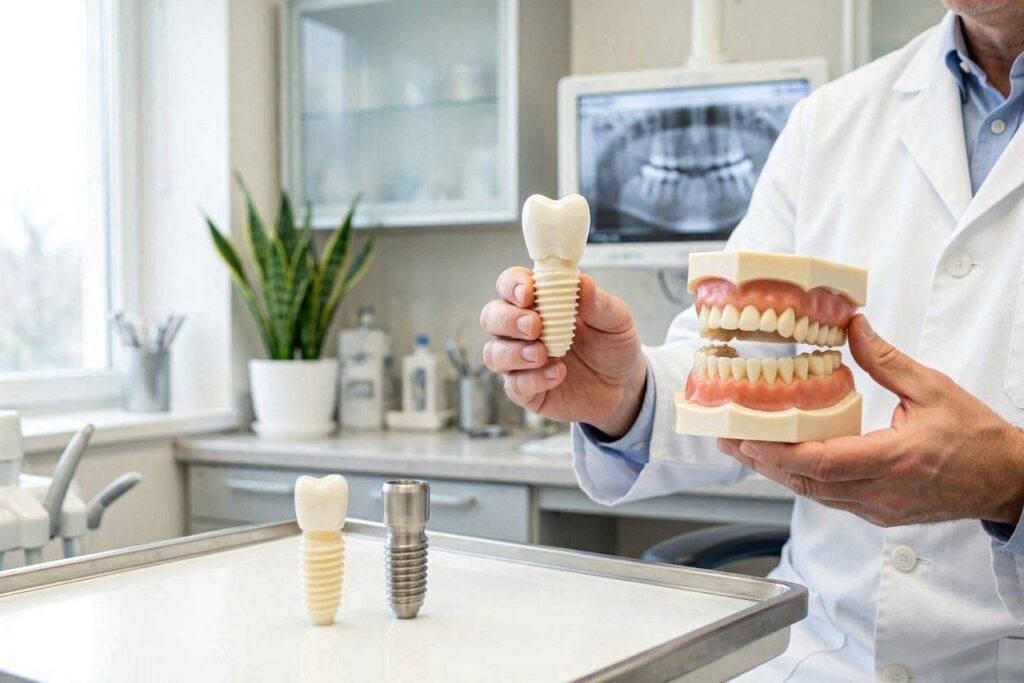
The term “zirconia” in dentistry refers to yttria-stabilized tetragonal zirconia polycrystal (Y-TZP). This is a ceramic material derived from zirconium, a silvery metal. Through a complex manufacturing process, the zirconium is oxidized, stabilized with a small amount of yttrium oxide, and transformed into a high-performance ceramic.
This material has several remarkable properties:
- High Flexural Strength: It can withstand extreme bending forces without fracturing. Modern dental zirconia has a flexural strength of 1000-1200 MPa, making it stronger than many metals.
- Fracture Toughness: It resists crack propagation. When stressed, the tetragonal crystals at the crack tip transform into a monoclinic phase, expanding in volume and compressing the crack shut. This “transformation toughening” is a unique self-healing property.
- Biocompatibility: Zirconia is biologically inert. It does not corrode, does not release ions, and elicits virtually no immune response.
- Low Plaque Affinity: The smooth, polished ceramic surface resists bacterial adhesion.
- Aesthetics: It is white, eliminating the risk of a gray metal show-through through thin gums.
The Safety Profile: Biocompatibility and Allergy
The primary driver for many patients seeking zirconia implants is the desire for a metal-free, hypoallergenic option. The safety data strongly supports this choice.
Corrosion Resistance
Titanium is highly corrosion-resistant, but it is not completely inert. Trace amounts of titanium ions can be released into the surrounding tissues over years, especially in an acidic inflammatory environment. For most people, this is biologically insignificant. For a small subset with a true hypersensitivity, it triggers a chronic inflammatory response.
Zirconia does not corrode. It is a ceramic oxide, chemically stable and inert in the oral environment. It releases no metal ions. For patients with confirmed or suspected metal allergies, zirconia offers peace of mind.
Soft Tissue Integration
Multiple studies have shown that zirconia supports excellent soft tissue adhesion. The gum tissue forms a healthy epithelial and connective tissue seal around a zirconia implant abutment. Some histological studies even suggest that the soft tissue cuff around zirconia shows less inflammatory infiltrate than around titanium, though this is not universally conclusive.
Systemic Safety
Zirconia is used extensively in orthopedic hip and knee replacements, where it articulates against polyethylene bearings. Its systemic biocompatibility is well-established. There are no known systemic toxicities associated with properly manufactured medical-grade zirconia.
The Evidence Base: How Well Do They Work?
Zirconia implants are not as extensively studied as titanium, which has 50+ years of literature. However, the body of evidence is growing robustly and paints a positive picture.
Osseointegration
Zirconia is capable of true osseointegration, forming a direct bone-to-implant contact. Early concerns that zirconia might undergo low-temperature degradation (aging) in the body’s moist environment have been largely addressed by modern manufacturing processes that use high-purity powders and optimized sintering cycles. The bone cells attach and mineralize onto the zirconia surface similarly to titanium.
Survival Rates
Systematic reviews of clinical studies on zirconia implants report short-to-medium term survival rates comparable to titanium, in the 92% to 98% range at five years. The long-term data (10+ years) is less voluminous than for titanium, but the available studies show no concerning decline in performance.
One-piece zirconia implants have been the most studied design, with some systems now having over 15 years of follow-up data.
The Design Difference: One-Piece vs. Two-Piece Zirconia Implants
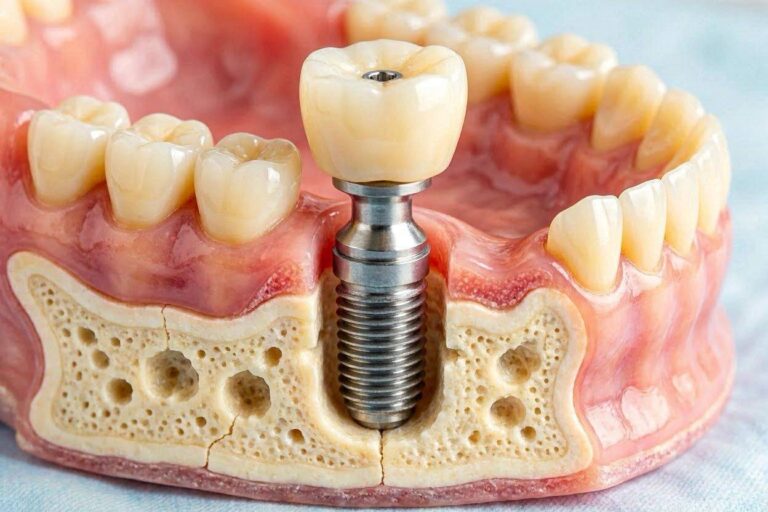
This is a critical distinction. Historically, zirconia implants were exclusively one-piece designs because machining a reliable internal connection in ceramic was challenging. The implant body and the abutment are milled as a single, monolithic unit.
Advantages of One-Piece Zirconia:
- No micro-gap between an implant and abutment, eliminating a bacterial reservoir.
- No risk of abutment screw loosening or fracture.
- Simpler, potentially stronger monolithic structure.
Disadvantages of One-Piece Zirconia:
- The abutment protrudes through the gum from day one. The implant cannot be submerged for a buried healing period. This requires immediate protection from chewing forces.
- The surgeon must place the implant with a very precise three-dimensional position, as the abutment angle is fixed. There is no angled abutment to correct a slightly off-angle placement. This makes surgical planning less forgiving.
Two-piece zirconia implants with a screw-retained connection are now available and gaining popularity. They offer the prosthetic flexibility of a two-piece system, familiar to dentists. The long-term data on these newer two-piece designs is still emerging but promising.
Zirconia vs. Titanium: A Balanced Comparison
| Feature | Titanium Implant | Zirconia Implant |
|---|---|---|
| Material | Medical-grade titanium alloy (Ti-6Al-4V) | Yttria-stabilized zirconia ceramic (Y-TZP) |
| Clinical History | 50+ years, massive global data. | 20+ years, growing data, comparable medium-term. |
| Osseointegration | Excellent, well-documented. | Excellent, documented, slightly different surface. |
| Allergy Risk | Very low (<1%), but exists. | Virtually nonexistent, completely metal-free. |
| Aesthetics | Metallic, can show gray through thin gums. | White, excellent for thin gum biotypes. |
| Plaque Affinity | Low. | Very low, smooth ceramic surface. |
| Design Options | Two-piece standard. Vast prosthetic library. | One-piece traditional. Two-piece emerging. |
| Surgical Flexibility | Buried healing possible. Angled abutments. | Less forgiving, more demanding surgically. |
| Fracture Risk | Extremely low. Ductile, can bend. | Low, but brittle. Can fracture under extreme load. |
| Cost | Generally lower cost for fixture. | Often slightly higher cost for fixture. |
The Specific Safety Concerns and How They Are Addressed
Risk of Fracture
The Achilles heel of ceramics is brittleness. Zirconia is incredibly strong under compression, but it can fracture under extreme bending or tensile stress. Modern Y-TZP zirconia has largely overcome this. The transformation toughening mechanism and high flexural strength make catastrophic fracture rare in clinical practice. However, in a patient with severe bruxism or a deep bite with heavy lateral forces, a zirconia implant may be at slightly higher risk of fracture compared to a metal implant, which tends to bend rather than break.
Low-Temperature Degradation (Aging)
Early generations of zirconia were susceptible to LTD, a spontaneous surface degradation in a moist environment over many years. This was a major concern. Modern, high-purity zirconia powders processed with optimized sintering parameters have dramatically improved LTD resistance. Current ISO standards require rigorous aging tests, and properly manufactured zirconia implants show negligible degradation.
Surgical Demands
Placing a one-piece zirconia implant requires exceptional surgical planning and execution. The implant must be placed in the ideal position because there is no angled abutment to correct the angle. A 3D CBCT scan and a digitally fabricated surgical guide are almost mandatory for predictable results with a one-piece design.
Who Is the Ideal Candidate for a Zirconia Implant?
Zirconia implants are particularly well-suited for:
- Patients with confirmed metal allergies or sensitivities.
- Patients with autoimmune conditions who wish to minimize any potential immune trigger.
- Patients with thin, translucent gum tissue, especially in the esthetic zone, where a gray titanium shadow would be aesthetically unacceptable.
- Patients who, for holistic or personal reasons, prefer a metal-free restoration.
Who Might Be Better Served by Titanium?
Titanium remains the gold standard for:
- Cases requiring angled abutments to correct implant position.
- Patients with severe bruxism where the ductility of metal is an advantage.
- Full-arch restorations where a large body of long-term evidence supports titanium frameworks.
- Complex cases where the vast prosthetic library and familiarity of the restoring dentist are critical.
Conclusion
Zirconia dental implants are a safe, biocompatible, and increasingly evidence-based alternative to traditional titanium implants. They offer the distinct advantages of being completely metal-free, highly aesthetic, and demonstrating very low plaque affinity. While the long-term data is less voluminous than for titanium, the medium-term survival rates are excellent. They are not inherently superior or inferior to titanium; they are a different tool with a specific set of advantages, ideal for patients with metal allergies, thin gums, or a holistic preference, provided the surgical and restorative protocols are followed precisely.
FAQ
1. Is zirconia stronger than titanium for implants?
Zirconia has higher compressive strength, meaning it resists being crushed. Titanium has higher ductility and can bend without breaking. Both materials are strong enough for the loads of normal chewing. In extreme overload, titanium bends; zirconia may fracture.
2. Will a zirconia implant set off a metal detector?
No. Zirconia is a ceramic oxide and is completely non-metallic. It will not trigger metal detectors at airports or security checkpoints.
3. Are zirconia implants more expensive than titanium?
Generally, yes. The cost of the raw material, the more complex manufacturing process, and the typically lower volume of production mean zirconia implant fixtures often have a slightly higher cost than comparable titanium fixtures.
4. Can any dentist place a zirconia implant?
A dentist must have specific training in the implant system. Placing one-piece zirconia implants is technically demanding and requires meticulous 3D planning and surgical precision. It is important to choose a clinician with specific experience in zirconia implant protocols.
Additional Resource
For further scientific information on zirconia in dental implantology, visit the Academy of Osseointegration: https://www.osseo.org/