How Long Is Dental Implant Procedure?
You clear your calendar for what you imagine will be an entire day in the dental chair. Friends have told you stories about hours of drilling, endless waiting, and a recovery that consumes weeks. The uncertainty about time commitment keeps many people from even scheduling the consultation. The reality of dental implant procedure duration surprises most patients. The actual surgical appointment runs shorter than expected, but the complete journey spans longer than most anticipate. Understanding where the time goes, what happens during each phase, and why certain periods require patience transforms an intimidating unknown into a manageable, predictable process.
Breaking Down the Surgical Appointment
The day of implant placement surgery follows a structured sequence. Knowing what happens from arrival to departure reduces anxiety and helps you plan realistically.
Pre-Surgery Preparation Time
You arrive at the dental office typically 30 to 60 minutes before the scheduled surgery time. This buffer allows completion of final paperwork, review of the surgical consent form, and any last-minute questions answered by the surgical team. If you have chosen oral sedation, you take the prescribed medication during this period, allowing time for it to take effect.
Vital signs are recorded. Blood pressure, heart rate, and oxygen saturation establish baselines. For patients receiving intravenous sedation, a small catheter is placed in the arm or hand. The surgical assistant reviews your medical history, confirming no changes since the consultation. The surgeon visits you briefly, reviewing the plan and answering final questions. This pre-operative phase ensures everyone is prepared before the procedure begins.
The Actual Surgery Duration
Implant placement surgery itself proceeds efficiently in experienced hands. For a single implant in an uncomplicated site, the actual surgical time from first incision to final suture typically ranges from 30 to 60 minutes. This includes raising the surgical flap, preparing the implant site through sequential drilling, placing the implant, placing the healing cap or cover screw, and suturing the tissue closed.
Multiple factors influence this duration. Bone density affects drilling time, with dense Type I bone requiring more deliberate, controlled drilling than softer bone. Immediate implant placement into a fresh extraction socket often takes longer than placement into a healed ridge because the socket requires debridement and evaluation before implant positioning. Sites requiring simultaneous bone grafting add 15 to 30 minutes for graft material placement and membrane fixation.
Complex anatomical situations extend surgical time. Proximity to the inferior alveolar nerve demands careful depth control and possibly intraoperative imaging to confirm position. Lingual concavities in the lower jaw require cautious preparation to avoid perforation. The surgeon prioritizes precision over speed. A deliberately performed surgery taking 75 minutes produces better outcomes than a rushed procedure completed in 30 minutes.
Recovery Room and Discharge
Following surgery, you spend 15 to 30 minutes in the recovery area. The surgical team monitors bleeding, checks that gauze pressure is adequate, and observes you as sedation effects begin to diminish. The assistant reviews post-operative instructions verbally and provides a written copy. You receive prescriptions for pain medication and possibly antibiotics. Ice packs are applied to reduce swelling.
Discharge occurs once the team confirms you are stable and your escort is present if sedation was used. The entire office visit for a single implant, from arrival to departure, typically spans two to three hours. Multiple implants placed in the same surgical session extend this proportionally.
Single Implant vs. Multiple Implants: Time Differences
The number of implants placed in one session affects total procedure duration, but not as linearly as you might expect.
Efficiency Gains with Multiple Implants
Placing multiple implants during one surgery captures efficiency gains. Setup, anesthesia administration, and surgical preparation occur once rather than being repeated for each implant. The surgeon works systematically across the arch, moving efficiently from site to site. Two adjacent implants may require only 90 minutes total rather than two separate 60-minute sessions. Four implants for an overdenture might require two to three hours.
However, the surgeon must balance efficiency with patient tolerance. Longer procedures increase swelling, patient fatigue, and the risk of operative complications. Most surgeons limit single-session implant placement to what can reasonably be accomplished within three to four hours. Full-arch cases requiring six to eight implants may be split into two surgical sessions for patient comfort.
Staging Multiple Procedures
When a treatment plan involves implants in different quadrants, staging the surgeries often makes sense. The patient can chew on the untreated side while the surgical site heals. Separate appointments spaced weeks apart allow each site to begin healing before the next is disturbed. This approach extends the overall treatment timeline but improves the recovery experience.
Patients traveling significant distances for implant surgery may prefer to complete all surgical procedures in one visit. This approach, common in dental tourism and destination implant centers, requires careful planning and a patient willing to endure a more challenging recovery period. The surgical team adjusts anesthesia and post-operative care accordingly.
Immediate Implant Placement: When Extraction and Placement Combine
Conditions That Allow Immediate Placement
Immediate implant placement inserts the implant into the extraction socket at the same appointment as tooth removal. This approach saves months of healing time and preserves bone and soft tissue architecture better than delayed placement. However, not every extraction site qualifies.
The ideal immediate placement site has intact bony walls, particularly the buccal plate on the cheek side. No active infection should be present, as bacteria compromise osseointegration. Adequate bone beyond the socket apex must exist to provide primary stability, typically 3 to 5 millimeters. The soft tissue should be healthy with adequate keratinized gingiva.
Molar sites present additional challenges. Multi-rooted teeth leave sockets with irregular anatomy and intervening bone, called interradicular septum, that may not provide ideal implant positioning. Single-rooted teeth in the front of the mouth are more amenable to immediate placement. The esthetic zone, where preserving soft tissue contours matters most, benefits particularly from immediate protocols.
Surgical Sequence Differences
Immediate placement modifies the standard surgical sequence. The extraction comes first, performed as atraumatically as possible using periotomes and gentle elevation rather than forceful luxation. The socket is thoroughly debrided, removing all granulation tissue and any residual periodontal ligament fibers. The bony walls are probed to confirm integrity.
Implant site preparation then proceeds, but rather than drilling into a flat ridge, the surgeon prepares the bone apical to and palatal to the socket. The implant engages the native bone 3 to 5 millimeters beyond the socket apex to achieve primary stability. The gap between the implant and the buccal socket wall, called the jumping distance, may be filled with bone graft material or left to fill with the blood clot depending on its size.
Surgical time for immediate placement typically runs 15 to 30 minutes longer than placement in a healed site. The extraction, socket evaluation, and decision-making about grafting require additional intraoperative time. The benefits of preserved bone and shortened overall treatment time justify this extra surgical duration for qualified candidates.
The Two-Stage vs. One-Stage Surgical Approach
Time Implications of Burying the Implant
The traditional two-stage approach places the implant and covers it completely with gum tissue. The implant heals buried beneath the mucosa, protected from the oral environment. After three to six months of osseointegration, a second minor surgery exposes the implant and places a healing abutment.
This second-stage surgery typically requires only 20 to 30 minutes. Local anesthesia suffices. The surgeon makes a small incision over the implant, removes any overlying bone or tissue, removes the cover screw, and places the healing abutment. Sutures may or may not be needed. Recovery from this second procedure is minimal, with mild soreness for a day or two.
The two-stage approach adds this second surgical appointment to the overall timeline but provides maximum protection during osseointegration. It remains the preferred approach when bone grafting was performed simultaneously, when primary stability was marginal, or when the patient has risk factors for infection.
One-Stage Protocol Efficiency
The one-stage approach places a healing abutment at the time of implant surgery, eliminating the need for a second exposure procedure. The healing abutment extends through the gum, visible in the mouth. The gum tissue heals around it, creating a tissue collar ready for the final restoration.
This approach saves a surgical appointment and two to four weeks of healing time associated with tissue maturation after exposure. The overall treatment timeline shortens by approximately four to six weeks. One-stage protocols work well when primary stability is excellent, no grafting was needed, and the patient maintains good oral hygiene during healing.
The choice between one-stage and two-stage approaches depends on surgical findings, not patient preference. The surgeon decides based on implant stability, bone quality, and risk assessment. Patients should understand that the surgeon’s intraoperative judgment on this point protects the long-term outcome.
Healing Period Duration: The Longest Phase
Mandibular vs. Maxillary Healing Times
Osseointegration proceeds at different rates in the upper and lower jaws due to differences in bone density and blood supply. The mandible, or lower jaw, features denser bone with better blood supply in most regions. Standard healing time before loading a mandibular implant is three to four months.
The maxilla, or upper jaw, contains less dense bone with more marrow spaces. Blood supply, while adequate, differs in pattern from the mandible. Standard healing time for maxillary implants is four to six months. The posterior maxilla, where Type IV bone predominates, often requires six months or longer for complete osseointegration.
These timelines assume uneventful healing in healthy patients. Clinical studies support these durations based on histological evidence of bone maturation and implant stability measurements over time. Shortening healing below these established timelines increases failure risk, particularly in compromised bone.
Factors That Extend Healing Requirements
Several patient and procedural factors demand extended healing periods. Bone grafting performed simultaneously with implant placement extends the healing timeline because both the graft and the implant-bone interface must mature. The new timeline typically matches the graft healing requirement, often six to nine months.
Compromised systemic health slows healing. Diabetic patients with hemoglobin A1c above 7 percent experience slower bone formation and higher complication rates. Smokers heal more slowly and face higher implant failure rates, with some studies suggesting healing periods extended by 50 percent. Patients on bisphosphonate medications or with history of radiation to the jaws require extended and sometimes indefinite healing before loading.
Poor primary stability at placement dictates longer healing. If insertion torque fell below 20 Newton-centimeters or the implant stability quotient measured below 60, the surgeon may extend the healing period to allow maximum osseointegration before loading forces are applied. The implant essentially needs more time to compensate for suboptimal initial conditions.
The Unloaded Healing Period
During osseointegration, the implant must remain unloaded or minimally loaded. Loading refers to forces transmitted to the implant through chewing or the presence of a restoration. Micromovement above 100 to 150 microns disrupts the cellular processes of bone formation and can result in fibrous encapsulation rather than osseointegration.
For this reason, temporary restorations during healing must avoid contact with opposing teeth. A removable temporary partial denture must be relieved over the implant site to prevent pressure transmission. Even tongue pressure and adjacent tooth contact can theoretically generate problematic micromovement, though clinical evidence suggests these forces rarely cause problems when primary stability is adequate.
The discipline required during this waiting period challenges many patients. The implant is in place but cannot be used. The temptation to test it, to chew cautiously on that side, must be resisted. The surgeon’s instructions about diet and oral function during healing exist to protect the osseointegration process.
Restoration Phase Timeline
Abutment Placement and Tissue Shaping
For two-stage implants, the second-stage surgery to expose the implant and place a healing abutment initiates the restorative phase. The healing abutment shapes the gum tissue for two to four weeks, creating an emergence profile that will be replicated in the final restoration.
During these weeks, the tissue collar matures and stabilizes. The gingival contours around the healing abutment determine the esthetic appearance of the final crown at the gum line. Insufficient healing time results in tissue shrinkage after crown delivery, exposing the abutment margin and compromising esthetics.
Impression and Laboratory Time
Taking the final impression marks the transition from surgical to restorative phases. Whether using traditional impression materials or digital scanning, this appointment captures the exact implant position, angulation, and surrounding soft tissue contours. The impression is sent to the dental laboratory where the crown will be fabricated.
Laboratory fabrication of a custom implant crown typically requires two to three weeks. Rush services can shorten this to one week when necessary, though added fees apply. During this period, the patient wears a healing abutment or a temporary crown fabricated at the impression appointment.
Crown Delivery Appointment
Crown delivery requires 30 to 60 minutes. The dentist removes the healing abutment or temporary crown, tries in the final crown, verifies contacts and occlusion, makes any necessary adjustments, and secures the crown definitively. If the crown requires cementation, careful cement cleanup follows. If screw-retained, the screw is torqued to specification and the access hole filled.
Final radiographic confirmation ensures complete seating of the restoration. Occlusal adjustment with articulating paper eliminates any premature contacts. Home care instructions specific to the implant restoration are reviewed. The restorative phase from abutment exposure to crown delivery typically spans four to eight weeks, depending on the number of appointments and laboratory turnaround time.
Same-Day Implants: Reality vs. Marketing
Immediate Loading Protocols
Same-day implants, properly termed immediate loading, place a temporary crown on the implant at the same surgical appointment. This approach eliminates the waiting period for osseointegration and provides the patient with a visible tooth immediately. The marketing appeal is obvious. The clinical reality requires careful case selection.
Immediate loading demands excellent primary stability, typically defined as insertion torque above 35 Newton-centimeters and implant stability quotient above 60. The bone must be of good quality, Type I through III, to support this protocol. The temporary crown must be carefully adjusted to eliminate all occlusal contacts in centric and excursive movements. The patient must commit to a soft diet and avoid loading the implant during the healing period.
Even with immediate loading, osseointegration still requires months. The temporary crown provides esthetics and some function but the biological healing timeline does not shorten. The final crown is fabricated after osseointegration is confirmed, typically at three to six months. Patients who interpret same-day implants as completing treatment in one day misunderstand the process.
Who Qualifies for Same-Day Protocols
Qualification criteria for immediate loading are stringent. The implant must achieve primary stability well above minimum thresholds. Multiple implants splinted together distribute forces and improve loading conditions, making immediate loading more feasible for full-arch cases than single implants. The anterior mandible, with its dense bone and favorable loading, proves most amenable to immediate loading of single implants.
Patients with parafunctional habits including bruxism or clenching do not qualify for immediate loading. These forces would overload the healing implant-bone interface. Smokers face higher risk of immediate loading failure and are typically excluded. Patients with uncontrolled diabetes or other healing compromises are not candidates.
The surgeon makes the final determination of immediate loading feasibility at the time of surgery based on implant stability measurements. Patients interested in this approach should understand that the plan may change intraoperatively if primary stability falls short of requirements. The surgeon prioritizes long-term success over the convenience of immediate restoration.
Complete Treatment Timeline Summary
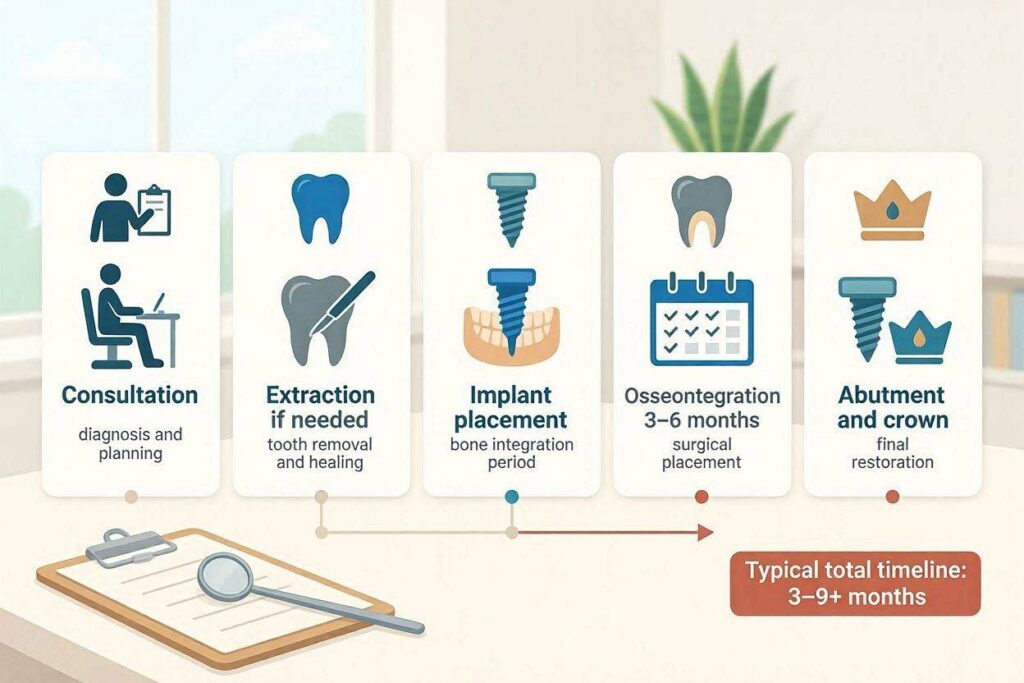
From Consultation to Final Crown: Typical Durations
| Treatment Phase | Uncomplicated Case | With Bone Grafting | With Sinus Lift |
|---|---|---|---|
| Consultation to surgery | 2-4 weeks | 2-4 weeks | 2-4 weeks |
| Extraction with grafting | N/A | 1 appointment | N/A |
| Graft healing | N/A | 4-6 months | 6-9 months |
| Implant surgery | 1 appointment | 1 appointment | 1 appointment |
| Osseointegration | 3-6 months | 4-6 months | 4-6 months |
| Abutment exposure | 1 appointment | 1 appointment | 1 appointment |
| Tissue healing | 2-4 weeks | 2-4 weeks | 2-4 weeks |
| Impressions | 1-2 appointments | 1-2 appointments | 1-2 appointments |
| Lab fabrication | 2-3 weeks | 2-3 weeks | 2-3 weeks |
| Crown delivery | 1 appointment | 1 appointment | 1 appointment |
| Total time | 4-8 months | 8-12 months | 10-15 months |
These timelines represent typical ranges for healthy patients with normal healing. Individual cases vary based on specific anatomical factors, healing response, and the treating clinician’s protocols.
Variables That Compress or Extend Timelines
Treatment can move faster under optimal conditions. Immediate implant placement after extraction eliminates the separate extraction healing period, saving three to four months. One-stage surgical protocols eliminate the second-stage exposure surgery and its associated healing, saving four to six weeks. Digital workflows with in-office milling can deliver the final crown within days rather than weeks.
Conversely, complications extend timelines unpredictably. Implant failure requiring removal and replacement adds six to nine months. Post-operative infection delays healing by weeks to months. Inadequate osseointegration confirmed at second-stage surgery requires additional healing time. Graft failure necessitates regrafting and restarting the clock.
Patients should view timeline estimates as ranges rather than fixed dates. The body heals at its own pace. The surgeon evaluates readiness to proceed based on clinical and radiographic signs, not calendar dates. Patience during the process protects the final result.
Appointment-by-Appointment Time Breakdown
What Each Visit Entails
The consultation visit spans 60 to 90 minutes, encompassing medical history review, clinical examination, imaging, treatment planning, and financial discussion. This investment in planning prevents problems later.
The surgical visit spans two to three hours for a single implant, from arrival through discharge. Multiple implants extend this proportionally. The second-stage exposure surgery, if needed, requires 30 to 60 minutes including anesthesia and recovery.
Impression appointments span 30 to 60 minutes depending on technique and number of implants. Crown delivery appointments span 45 to 90 minutes, allowing time for adjustments. Follow-up appointments at one week, one month, three months, six months, and one year after crown delivery typically require 15 to 30 minutes each.
Total Chair Time Calculation
For a straightforward single implant case, total chair time across all appointments typically ranges from five to eight hours spread over six to eight visits across four to eight months. This represents the cumulative time the patient actually spends in the dental chair. The vast majority of the treatment timeline consists of healing periods during which the patient is not in the office at all.
This relatively modest chair time surprises many patients who have delayed implant treatment fearing endless dental visits. Understanding this reality helps overcome treatment anxiety. The procedure demands patience not because of time in the chair but because of the biological requirements of healing.
Time Considerations for Complex Cases
Full-Arch Restoration Timelines
Full-arch implant restorations, replacing all teeth on an arch with an implant-supported prosthesis, follow extended timelines. Surgical placement of four to eight implants per arch may require two to four hours. If extractions of remaining teeth are performed simultaneously, surgical time extends further.
Immediate loading with a provisional fixed prosthesis, common in full-arch protocols, provides function during osseointegration. The provisional prosthesis is fabricated before surgery based on the planned implant positions. At surgery, after implant placement, the provisional is attached to the implants. The patient leaves with fixed teeth the same day.
The definitive prosthesis is fabricated after three to six months of healing. Multiple appointments are required for final impressions, jaw relation records, try-in of the framework, and final delivery. The complete full-arch treatment timeline from initial surgery to final prosthesis typically spans six to twelve months.
Cases Requiring Multiple Grafting Procedures
Severely atrophic jaws may require staged reconstruction. The first surgery harvests bone from the hip or another extraoral site and grafts it to the jaw. After six to nine months of healing, implants are placed. After an additional four to six months of osseointegration, the restorative phase begins. Total treatment time can extend to eighteen to twenty-four months.
These complex cases require extraordinary patience from both patient and treatment team. Each phase must succeed before the next begins. Rushing leads to compounding failures that set treatment back further. Patients embarking on this path should understand the extended commitment before starting.
Conclusion
A single dental implant surgical procedure typically requires 30 to 90 minutes of operating time within a two to three-hour office visit, while the complete treatment journey from consultation to final crown spans four to eight months for uncomplicated cases. Healing during osseointegration accounts for the majority of this timeline, requiring three to four months in the lower jaw and four to six months in the upper jaw before the implant can support a functional restoration. Cases requiring bone grafting, sinus lifts, or multiple implants extend the overall timeline to eight to fifteen months or longer, with the longest phase always being the biological healing that cannot be rushed without compromising long-term success.
Frequently Asked Questions
How long does the actual implant surgery take?
For a single implant, the surgical procedure from incision to final suture typically takes 30 to 60 minutes. The entire office visit, including preparation and recovery, spans two to three hours.
Can I go back to work the next day?
Most patients return to work the day after single implant surgery. Some soreness and swelling are normal but manageable. If your work involves heavy physical labor, your surgeon may recommend an additional day or two of rest.
Why do I have to wait so long for the crown?
Osseointegration, the biological fusion of bone to the implant surface, requires three to six months. Loading the implant before this process completes risks fibrous encapsulation instead of bone fusion, causing implant failure.
How soon can I eat normally after implant surgery?
Soft foods are recommended for the first week. You should avoid chewing on the implant site for the entire osseointegration period. Normal diet resumes after the final crown is delivered and you have adapted to it.
Can multiple implants be placed at the same time?
Yes. Multiple implants placed during one surgical session capture efficiency in setup and anesthesia. Four implants typically require two to three hours of surgery. Your surgeon determines the safe number based on your health and tolerance.
How many appointments will I need total?
A straightforward single implant case typically requires six to eight appointments over four to eight months. Complex cases require more appointments spread over a longer period.
Does the procedure time differ between front and back teeth?
Posterior implants often take slightly longer due to limited access and the need to carefully manage proximity to nerves and sinuses. Anterior implants in the esthetic zone require additional time for precise positioning and soft tissue management.
What happens if something goes wrong during surgery?
Your surgeon is trained to manage intraoperative complications. The procedure may take longer than planned if unexpected conditions require modification of the surgical approach. The priority is always safe, successful implant placement, not speed.
Additional Resource
American Association of Oral and Maxillofacial Surgeons: Dental Implant Information
https://myoms.org/procedures/dental-implant-surgery