What Dental Implant Wobble Means
You press your tongue against the back of your implant crown, a habit you developed soon after it was placed. For months, it felt like a rock. Solid. Immovable. Part of you. Today, there is a sensation that sends a chill through your chest. The slightest give. A movement so subtle you question whether you imagined it. You press again, more deliberately this time. There it is. A wobble. The word itself feels ominous when applied to something that was promised to be permanent. Understanding what implant wobble means, what causes it, and what must happen next transforms this frightening discovery into a manageable clinical situation with clear treatment pathways. Not all wobble means the implant is lost. Some wobble is fully reversible with relatively simple intervention. The key lies in identifying what type of movement you are experiencing and acting before a reversible problem becomes an irreversible one.
Understanding the Significance of Implant Movement
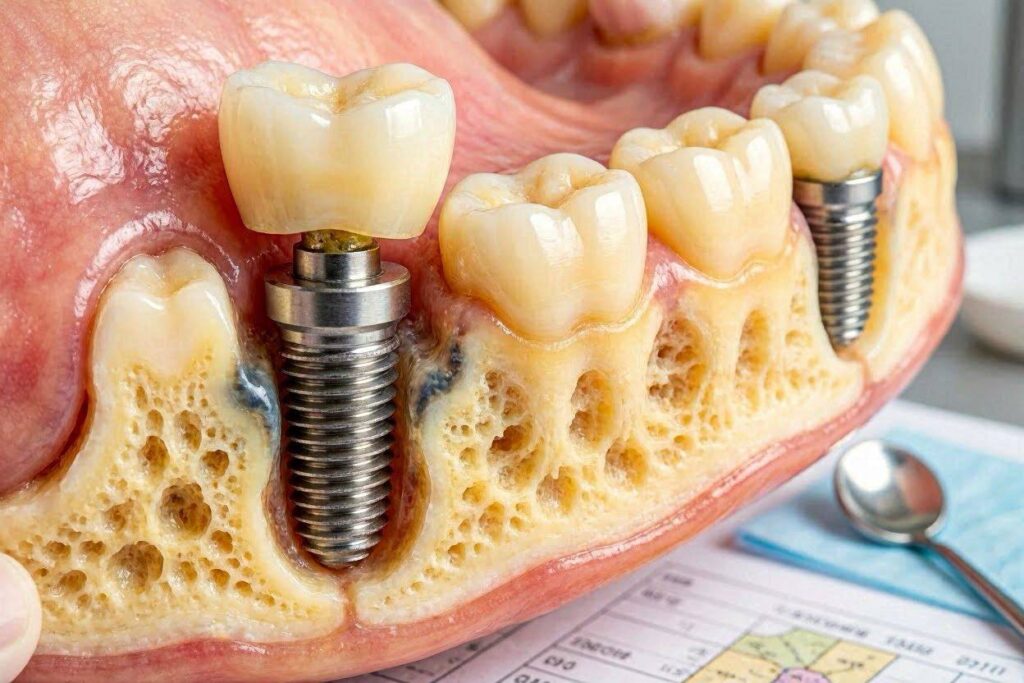
Dental implants are designed to be absolutely rigid. Unlike natural teeth, which have a physiological ligament that permits microscopic movement, an integrated implant is fused directly to bone through osseointegration. Any perceptible movement represents a deviation from the normal, healthy state.
Why Implants Should Never Move
Osseointegration creates a direct structural and functional connection between living bone and the implant surface. There is no ligament, no elastic tissue, no give in this connection. The implant and the bone behave as a single mechanical unit. When force is applied to the implant crown, the entire implant-bone complex transmits that force without independent movement of the implant.
Natural teeth move because the periodontal ligament, approximately 0.2 millimeters wide, suspends each tooth in its socket. This ligament provides shock absorption, proprioceptive feedback, and allows orthodontic movement. Implants have none of these features. The trade-off for absolute rigidity is the absence of the sensory feedback and adaptive capacity that natural teeth possess.
When an implant moves, the osseointegration has been compromised at some level. The movement may originate from different components of the implant system, and identifying the source determines the treatment approach and prognosis.
The Difference Between Actual and Perceived Movement
Patients sometimes perceive movement that does not actually exist. Understanding this phenomenon prevents unnecessary alarm while ensuring genuine problems receive prompt attention.
Perceived movement can occur when adjacent natural teeth, which have normal physiological mobility, move under pressure while the implant remains rigid. The brain interprets the relative motion as coming from the implant rather than the teeth. This illusion is particularly common when the patient presses laterally on the implant crown, causing the adjacent teeth to move within their ligaments while the implant stays fixed. The sensation can be convincing, even to an anxious patient who is hyperaware of their implant.
Similarly, a removable prosthesis that contacts the implant can create the sensation of implant movement when the prosthesis itself is moving. Denture movement on implant attachments, for example, feels like the attachment is loose when the denture base is actually rocking on the tissue.
Professional evaluation distinguishes actual from perceived mobility through direct visualization and instrument testing. The clinician stabilizes adjacent teeth while applying controlled force to the implant, isolating the implant’s response from the surrounding dentition. If you are unsure whether you are feeling actual movement, schedule an evaluation rather than continuing to manipulate the area, which can worsen an actual problem.
Types of Implant Wobble and Their Causes
Not all implant wobble has the same significance. The location of the movement within the implant system determines the diagnosis, treatment, and prognosis.
Abutment Screw Loosening
The abutment screw connects the abutment, which supports the crown, to the implant body. This small screw, typically made of titanium or gold alloy, is tightened to a specific torque during restoration delivery. Over time, under the cyclic loading of chewing, this screw can gradually loosen.
Abutment screw loosening produces movement of the crown and abutment as a unit while the implant body remains rigidly fixed in the bone. The crown may rock slightly or rotate. The movement is typically in the coronal portion of the restoration, with the implant itself remaining immobile.
This is the most common cause of implant wobble and the most favorable diagnosis, as it represents a purely mechanical problem that does not threaten the implant’s biological integration. The screw can be accessed, retightened to the proper torque, and the access hole resealed. In some cases, replacing the screw with a new one is recommended, as used screws may have altered thread characteristics.
The patient may notice a clicking sensation when biting or pressing on the crown. The movement may be intermittent initially, becoming more consistent as the screw continues to loosen. A loose abutment screw that remains untreated can lead to screw fracture, which is a more complicated problem requiring screw retrieval from the implant body.
Crown Cement Failure
For cement-retained implant restorations, the cement layer between the crown and the abutment can fail. The crown becomes loose on the abutment while the abutment remains firmly attached to the implant. The patient perceives the crown moving independently, possibly lifting off or rotating.
This type of wobble is entirely restorative in nature. The implant and abutment are unaffected. The crown can be removed, the old cement cleaned from both the crown interior and the abutment surface, and the crown recemented. If the crown has been loose for some time, it should be evaluated for fit and marginal integrity before recementation.
Cement failure occurs for several reasons. The original cement may have been inadequately mixed or applied. The crown preparation may lack adequate retention form. Occlusal forces may exceed the cement’s retention capacity. Temporary cement, used intentionally to allow future retrievability, has a finite lifespan and will eventually fail, requiring recementation.
Abutment Fracture
Less common than screw loosening but more serious, abutment fracture creates a different type of wobble. The abutment, the component between implant and crown, can fracture under excessive load or due to material fatigue over time. The fracture may be partial, creating subtle movement, or complete, resulting in a loose segment.
Abutment fractures occur more frequently with narrower abutments, with angled abutments that create bending moments, and in patients with heavy occlusal forces or parafunctional habits. Zirconia abutments, while esthetically superior for anterior implants, have a higher fracture risk than titanium abutments, particularly in posterior sites with high forces.
When an abutment fractures, the remaining portion is still attached to the implant. The fractured segment must be retrieved, which can be technically challenging if the fracture occurs at or below the implant platform. The implant internal connection should be evaluated for damage. A new abutment is fabricated and delivered once the implant is confirmed intact.
Implant Body Fracture
Implant body fracture represents a catastrophic mechanical failure. The titanium implant itself breaks, typically at the point of highest stress concentration where the abutment screw threads engage. This complication is rare with modern implant designs but still occurs, particularly with narrow-diameter implants subjected to excessive forces.
An implant fracture produces a wobble that is distinct from other types. The movement is at or below the gum level, with the coronal fragment mobile while the apical fragment remains in the bone. Radiographs may show the fracture line, though it can be subtle if the fragments remain closely approximated.
Treatment requires removal of the mobile coronal fragment. The remaining apical fragment, which is integrated in bone, must also be removed unless it is completely buried and asymptomatic. This removal is more invasive than removal of an intact failed implant because the fragment must be trephined from the bone. After complete implant removal and site healing, a new implant can be placed.
Loss of Osseointegration
The most concerning cause of implant wobble is true loss of osseointegration. The implant, which was once fused to the bone, is now surrounded by fibrous tissue rather than bone. The entire implant moves within the bone, not just the components attached to it.
This type of mobility is typically more pronounced than mechanical component movement. The implant may rock perceptibly in all directions. There may be associated symptoms including dull pain, swelling, bleeding, or suppuration. Radiographs show a radiolucent line around the implant where bone has been replaced by inflammatory or fibrous tissue.
Loss of osseointegration is irreversible. The implant cannot reintegrate once fibrous tissue has formed at the interface. Treatment requires implant removal, management of the bone defect, and after adequate healing, consideration of replacement implant placement.
Diagnosing the Source of Implant Wobble
Accurate diagnosis of the wobble source requires systematic clinical and radiographic evaluation. Patients should not attempt self-diagnosis, as incorrect identification can lead to inappropriate management and further damage.
Clinical Testing Procedures
The clinician begins by isolating the movement. With one hand stabilizing the jaw and adjacent teeth, the other hand applies controlled force to the implant restoration in various directions. The pattern of movement, its location, and its extent are noted.
Percussion testing involves tapping the implant crown with a mirror handle or similar instrument. A solid, integrated implant produces a crisp, high-pitched sound. An implant with loss of osseointegration produces a dull, thudding sound due to the dampening effect of the surrounding fibrous tissue. This simple test provides immediate diagnostic information.
Screw access allows direct evaluation of abutment screw tightness. If the screw is accessed and found to be loose, the diagnosis is confirmed. Retightening the screw and reassessing mobility confirms that the wobble was mechanical rather than biological.
Radiographs are essential but have limitations for diagnosing the cause of mobility. A periapical radiograph may show a radiolucent line around the implant indicating loss of osseointegration. It may show a gap between the abutment and implant platform indicating an incompletely seated abutment. It may show a fracture line, though this is often difficult to visualize. A radiograph cannot show abutment screw loosening directly, as the screw threads are not visible in detail.
The Role of the Patient’s Observations
The patient’s description of how and when they notice the wobble provides valuable diagnostic information. Wobble that is noticed primarily when biting or chewing, with the implant feeling solid at rest, suggests mechanical overload or component loosening. Wobble that is constant, present even when the implant is not loaded, suggests more significant loss of integration.
The timeline of symptom development is important. Wobble that developed suddenly, perhaps after biting something hard, suggests acute mechanical failure such as screw loosening or fracture. Wobble that developed gradually over weeks or months suggests progressive biological failure from peri-implantitis or chronic overload.
Associated symptoms guide diagnosis. Pain on biting suggests inflammation or movement at the bone-implant interface. Bleeding, swelling, or pus suggests peri-implant infection. The absence of any discomfort suggests mechanical rather than biological problems, as osseointegration loss typically involves some degree of inflammation.
Immediate Steps When Wobble Is Detected
The discovery of implant mobility requires specific actions and avoidance of behaviors that could worsen the situation.
What Patients Should Do Immediately
Stop loading the implant immediately. Do not chew on that side. Avoid pressing on the implant with your tongue or finger to test it further. Every episode of movement, even if small, can cause additional damage to the compromised bone-implant interface or to the mechanical components.
Contact your implant dentist or the dental office that placed or restored the implant. Describe your findings clearly and schedule an evaluation promptly. Most offices prioritize implant complication appointments because early intervention improves outcomes.
If the implant crown is very loose and at risk of aspiration or swallowing, it may be removed by the patient with gentle finger pressure. Do not force removal. If the crown does not come away easily, leave it in place and cover it with a small piece of gauze or dental wax if it is irritating the tongue or cheek. A loose restoration that cannot be removed should be treated as requiring professional attention.
What Patients Should Avoid
Do not attempt to tighten anything yourself. Implant abutment screws require specific torque values and specialized drivers. Attempting to tighten a screw with household tools can strip the screw head, damage the implant internal connection, or apply incorrect torque that leads to further problems.
Do not use adhesives, dental cement from the pharmacy, or household glues to stabilize a loose implant crown. These materials are not designed for intraoral use and can cause tissue damage. They will complicate the dentist’s ability to properly treat the implant.
Do not ignore the problem hoping it resolves spontaneously. It will not. Loose components become looser with continued function. A loose abutment screw can fatigue and fracture. A failing implant will continue to lose bone support. Early intervention preserves treatment options.
Do not panic. The majority of implant wobble cases are mechanical rather than biological, meaning the implant itself is still integrated and the problem is fully reversible with appropriate treatment. Even if the implant has failed biologically, replacement options exist and are successful in the vast majority of cases.
Mechanical Wobble: Treatment and Prognosis
Mechanical causes of implant wobble, when identified and treated promptly, carry an excellent prognosis. The implant body remains integrated, and treatment focuses on restoring the mechanical integrity of the restoration.
Managing Loose Abutment Screws
The treatment for a loose abutment screw is straightforward but must be performed correctly. The dentist accesses the screw through the crown, removing the filling material that covers the access hole. The screw is visually inspected and removed.
The implant internal connection is inspected for damage or debris. The abutment is checked for complete seating, as incomplete seating is a common cause of screw loosening. The screw is examined for thread damage or deformation. If any component shows signs of compromise, it is replaced.
The screw is retightened to the manufacturer’s specified torque using a calibrated torque wrench. This torque, typically 25 to 35 Newton-centimeters depending on the implant system, is critical. Under-torqued screws loosen again. Over-torqued screws may fracture or damage the implant connection.
After tightening, the occlusion is carefully evaluated. Premature contacts or excursive interferences that could have contributed to screw loosening are adjusted. The access hole is resealed with a material that allows future retrieval. The patient returns to normal function, though follow-up evaluation of screw stability is scheduled.
Recementing Loose Crowns
When cement failure has occurred, the crown is removed, if it has not already come off. The intaglio surface of the crown and the abutment surface are thoroughly cleaned of all old cement. Residual cement left in place compromises the bond of the new cement and can alter the crown’s fit.
The crown is tried in to confirm complete seating and proper marginal adaptation. The occlusion is verified with the crown seated but not yet cemented. Any necessary adjustments are made before cementation.
The choice of cement is reconsidered. If the crown was originally cemented with temporary cement for retrievability, and loosening occurred sooner than expected, the dentist may switch to a stronger temporary cement or consider a screw-retained alternative. If permanent cement was used and failed, the abutment retention form may be inadequate, and a new abutment or screw-retained approach may be indicated.
Repairing or Replacing Fractured Components
Abutment fracture requires component replacement. The remaining abutment portion and abutment screw are removed from the implant. The implant internal connection is inspected. If intact, a new abutment is fabricated and delivered. The occlusion is carefully managed to reduce the forces that contributed to the original fracture.
Abutment screw fracture presents a retrieval challenge. The screw has fractured, leaving a portion threaded into the implant body. Specialized retrieval kits use reverse-threaded instruments to engage and remove the fractured screw fragment. If retrieval is not possible, the implant may need to be removed, even though it was integrated, because a restoration cannot be attached to it.
Implant body fracture treatment involves removal of the entire implant and replacement after healing. This is the only mechanical complication that results in loss of the implant itself. Prevention through proper implant selection, occlusal management, and patient education about parafunctional habits is essential.
Biological Wobble: Treatment and Prognosis
When implant mobility results from loss of osseointegration rather than mechanical component failure, the treatment approach and prognosis differ significantly.
Can a Biologically Loose Implant Be Saved
The short answer, supported by decades of clinical evidence, is that an implant with established mobility due to loss of osseointegration cannot be salvaged. The fibrous tissue that has replaced bone at the implant interface will not spontaneously convert to bone. No treatment can restore osseointegration once it has been lost throughout the implant surface.
Research into treatments for peri-implantitis has focused on arresting progressive bone loss in implants that are not yet mobile. Once mobility develops, indicating complete or near-complete loss of osseointegration, removal is indicated. Attempting to retain a mobile implant leads to continued bone loss, infection risk, and deterioration of the site for future replacement.
The one exception involves implants that are mobile due to acute infection superimposed on otherwise adequate bone support. If the infection is drained, treated with antibiotics, and resolved, the implant may regain stability. This scenario is rare and requires careful clinical judgment to distinguish from true osseointegration loss.
The Removal and Replacement Process
Biologically failed implant removal follows the process described in the implant failure article. The implant, lacking bone attachment, is typically removed with minimal force under local anesthesia. The site is debrided of granulation tissue and inflammatory infiltrate. Bone grafting may be placed immediately or in a staged procedure.
Healing requires three to six months, longer if bone grafting was performed. Once the site has healed and bone volume is adequate, a replacement implant can be placed. The success rate for replacement implants placed into appropriately managed failed sites approaches that of primary implant placement.
The patient should understand that the replacement implant requires the same healing timeline as the original. The process is not accelerated because an implant was previously in the site. Patience during healing protects the investment in the replacement implant.
Risk Factors for Implant Wobble
Understanding why implants develop mobility helps patients and clinicians prevent recurrence after treatment.
Patient-Related Factors
Bruxism and clenching generate forces far exceeding normal chewing loads. These parafunctional forces, often occurring during sleep when the patient is unaware, transmit to the implant-bone interface and to the mechanical components. Without protection such as a night guard, these forces cause screw loosening, component fracture, and potentially overload bone loss.
Heavy occlusal forces during waking hours, whether from habitual chewing patterns, dietary choices, or occupational factors, similarly stress the implant system. Patients who habitually chew ice, hard candy, or other hard objects expose their implants to forces they were not designed to withstand.
Poor oral hygiene contributes to peri-implantitis, which causes bone loss around the implant. As bone support diminishes, the implant becomes more susceptible to mechanical overload. The combination of biological and mechanical factors accelerates the progression to mobility.
Smoking compromises healing and ongoing tissue health around implants. Smokers experience higher rates of both peri-implantitis and implant failure. The vasoconstrictive and cytotoxic effects of tobacco smoke impair the bone’s ability to maintain osseointegration and respond to mechanical stress.
Restorative Factors
Occlusal overload from a poorly designed restoration creates conditions for both mechanical and biological failure. A crown with premature contacts absorbs all the occlusal force before other teeth engage. Cantilevered prostheses magnify forces on the supporting implants. Insufficient implant number or distribution for the prosthesis being supported leads to overload of individual implants.
Inadequate screw torque at delivery predisposes to screw loosening. Each implant system specifies a torque value for abutment screws. Deviation from this value, either through inadequate tightening or failure to use a torque wrench, increases loosening risk.
Non-passive fit of implant frameworks creates static stress on the implant components. A multi-unit prosthesis that does not seat passively on all implants places continuous tension on the abutment screws. This tension, combined with functional loading, leads to screw loosening or fracture over time.
Surgical Factors
Poor bone quality at the implant site reduces the bone’s ability to support the implant under load. Implants placed in Type IV bone, with minimal cortical bone and low-density cancellous bone, are more susceptible to overload failure. Longer healing times and careful occlusal management partially compensate for poor bone quality.
Inadequate implant dimensions for the anticipated forces increase failure risk. A narrow, short implant placed in a posterior site with heavy occlusal loads is more likely to fail than an appropriately sized implant. The implant must be matched to the mechanical demands of the site.
Implant malposition creates unfavorable force vectors on the implant and its components. An implant angled significantly off the long axis of the planned crown experiences bending moments rather than compressive forces. These bending moments stress both the bone-implant interface and the abutment screw connection.
Preventing Implant Wobble
Prevention strategies begin before implant placement and continue throughout the implant’s lifetime.
Pre-Treatment Planning
Comprehensive treatment planning identifies risk factors before the implant is placed. CBCT imaging assesses bone quantity and quality, allowing selection of appropriate implant dimensions and positions. Diagnostic wax-ups and surgical guides ensure the implant is placed in the optimal position for the planned restoration.
Occlusal analysis identifies patients with heavy bites, bruxism, or parafunctional habits. These patients require protection strategies including night guards, careful occlusal design, and possibly additional or larger implants to distribute forces.
Medical evaluation identifies and optimizes systemic conditions that affect implant success. Smoking cessation counseling is offered. Diabetes control is assessed. Medications that affect bone metabolism are reviewed. The patient enters implant treatment with all modifiable risk factors addressed.
Maintenance Protocols
Regular professional maintenance visits, typically every three to six months, include evaluation of implant stability, abutment screw tightness, and occlusal contacts. Early detection of screw loosening allows retightening before the screw fatigues and fractures.
Occlusal evaluation at each maintenance visit identifies changes in the patient’s bite that could create implant overload. Teeth shift over time. Restorations wear. The opposing dentition may change. The implant occlusion must be adjusted to reflect these changes.
Night guard fabrication and use protect against nocturnal parafunctional forces. Patients with known bruxism should wear their night guard consistently. The guard is evaluated periodically for wear and fit, with replacement when indicated.
Patient education reinforces proper home care techniques and awareness of warning signs. Patients who understand the importance of reporting changes promptly are more likely to seek care before minor problems become major ones.
Psychological Impact of Implant Wobble
The discovery of implant mobility carries psychological weight that deserves acknowledgment and support.
Trust and Anxiety
Patients who experience implant wobble often lose trust in their restoration. The implant that was supposed to be permanent has proven fallible. This loss of confidence can extend to the treating clinician, particularly if the patient perceives the problem resulted from error.
Anxiety about implant failure, the need for additional procedures, and the financial implications of retreatment is normal. Patients may catastrophize, assuming that wobble means the implant will be lost and cannot be replaced. Education about the various causes of wobble and their generally favorable prognosis helps contain this anxiety.
Some patients develop hypervigilance after experiencing implant wobble, constantly checking the implant for movement and worrying about every minor sensation. This hypervigilance, while understandable, can impair quality of life. Counseling and reassurance from the treatment team help patients return to normal function without constant monitoring.
Financial Concerns
The cost of treating implant wobble varies widely depending on the cause. Simple abutment screw retightening costs little, often covered as part of the implant warranty or at a nominal fee. Crown recementation is similarly inexpensive. Component replacement, particularly custom abutments, costs more. Implant removal and replacement represents a significant expense approaching the original implant cost.
Patients should understand their clinician’s policies on implant complications and their manufacturer’s warranty coverage before beginning treatment. These policies vary. Some practices cover complication management at no additional fee for a specified period. Others charge for all services regardless of timing. Transparent discussion before treatment prevents misunderstanding after complications occur.
Conclusion
Dental implant wobble signals a deviation from the absolute rigidity that characterizes healthy osseointegration, but the underlying cause ranges from simple mechanical issues like abutment screw loosening or cement failure, which are fully reversible with straightforward treatment, to serious biological failure involving loss of osseointegration, which requires implant removal and eventual replacement. The location and character of the movement provide diagnostic clues: movement confined to the crown or crown-abutment unit indicates a mechanical component problem with excellent prognosis, while movement of the entire implant body within the bone indicates biological failure with a more complex treatment path. Prompt professional evaluation when wobble is first detected preserves treatment options and prevents minor mechanical problems from escalating into major complications through continued function on compromised components. With appropriate diagnosis and treatment, the vast majority of implant wobble cases resolve successfully, either through component repair or, when necessary, implant replacement in a healed and properly prepared site.
Frequently Asked Questions
Is a slightly wobbly implant always failing?
No. Most implant wobble results from mechanical problems like a loose abutment screw or failed crown cement rather than biological failure of osseointegration. These mechanical issues are fully reversible with appropriate treatment. Only mobility of the entire implant within the bone indicates true failure.
Can I tighten my loose implant crown at home?
No. Implant abutment screws require specific torque values applied with calibrated instruments. Attempting home tightening can damage the implant connection, strip the screw, or apply incorrect torque. Always seek professional care for a loose implant restoration.
How urgent is implant wobble?
Implant wobble should be evaluated promptly, ideally within days of discovery. Continued function on a loose restoration can damage implant components, cause screw fracture, or worsen biological problems. While not typically an emergency requiring after-hours care, the situation should not be ignored.
Will a loose implant cause pain?
Mechanical loosening of the abutment screw or cement failure may cause no pain at all. The patient notices movement but no discomfort. Biological loosening from loss of osseointegration often involves dull aching pain, particularly when biting, due to inflammation at the failing bone-implant interface.
Can an implant that is loose due to bone loss be saved?
Once an implant becomes mobile due to loss of osseointegration, it cannot be saved. The fibrous tissue that replaces bone at the implant interface will not reconvert to bone. The implant must be removed. However, implants with peri-implantitis that are not yet mobile can often be treated to arrest bone loss.
What causes an abutment screw to loosen?
Common causes include inadequate initial torque, incomplete seating of the abutment, heavy occlusal forces, bruxism, cantilevered prostheses, and micromovement from a non-passive framework. Regular professional maintenance that includes checking screw torque identifies loosening before it becomes clinically apparent.
How long does it take to fix a loose implant crown?
Simple screw retightening or crown recementation typically requires a single appointment of 30 to 60 minutes. If a new abutment or crown must be fabricated, treatment extends over multiple appointments spanning several weeks. Implant removal and replacement requires months of healing before the new implant can be placed.
Can I prevent implant wobble from happening?
Many cases are preventable through proper treatment planning, appropriate implant selection, meticulous surgical and restorative technique, occlusal management, regular professional maintenance, and consistent home care. Patients with bruxism should use night guards. All implant patients should attend recommended maintenance visits.
Additional Resource
Academy of Osseointegration: Dental Implant Maintenance and Complications
https://osseo.org/patient-resources/