What to Look for During Dental Implant Surgery
You sit in the dental chair, the local anesthetic taking effect, the surgical team moving around you with quiet efficiency. You are about to undergo a procedure that will place a titanium post into your jawbone, the foundation for a new tooth that should last decades. But what should you actually expect during this procedure? What is normal, what is not, and what should you be aware of as the surgery unfolds? Most patients receive thorough pre-operative and post-operative instructions, yet surprisingly little guidance about the intraoperative experience itself. Understanding what happens during implant surgery, what sensations are normal, what the surgical team is doing at each stage, and what warning signs warrant speaking up transforms an anxious mystery into a comprehensible, manageable experience.
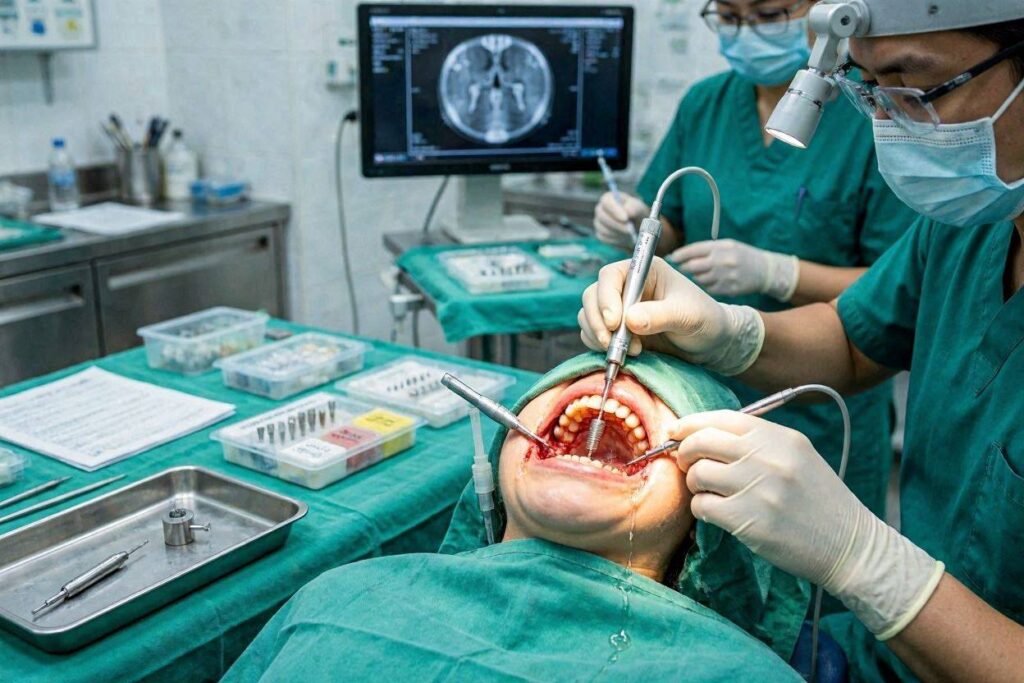
The Surgical Environment and Team
The environment in which your implant surgery takes place and the people who surround you are designed to maximize safety, sterility, and efficiency. Understanding their roles and the setting helps you feel oriented and confident.
Who Is in the Room and What They Do
A typical implant surgery involves several team members, each with specific responsibilities. Knowing who is who and what they are doing reduces the sense of being surrounded by strangers performing incomprehensible tasks.
The surgeon is the doctor performing your procedure. This may be an oral and maxillofacial surgeon, a periodontist, or a general dentist with advanced implant training. The surgeon makes the decisions, performs the critical steps, and manages any complications. They should communicate with you throughout the procedure, letting you know what to expect next and checking on your comfort.
The surgical assistant works directly with the surgeon, handing instruments, providing suction, retracting tissues, and anticipating the surgeon’s needs. A skilled assistant makes the procedure flow smoothly. The assistant may also monitor your vital signs and comfort level.
If you are receiving intravenous sedation, an anesthesia provider may be present. This could be the surgeon if they have anesthesia training, a dental anesthesiologist, or a certified registered nurse anesthetist. The anesthesia provider manages your sedation level, monitors your vital signs continuously, and ensures your safety throughout the procedure.
Additional staff may include a circulating assistant who retrieves supplies and equipment as needed, and administrative staff who manage records and communication. In teaching institutions, residents or students may be present as observers or participants under supervision.
The Sterile Field and Why It Matters
Implant surgery requires a sterile environment to prevent bacterial contamination of the implant and the surgical site. Understanding the sterility protocols helps you cooperate with them and appreciate their importance.
The surgical team will have scrubbed their hands and arms with antimicrobial soap and will be wearing sterile gowns and gloves. These are not the same gloves worn for routine dental procedures. They have been packaged and sterilized specifically for surgical use.
Sterile drapes will cover you and the equipment around you. A drape over your chest and clothing protects you and helps maintain the sterile field. You may have a drape over your hair as well. The only part of you that is exposed is your mouth and the surrounding area of your face, which will be cleaned with an antiseptic solution.
Only sterilized instruments and implant components will touch the surgical site. The implant itself comes in a sterile package that is opened only at the moment of use. The surgical drills, wrenches, and other instruments have been through a sterilization process that eliminates all microorganisms.
You should avoid touching the surgical team’s sterile gowns, gloves, or instruments. If you need to communicate something, use your voice. Do not reach toward the sterile field. If you are uncomfortable or need to pause, say so verbally.
Monitoring Equipment
During your procedure, various monitoring devices track your vital signs to ensure your safety. Understanding what they do reduces any alarm you might feel at being connected to machines.
A blood pressure cuff on your arm inflates periodically to measure your blood pressure. This is normal and expected. The cuff may be set to cycle automatically every few minutes.
A pulse oximeter, a small clip placed on your finger, measures the oxygen level in your blood and your pulse rate. This device uses light to assess oxygenation and is painless. It provides continuous monitoring of your respiratory status.
If you are receiving intravenous sedation, electrocardiogram leads may be placed on your chest to monitor your heart rhythm. A capnography device may monitor the carbon dioxide in your exhaled breath to assess ventilation.
These monitors are standard safety equipment. Their presence does not indicate that anything is wrong. They are precautionary measures that allow the surgical team to detect and respond to any changes in your status immediately.
Anesthesia: What to Expect
The type of anesthesia used for your procedure determines much of your intraoperative experience. Understanding what to expect from your specific anesthesia approach helps you prepare mentally and recognize when something is not right.
Local Anesthesia Alone
If you are having your procedure under local anesthesia only, you will be fully alert and aware throughout. The surgical site will be profoundly numb, but you will feel pressure, vibration, and movement. You will hear everything happening around you.
The local anesthetic injection is typically the only part of the procedure that causes sharp sensation. Once the anesthetic takes effect, which usually requires five to ten minutes, you should feel no sharp pain. The surgeon will test the anesthesia by probing the surgical site and asking if you feel anything sharp.
During the procedure, you will feel pressure and vibration. The pressure is from the surgical instruments and the implant being placed. The vibration is from the surgical drill. These sensations are normal and expected. They do not indicate that the anesthesia is failing.
If you feel sharp pain at any point during the procedure, inform the surgeon immediately. They can administer additional local anesthetic. Some areas are more difficult to anesthetize completely, particularly in the lower back jaw where bone density can limit anesthetic diffusion. Pain is a signal that should be communicated, not endured silently.
Nitrous Oxide Sedation
Nitrous oxide, commonly called laughing gas, adds a layer of relaxation to local anesthesia. You breathe the gas through a nasal mask throughout the procedure, and you remain conscious and able to communicate.
The experience of nitrous oxide varies among patients. Most describe a feeling of warmth, floating, or mild euphoria. Your arms and legs may feel heavy. Time may seem to pass differently. You remain aware of your surroundings but feel detached from the procedure.
The gas concentration is adjusted throughout the procedure to maintain your comfort. If you feel too sedated or not sedated enough, communicate this to the surgical team. They can adjust the concentration accordingly.
At the end of the procedure, the nitrous oxide is discontinued and you breathe pure oxygen for several minutes. The effects dissipate within minutes, and you can drive yourself home and resume normal activities.
Oral Conscious Sedation
Oral sedation involves taking a prescribed sedative pill, typically a benzodiazepine, approximately one hour before the procedure. The medication produces a state of deep relaxation while you remain conscious and able to respond to commands.
You will feel drowsy and relaxed. Many patients have partial amnesia of the procedure, remembering little afterward even though they were conscious and cooperative during. This amnesia is a normal effect of the medication and is often desirable for anxious patients.
You may drift in and out of light sleep but can be easily aroused. The surgical team will monitor your level of consciousness and responsiveness throughout the procedure. You should be able to respond to simple commands such as opening your mouth wider or turning your head.
The medication effects persist for several hours after the procedure. You will need an escort to drive you home, and you should not drive, operate machinery, or make important decisions for 24 hours.
Intravenous Sedation
Intravenous sedation delivers sedative medications directly into your bloodstream through a small catheter placed in your arm or hand. This provides deeper sedation with rapid onset and the ability to adjust medication levels continuously throughout the procedure.
The intravenous line placement involves a brief needle stick, after which the catheter is soft and flexible. The medications enter your bloodstream quickly, and you will feel the effects within seconds to minutes. Most patients describe a warm sensation followed by drowsiness and relaxation.
You will be in a state of conscious sedation or deep sedation, depending on the medications used and the depth required. You may drift in and out of consciousness, and you will likely have amnesia for much or all of the procedure. You remain able to breathe on your own and respond to stimulation.
The anesthesia provider continuously monitors your vital signs and adjusts medication delivery throughout the procedure. Your safety is their sole responsibility, allowing the surgeon to focus entirely on the surgical procedure.
After the procedure, the medications are discontinued and you will gradually become more alert. Full recovery takes hours. You must have an escort drive you home, and you should not drive or make important decisions for 24 hours.
The Surgical Procedure Step by Step
Understanding what will happen at each stage of the surgery allows you to anticipate sensations and cooperate effectively. While individual procedures vary based on the specific case, most implant surgeries follow a similar sequence.
Preparation and Draping
After you are positioned comfortably in the chair and anesthesia has been administered, the surgical team prepares you for the procedure. An antiseptic solution, typically chlorhexidine or povidone-iodine, is applied to the skin around your mouth to reduce bacterial levels.
Your face is then isolated with sterile drapes, leaving only your mouth and nose exposed. A drape may cover your eyes, which many patients find calming. If you are claustrophobic or uncomfortable with your eyes covered, inform the team before draping. Some patients prefer to see what is happening.
A mouth rinse with chlorhexidine or another antiseptic may be administered to reduce oral bacteria. You will swish and spit, or the assistant may suction the rinse from your mouth if you are sedated.
The Incision and Flap Elevation
The surgeon begins by making an incision in the gum tissue over the implant site. You will feel pressure from the scalpel or surgical blade, but no sharp pain. The incision design is planned to provide access to the underlying bone while preserving blood supply to the tissue.
After the initial incision, the surgeon elevates the gum tissue from the bone, creating a flap that remains attached at its base. You will feel pressure and possibly a sensation of stretching or pulling. This is normal. The surgeon needs to expose the bone surface to visualize the implant site and guide the drills accurately.
The flap is retracted and held in position by the surgical assistant or with specialized retractors. You may feel the retractor against your cheek or lip. This pressure is normal and temporary.
Implant Site Preparation
With the bone exposed, the surgeon begins preparing the site for implant placement. This involves a sequence of drills used in a specific order, starting with a small pilot drill and progressing through incrementally larger drills.
You will feel vibration from the drill and pressure as it advances into the bone. The vibration may be intense, particularly with the larger drills. This is normal. You should not feel sharp pain. If the vibration is uncomfortable or if you feel pain, inform the surgeon.
The surgeon uses copious sterile saline irrigation during drilling. This keeps the bone cool, preventing the thermal injury that can cause bone cell death and compromise osseointegration. You will feel the irrigation fluid in your mouth. The surgical assistant uses suction to remove it continuously.
The drilling sequence is precise and methodical. The surgeon checks the depth and angulation of each drill against the surgical plan. If a surgical guide is being used, it directs the drills to the planned position, angle, and depth. The preparation phase takes time because accuracy here determines the final implant position.
During the drilling, you may hear sounds that are unfamiliar. The surgical drill has a distinctive sound, and you may hear the change in pitch as the drill moves through different bone densities. These sounds are normal. Some patients find it helpful to listen to music through headphones during this phase.
Implant Placement
Once the site is prepared to the final dimensions, the implant is placed. The surgeon removes the implant from its sterile packaging and carries it to the prepared site. You may feel a brief pause in the procedure as this transfer occurs.
The implant is threaded into the prepared site. The surgeon may use a hand ratchet or the surgical drill at controlled torque to seat the implant. You will feel significant pressure as the implant advances into the bone. This pressure is the implant engaging the bone walls and achieving primary stability. It is a normal and necessary part of the procedure.
The surgeon may check the implant position with a radiograph or by direct visualization. You may be asked to bite down gently so the surgeon can evaluate the implant position relative to the opposing teeth. The implant must be positioned correctly not only in the bone but also relative to the planned restoration.
Once the surgeon is satisfied with the implant position and stability, the implant driver is removed. The surgeon may test the implant stability by attempting to move it. A stable implant feels like it is part of the bone.
Healing Cap or Cover Screw Placement
The surgeon must now decide whether to place a cover screw that sits flush with the implant platform and close the gum over it, or place a healing abutment that extends through the gum.
A cover screw is used when the surgeon wants the implant to heal completely buried under the gum tissue, protected from the oral environment. This two-stage approach requires a second minor surgery months later to expose the implant.
A healing abutment is used when the surgeon wants the implant to heal with an opening through the gum. This one-stage approach eliminates the need for a second surgery but requires that the implant have adequate stability for the healing abutment to remain undisturbed.
You will feel pressure as the cover screw or healing abutment is placed. If a healing abutment is used, you will see and feel the metal cylinder protruding through your gum after surgery. This is normal and expected.
Suturing and Closure
The final step of the surgical procedure is closing the incision. The surgeon repositions the gum tissue and secures it with sutures. You will feel the sutures being placed and tied, a sensation of pulling or tightening.
If a cover screw was placed, the gum will be closed completely over the implant, and the sutures will hold the wound edges together. If a healing abutment was placed, the gum will be closed around it, with the abutment protruding through the closure.
The number of sutures depends on the incision size and the surgeon’s closure technique. Sutures may be resorbable, designed to dissolve over one to three weeks, or non-resorbable, requiring a removal appointment in one to two weeks.
Once suturing is complete, the surgeon may place gauze over the surgical site and ask you to bite down to apply pressure. The drapes are removed. If you had sedation, the sedative medications are discontinued.
Normal Sensations During Surgery
Understanding what sensations are normal during implant surgery prevents unnecessary alarm and helps you distinguish between expected experiences and problems that need attention.
Pressure and Vibration
Throughout the procedure, you will feel pressure. Pressure from the retractors holding your cheek or lip. Pressure from the surgeon’s hands as they work. Pressure as the drills advance into the bone. Pressure as the implant is seated. This pressure is normal and expected. It does not indicate a problem.
Vibration from the surgical drill is perhaps the most notable sensation. The vibration may be intense and may travel through your skull. Some patients find this the most uncomfortable aspect of the procedure, even though it is not painful. Understanding that the vibration is normal and temporary helps you tolerate it.
The vibration may seem to go on for a long time, but the actual drilling time for a single implant is typically only a few minutes total, spread across multiple drills. Your perception of time may be altered by anxiety or sedation, making the drilling seem longer than it actually is.
Sounds and Smells
The surgical environment involves sounds that may be unfamiliar. The surgical drill has a distinctive sound that changes as it moves through different tissues. You may hear the irrigation saline being suctioned. You may hear the surgical team communicating with each other.
Some patients report a smell during the drilling that they describe as similar to the smell during a routine filling or crown preparation. This is the smell of the drill cutting through bone and is normal. Adequate irrigation minimizes this smell.
If you are bothered by the sounds, listening to music through headphones can mask them effectively. Ask your surgeon before the procedure if this is permitted. Most surgical offices accommodate music requests.
The Passage of Time
Implant surgery, particularly for a single implant, is often faster than patients expect. The actual surgical time, from incision to final suture, typically ranges from 30 to 60 minutes for a straightforward single implant. The entire time in the office, including preparation and recovery, is two to three hours.
However, time perception during surgery can be distorted. Anxiety makes time feel slower. Sedation makes time feel faster or causes you to lose track of time entirely. Many patients are surprised when the surgeon announces the procedure is complete because it felt shorter than expected.
If you need a break during the procedure, you can ask for one. A moment to rest your jaw, swallow, or simply pause can make the experience more tolerable. The surgeon can accommodate brief breaks between steps.
What Should Not Happen During Surgery
Knowing what is not normal allows you to recognize when something is wrong and communicate it to the surgical team.
Pain That Should Not Be Present
Sharp, lancinating pain during the procedure is not normal. The profound local anesthesia used for implant surgery should eliminate sharp pain entirely. You may feel pressure and vibration, but you should not feel pain.
If you feel pain, inform the surgeon immediately. Do not assume that some pain is normal or that you should tough it through. Pain indicates that the anesthesia is inadequate in that area, and additional anesthetic can be administered. The surgeon wants to know if you are experiencing pain.
Sometimes, the pain you feel may not be at the surgical site but in a distant location. Jaw muscle fatigue from prolonged opening can cause discomfort. The temporomandibular joint may ache. Neck strain from positioning can become uncomfortable. Inform the team of any discomfort, as they may be able to provide support, adjust your position, or offer brief breaks.
Excessive Duration Without Communication
While implant surgery should proceed efficiently, the surgeon should not rush through critical steps. If the procedure seems to be taking longer than expected, and you have not been informed why, it is appropriate to ask. The surgeon should communicate significant findings or deviations from the planned procedure.
A procedure that extends significantly beyond the estimated time may indicate unexpected complexity, such as poor bone quality requiring modified technique, or a complication requiring management. You deserve to be informed of these developments, even if you are sedated and may not remember the conversation.
Absence of Sterile Protocol
The surgical team should adhere visibly to sterile technique. Gloves should be changed if they touch non-sterile surfaces. Instruments should be handled carefully to maintain sterility. The implant should not be touched by anything non-sterile before placement.
If you observe a break in sterile technique, you have the right to speak up. While such observations are rare in professional surgical settings, your awareness contributes to safety. A simple question such as Should those gloves be changed? is entirely appropriate.
Communicating During Surgery
Effective communication between you and the surgical team enhances safety and comfort. Understanding how to communicate, even when your mouth is being worked on, is important.
How to Signal If You Need Something
Before the procedure begins, establish a communication system with your surgeon. A common method is raising your hand if you need attention or need the procedure to pause. The surgical team should acknowledge your signal and address your need.
If you are sedated or draped in a way that limits hand movement, agree on an alternative signal. This might be a specific sound, a foot movement, or any other signal that you can reliably produce and the team can reliably detect.
For routine communication during the procedure, simple verbal responses such as yes, no, or uh-huh are usually sufficient. The surgeon may ask you questions throughout the procedure to check on your comfort. Respond honestly.
Questions You Can Ask During the Procedure
While the surgeon is focused on the procedure, brief questions are usually appropriate. How is everything going? Are things looking as expected? These questions can provide reassurance without disrupting the surgical flow.
If you feel something unexpected or concerning, describe it clearly. I feel a sharp sensation on the left or The pressure feels very intense are more helpful than vague statements. Specific descriptions allow the surgeon to assess and address your concern.
If you need a break to rest your jaw or simply regroup, ask for one. Most surgeons would rather pause briefly than have an uncomfortable or anxious patient. A cooperative patient makes the procedure easier and safer for everyone.
Conclusion
During dental implant surgery, you should expect to feel pressure and vibration but no sharp pain, as profound local anesthesia renders the surgical site numb while allowing normal sensations of movement and manipulation. The surgical team follows strict sterile protocols to prevent implant contamination, and the procedure follows a systematic sequence from incision through flap elevation, sequential drilling with copious irrigation, implant placement achieving primary stability, and closure with sutures. Effective communication with the surgical team, including a pre-established signal for needing attention and honest reporting of any discomfort, enhances both safety and comfort. Understanding what is normal, what is not, and how to participate actively in your care transforms the surgical experience from an anxious mystery into a comprehensible procedure that you navigate with confidence.
Frequently Asked Questions
Will I feel pain during implant surgery?
You should not feel sharp pain. Local anesthesia numbs the surgical site completely. You will feel pressure, vibration, and movement, which are normal. If you feel pain at any point, inform the surgeon immediately so additional anesthetic can be administered.
How long does the actual surgery take?
For a single implant, the surgical procedure from incision to final suture typically takes 30 to 60 minutes. Multiple implants take proportionally longer. The entire office visit, including preparation and recovery, spans two to three hours.
Can I listen to music during the procedure?
Most surgical offices accommodate music through headphones. Listening to music or a podcast can mask unfamiliar sounds and help pass the time. Ask your surgeon before the procedure if this is permitted.
What if I need to swallow or rest my jaw?
You can communicate this need to the surgical team. Brief pauses to swallow, rest your jaw, or simply regroup are usually accommodated. A pre-established hand signal can communicate this need quickly.
Will I be aware of what is happening?
It depends on the anesthesia used. With local anesthesia alone, you will be fully aware. With nitrous oxide or oral sedation, you will be relaxed and may have partial amnesia. With intravenous sedation, you may drift in and out of consciousness and likely will have amnesia for much of the procedure.
What are the noises I hear during surgery?
You will hear the surgical drill, which has a distinctive sound that changes pitch as it moves through different bone densities. You will hear the irrigation saline and suction. You may hear the surgical team communicating. These sounds are normal.
Can the surgeon tell if the implant is placed correctly?
Yes. The surgeon checks the implant position throughout the procedure, using visual references, measurements, and sometimes intraoperative radiographs. Primary stability is confirmed by testing the implant for movement before closing.
What happens if something goes wrong during surgery?
Your surgeon is trained to manage intraoperative complications. These may include modifying the implant position, placing a different size implant, adding bone graft material, or in rare cases, aborting the procedure and planning a staged approach. Significant findings should be communicated to you.
Additional Resource
American Association of Oral and Maxillofacial Surgeons: Dental Implant Surgery
https://myoms.org/procedures/dental-implant-surgery