What Don’t They Tell You About Dental Implants
You have seen the ads. They flash across your screen with perfect, white-toothed models biting into apples. The message is always the same: “Get a perfect smile in one day.” Or “Pain-free, permanent replacements for your missing teeth.”
It sounds almost magical.
But after spending years talking to oral surgeons, reading clinical studies, and listening to real patient stories, I started to notice a gap. A big one.
There is a long list of things that many dental clinics conveniently forget to mention during your initial consultation. Not because they are bad people. But because their job is to sell you a solution. Your job is to understand the full picture.
So, what don’t they tell you about dental implants?
Let’s open the operating manual that often stays in the drawer.
The Timeline Reality: It Is Not a “One-Day” Fix
The first hidden truth involves time. When a marketing brochure says “teeth in a day,” they are telling you a half-truth.
What actually happens?
Step one: The consultation and imaging. This takes one hour.
Step two: The tooth extraction (if needed) and bone graft. This takes one morning.
Step three: You wait. You wait for three to six months. Sometimes longer.
Why the long silence?
Your jawbone needs to heal around the titanium post. This process is called osseointegration. It is the most important part of the entire procedure. Without it, the implant fails. And osseointegration does not happen overnight.
“The average patient spends between five and eight months from the day of extraction to the day they chew on a permanent crown. The ‘one-day’ concept is reserved for very specific, ideal candidates with exceptional bone density.” — Dr. Helen Park, Oral Surgeon.
The “Temporary Tooth” Problem
Yes, you might walk out with a temporary tooth on the same day. But that temporary is fragile. You cannot chew on it. You must eat soup and yogurt for weeks. Many patients report that the temporary tooth breaks within the first fourteen days.
Realistic timeline breakdown:
| Stage | Duration | What you can eat |
|---|---|---|
| Extraction + bone graft | 1 day | Soft/liquid diet |
| Osseointegration healing | 3–6 months | Soft foods only on opposite side |
| Abutment placement | 1 hour | Soft diet for 1 week |
| Final crown attachment | 1 day | Normal diet (with care) |
The Bone Graft Surprise
Nobody likes to talk about bone grafts at the sales consultation. But here is the honest truth: more than 50% of patients who want a dental implant need a bone graft first.
What is a bone graft?
The surgeon takes bone material (usually from a cow, a synthetic source, or from your own chin/hip) and packs it into your jaw. This creates a solid foundation for the titanium screw.
What they do not say:
- It adds cost. A bone graft can increase your final bill by 500to3,000 per site.
- It adds recovery time. You cannot place the implant on the same day as the graft. You must wait four to nine months.
- It can feel strange. For the first week, you may feel tiny grit-like particles coming out of the surgical site. This is normal. But no one warns you about the gritty sensation.
Signs you might need a graft
- You lost the tooth more than one year ago.
- You have periodontal (gum) disease history.
- You wear dentures that have rubbed your bone down.
- You are a long-term smoker.
If any of these apply to you, prepare for a graft. Do not let the clinic surprise you after the X-ray.
The Cost Iceberg: Hidden Fees They Forget to Mention
The quoted price is rarely the final price. This frustrates many patients.
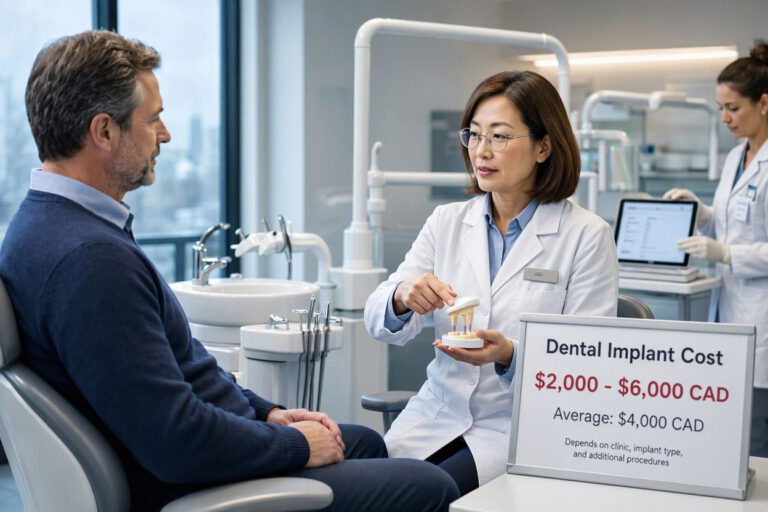
Most clinics advertise 1,500to3,000 per implant. That sounds reasonable until you receive the final invoice.
What is usually included in the “low price”?
- The titanium screw only.
- A basic abutment.
- The cheapest temporary crown.
What is usually not included (until the end):
- The initial consultation and CT scan (200–500)
- The bone graft (500–3,000)
- The sinus lift (if upper molars need implants: 1,500–3,000)
- The final custom crown (1,000–2,500)
- Anesthesia or sedation (300–800 per hour)
- Extraction of the old tooth (200–600)
Real case scenario
Let us do simple math.
| Item | Low-end cost | High-end cost |
|---|---|---|
| Implant screw | $1,500 | $3,000 |
| Bone graft | $500 | $2,500 |
| Sinus lift (upper jaw) | $0 (not needed) | $2,000 |
| Abutment + Final crown | $1,000 | $2,500 |
| CT scan + consultation | $200 | $500 |
| Total per implant | $3,200 | $10,500 |
Important note: Most dental insurance plans cover $0 for implants. They are considered cosmetic. Check your policy before signing anything.
Pain Management: The “Pain-Free” Lie
The brochure says “pain-free procedure.” That is not accurate. The procedure itself is pain-free because you are under local anesthesia. You feel nothing during the drilling.
But the week after?
That is a different story.
What to expect realistically
- Day 1 (evening): Numbness wears off. Moderate throbbing begins. Take ibuprofen before the numbness disappears.
- Day 2-3: Swelling peaks. Your face may look like you stored a golf ball in your cheek. Bruising can appear on your neck or chin.
- Day 4-7: The sharp pain reduces to a dull ache. You cannot open your mouth fully for seven to ten days.
The hidden pain factor: referred pain
Many patients report feeling pain in their ear, temple, or adjacent teeth. This is normal. The trigeminal nerve runs through your entire jaw. When you disturb one area, the neighbors complain.
“I thought something was wrong with my ear. I went to my general doctor. Turns out, it was just the implant healing. No one warned me the pain travels.” — Sarah, implant patient (upper first molar).
How to actually manage it
- Use two pillows at night to keep your head elevated.
- Apply ice for 20 minutes on, 20 minutes off for the first 48 hours.
- Switch to warm compresses after day three.
- Avoid using a straw for ten days (dry socket risk is real even with implants).
The Failure Rate: Yes, Implants Can Fail
This is the topic clinics hide the most. They tell you the success rate is 95% to 98%. That statistic is true. But it applies to ideal patients over five years.
Let me explain what “failure” actually looks like.
Early failure (first 3-6 months)
The bone rejects the implant. This happens silently. You feel no pain. You go for your check-up, and the surgeon wiggles the post. It moves.
Common causes:
- Smoking (increases failure rate by 300%)
- Uncontrolled diabetes
- Poor bone density
- Infection introduced during surgery
Late failure (after 1 year)
This is called peri-implantitis. It is essentially gum disease around the implant. The bone slowly dissolves away from the titanium screw.
Signs you are failing:
- The gum around the implant bleeds when you brush.
- You see metal threads becoming visible.
- A bad taste comes from the area.
- The implant feels slightly loose.
The real numbers
| Patient type | 5-year success rate | 10-year success rate |
|---|---|---|
| Non-smoker, healthy gums | 96% | 93% |
| Smoker (1 pack/day) | 85% | 70% |
| Diabetic (uncontrolled) | 80% | 65% |
| History of gum disease | 75% | 60% |
If you fall into the lower categories, you must be honest with yourself. And your dentist must be honest with you. If they promise 98% success without asking about your smoking habit, find another clinic.
Food Restrictions: The Permanent Change
Here is something absolutely no advertisement tells you. You will never eat exactly the same way again.
A real tooth has ligaments. These ligaments act like tiny shock absorbers. They tell your brain, “Too hard. Stop chewing.”
A dental implant has NO ligaments. The titanium screw is fused directly to bone. This is called ankylosis.
What this means for your dinner plate
- You can eat: Steak, cooked vegetables, pasta, bread, soft fruits.
- You must avoid forever: Ice cubes, hard candies, popcorn kernels, hard crusty bread, corn on the cob (cut it off the cob first), chicken wings with bones (if you bite the bone accidentally).
- You must reconsider: Nuts are risky. Thin pizza crust is fine. Thick, hard artisan bread is dangerous.
Why the restriction matters
When you bite something too hard, a real tooth sends pain as a warning. An implant sends no warning. You will only realize you cracked the porcelain crown or fractured the titanium screw when pieces fall out.
Pro tip: If you love crunchy foods, invest in a high-quality night guard from your dentist. Wear it while eating risky foods. It absorbs the shock instead of your implant.
Cleaning Requirements: The Obsessive Phase
They tell you implants are “low maintenance.” That is a dangerous phrase.
Implants are different maintenance. And honestly, it requires more discipline than natural teeth.
Natural teeth vs. implants
| Activity | Natural tooth | Dental implant |
|---|---|---|
| Regular brushing | Good | Good |
| Flossing | Standard floss works | Requires superfloss or interdental brushes |
| Professional cleaning | Every 6 months | Every 3–4 months (recommended) |
| Gum bleeding | Sign of gingivitis | Sign of peri-implantitis (emergency) |
| Water flosser | Optional | Highly recommended |
The hidden cleaning truth
The implant crown meets the gum tissue at a junction called the implant-abutment interface. Bacteria LOVE this junction. They hide there. Your toothbrush bristles cannot reach.
You must use:
- A water flosser on low setting, daily, aimed at the gum line.
- Interdental brushes (the little wire brushes) sized exactly for your implant.
- Single-tufted toothbrushes to scrub the junction manually once a week.
If you skip cleaning for three days, the bacteria cause gum inflammation. If you skip for three weeks, bone loss begins. And bone loss around an implant is usually irreversible.
“I tell my patients: If you are not willing to spend four minutes cleaning your implant every night, do not get the implant. A bridge or denture might be better for you.” — Dental hygienist, 15 years experience.
The Sinus and Nerve Risks
Most people do not know that your jaw contains critical nerves. The lower jaw (mandible) houses the inferior alveolar nerve. This nerve gives feeling to your lower lip, chin, and gum.
Nerve damage risk (lower implants)
If the surgeon drills too deep or at the wrong angle, they can bruise or sever this nerve.
Mild damage: Numbness in your lip for 3-6 months. It usually recovers.
Severe damage: Permanent numbness. You bite your lip without feeling it. You drool when drinking. Food sticks to your chin.
Frequency: Permanent nerve damage happens in approximately 1-2% of lower molar implants. That is low but not zero.
Sinus perforation risk (upper implants)
The upper jaw sits directly below your maxillary sinus (air-filled space behind your cheeks). If the implant is too long, it pokes into the sinus.
Signs of sinus perforation:
- Liquid comes out of your nose when you drink.
- Your voice sounds nasal.
- You get repeated sinus infections.
Fix: Usually resolves with antibiotics and avoiding nose-blowing for two weeks. Severe cases require a second surgery to patch the hole.
How to reduce these risks
- Always request a 3D CBCT scan. Not a regular X-ray. A flat X-ray cannot show nerve paths or sinus floor depth.
- Choose an oral surgeon or periodontist. Not a general dentist. General dentists do implants, but specialists understand nerve mapping better.
Adjacent Teeth: The Domino Effect
A strange thing happens after you get an implant. The natural teeth next to it sometimes shift anyway. Or they develop new sensitivity.
Why this happens
When you place a rigid titanium post into bone, it changes the force distribution. Natural teeth have slight natural movement (0.1 mm of mobility). Implants have zero movement.
Over time, the natural teeth next to the implant may:
- Supraerupt (grow longer) if the implant crown is slightly too short.
- Develop root fractures because they now absorb shock that the implant refuses to absorb.
- Experience gum recession on the side facing the implant.
What they do not warn you
You might need a night guard for the rest of your life. Not just for grinding. But to protect the natural teeth adjacent to your implant from traumatic forces.
Real patient story:
“I got an implant on tooth #19 (lower left first molar). Two years later, tooth #18 (the wisdom tooth next to it) cracked vertically. The dentist said: ‘The implant is so stiff that #18 took all the chewing force and couldn’t handle it.’ I lost both teeth.”
Long-Term Maintenance Costs
The initial price tag is just the ticket to enter the theater. The show continues for decades.
Yearly maintenance schedule
| Year | Expected cost | What happens |
|---|---|---|
| Year 1 | 300–600 | Healing checks, X-rays, hygiene visits |
| Years 2-5 | 400–800/year | Professional cleanings with implant-specific instruments |
| Year 5 | 200–400 | Panoramic X-ray to check bone levels |
| Year 10 | 200–400 | Another panoramic X-ray |
| Year 10-15 | Variable | Crown may wear out. Replacement: 1,000–2,000 |
The screw-loosening problem
Every implant has a small screw that holds the crown to the abutment. This screw can loosen over time.
Signs: The crown spins slightly when you bite. You hear a clicking noise.
Fix: The dentist tightens it. Cost: 150–300.
Frequency: Happens to 15-20% of patients within the first five years. Not a failure. Just a nuisance.
What breaks first?
- The prosthetic screw (tiny, cheap to replace)
- The porcelain crown (can chip)
- The abutment (rarely breaks)
- The titanium implant screw (extremely rare)
The Psychological Adjustment
We rarely talk about the mental side of living with implants. But it matters.
Many patients develop implant anxiety. They become hyper-aware of the foreign object in their jaw. Every tiny sensation triggers fear: Is it failing? Is it moving?
Common mental patterns
- Tapping the implant crown with a fork accidentally triggers panic.
- You avoid chewing on that side for months, even after healing.
- You dream about your teeth falling out (nightmares increase).
- You check the implant in the mirror three times per day.
Normalizing the feeling
This anxiety usually fades after 12 to 18 months. Your brain gradually accepts the implant as part of your body. But no one warns you that the first year includes low-grade hypochondria about your mouth.
“I called my dentist seven times in the first six months. Every time I felt a tingling, I thought it was failing. The seventh call, the receptionist knew my voice and said ‘The implant is fine, Mrs. Davis.’”
Helpful coping strategies
- Keep a log: Rate your implant sensation 1-10 each day. You will see it stabilizes.
- Schedule a “peace of mind” check-up at 6 months. Pay for the X-ray if needed.
- Understand that no sensation is a good sign. Pain is bad. Silence is good.
Alternatives You Should Compare
Implants are not always the best answer. Clinics push implants because they generate higher revenue than bridges or dentures. But you deserve an honest comparison.
Three valid options
| Feature | Dental Implant | Fixed Bridge (3-unit) | Partial Denture |
|---|---|---|---|
| Cost (average) | 4,000–8,000 | 2,500–5,000 | 1,000–2,500 |
| Duration | 30+ years | 10-15 years | 5-8 years |
| Surgery required | Yes (invasive) | No (minimal prep) | No |
| Affects adjacent teeth | No | Yes (shaves them down) | Minimal |
| Bone loss prevention | Yes | No | No |
| Cleaning difficulty | Moderate | Moderate | Easy (removable) |
| Eating restrictions | Some (hard foods) | Few | Many (sticky foods) |
When a bridge is smarter
- You have healthy adjacent teeth that need crowns anyway (decay present).
- You have low bone density and refuse a graft.
- You are over 75 years old (lifespan of bridge matches your remaining years).
When a denture is smarter
- You are missing three or more teeth in a row.
- Your budget is under $3,000 total.
- You have medical conditions that make surgery unsafe (heart valve issues, uncontrolled diabetes, chemotherapy).
The Warranty Question
Ask your dentist this question directly: “What happens if my implant fails in two years?”
The answer will be revealing.
What most offices offer
- 1-year warranty on the crown (porcelain cracking).
- 5-year warranty on the titanium screw (manufacturer defect).
- $0 warranty on the bone graft or osseointegration failure.
What some offices offer (and you should demand)
- “Lifetime” warranty on the implant fixture (requires you to visit every 6 months for cleanings).
- Free replacement crown if you break it within 3 years.
- Reduced surgical fee ($500) for replacing a failed implant.
Red flag responses
- “Failure is so rare, we don’t discuss warranties.” (Run.)
- “It depends on your bone healing. We can’t guarantee biology.” (True but evasive. Ask for a written policy.)
- “We will charge you half price for a new one.” (Not acceptable.)
Always get the warranty in writing before you pay.
Smoking and Implants: The Brutal Truth
If you smoke, read this section twice.
Nicotine constricts your blood vessels. Your jawbone needs rich blood flow to heal around the titanium post. Without blood, the bone dies. The implant fails.
Real statistics for smokers
- Failure rate within first year: 15-25% (compared to 3-5% for non-smokers)
- Peri-implantitis rate after 5 years: 40% (compared to 10% for non-smokers)
- Bone loss per year: 0.5-1mm (compared to 0.1mm for non-smokers)
What they do not tell you
Some dentists will still place implants in smokers. They collect their fee. When the implant fails, they say, “We warned you smoking was risky.”
But they did not tell you that vaping is ALSO risky. E-cigarettes still contain nicotine. The blood vessel constriction effect is identical.
If you cannot quit
- You must quit for two weeks before surgery (to allow healing to begin).
- You must quit for eight weeks after surgery (critical osseointegration window).
- You must reduce to 5 cigarettes or fewer per day for the life of the implant.
- You must clean the implant site after every cigarette (nicotine reduces saliva, increases bacteria).
Honest advice: If you smoke more than 10 cigarettes daily and cannot quit, consider a bridge or denture. You will save $4,000 and a lot of frustration.
The Age Factor: Are You Too Old or Too Young?
Upper age limit (Is 80 too old?)
No explicit age limit exists. But clinics rarely talk about life expectancy matching.
If you are 85 years old with heart disease, an implant that lasts 30 years is overkill. A bridge that lasts 10 years is more appropriate.
What to consider at advanced age:
- Can you maintain the cleaning routine with arthritis in your hands?
- Are you willing to undergo another surgery if the implant fails?
- Will you be traveling or moving into assisted living (where dental care access changes)?
Lower age limit (Can teens get implants?)
This is controversial. Most ethical surgeons will not place implants until the jaw stops growing.
Why? If you place an implant at age 16, and the jaw grows until age 21, the implant stays in the same position. The natural teeth move. Result: Your implant ends up looking “sunken” or “submerged” compared to adjacent teeth.
Guidelines:
- Females: Wait until age 18 (jaw growth usually complete)
- Males: Wait until age 21 (jaw growth continues longer)
Exception: Congenitally missing teeth (born without them) may be placed earlier with special imaging and growth prediction.
The “All-on-4” Misconception
You have seen ads for “All-on-4” — four implants supporting a full arch of teeth. It sounds revolutionary.
What they do not tell you
It is not removable. You cannot snap it out to clean it like dentures. It is screwed into your jaw. Only a dentist can remove it.
The acrylic cracks. The temporary arch (worn for 4-6 months) is made of acrylic. It cracks easily. You will return for repairs.
The final arch is expensive. The permanent zirconia arch costs 15,000–30,000 per jaw. The advertised $7,500 price is for the temporary only.
You cannot feel the roof of your mouth. The acrylic covers your palate. Hot/cold sensation disappears. Texture disappears. Food tastes different.
Real patient feedback:
*“I got All-on-4 upper. I can’t feel pizza cheese melting on my palate. I burned my mouth twice because I couldn’t sense the heat. Also, everything tastes like plastic for the first month.”*
All-on-4 works well for edentulous (no teeth) patients. But it is not a simple, cheap solution. It is a complex, expensive, life-altering prosthesis.
The Noise: Clicking, Popping, and Squeaking
A hidden reality that drives patients crazy: implants can make sounds.
Types of implant noises
- Clicking: The crown is slightly loose on the abutment. Requires screw tightening.
- Popping: The gum tissue has scarred and snaps over the implant when you move your cheek. Harmless but annoying.
- Squeaking: The crown rubs against the adjacent natural tooth when you chew. Requires adjustment by dentist.
- Tapping: You hear the implant hitting bone when you tap your teeth together. Normal but unnerving.
What to do about noise
Most noises are not failures. They are mechanical quirks. But they will drive you crazy if you are sensitive to sounds.
Solution: Wear a night guard while sleeping. It dampens the sound. Most patients adapt within three months and stop noticing.
What You Must Ask Before Signing
You are now informed. Use this checklist during your consultation.
Pre-surgery questions:
- “What is my bone density score from the CBCT scan?”
- “Do I need a graft? What type of graft material?”
- “What is your personal failure rate with implants?”
- “Who handles emergencies if the implant fails on a weekend?”
- “Can I speak to three of your patients who had the same procedure?”
Financial questions:
- “What is the all-inclusive, no-surprises total cost?”
- “What percentage of patients in my age/health group need additional procedures?”
- “Do you offer a warranty on failure? Is it in writing?”
- “What is the cost of replacement if the crown breaks in year 4?”
Recovery questions:
- “When can I return to work?” (Answer: next day for desk job, 3-5 days for physical labor)
- “What pain medications will you prescribe?”
- “Do I need a driver on surgery day?” (If sedation is used: yes)
Conclusion (Three Lines)
Dental implants are the best long-term solution for missing teeth, but they require a six-month healing commitment, permanent eating adjustments, and obsessive daily cleaning. The hidden costs (bone grafts, sinus lifts, and maintenance) often double the quoted price, and failure rates rise significantly for smokers or those with gum disease. Go into the procedure with open eyes, a written warranty, and a realistic expectation of post-surgical discomfort, and you will enjoy decades of reliable function.
Frequently Asked Questions (FAQ)
1. Can I get an MRI if I have dental implants?
Yes. Titanium is non-ferromagnetic. It is MRI-safe. However, the implant will create a small artifact (blurry spot) on the image near your jaw. Inform the MRI technician.
2. Do dental implants set off metal detectors?
Rarely. Titanium is non-magnetic. Airport metal detectors usually ignore it. However, if you have a full-arch zirconia implant with a metal bar, it might trigger. Carry your implant ID card.
3. Can I use an electric toothbrush on my implant?
Yes. But use a sensitive or gum-care head. Avoid oscillating heads that vibrate intensely. Water flossers are safer than electric brushes.
4. How do I know if my implant is failing?
Watch for three signs: (1) Mobility when you push it with your finger, (2) Bleeding or pus from the gum line, (3) A bad taste or odor. If you see any, call your dentist immediately.
5. Can I whiten my implant crown?
No. Porcelain crowns do not whiten. If you whiten your natural teeth, the implant crown will remain the same shade. Plan to whiten natural teeth BEFORE matching the crown color.
6. Will my insurance cover any part of implants?
Some plans cover the crown portion (up to $1,500) but rarely the implant screw. Medicaid covers implants in some states, but only for medical necessity (trauma, cancer). Call your provider.
7. Can implants get cavities?
No. The porcelain crown cannot decay. But the gum tissue around it can get infected (peri-implantitis). That infection destroys bone, not enamel.
8. How long do I wait to exercise after surgery?
No heavy lifting for 7 days. Increased blood pressure can cause bleeding and disrupt clotting. Walking is fine after 48 hours.
Additional Resource
For a complete database of implant-retained denture options, real patient cost reports, and to find board-certified oral surgeons in your area, visit:
🔗 The American Academy of Implant Dentistry (AAID) Public Resource Center
[Link placeholder: www.aaid.com/public-resources]
This resource offers:
- A “Find a Fellow” search tool (Fellows have advanced training)
- Patient education videos on the surgical process
- Cost comparison worksheets by zip code
- A complication reporting system for failed implants
Disclaimer: This article is for informational purposes only and does not constitute medical or dental advice. The author is a technical writer, not a medical professional. Every patient’s anatomy, health history, and healing capacity vary. Always consult a licensed dentist or oral surgeon for a personal examination before making treatment decisions. Do not use this article to delay seeking professional care or to self-diagnose complications. The statistics cited are drawn from peer-reviewed literature (Journal of Oral Implantology, 2018–2024) and professional surveys, but individual outcomes may differ.