How Does Oral Cancer Cause Death?
Oral cancer is a serious and potentially life-threatening disease that affects thousands of people each year. When detected early, the survival rates are encouraging. When diagnosis comes late, the consequences can be devastating. Understanding how oral cancer causes death is not about fear. It is about awareness, about recognizing the importance of early detection, and about understanding why prompt treatment matters so profoundly.
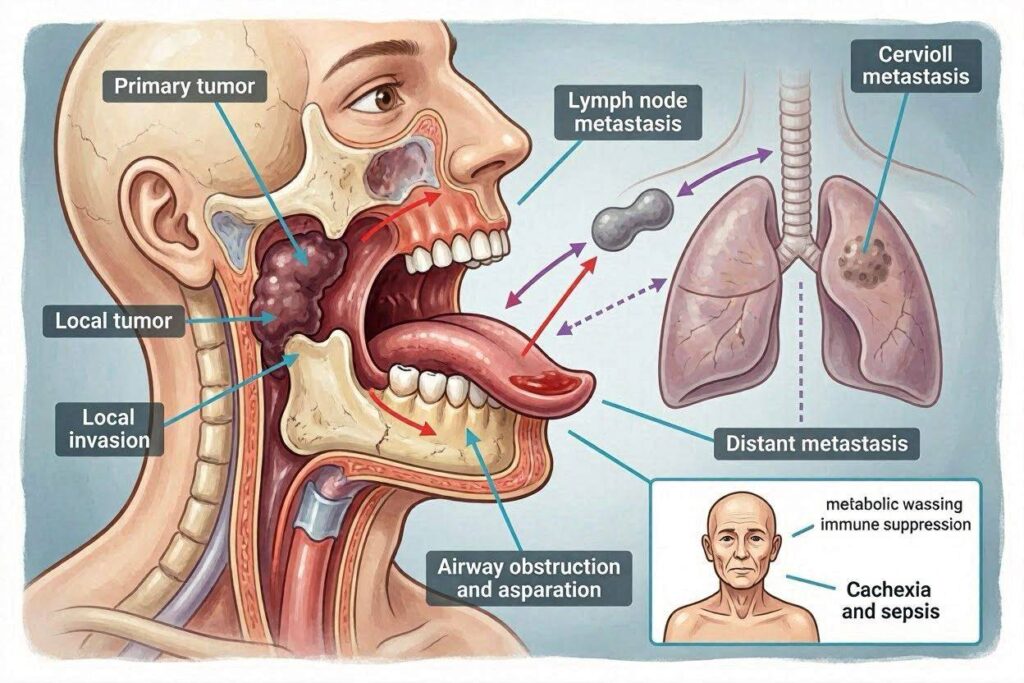
Oral cancer causes death through several interconnected mechanisms. The disease can destroy vital structures needed for breathing, swallowing, and speaking. It can spread to distant organs, disrupting their function. It can cause severe malnutrition as eating becomes impossible. And the treatments themselves, while life-saving, can place enormous strain on the body. This guide explains each of these pathways with clarity and respect, providing the knowledge that empowers you to take your oral health seriously and seek evaluation when something does not feel right.
The Nature of Oral Cancer
Oral cancer refers to malignant growths that develop in any part of the mouth, including the lips, tongue, floor of the mouth, cheeks, gums, roof of the mouth, and the area behind the wisdom teeth. The vast majority of oral cancers are squamous cell carcinomas, which arise from the flat, thin cells that line the oral cavity.
Risk Factors and Development
The primary risk factors for oral cancer include tobacco use in all its forms, heavy alcohol consumption, and infection with certain strains of the human papillomavirus, particularly HPV-16. When tobacco and alcohol are used together, the risk multiplies rather than simply adding together. Sun exposure contributes to lip cancers. A diet low in fruits and vegetables may also increase risk.
Oral cancer typically begins as a small, often painless lesion. It may appear as a white patch, a red patch, an ulcer that does not heal, or a lump or thickening in the oral tissues. Because early lesions often do not hurt, they can go unnoticed or be dismissed as minor irritations. This is why regular dental checkups that include oral cancer screening are critically important.
The Importance of Early Detection
When oral cancer is found at its earliest stage, when the tumor is small and has not spread, the five-year survival rate exceeds eighty percent. When it is found after it has spread to distant parts of the body, the five-year survival rate drops dramatically, to below forty percent. The difference between these outcomes often comes down to how soon the cancer was detected. Early detection saves lives, and delays can be fatal.
Local Destruction of Vital Structures
The first way oral cancer causes death is through the local destruction of the structures necessary for basic life functions. As the tumor grows, it invades and destroys the tissues around it.
Airway Compromise
The oral cavity and the throat form the upper portion of the airway. A tumor that grows on the tongue, the floor of the mouth, the soft palate, or the throat can physically obstruct the passage of air. As the tumor enlarges, breathing becomes progressively more difficult. The patient may experience shortness of breath, noisy breathing, and eventually the inability to move air effectively.
Complete airway obstruction is a medical emergency. Without a secure airway, the patient suffocates. In some cases, a surgical airway such as a tracheostomy can bypass the obstruction, but if the tumor has extensively involved the neck structures, even this may be difficult or impossible.
Tumors in the throat area, the oropharynx and hypopharynx, are particularly dangerous because they grow in the space through which air must pass to reach the lungs. Even a relatively small tumor in a critical location can have devastating effects on breathing.
Inability to Swallow and Eat
The structures involved in swallowing, the tongue, the muscles of the throat, and the esophagus, can be infiltrated by oral cancer. As the tumor grows, swallowing becomes first difficult, then painful, and eventually impossible. The patient cannot eat or drink adequately.
Dysphagia, the medical term for difficulty swallowing, leads to several cascading problems. The patient takes in fewer and fewer calories, leading to progressive weight loss and malnutrition. The body, already fighting cancer, is deprived of the energy and nutrients it needs. Aspiration, the entry of food or liquid into the airway, becomes more likely as swallowing control deteriorates. Aspiration can cause pneumonia, which in a weakened patient can be fatal.
Hemorrhage
Oral cancers can erode into blood vessels. The head and neck region has a rich blood supply, with major arteries including the carotid artery and its branches passing through the area where oral cancers grow. When a tumor invades the wall of a blood vessel, the vessel can rupture.
A carotid artery rupture, sometimes called a carotid blowout, causes massive, rapid bleeding that is often fatal within minutes. Even smaller vessels, when they bleed, can cause significant blood loss, particularly if the bleeding is difficult to control because of the tumor’s location.
Hemorrhage can occur spontaneously as the tumor erodes a vessel, or it can occur as a complication of treatment, when surgery or radiation has weakened the vessel wall.
Metastasis to Distant Organs
Cancer’s ability to spread, or metastasize, is what makes it a systemic rather than a localized threat. Oral cancer cells can break away from the primary tumor and travel to other parts of the body.
Lymphatic Spread
The most common first route of spread for oral cancer is through the lymphatic system. Cancer cells enter the lymphatic vessels and travel to the lymph nodes in the neck. Enlarged, firm lymph nodes in the neck are often the first sign that oral cancer has begun to spread.
From the cervical lymph nodes, cancer cells can continue through the lymphatic chain to reach lymph nodes in the chest and beyond. Lymphatic spread indicates that the cancer is no longer confined to its original site and requires more aggressive treatment.
Spread to the Lungs
The lungs are among the most common sites for distant metastasis from oral cancer. Cancer cells travel through the bloodstream or lymphatic system and establish new tumors in the lung tissue. These metastatic tumors disrupt normal lung function. The patient develops shortness of breath, cough, and chest pain. As the lung tumors grow, the capacity of the lungs to oxygenate the blood decreases. Respiratory failure from pulmonary metastases is a common final pathway in oral cancer deaths.
Spread to the Liver and Bones
Oral cancer can also metastasize to the liver, bones, and brain. Liver metastases impair the organ’s ability to process nutrients, filter toxins, and produce essential proteins. Liver failure causes jaundice, fluid accumulation, confusion, and eventually multi-organ dysfunction.
Bone metastases cause severe pain and can lead to fractures. They also disrupt the bone marrow’s production of blood cells, leading to anemia, increased infection risk, and bleeding problems. Brain metastases cause neurological symptoms depending on their location, including seizures, weakness, personality changes, and loss of consciousness.
Once oral cancer has spread widely to distant organs, cure becomes unlikely. Treatment shifts from curative intent to palliative care, focusing on comfort and quality of life.
Malnutrition and Cachexia
The relationship between oral cancer and nutrition is particularly cruel because the disease directly attacks the means by which the body takes in nourishment.
Mechanical Obstruction to Eating
As described earlier, tumors in the mouth and throat physically block the passage of food. A patient with a large tongue tumor cannot move food around the mouth effectively. A patient with a tumor involving the throat cannot swallow without pain or obstruction. Eating, a basic human pleasure and necessity, becomes an ordeal.
Cancer Cachexia
Beyond the mechanical problems, cancer induces metabolic changes throughout the body. Cancer cachexia is a wasting syndrome characterized by loss of muscle mass and fat, weakness, and profound weight loss. It is driven by substances produced by the tumor and by the body’s inflammatory response to the cancer.
Cachexia is not simply starvation. It is a metabolic derangement in which the body breaks down its own tissues. Even if the patient could eat adequately, which they often cannot, the body would not use the nutrients normally. Cachexia is estimated to be a contributing factor in twenty to thirty percent of cancer deaths. The patient simply wastes away.
Infection in the Malnourished State
Malnutrition severely impairs the immune system. A malnourished patient cannot mount an effective defense against infections. Pneumonia, wound infections, and systemic infections become more common and more severe. An infection that a well-nourished person would fight off easily can become life-threatening in the context of advanced oral cancer.
Treatment-Related Mortality
The treatments for oral cancer are aggressive because the disease is aggressive. Surgery, radiation therapy, and chemotherapy can all cause complications that, in some cases, contribute to death.
Surgical Complications
Surgery for oral cancer can be extensive. Resection of large tumors may require removal of portions of the jaw, tongue, or throat. Reconstructive surgery using flaps of tissue from other parts of the body attempts to restore form and function, but these are major operations with significant risks.
Post-operative complications include infection of the surgical site, failure of the reconstructive flap due to compromised blood supply, bleeding, and blood clots. Patients with oral cancer often have other health problems, such as heart disease or lung disease from years of smoking, which increase their surgical risk. A patient may survive the cancer removal but succumb to a surgical complication.
Radiation Therapy Complications
Radiation therapy targets the tumor with high-energy beams that kill cancer cells. Unfortunately, radiation also affects the healthy tissues in the treatment field. The side effects can be severe.
Radiation to the head and neck causes mucositis, a painful inflammation and ulceration of the lining of the mouth and throat. Eating and drinking become excruciating. Dry mouth from damage to the salivary glands is permanent. Radiation damages the blood supply to the jawbone, creating a risk of osteoradionecrosis, a condition in which the bone dies and becomes exposed. This condition is painful, difficult to treat, and can lead to jaw fracture and overwhelming infection.
Radiation can also cause fibrosis, the thickening and stiffening of tissues, which restricts mouth opening and impairs swallowing permanently. Late effects of radiation can appear months or years after treatment and can be progressive.
Chemotherapy Complications
Chemotherapy drugs target rapidly dividing cells, a characteristic of cancer, but they also affect the rapidly dividing cells of the bone marrow, the lining of the gut, and the hair follicles. Bone marrow suppression reduces the production of white blood cells, red blood cells, and platelets.
A low white blood cell count leaves the patient vulnerable to infection. A fever in a chemotherapy patient with low white counts is a medical emergency because the body cannot fight off even routine bacteria. Sepsis, a systemic infection that causes organ failure, can develop rapidly and be fatal.
Low platelet counts increase the risk of bleeding. Low red blood cell counts cause fatigue and reduce the body’s oxygen-carrying capacity. Chemotherapy also causes nausea, vomiting, and mouth sores that compound the nutritional difficulties.
The Final Pathway
In advanced oral cancer, multiple factors often converge. A patient may be dealing with a recurrent tumor that obstructs their airway, malnutrition from an inability to eat, pneumonia from aspiration, and systemic infection from a compromised immune system. Each problem makes the others worse, and together they overwhelm the body’s ability to compensate.
Death from oral cancer is rarely a single event with a single cause. It is typically a process involving the interaction of local tumor effects, distant metastases, malnutrition, infection, and the cumulative toll of treatment. Understanding this process underscores why early detection and prevention are so critical.
Conclusion
Oral cancer causes death through local destruction of vital structures necessary for breathing and swallowing, metastasis to distant organs including the lungs and liver, severe malnutrition and cancer cachexia that deplete the body’s reserves, and complications from aggressive treatments including surgery, radiation, and chemotherapy. Early detection dramatically improves survival because treatment can remove or destroy the cancer before it invades deeply or spreads. This reality makes regular oral cancer screening, awareness of risk factors, and prompt evaluation of any persistent oral lesion essential components of health maintenance.
FAQ
How fast does oral cancer spread?
The rate of spread varies depending on the tumor’s aggressiveness, location, and the individual’s overall health. Some oral cancers grow slowly over months, while others progress rapidly. Squamous cell carcinomas, the most common type, generally grow at a moderate pace, but early detection remains crucial regardless of the growth rate.
Can oral cancer kill you without spreading?
Yes. Even without distant metastasis, a tumor in the mouth or throat can cause death by obstructing the airway, eroding into a major blood vessel and causing fatal hemorrhage, or preventing adequate nutrition to the point of starvation.
What are the first signs that oral cancer is becoming life-threatening?
Warning signs include difficulty breathing or swallowing, significant unexplained weight loss, severe pain that is not controlled with medication, bleeding from the mouth, a mass that is visibly growing, and the development of new symptoms such as bone pain or shortness of breath that suggest metastasis.
Does treatment for oral cancer always involve disfiguring surgery?
Not always. Early-stage oral cancers can often be treated with relatively limited surgery or with radiation alone, preserving function and appearance. The more advanced the cancer, the more extensive the treatment required. This is another reason why early detection is so important.
Can oral cancer come back after successful treatment?
Yes. Recurrence is a significant concern. It can occur at the original site, in the nearby lymph nodes, or as distant metastases. Patients who have been treated for oral cancer require lifelong surveillance with regular examinations and imaging.
How can I reduce my risk of dying from oral cancer?
Stop using tobacco in all forms. Limit alcohol consumption. Protect your lips from sun exposure. Eat a diet rich in fruits and vegetables. See your dentist regularly for examinations that include oral cancer screening. Report any sore, lump, or patch in your mouth that does not heal within two weeks.
What is the survival rate for oral cancer?
The overall five-year survival rate for oral cancer is approximately sixty to sixty-five percent. However, this figure masks significant variation by stage. Early-stage oral cancer has survival rates above eighty percent. Late-stage oral cancer with distant metastasis has survival rates below forty percent.
Does HPV-related oral cancer have a different prognosis?
HPV-positive oral cancers, which typically occur in the oropharynx, including the tonsils and base of the tongue, tend to respond better to treatment and have a better prognosis than HPV-negative oral cancers. This is an area of active research and has implications for treatment decisions.
Additional Resource
For authoritative information about oral cancer prevention, detection, and treatment, visit the Oral Cancer Foundation at oralcancerfoundation.org. The foundation provides comprehensive patient education resources, screening information, and support services for those affected by oral cancer.