Are Dentures Covered By Missouri Care?
The intersection of Medicaid managed care and dental benefits is a labyrinth of plan documents, provider directories, prior authorization requirements, and coverage limitations that varies dramatically from state to state. In Missouri, the Medicaid program—MO HealthNet—underwent a significant transformation with the expansion of managed care, and the dental benefit structure that emerged is a patchwork of covered services, excluded procedures, and plan-specific rules that can confuse even experienced healthcare navigators. For a Missouri resident who has lost their teeth and is facing the prospect of dentures, the question is urgent and practical: “Are dentures covered by Missouri Care?”
The answer requires disentangling terminology, understanding the specific managed care plan’s benefit schedule, and navigating the clinical and administrative pathways to approval. Missouri Care, now known as Healthy Blue Missouri after a rebranding and acquisition by Anthem, is one of the MO HealthNet managed care plans serving Missouri’s Medicaid population. Under MO HealthNet, comprehensive dental benefits for adults are limited, but dentures are covered under specific conditions, with prior authorization requirements, and subject to frequency limitations and the plan’s provider network. This article provides a detailed map of the MO HealthNet adult dental benefit as it applies to dentures, the specific coverage rules under Healthy Blue Missouri (formerly Missouri Care), the prior authorization process, the provider access challenge, and the practical steps a Missouri Medicaid beneficiary must take to obtain dentures through their managed care plan.
MO HealthNet Adult Dental: The Baseline Benefit
The adult dental benefit under MO HealthNet is administered through the state’s managed care plans for most beneficiaries. The Missouri Department of Social Services, which oversees MO HealthNet, contracts with managed care organizations to deliver healthcare services to the majority of the state’s Medicaid population. These plans—Healthy Blue Missouri, UnitedHealthcare Community Plan, and Home State Health—are responsible for delivering the dental benefit defined in their contracts with the state.
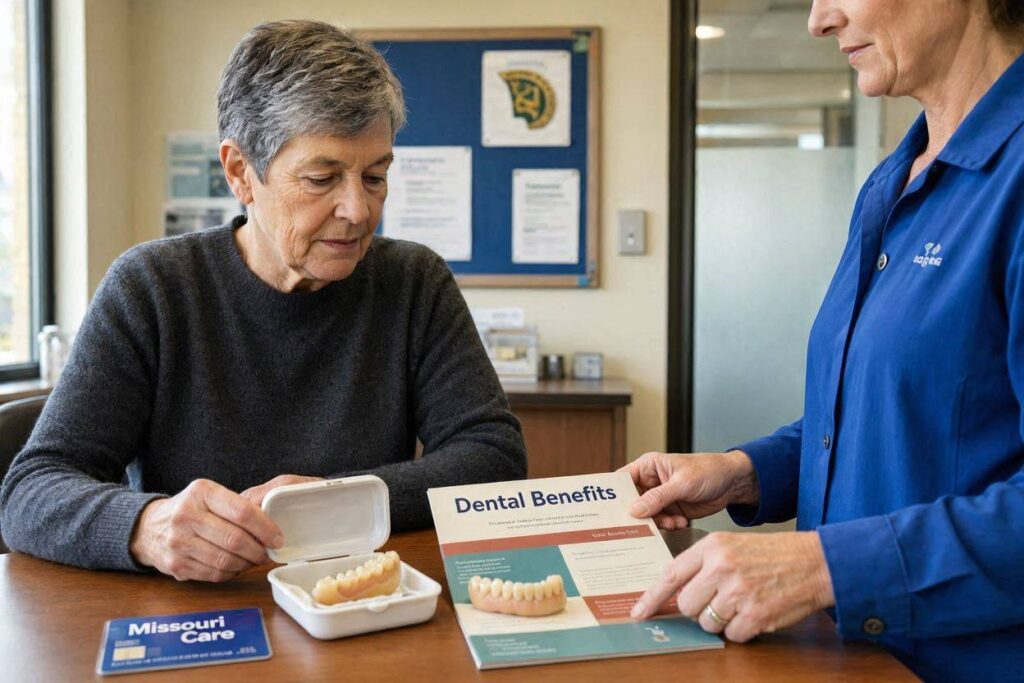
The baseline MO HealthNet adult dental benefit is more comprehensive than many states but is not a full-mouth restoration program. Covered services include diagnostic and preventive care—exams, cleanings, X-rays, fluoride treatments—at defined intervals. Restorative services include amalgam and composite fillings, stainless steel crowns, and tooth extractions. Periodontal services include scaling and root planing for diagnosed periodontitis. The most significant coverage for edentulous and partially edentulous patients is the inclusion of complete and partial dentures, subject to specific conditions.
MO HealthNet covers the fabrication and delivery of complete dentures and partial dentures. The coverage is subject to a frequency limitation: complete dentures are typically covered once every eight years, and partial dentures once every eight years, per arch, unless a significant change in the patient’s oral condition necessitates replacement sooner. Relines, rebases, and repairs of existing dentures are covered within defined frequency limits. Denture adjustments are covered. The specific benefits, frequency limits, and prior authorization requirements are outlined in the MO HealthNet Dental Manual and in each managed care plan’s provider manual and member handbook.
Healthy Blue Missouri (Formerly Missouri Care): The Specifics
Healthy Blue Missouri, the Anthem-affiliated managed care plan that absorbed Missouri Care, administers the MO HealthNet dental benefit for its enrolled members. The plan’s coverage for dentures follows the state’s baseline benefit but may have additional administrative requirements, prior authorization processes, and network restrictions.
Complete dentures (full upper and/or lower) are a covered benefit under Healthy Blue Missouri when medically necessary. Medical necessity in this context means that the patient is edentulous (all teeth are missing in the arch) and that the dentures are required to restore masticatory function, speech, and facial contour. A comprehensive dental examination, including appropriate radiographs, must be performed by a participating network provider. The treating dentist must document the patient’s edentulous status, the adequacy of the alveolar ridge, and the absence of any active oral pathology—untreated caries, periodontal abscesses, soft tissue lesions—that would contraindicate denture fabrication.
Partial dentures are covered when the patient is partially edentulous and has sufficient healthy natural teeth remaining to serve as abutments for the partial denture. The same medical necessity and documentation standards apply. The dentist must demonstrate that the remaining teeth are periodontally stable and caries-free and that the partial denture will restore function without compromising the health of the abutment teeth.
Prior authorization is the critical gateway. The dentist submits a treatment plan, radiographs, and clinical documentation to Healthy Blue Missouri for review. The plan’s dental director or a contracted dental consultant reviews the submission and determines whether the proposed dentures meet the medical necessity criteria. If approved, the authorization is issued with a specific validity period—typically 6 to 12 months—during which the denture must be fabricated and delivered. If denied, the patient and dentist have the right to appeal. The prior authorization process can take several weeks, and the patient should expect a waiting period between the initial examination and the delivery of the final prosthesis.
The Prior Authorization Process: A Step-by-Step Guide
For a Missouri Medicaid beneficiary enrolled in Healthy Blue Missouri, the journey to obtaining dentures proceeds through a defined sequence.
First, the patient must establish care with a general dentist who participates in the Healthy Blue Missouri network. This is a non-trivial step; the network of dentists accepting new MO HealthNet patients is limited, particularly in rural areas. The patient should use the plan’s online provider directory or call member services to obtain a list of participating dentists in their geographic area, then call those offices to confirm that they are currently accepting new Healthy Blue Missouri patients and that they provide denture services.
Second, the dentist performs a comprehensive oral evaluation, including necessary radiographs—typically a panoramic X-ray to evaluate the jawbone, the sinuses, and any remaining teeth—and develops a treatment plan. If the patient requires extractions before denture fabrication, those extractions are a covered benefit and should be completed and healed—typically 6–8 weeks for initial ridge healing—before the denture impressions are taken. Immediate dentures, placed at the time of extraction, may be covered but require specific documentation of the medical necessity for an immediate rather than a conventional delayed denture.
Third, the dentist submits the prior authorization request, including the treatment plan, the panoramic radiograph, clinical photographs if indicated, and a narrative documenting the patient’s edentulous or partially edentulous status and the functional impairment caused by the missing teeth. The request should specify the type of denture, the material, and the fee schedule code. The plan reviews the request and issues an approval, a denial, or a request for additional information.
Fourth, upon approval, the dentist schedules the denture fabrication appointments: preliminary impressions, final impressions, bite registration, wax try-in, and delivery. The patient must attend all appointments; missed appointments can void the authorization if the time limit expires. The denture is delivered, adjusted, and the patient enters the follow-up phase for adjustments and relines as needed.
Limitations and Exclusions: What Missouri Care/Healthy Blue Does Not Cover
The denture coverage under Healthy Blue Missouri is not unlimited. Patients must understand the boundaries to avoid unexpected out-of-pocket costs, which can be significant for a Medicaid population with limited financial resources.
Implant-retained dentures—snap-on overdentures supported by dental implants—are not a covered benefit for adults under MO HealthNet. The plan covers conventional tissue-supported complete and partial dentures only. The implants, the abutments, and the specialized overdenture attachments are excluded. A patient who desires an implant-stabilized denture must pay the entire cost of the implant surgery and the upgraded prosthesis out-of-pocket.
Immediate dentures—placed at the time of extraction, before the extraction sites have healed—are covered when medically necessary, but the plan expects that a conventional delayed denture will be the standard approach. The immediate denture requires a reline after the ridge heals, which is a covered benefit, but the initial authorization must specifically request the immediate denture and document the rationale.
Premium denture materials, such as high-impact acrylic, flexible thermoplastic partials, or porcelain denture teeth, may not be covered or may be considered an upgraded service for which the patient is responsible for the difference in cost between the base material and the premium material. The standard covered denture is typically fabricated from conventional acrylic with acrylic teeth. The patient should discuss material options with the dentist and clarify what is covered and what would incur an out-of-pocket expense.
Replacement of lost or broken dentures is a specific, narrow benefit. MO HealthNet covers denture replacement only when the existing denture is beyond repair and the patient has met the frequency limitation (typically eight years from the original delivery). A patient who loses a denture or breaks it through negligence within the frequency limitation period may not be eligible for a replacement. The treating dentist must document the condition of the existing prosthesis and demonstrate that it cannot be repaired. Denture repairs—relines, rebases, replacement of broken teeth, repair of fractured acrylic bases—are covered within frequency limits as a separate benefit and do not reset the eight-year replacement clock.
The Provider Access Challenge: Finding a Dentist Who Accepts Healthy Blue Missouri
The most significant barrier to denture care under MO HealthNet is not coverage policy but provider access. Missouri, like many states, faces a severe shortage of dentists who participate in the Medicaid program. Reimbursement rates for dental services under MO HealthNet, while periodically adjusted by the state legislature, remain below market rates for private practice. The administrative burden of prior authorization, claims submission, and managed care plan credentialing is a further disincentive. Many private dentists do not participate in the MO HealthNet network or limit the number of Medicaid patients they accept.
Federally Qualified Health Centers (FQHCs) and community health centers are the primary safety net providers for MO HealthNet dental patients. Organizations such as Missouri Highlands Health Care, Southeast Missouri Health Network, and the various community health centers across the state provide comprehensive dental services, including dentures, to Medicaid beneficiaries on a sliding fee scale where applicable. These centers are familiar with the Healthy Blue Missouri prior authorization process and can guide patients through the administrative requirements.
Patients should contact the Healthy Blue Missouri member services line directly at the number on their insurance card to request assistance finding a participating dentist who provides denture services. The plan is contractually obligated to maintain an adequate provider network, and if a member cannot find a participating dentist within a reasonable distance, the member services department can facilitate an out-of-network referral or single-case agreement with a non-participating provider.
The Appeals Process: What to Do If Dentures Are Denied
A prior authorization denial for dentures is not the end of the road. The patient has the right to appeal the denial through the Healthy Blue Missouri internal appeals process and, if the internal appeal is denied, through the Missouri Department of Social Services’ MO HealthNet fair hearing process.
The denial letter will specify the reason for the denial—lack of medical necessity, insufficient documentation, frequency limitation, or a specific exclusion. The patient and the treating dentist should review the denial reason carefully and address it in the appeal. If the denial was for insufficient documentation, the dentist can submit additional clinical information: more detailed radiographs, a narrative explaining the functional impairment, or documentation of the patient’s inability to eat and speak effectively without dentures. If the denial was based on a frequency limitation and the patient’s circumstances warrant an exception—for example, significant ridge resorption making the existing denture unusable—the dentist can submit documentation of the exceptional circumstances.
The internal appeal must be filed within the timeframe specified in the denial letter, typically 60 days. The plan reviews the appeal and issues a decision. If the internal appeal is denied, the patient can request a state fair hearing. The fair hearing is an administrative law proceeding before an impartial hearing officer. The patient can present evidence, call witnesses, and be represented by legal counsel or a healthcare advocate. Legal aid organizations in Missouri, such as Legal Services of Eastern Missouri and Legal Aid of Western Missouri, provide free legal representation to eligible MO HealthNet beneficiaries in fair hearing cases. The fair hearing decision is binding on the plan and the state.
The MO HealthNet Spend-Down and Medically Needy Pathway
Some Missouri residents have incomes too high to qualify for standard MO HealthNet but have medical expenses—including dental expenses—that consume a significant portion of their income. Missouri’s Medically Needy program, also known as the spend-down program, allows individuals to qualify for MO HealthNet coverage by “spending down” their excess income on medical and dental expenses. Dentures, which can cost $1,500 to $3,000 per arch out-of-pocket, can contribute significantly to meeting a spend-down amount. A patient who is ineligible for standard MO HealthNet but faces catastrophic dental expenses should contact the Missouri Department of Social Services’ Family Support Division to inquire about the Medically Needy program and whether their dental expenses can be applied to a spend-down calculation.
Conclusion
Dentures are a covered benefit under Healthy Blue Missouri (formerly Missouri Care), the Anthem-affiliated MO HealthNet managed care plan, subject to medical necessity documentation, prior authorization, frequency limitations of approximately eight years per arch, and the availability of a participating network dentist to perform the comprehensive examination and submit the authorization request. Conventional tissue-supported complete and partial dentures are covered; implant-retained overdentures, premium materials, and immediate dentures without medical necessity are excluded or subject to additional documentation. The most significant barrier is not the coverage policy itself but the limited network of MO HealthNet-participating dentists who provide denture services, making Federally Qualified Health Centers the primary access point. A prior authorization denial can be appealed through the plan’s internal process and, if necessary, through a state fair hearing with the assistance of legal aid.
FAQ
Q: How often will Healthy Blue Missouri pay for a new set of dentures?
A: The standard frequency limitation is once every eight years per arch for complete and partial dentures. If your dentures are less than eight years old and need replacement due to a significant change in your oral condition—such as severe bone resorption, weight loss or gain, or a medical condition that altered your jaw structure—your dentist can submit documentation of the exceptional circumstances and request an override of the frequency limitation. The request must demonstrate that the existing denture cannot be repaired or relined to restore function and that the replacement is medically necessary.
Q: What should I do if no dentist in my area accepts Healthy Blue Missouri for dentures?
A: Call Healthy Blue Missouri member services at the number on your insurance card and inform them that you cannot find a participating dentist within a reasonable distance. The plan is required to maintain an adequate network. They may facilitate a single-case agreement with a non-participating dentist who agrees to treat you at the MO HealthNet rate, or they may direct you to a provider you have not yet contacted. Federally Qualified Health Centers in your region are the most reliable source of MO HealthNet dental care. If all options are exhausted, you can file a complaint with the Missouri Department of Social Services.
Q: Does Healthy Blue Missouri cover denture repairs?
A: Yes. Denture repairs—replacing broken teeth, repairing a fractured acrylic base, adding a tooth to an existing partial denture—are a covered benefit. Denture relines and rebases are also covered. These services have their own frequency limitations, typically one reline per arch every two years. They do not reset the eight-year replacement clock. Repairs and relines require prior authorization. Your dentist must document that the existing denture is in a condition that can be repaired and that the repair is medically necessary. If the denture is beyond repair, the dentist should document this and request a replacement rather than a repair.
Additional Resource
For the MO HealthNet Dental Manual, the Healthy Blue Missouri member handbook, provider directories, and the state fair hearing request form, visit the Missouri Department of Social Services MO HealthNet website at www.dss.mo.gov and the Healthy Blue Missouri member portal at www.healthybluemo.com.