What Does Invisalign Not Fix?
Invisalign is a remarkably versatile and effective clear aligner system that has transformed modern orthodontics. It can successfully treat a vast range of malocclusions, from simple crowding and spacing to complex Class II and Class III bite discrepancies. However, it is not a magical, limitless solution. Invisalign, like any orthodontic modality, has specific, well-defined biomechanical limitations. There are certain types of tooth movements, skeletal discrepancies, and dental problems that Invisalign cannot fix or can only partially correct, often requiring a combined approach with braces, adjunctive procedures, or even jaw surgery. Understanding these limitations is essential for any patient considering clear aligner therapy.
Severe Skeletal Discrepancies: The Foundation Problem
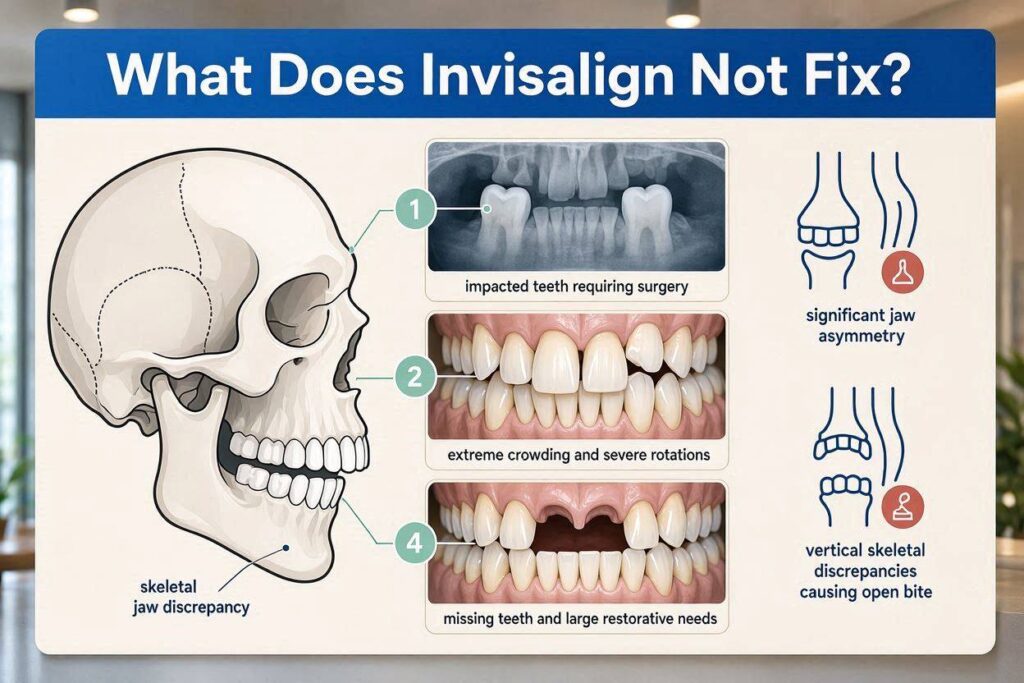
The most fundamental limitation of Invisalign is that it moves teeth, not jawbones. A significant skeletal malocclusion, where the problem is the size, shape, or position of the upper or lower jaw itself, is outside the therapeutic reach of aligners alone. Invisalign can compensate for a mild skeletal discrepancy by tilting the teeth to achieve a functional bite, a process called dental compensation. This has its limits.
A patient with a severe Class II malocclusion, where the lower jaw is significantly retruded relative to the upper jaw, creating a large overjet and a recessive chin profile, cannot have their skeletal problem fixed by Invisalign. The aligners can upright the lower incisors and retract the upper incisors to reduce the overjet by several millimeters, effectively camouflaging the skeletal problem to produce an acceptable aesthetic and functional result. However, the aligners cannot physically advance the mandible. A patient with a severe Class III underbite, where the lower jaw is excessively protrusive, cannot have the mandible shrunk with plastic trays. The only definitive treatment for a severe skeletal discrepancy is combined orthodontic and orthognathic surgical treatment. Invisalign can be used in these surgical cases to align the teeth pre- and post-operatively, but the surgery fixes the jaw position.
Difficult Tooth Movements and Biomechanical Limitations
Within the realm of tooth movement, Invisalign has a well-characterized set of biomechanical inefficiencies. These are the movements that the aligner plastic, pushing on a tooth’s crown, finds most difficult to execute predictably and completely. The smart track material and the precise, digitally planned attachments have improved these movements, but they remain the clinical challenges where braces still outperform aligners.
Extrusion and Intrusion of Specific Teeth
Extrusion is the vertical movement of a tooth out of its socket. Invisalign struggles to grip a tooth and pull it down or outward. A deeply impacted canine that is buried high in the palate or the labial bone cannot simply be pulled down with an aligner. The aligner plastic does not provide a rigid, fixed anchor for the specific, high-force, directional pull that an extrusion movement requires. This is why impacted canines are almost always managed with traditional brackets and a rigid archwire, with a gold chain attached to the tooth that applies a direct, controlled eruptive force.
Intrusion, pushing a tooth deeper into its socket, is also challenging. Posterior open bites, where the front teeth touch but the back teeth do not, are frequently created or incompletely closed by aligner treatment due to the thickness of the plastic between the teeth acting as a posterior bite block and the difficulty of actively intruding posterior teeth. The anterior bite plane effect of the aligner often leads to the opposite of what is desired. Intrusion of a single over-erupted tooth can be assisted with aligners, but a true, deep skeletal open bite requires surgery, not tooth movement alone.
Rotation of Rounded Teeth and Significant Root Movements
The rotational correction of a severely turned tooth, particularly a canine or a lower bicuspid, is a classic Invisalign difficulty. An aligner corrects a rotation by applying a couple of forces to the facial and lingual surfaces of the crown. The appliance needs a firm, flat surface to push against. Canines and premolars have curved, elliptical, or conical crown anatomies that are inherently difficult for a smooth plastic shell to grip. A precisely shaped, rectangular composite attachment bonded to the tooth is essential to create a purchase point for the aligner to engage and turn the tooth. Without optimal attachment design and placement, a severe rotation will not track fully, and the aligner will progressively gap away from the tooth surface.
The concept of bodily movement, where the entire tooth, including the root, translates through the bone, as opposed to simply tipping the crown, is difficult for any removable appliance. Aligners, by their nature, apply force to the crown, creating a tipping moment. The goal of the attachment system and the specific plastic material properties is to control this moment and achieve as close to bodily movement as possible. However, a pure, mathematical translation of a tooth without any tipping is exceedingly difficult. The root will often not follow the crown exactly, and this limits the final root parallelism and the long-term stability of the result.
Non-Orthodontic Dental Conditions
A critical category of “what Invisalign does not fix” is any dental problem that is not a tooth movement problem. Invisalign is an orthodontic appliance. It has no therapeutic effect on caries, the bacterial decay of tooth structure. It does not whiten teeth. It does not replace missing tooth structure from trauma or wear. A tooth with a fractured cusp or a large, active cavity must be restored by a general dentist before, or during, orthodontic treatment.
Invisalign does not treat periodontal disease. The aligners themselves are clean, sterile, and do not cause gum disease. However, a patient with active periodontitis, with deep, bleeding pockets and progressive bone loss, is not a candidate for any orthodontic treatment. The light, controlled orthodontic forces that move teeth through healthy bone can, in the presence of active inflammatory periodontitis, accelerate the destruction of the periodontal ligament and lead to rapid, severe bone loss and tooth mobility. Periodontal disease must be diagnosed, treated, and stabilized before any aligner therapy can begin.
Loss of Vertical Dimension and Posterior Support
A collapsed bite, where the back teeth are so severely worn, broken, or missing that the vertical height of the lower face has decreased, is a complex restorative and prosthetic problem, not a purely orthodontic one. Invisalign can extrude teeth, but it cannot reliably and predictably increase the vertical dimension of occlusion in a way that is stable against the powerful closing muscles of mastication.
Restoring a severely worn, collapsed dentition to a new, therapeutic vertical dimension is a full mouth rehabilitation procedure. It involves building up the worn posterior teeth with crowns or onlays to a new, taller height. Invisalign can be an invaluable adjunct to this process, aligning the teeth so they are positioned ideally for the new restorations. But the aligners themselves cannot create the new vertical space. The new bite height is a restorative and neuromuscular decision, not an orthodontic one.
The Problem of Patient Compliance
Invisalign’s effectiveness is entirely compliance-dependent. Unlike fixed braces, which are cemented to the teeth and work continuously, 24 hours a day, with no behavioral input from the patient, the aligner tray only works when it is in the mouth. A patient who fails to wear the aligners for the prescribed 20 to 22 hours per day is not being treated. The teeth will not move predictably. The subsequent aligners will not fit. The case will fall off the digital plan, requiring a costly and time-consuming mid-course correction or a complete re-start.
This is not a failure of the Invisalign system. It is a failure of the patient to meet the treatment contract. It is a problem the system cannot fix. The dentist can educate, encourage, and monitor with compliance indicators, but ultimately, the patient must physically place the appliance. Invisalign cannot fix a non-compliant patient.
Conclusion
Invisalign cannot fix severe skeletal jaw discrepancies that require orthognathic surgery, nor can it reliably execute difficult biomechanical movements like the extrusion of an impacted canine or the pure bodily translation of a tooth root. It is not a treatment for non-orthodontic dental conditions, including active tooth decay, periodontitis, or a severely worn, collapsed bite that requires a full mouth rehabilitation. Crucially, its success is entirely dependent on the patient’s consistent, daily 22-hour wear, and the system is powerless to correct the course of a non-compliant patient without a costly and time-consuming restart of the digital treatment plan.
Frequently Asked Questions
Q: Can Invisalign fix a severe overbite?
A: It can significantly improve a deep bite by intruding the front teeth and extruding the back teeth. However, a severe skeletal deep bite, where the lower face is short and the chin is bunched, cannot be fully corrected without jaw surgery. The skeletal problem is beyond the reach of any orthodontic appliance alone.
Q: Will Invisalign fix my chipped or worn teeth?
A: No. Invisalign aligns the teeth. It does not restore chipped enamel, replace missing tooth structure from grinding, or change the shape of a tooth. After Invisalign treatment, your dentist will perform the necessary cosmetic bonding, veneers, or crowns to repair the wear.
Q: Can Invisalign close a gap from a missing tooth?
A: Invisalign can close the space left by a missing tooth, moving the adjacent teeth together to close the edentulous gap. Alternatively, it can align the adjacent teeth and maintain the space perfectly for a future dental implant. The choice between space closure and implant replacement is a treatment planning decision.
Additional Resource
For a candid, research-based understanding of the clinical effectiveness and the defined biomechanical limits of clear aligner therapy, the following orthodontic journal provides peer-reviewed evidence.
- American Journal of Orthodontics and Dentofacial Orthopedics: ajodo.org