how to get money for dental work
Facing the prospect of expensive dental work with an empty wallet feels overwhelming. You might feel a sharp pain when you drink cold water or a dull, constant ache that keeps you awake at night. You know you need a dentist. Yet, the fear of the bill overshadows the fear of the drill. You are not alone in this predicament. Millions of adults postpone essential care every single year because they do not know how to get money for dental work. This massive, comprehensive guide exists to solve that precise problem.
This is not a collection of empty platitudes or risky hacks. This is a realistic, ground-level map of every legitimate financial pathway available to you right now. The journey to a healthy smile might require navigating government bureaucracy, researching charitable organizations, negotiating fearlessly with billing departments, or rethinking your approach to insurance altogether. You will find every single one of those routes detailed in the sections below.
We will start with the most urgent, low-cost solutions and move methodically toward long-term financing and systemic support. You will learn exactly where to apply, what to say, which red flags to avoid, and how to piece together a multi-source financial plan that covers the total cost of your treatment. By the end of this guide, you will have a clear, actionable plan. Take a deep breath. Let us fix this, step by logical step.
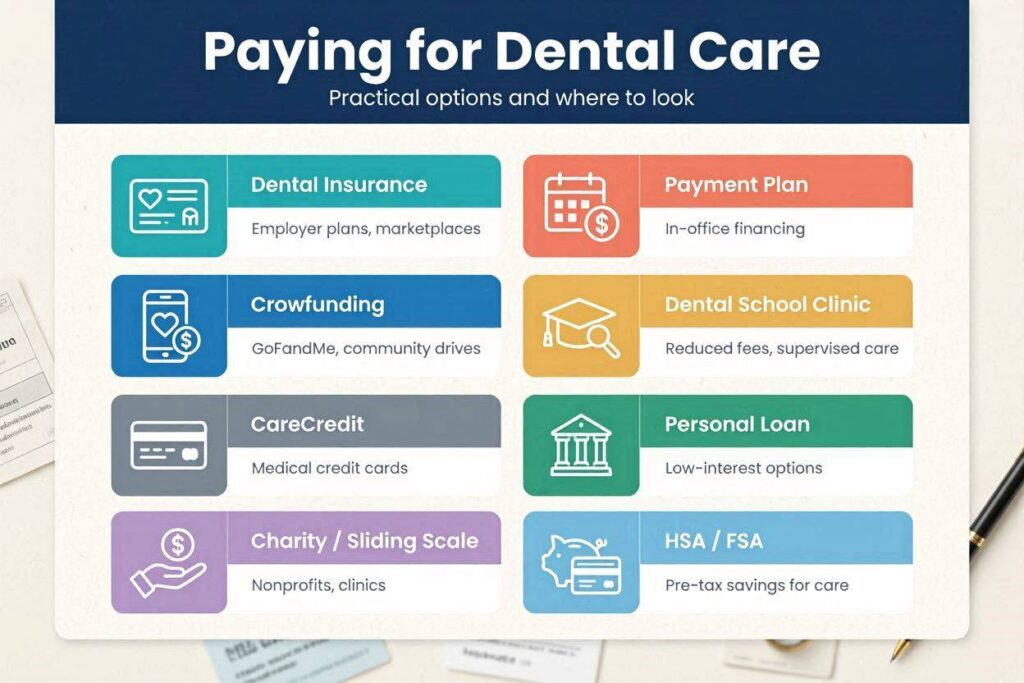
The True Landscape of Dental Financing: Why It Feels Impossible
Before diving into the specific sources of funds, you must understand why paying for dental care feels uniquely difficult. Knowing the structural problem helps you navigate around it more effectively. The oral health system often operates in a strange, isolated silo separate from the rest of medical care. You likely have a medical insurance card in your wallet, but that card probably offers zero coverage for your teeth. This separation creates a financial shock that few people are prepared to handle.
The Great Medical-Dental Divide
Historically, medicine and dentistry developed as completely separate professions. Doctors treated the body. Dentists treated the teeth. This historical quirk became embedded in our insurance infrastructure. Consequently, health insurance policies routinely exclude the mouth. Insurance companies treat dental care as a non-essential, optional add-on rather than a critical component of your overall health. This artificial division ignores the scientific reality that gum disease directly impacts heart health, diabetes management, and pregnancy outcomes.
The consequences of this divide hit your wallet hard:
- You pay separate monthly premiums for dental coverage.
- You navigate a completely different network of approved providers.
- You face an annual maximum cap, a concept almost non-existent in medical insurance.
- Once you hit that cap, often a low limit like $1,500, you pay 100% of the remaining costs.
Understanding this flawed system allows you to stop blaming yourself. You are not bad with money. You are navigating a broken model. This perspective shift is the first step to finding creative, effective ways to secure the money you need.
Why the “Just Get Insurance” Advice Fails
Well-meaning friends often say, “You should just get dental insurance.” This advice often proves useless for someone in immediate pain. Dental insurance is not designed for immediate, expensive needs. Insurance companies build their business models on the concept of risk avoidance. They actively use waiting periods to prevent exactly what you need right now: immediate coverage for expensive procedures.
The standard waiting periods defeat the purpose of immediate care:
- Preventive services: Cleanings and exams often have zero waiting period.
- Basic restorative: Fillings and simple extractions might have a 3 to 6-month wait.
- Major restorative: Crowns, bridges, dentures, and root canals often carry a 12-month waiting period.
- Orthodontics: Braces or aligners might have a 12 to 24-month waiting period.
If you buy a policy today, you still cannot get a crown covered for a full year. Meanwhile, your tooth cannot wait twelve months. The infection will spread. The pain will intensify. You will end up needing an even more expensive procedure like an extraction and implant. Therefore, individual dental insurance is a prevention tool for the future, not a rescue plan for the present moment.
The Critical Triage: Stabilization Before Perfection
When money feels impossibly tight, you must adopt a battlefield mindset: triage. A Marine Corps general once stated, “In a crisis, you do not aim for perfect. You aim for effective.” This philosophy applies directly to your dental situation. You must separate the absolutely necessary treatment to eliminate pain and infection from the ideal treatment plan to restore your perfect smile. The full, ideal treatment plan presented by your dentist might carry a price tag of $8,000, $12,000, or even $30,000. That number sends you into a spiral of hopelessness.
Stop staring at that giant number. Instead, ask your dentist a critical, direct question: “What is the absolute minimum I need right now to stop the active infection and severe pain?” This changes the conversation completely. Perhaps a tooth can be extracted for $200 instead of saved with a $2,500 root canal and crown. Extraction is not the ideal outcome. However, extraction is definitively better than letting a dangerous infection spread into your jawbone and bloodstream. You can always replace that missing tooth with an implant or bridge years later when your financial situation improves. Right now, you need to stop the biological crisis. A trusted dentist will understand and respect this honest conversation about financial reality.
Dental Schools: High-Quality Care at a Fraction of the Cost
One of the most underutilized sources of affordable, high-quality care sits right in your own state’s university system. Dental schools provide a practical solution that drastically reduces the cost of procedures. Many people immediately dismiss this option, picturing a nervous student fumbling around in their mouth. The reality of a modern dental school clinic could not be further from that image. You receive meticulous, heavily supervised care at fees often 50% to 70% lower than a private practice.
The Hidden Gold Standard of Supervised Treatment
When you sit in a dental school chair, you do not just have one student looking at your tooth. You have a licensed, experienced faculty dentist, often a specialist, hovering directly over their shoulder and checking every single movement. A cavity preparation will be inspected before filling. The depth of a root canal will be verified with a radiograph mid-procedure. Every step requires a sign-off. In private practice, your dentist works alone, with no one checking their margins on a crown prep. The intense scrutiny in a school environment creates a system of checks and balances that is rare in standard offices.
Expect a different pace, not a different quality of care:
- Appointments last much longer, often three hours for a single filling.
- A full treatment plan might require several visits to complete.
- The supervising faculty often catches issues a busy private dentist might miss due to time pressure.
- You contribute directly to the education of the next generation of dentists.
The trade-off is your time. You invest hours to save thousands of dollars. If you have flexibility in your schedule or can take a day off work, this trade-off almost always proves worthwhile for major work.
How to Locate and Navigate a Dental School Clinic
Finding a clinic requires a simple but specific search. Do not just type “cheap dentist” into a search engine. Type “accredited dental school clinic near me” or search for the nearest state university with a College of Dentistry. The American Dental Association website provides a comprehensive, searchable list of accredited programs. Once you locate the facility, prepare for an intake process that is more deliberate and thorough than a standard office.
Your first visit will be a screening appointment, not treatment:
- A student dentist will conduct a full-mouth examination, often including a full set of X-rays.
- The supervising faculty will review the findings and assign a treatment complexity level.
- The school must accept your case as an appropriate teaching opportunity for its students.
- Complex medical histories or extremely difficult cases may be assigned to a graduate residency clinic instead.
This screening can feel frustrating if you desperately need a painful tooth fixed today. Call ahead and ask specifically about the emergency protocol. Many schools operate a separate urgent care clinic where students under supervision handle immediate extractions and pain relief. You can get the offending tooth removed on the first visit, then schedule the comprehensive treatment plan for the remaining restorative work later.
Hygiene Programs: The Cheapest Professional Cleaning You Will Ever Find
The high-cost barrier for routine preventive care often causes people to avoid the dentist for years, leading to the very crisis you now face. You must interrupt this cycle. Dental hygiene programs offer the most affordable way to remove the heavy calculus buildup fueling your gum disease.
A hygiene school visit provides remarkable value:
- A cleaning might cost $20 to $50 total.
- The appointment will last three to four hours due to the educational nature.
- A licensed hygienist instructor meticulously checks every tooth surface after the student finishes.
- You will leave with the most thorough cleaning and gum assessment you have ever received.
While you pursue funding for the big procedures, get a cleaning at a hygiene school. Active periodontal infection will destroy the bone around your teeth. Halting that process for less than the price of a dinner out represents a wise, strategic move.
Government-Funded Solutions: Navigating Medicare, Medicaid, and State Programs
Government programs represent a massive, complex, and often intimidating source of potential funding. The rules vary wildly from state to state, and the bureaucratic language can feel designed to confuse you. You must approach these systems with patience, persistence, and a clear understanding of what they actually cover. Do not trust a neighbor’s casual statement that “Medicaid doesn’t cover dental.” The only truth that matters is the one printed in your specific state’s current provider manual.
The Stark Reality of Medicare Dental Coverage
You need to understand a hard truth about original Medicare (Part A and Part B). It does not cover routine dental care. It does not cover cleanings, fillings, extractions, dentures, or root canals. Period. This exclusion shocks many retired individuals facing a dental crisis. You paid into the system for decades, yet your mouth remains excluded from coverage. Medicare Part A might pay for a dental procedure if it constitutes an integral part of a covered inpatient hospital procedure, such as a jaw reconstruction after an accident or an extraction preparatory to radiation treatment for oral cancer. A tooth infection that spread to your bloodstream and requires hospitalization? Medicare covers the hospital stay and the IV antibiotics, but not the extraction of the infected tooth itself.
However, you have a Medicare pathway through Part C (Medicare Advantage):
- Private insurance companies administer these plans, mandated to cover everything Original Medicare covers.
- Many Advantage plans then voluntarily add supplemental dental benefits as a competitive perk.
- Coverage usually includes preventive care (cleanings, exams, X-rays) at 100%.
- Basic services like fillings and extractions might receive a 50% to 80% coinsurance.
- Major services like crowns or dentures might carry a 50% coinsurance with a low annual maximum cap, often $1,000 to $2,000.
Important Note: Investigate your specific Medicare Advantage plan’s dental rider. Call the member services number on the back of the card and ask for the “Evidence of Coverage” document detailing dental benefits. Do not assume anything. Ask specifically about the annual maximum and whether your needed procedure falls under a waiting period.
Medicaid Dental Coverage for Adults: A State-by-State Battlefield
Medicaid provides the most significant government-funded pathway for low-income adults, but it also presents the most frustrating labyrinth of inconsistent rules. The federal government sets broad guidelines, but each state designs its own specific adult dental benefit. A person living in one state might get full dentures covered, while a person with the exact same income and condition living across the state line might get absolutely nothing except emergency extraction for pain relief.
The coverage landscape splits into three broad categories:
- Emergency-Only Coverage: The state pays for palliative treatment (pain relief and extraction) but nothing restorative. This represents the minimum standard.
- Limited Coverage: The state covers preventive, basic restorative, and possibly some periodontal treatment, but caps the total dollar amount per year or excludes major work.
- Comprehensive Coverage: A smaller number of states cover a full range of services, including crowns, root canals, and dentures, subject to prior authorization and medical necessity rules.
Your immediate action step: Find your state’s official Medicaid agency website. Look for the “Dental Provider Manual” or “Member Handbook” for adult dental benefits. Do not call a dental office and ask, “Do you take Medicaid?” Their front desk person might say no simply because the office’s policy changed. First, confirm that your state’s Medicaid program covers the procedure you need. Then, use the agency’s online provider search tool to find a dentist actively enrolled as a Medicaid provider and currently accepting new patients. This sequence saves you countless dead-end phone calls.
CHIP: Comprehensive Dental Care for Children
If the dental crisis concerns your child, the Children’s Health Insurance Program (CHIP) offers the most robust safety net available. Congress recognized that untreated dental disease in children constitutes a national health crisis and mandated that CHIP provide comprehensive dental coverage. This is not optional for states.
CHIP dental coverage must include:
- Preventive services (cleanings, exams, sealants, fluoride).
- Restorative services (fillings, stainless steel crowns).
- Endodontic services (root canals on primary and permanent teeth).
- Periodontal treatment.
- Oral surgery and extractions.
- Orthodontics when medically necessary to correct a handicapping malocclusion.
A child cannot legally be denied medically necessary dental care under CHIP due to cost. If your child’s teeth hurt, check your income eligibility for CHIP on your state’s Medicaid/CHIP website immediately. Eligibility thresholds for children are significantly higher than for adults. A family of four might earn $60,000 per year and still qualify for CHIP dental coverage for the kids, even if the parents receive no benefits.
The Essential Role of Federally Qualified Health Centers (FQHCs)
Federally Qualified Health Centers operate as a cornerstone of the healthcare safety net, and they deserve their own dedicated section in your funding plan. These non-profit, community-based clinics receive federal grants specifically to provide comprehensive primary and preventive care to underserved populations, regardless of ability to pay. An FQHC is not a charity offering free care for everyone. Rather, it operates on a sliding fee discount scale mandated by federal law.
The FQHC sliding fee scale is the most important concept for your wallet:
- The clinic calculates your discount percentage based strictly on your household income and size relative to the federal poverty level.
- You provide proof of income (pay stubs, tax return, unemployment statement).
- The clinic assigns you a nominal fee for each visit, calibrated to your ability to pay.
- No one is turned away due to inability to pay the nominal fee.
Locate your nearest FQHC by using the official federal locator tool on the HRSA website. Call and ask three specific questions:
- “Do you provide dental services on-site, or do you refer out to a private dentist?”
- “Are you currently accepting new dental patients, and what is the approximate wait time for a new patient exam?”
- “What documentation do I need to bring to qualify for the sliding fee discount?”
Wait times can range from a week to several months, depending on your region. Get your name on the waiting list immediately. While you wait, the clinic might offer an emergency walk-in slot for pain relief. Ask about this specifically. You might get the infection addressed today and then schedule the full restorative plan on a discounted basis.
Charitable and Non-Profit Funding Sources: From Nationwide Giants to Local Heroes
When government programs fall short and your wallet is empty, the charitable and non-profit dental sector becomes your most critical lifeline. A vast, loosely organized ecosystem of organizations exists solely to connect people in need with free or heavily subsidized dental care. You simply need to know where to look, how to qualify, and which event cycles to anticipate.
Dentistry from the Heart and Mission of Mercy: The Event Model
These massive, volunteer-driven pop-up clinics provide a powerful, if intermittent, source of completely free care. Organizations like Dentistry from the Heart, Mission of Mercy (MOM), and similar regional groups set up massive temporary clinics in convention centers, high school gymnasiums, or fairgrounds for a weekend. Hundreds of dentists, hygienists, and assistants volunteer their time. They treat as many patients as they physically can over two or three days.
The reality of these events requires strategy:
- The care focuses on the most urgent need: fillings, extractions, and basic cleanings. You will not get a crown, bridge, or implant.
- The event operates on a first-come, first-served basis. People start lining up at 4:00 AM, or even the night before.
- Medical triage dictates treatment priority. A patient with a swollen, infected abscess will likely be treated before a patient needing a small, asymptomatic filling.
- You must prepare for a long day. Bring water, snacks, a folding chair, warm clothing, and any necessary medications.
To find these events, your search strategy must be proactive. Search “[Your State] Mission of Mercy 2024” or “free dental clinic event [Your City].” Check the Facebook pages of your state’s dental association foundation. These events require stamina and flexibility, but they provide immediate, tangible relief from the infection and pain that are ruining your quality of life.
Donated Dental Services (DDS): The Gold Standard for Severe Need
The Dental Lifeline Network operates the Donated Dental Services (DDS) program, and this program represents the highest-quality long-term solution for a specific population. DDS does not run pop-up clinics. Instead, it meticulously matches eligible patients with a local volunteer dentist who provides comprehensive treatment in their own private office, completely free of charge. You receive the same care, in the same comfortable setting, using the same high-quality materials, as a paying patient.
The DDS eligibility criteria are strict and non-negotiable:
- You must be 65 years or older, OR have a permanent disability, OR be medically fragile/severely immunocompromised.
- You must lack sufficient income to afford the needed care. The program uses a specific income threshold that varies slightly by state but generally aligns with 200-250% of the federal poverty level.
- The care must be substantial and complex. This program is not for a single filling. They look for patients needing full-mouth rehabilitation, dentures, or treatment for a condition that severely impacts their health and function.
The application process requires patience. A caseworker will contact you, collect your medical and financial documentation, and then attempt to find a volunteer specialist willing to take on your complex case. Wait times can stretch from months to over a year. However, if you meet the criteria, this program provides tens of thousands of dollars in elite, private-practice care without you paying a single penny. Visit the Dental Lifeline Network website and check your state’s specific eligibility page.
Local Faith-Based and Community Charities
Do not underestimate the direct financial assistance available from local organizations that will never appear in a national dental directory. Small, hyper-local charities, particularly those affiliated with faith communities like Catholic Charities, St. Vincent de Paul, Lutheran Social Services, or a Jewish Family Service agency, often maintain a discretionary “direct assistance” fund. These funds exist precisely for a community member facing a one-time, urgent, verifiable need like a dental extraction to prevent a life-threatening infection.
Your approach to a local charity must be specific and documented:
- Do not walk in and say, “I need money for my teeth.”
- Walk in with a written treatment plan from a dentist on official letterhead, showing the specific procedure code, the exact dollar amount, and a statement indicating the procedure is medically necessary to resolve pain/infection.
- Ask specifically, “Does your organization offer a direct assistance program that could contribute a portion of this bill?”
- Offer to allow them to pay the dentist directly. Do not ask for cash paid to you. Charities feel far more comfortable cutting a check to a vendor (the dentist) for a verified, urgent service.
- Contact the United Way 2-1-1 helpline. Simply dial 2-1-1 from any phone. Tell the operator you are seeking financial assistance from local charities for an urgent, medically necessary dental extraction. They maintain a database of local organizations with grant funds.
This strategy often works best for a single, discrete crisis need. Requesting $200 for an extraction to stop an infection often succeeds. Requesting $5,000 for a full set of implants will almost certainly be denied. Think small, specific, urgent, and payee-to-provider direct.
Low-Interest Programs and Innovative Non-Insurance Models
The traditional model of dental insurance fails so many people because it operates like a coupon book with restrictive caps. You need to pivot your thinking away from “insurance” and toward “dental financing vehicles.” A new breed of financial tools has emerged that behaves far more responsibly and transparently than the predatory credit cards of the past. Understanding these models gives you negotiating power and access to manageable monthly payments.
Dental Savings Plans: The Insurance Alternative You Never Considered
A dental savings plan, also known as a dental discount plan, is not insurance. Think of it as a club membership that instantly unlocks a pre-negotiated discount rate at a network of participating dentists. You pay an annual membership fee, often between $80 and $200 for a family, and you receive a card that entitles you to a specific percentage off every procedure.
The simple mechanics of a savings plan:
- You join the plan online today. Your membership activates within 24 to 72 hours.
- You select a participating dentist from the plan’s network list.
- You present your membership card at the appointment.
- The dentist applies the contracted discounted fee schedule to your treatment.
- You pay the discounted fee directly to the dentist at the time of service.
Comparison: Dental Savings Plan vs. Traditional Insurance
| Feature | Dental Savings Plan | Traditional Dental Insurance |
|---|---|---|
| Annual Cap | No maximum limit. You save on every procedure, all year. | Strict annual maximum, typically $1,000-$2,000. |
| Waiting Period | No waiting period. Use it immediately. | 6-12 month wait for major procedures. |
| Deductible | None. | Typically $50-$100 per person. |
| Pre-existing Conditions | Covered. No exclusions. | Often excluded or subject to waiting periods. |
| Claim Forms | None. You pay the discounted rate directly. | Complex claim submissions and waiting for reimbursement. |
| Cost Basis | Low annual membership fee. | High monthly premiums plus deductibles and copays. |
A plan like this can transform an unaffordable $1,500 crown into a $700 crown, paid directly to the dentist. You still need the $700, but the total cash needed drops dramatically. This tool works brilliantly in conjunction with a community loan or a small charitable grant. When a St. Vincent de Paul chapter offers you a $700 grant, you can actually cover the full procedure.
The Rise of Compassionate Financing Companies
The traditional dental credit card, like CareCredit, presents a dangerous trap for many consumers if not understood perfectly. The core issue is “deferred interest.” The card offers a promotional period, such as “12 months no interest.” However, if you leave even a single dollar of that balance unpaid at the end of the 12-month period, the company retroactively applies the full interest rate, often a staggering 26.99%, back to the very first day of the loan. This surprise can devastate your finances.
However, a new generation of financing companies has emerged with a fundamentally different, patient-friendly model:
- Companies like Walnut, Sunbit, and Alpheon focus on transparent, fixed-term installment loans with simple interest.
- They show you the total cost of the loan upfront, broken into a fixed number of monthly payments.
- You know exactly when the loan will be paid off. There is zero deferred interest trap.
- Approval rates for these platforms are often higher than traditional credit cards, as they use a broader data set for underwriting.
Ask your dentist’s financial coordinator a direct question: “Do you partner with a true simple-interest installment lender, like Sunbit or Walnut, or do you only offer a deferred-interest medical credit card?” A dentist who has partnered with a transparent, fixed-term lender is signaling a commitment to the financial well-being of their patients. A dental office that only pushes a risky deferred-interest card, without warning you of the catastrophic penalty, is an office whose financial practices you should view with caution.
Peer-to-Peer Lending for Dental Crises
You can bypass traditional banks entirely and appeal directly to individual lenders or donors through online platforms. This method requires you to tell your story authentically and vulnerably. You are not asking for a handout based on a credit score; you are asking human beings to invest in your health and dignity.
Two distinct models exist for this peer-to-peer approach:
- Crowdfunding (GoFundMe): This is a donation model. You create a page explaining your dental crisis, with clear photos and specific treatment goals. You share it on social media and with your community. Donors contribute money with no expectation of repayment. The success of this model relies almost entirely on the emotional resonance of your story and the strength of your social network.
- Social Lending (Kiva US): Kiva operates a unique model where lenders crowdfund a 0% interest loan for you. To qualify, you often invite friends and family to make a small, private loan to you first via the platform, demonstrating your creditworthiness to the public. Once you build that “private tier,” the loan opens to the Kiva community. You repay the loan over time, but you pay zero interest. This model allows you to borrow with dignity.
To craft a compelling appeal on these platforms, you must be specific.
Bad appeal: “I need dental work, please help.”
Effective appeal: “I am a single mom working two jobs. I have a severe abscess on tooth #14 that requires extraction and a bone graft to prevent my jawbone from collapsing. The infection is resistant to antibiotics and poses a risk to my overall health. My quote from [Clinic Name] is $850. I have saved $200, and I am seeking $650 to reach my goal and schedule the surgery immediately. Any funds raised above the goal will be donated to [Local Dental Charity] to pay the kindness forward.”
A specific, quantified, vulnerable, and honest appeal moves people to act. Include a photo of the quote. Include a photo of your swollen face. Human beings connect with concrete, specific reality, not vague misery.
Crowdfunding Mastery: The Art and Ethics of the Appeal
Crowdfunding deserves a dedicated deep dive because it represents the most direct, scalable way to raise a significant sum quickly, yet most campaigns fail miserably. People create a page, post it once, and watch in disappointment as a few relatives donate small amounts before the campaign goes silent. A successful dental crowdfunding campaign is not a passive ask. It is an active, strategic, multi-week marketing and storytelling operation.
Building a Campaign That People Trust and Fund
Trust is the absolute currency of crowdfunding. Scammers have poisoned the well, so you must overcorrect with radical transparency. Your campaign page must answer every skeptical question a potential donor might have before they even ask it.
The anatomical checklist of a high-converting campaign page:
- The Title: Contains your name, the specific procedure, and a time sensitivity. Example: “Help Mark Afford Emergency Extraction and Stop a Life-Threatening Infection.”
- The Hero Image: A clear, well-lit photo of you. Not a selfie in your car. A photo where you look directly into the camera. Do not hide. If you are comfortable, include a second photo showing the visible swelling or the dark, decayed tooth. This visual evidence grounds your story in reality.
- The Personal Story: Write in short, clear sentences. Explain how this dental problem impacts your ability to work, sleep, and be present as a parent. Describe the physical pain. Then, describe the exact moment the dentist showed you the treatment plan and the cost. Let the reader feel that sinking feeling.
- The Specific Ask: Upload a clear, unobstructed photo or PDF scan of the dentist’s signed treatment plan. The plan must show the clinic’s name, the date, the procedure codes, and the exact dollar amount. This document serves as the single most powerful trust-builder in your entire campaign.
- The Use of Funds Statement: Break down exactly where every dollar goes. “Total goal: $1,800. $1,500 goes directly to Dr. Smith for the extraction and bone graft. $300 covers GoFundMe transaction fees and taxes on the donation. If I exceed my goal, the excess will go to [Specific Dental Charity] to help someone else in pain.”
- The Updates Plan: Pledge publicly on the page that you will post a photo of yourself in the dental chair on the day of the procedure and a photo of the paid receipt afterward. This commitment proves you are a real person with a real plan.
A campaign built with this level of transparent documentation converts skeptical browsers into donors at a far higher rate than a vague, text-only plea.
The Week-Long Promotion Blitz
The platform algorithm favors campaigns with high early momentum. Most of your donations will come from your own extended social network, not from random strangers. You must systematically, and without shame, promote your campaign.
A realistic promotion schedule looks like this:
- Day 1 (Launch): Post the campaign to your personal Facebook, Instagram, and any neighborhood platforms like Nextdoor. Tag the 10 closest people in your life and ask them directly to donate just $5 or $10 and share the post. The small donations trigger the algorithm.
- Day 3 (Story Update): Do not just repost the link. Go on video. A 60-second video update on your phone, showing your face, describing the pain from the infection flaring up last night, creates an emotional connection no text post can match. Ask for shares, not just donations.
- Day 5 (Outreach to Groups): Identify local Facebook community groups, church groups, or parenting groups. Contact the admin first and ask permission to share your story. When you share, explain your connection to the group. “I’m a member of this congregation, and I’m facing a health crisis…”
- Day 7 (The Urgency Push): Post a photo of the calendar. “My extraction is scheduled for Thursday. I am still $400 short. If I don’t hit the goal, I have to reschedule and risk this infection getting worse. Please consider helping.”
You must treat this week like a part-time job. The energy and persistence you pour into promotion directly correlate to the total dollars raised.
Negotiating Directly: The Phone Call That Saves You Hundreds
The white coat and the sterile office environment create an illusion of fixed, non-negotiable prices. This illusion costs you money. Dental fees are almost always negotiable, but you must approach the conversation with the right strategy and the right person. You do not negotiate with the dentist chairside. You negotiate politely, privately, and professionally with the office manager or financial coordinator.
The Powerful Language of the Cash Patient
Dental offices lose a significant percentage of their collected fee to insurance company processing. The administrative cost of filing claims, chasing denials, posting payments, and waiting months for reimbursement represents a real, calculable drain on the practice’s revenue. You represent a clean, immediate, zero-hassle source of revenue.
When you ask for the cash discount, use this exact script:
“I don’t have dental insurance, so I’m what they call a self-pay patient. I understand your office has to deeply discount fees for the big insurance networks like Delta Dental and Aetna. I’m not asking for charity, but I am asking if you can offer me the same lower reimbursement rate you’ve already agreed to accept from the largest PPO network you participate in, if I pay in full with cash or a debit card today.”
This script frames the request brilliantly. You are not begging for a special favor. You are asking to be treated as well as a large insurance corporation. You highlight the cash payment, eliminating the office’s risk of a bad check or a chargeback. The office manager will often pause, click a few keys, and say, “Yes, I can adjust this to our PPO fee schedule for you.” That single sentence might reduce your total bill by 20% to 40%.
The Art of the Multi-Procedure, Same-Day Proposal
Dentists hate empty chair time more than they hate discounting. An empty chair generates zero revenue and still racks up overhead costs. If you require extensive work on multiple teeth in the same quadrant of your mouth, you present a lucrative, efficient block of production for the dentist.
Use the following logic when speaking with the treatment coordinator:
“I see my treatment plan requires a core buildup, a post, and a crown on tooth #30, and a filling on tooth #31. That’s a significant amount of work, but it’s all in one area, and it can all be done in one long appointment. If I commit to doing all three procedures in a single visit, and I pay in cash, is the doctor willing to discount the total package by 25%?”
You are selling efficiency. You are selling a guaranteed, prepaid block of high-value production. The dentist fills a three-hour slot that might have otherwise gone half-empty. The office takes on zero collection risk. This is a strong business proposition, and many dentists will gladly accept a slightly lower margin in exchange for a guaranteed, efficient, high-value day.
The Material Substitution Question
A significant portion of a crown’s cost is the material and the lab’s fee to fabricate it. A porcelain-fused-to-high-noble-metal crown is far more expensive than a full cast high noble metal crown, which is more expensive than a base metal alloy crown. The dentist recommends the ideal material based on aesthetics and biomechanics. You can ask an honest question about downgrading the material to a functional, durable, but less aesthetically perfect option, particularly on a back molar that no one ever sees.
Phrase it this way:
“Doctor, I understand a porcelain crown is the ideal aesthetic choice. Given my immediate financial reality, is a full metal crown a clinically acceptable alternative for this back tooth that would still last me many years, and could we use that to reduce the lab fee on my bill?”
A full gold crown is often the single best, longest-lasting restoration in dentistry, but the high noble metal cost makes it expensive. A full base metal crown, while not beautiful, is incredibly strong and significantly cheaper. If you are trying to save a second molar from extraction and you have no budget for aesthetics, this honest conversation could reduce the cost of that crown by hundreds of dollars while still providing a restoration that functions for decades.
Understanding Clinical Trials and Research Studies
You can access leading-edge, often completely free, dental treatment by participating in a clinical research study. Universities, teaching hospitals, and private research institutions constantly conduct studies to test new materials, new techniques, and new drugs. These institutions need human subjects, and they pay for the privilege of treating you.
The World of Free Treatment in Exchange for Data
Participating in a study is not a trip to a regular dentist. You are contributing to science. The primary goal of the researchers is to collect data, not necessarily to provide you with a comprehensive, full-mouth treatment plan. However, the specific treatment under investigation is provided at zero cost, and you often receive a stipend for your time and travel.
A dental implant study, for example, often looks like this:
- A major implant manufacturer has developed a new implant surface or thread design.
- The university research clinic needs 50 patients needing a single-tooth implant in the posterior mandible.
- The study covers the full 3D cone beam scan, the surgical placement of the implant, the abutment, and the final crown.
- You receive this entire sequence of care, worth $4,000-$6,000, for free.
- In return, you agree to return for specific follow-up visits at 3 months, 6 months, 1 year, and 2 years, where they take radiographs and measure gum health.
- You might also receive a $200 stipend for completing the follow-up protocol.
Finding and Qualifying for a Study
The primary database for finding these studies is ClinicalTrials.gov, a searchable registry maintained by the U.S. National Library of Medicine. Your search strategy must be precise.
Follow this sequence on ClinicalTrials.gov:
- In the “Condition or disease” field, type the core problem: “dental caries,” “periodontal disease,” “edentulism,” or “tooth loss.”
- In the “Other terms” field, type the intervention you need: “implant,” “dental filling,” “bone graft,” or “denture.”
- Under “Status,” filter for “Recruiting” and “Not yet recruiting” studies. Closed studies are useless to you.
- Scroll down to “Location” and enter your city and state.
When you find a study, read the “Eligibility Criteria” with painstaking detail. Researchers are incredibly strict about these criteria. If the study requires you to have “Class I bone density in the posterior mandible” and your bone is soft from years of denture wear, you will not qualify. Do not take the rejection personally. Call the research coordinator listed on the study page. Ask them directly, “I see study NCT123456. I need an implant and have good general health. Are you still recruiting, and can I schedule a screening appointment?”
The Military and Veteran-Specific Dental Benefits
If you served in the United States armed forces, you have access to a separate, entirely different system of care from the civilian world. Many veterans incorrectly assume the VA will cover all their dental needs simply because they are a veteran. This misunderstanding leads to untreated pain and frustration. The reality is complex, with specific eligibility tiers that determine exactly what the VA will pay for.
VA Dental Care Eligibility: The Tiered System
The Veterans Health Administration classifies veterans into specific classes for dental benefits. Your class determines your access to care. You must find your exact classification.
The VA Dental Classes break down as follows:
- Class I: You have a service-connected, compensable dental disability or condition. The VA provides any needed dental care to maintain or restore your oral health.
- Class II: You are a former prisoner of war. The VA provides any needed dental care.
- Class IIc: You have a service-connected non-compensable dental condition or disability related to combat wounds or service trauma. The VA provides care for the specifically service-connected issue.
- Class IV: You have a service-connected disability rated at 100% total and permanent. You receive comprehensive outpatient dental care.
- Class V: You are enrolled in a VA homeless program or other specific rehabilitative programs for 60 consecutive days.
- Class VI: You are scheduled for a hospital admission, and outpatient dental care is medically necessary to prepare you for that admission.
If you do not fall into one of these classes, the VA will generally not provide you with routine dental care through its clinics. However, do not stop your search here. The VA Dental Insurance Program (VADIP) allows eligible veterans not enrolled in VA health care, and enrolled veterans ineligible for VA dental benefits, to purchase deeply discounted private dental insurance through Delta Dental or MetLife. These VADIP plans often have lower premiums and richer benefits than open-market individual plans. Visit the VA’s VADIP page for the current enrollment periods and rate sheets.
The Value of the Local VSO (Veterans Service Organization)
The American Legion, Disabled American Veterans (DAV), and Veterans of Foreign Wars (VFW) all employ accredited service officers. These trained professionals exist to help veterans navigate the VA’s complex bureaucracy and secure every benefit they are legally entitled to receive. A VSO can review your specific disability rating decisions, your service medical records, and your current dental needs and identify a pathway you might have overlooked. This service is provided at no cost to you. Do not struggle alone with the VA’s phone tree. Find your local VSO and let an expert advocate for you.
Disease-Specific and Research-Driven Financial Aid
Certain systemic medical conditions are so intimately linked to oral health that specific charitable foundations exist solely to provide financial assistance for dental treatment related to that disease. These organizations bridge the gap between medical necessity and insurance exclusion. If you suffer from one of these conditions, you have a specialized funding pathway not available to the general public.
The Oral Cancer Foundation’s Direct Financial Assistance
The treatment for oral, head, and neck cancers involves brutal radiation and surgical protocols that often devastate the mouth. Radiation causes rampant radiation caries (decay) and can lead to osteoradionecrosis, a condition where the jawbone essentially dies and breaks down. Reconstructive surgery and dental rehabilitation are considered an integral part of cancer recovery, yet insurance often balks at the costs, labeling procedures as “dental” and therefore excluded.
The Oral Cancer Foundation maintains a Patient Support Fund that provides small but vital grants to oral cancer patients in active treatment or recovery. A grant might cover the cost of a necessary extraction before radiation begins or a portion of a specialized denture. The application is typically mediated by a social worker. Contact the foundation directly and ask about the current cycle for the Patient Support Fund.
The National Organization for Rare Disorders (NORD)
NORD manages dozens of disease-specific patient assistance programs funded by pharmaceutical and biotechnology companies. If your dental crisis stems directly from a rare genetic condition, such as ectodermal dysplasia (which results in missing teeth), hypophosphatasia (which causes premature tooth loss), or amelogenesis imperfecta (which causes defective enamel that crumbles away), NORD might have an active program to provide financial assistance for dental rehabilitation.
Navigate to the NORD website, look for their “Patient Assistance Programs,” and search for your exact genetic diagnosis. These programs provide grants for specific medically necessary treatments, including dental procedures that directly address the pathology of the rare disease. The paperwork requires a physician’s certification of the diagnosis, but the funding can provide a life-changing, multi-thousand-dollar grant for a full-mouth rehabilitation.
State and Local Cancer Coalitions
In addition to national organizations, many states have local cancer coalitions that maintain emergency funds for patients undergoing active cancer treatment. A social worker at your cancer center can often connect you to a $500 or $1,000 grant designed to solve a specific barrier to treatment, such as a dental infection that must be cleared before a stem cell transplant can proceed. If you are a cancer patient with a dental crisis, do not call the dental society; call your oncologist’s social worker today.
Traveling for Care: The Cross-Border and Cross-County Calculation
Sometimes, the most direct way to afford dental work is to physically move yourself to a location where the cost is a fraction of what it is in your area. This phenomenon, often called dental tourism, requires meticulous planning and a clear understanding of the risk calculus. You must separate the reputable, accredited international clinics from the dangerous, unregulated operators.
The Deep Dive into Dental Tourism: Mexico, Costa Rica, Thailand
The cost differential for major work is astonishing. A full-mouth restoration requiring multiple implants that costs $45,000 in an American city might cost $15,000 in Los Algodones, Mexico, or $12,000 in San José, Costa Rica. These prices include the lab fees, the specialist’s time, and sometimes even a hotel stay. The lower cost structure is real, driven by lower labor costs, lower malpractice insurance premiums, and lower real estate overhead, not necessarily lower quality.
However, you carry the entire burden of quality control on your own shoulders.
- Seek accreditation: Look for clinics accredited by the American Dental Association’s international arm, the Joint Commission International (JCI), or certified by the International Congress of Oral Implantologists (ICOI).
- Demand the specific implant brand: Do not let a clinic place a random “generic” implant. Demand a major, globally reputable brand like Straumann, Nobel Biocare, or Dentsply Sirona. This ensures that if the prosthetic screw loosens or the crown chips five years from now, a dentist in your hometown can actually identify the part and order a replacement.
- Plan your follow-up: Schedule the trip with the explicit understanding that you will be in the clinic for the entire initial treatment sequence. Ask the clinic for a specific, written protocol for what happens if you have a complication after returning home. Do they have a partner dentist in the United States who can handle warranty work? If the answer is vague, factor the cost of a second opinion and potential full re-treatment by a local dentist into your overall risk calculation.
The Regional Rural-Urban Price Differential
You do not need a passport to find significantly lower prices. The United States contains massive internal price variations for dental procedures. A dentist in downtown Manhattan, where commercial rent can exceed $50,000 per month, must charge drastically more than a dentist in a rural community in Arkansas or West Virginia, where the cost of living and practice overhead is a fraction of that amount.
A molar root canal and crown sequence might cost:
- $4,200 in a high-overhead coastal metro area.
- $2,200 in a Midwestern suburban practice.
- $1,600 in a rural small-town practice.
If you are looking at a quote for $4,000 in a major city and you have a cousin in a small town a three-hour drive away, ask that cousin for the name of their local dentist. Call that small-town practice. Describe your needs and ask for a ballpark fee for a self-pay patient. Even factoring in a tank of gas and a night in a budget hotel, the savings can amount to thousands of dollars. The key is to ask the rural dentist about their laboratory. A small-town dentist who uses the same high-end national dental lab as the city dentist will produce a crown of identical quality at a lower price point because the overhead is lower, not the lab standard.
Table: A Spectrum of Immediate Solutions Based on Urgency Level
When pain strikes, you need a clear, prioritized action plan. The following table maps your level of urgency to the most appropriate funding and care solution. Work your way down the table, matching your specific situation to the intervention.
| Urgency Level | Your Situation | Immediate Action | Potential Result | Recommended Resource |
|---|---|---|---|---|
| CRITICAL (Hours) | Facial swelling, fever, difficulty breathing or swallowing. | Go to the emergency room immediately. Do not delay. This is a medical, not a dental, emergency. | Medical stabilization and IV antibiotics. Hospital may have an oral surgeon on call. | Nearest Hospital ER; explain that dental infection is affecting airway. |
| EMERGENT (Today) | Severe, throbbing pain, visible abscess, unable to sleep, but no facial swelling or fever. | Call an FQHC or dental school. Ask for an emergency walk-in extraction appointment. | Extraction of the offending tooth; relief of pain and source of infection. | HRSA Find a Health Center; Local Dental School Urgent Care Clinic. |
| URGENT (This Week) | Broken tooth with sharp edges, lost filling with sensitivity, known large cavity. | Call local charity or church. Request a grant for a specific, documented extraction or temporary filling. | Temporary stabilization, financial assistance check sent to dentist. | United Way 2-1-1; Local St. Vincent de Paul; Dentistry from the Heart event. |
| PLANNED (This Month) | Full-mouth treatment plan, multiple crowns, partial dentures, non-emergent. | Apply for a fixed-rate, simple-interest loan. Get on a dental school comprehensive care waitlist. | Financing approval for full treatment; scheduled for school intake. | Sunbit, Walnut; University Dental School; Donated Dental Services application. |
| LONG-TERM (This Year) | Considering implants, orthodontics, or full-mouth reconstruction. | Research clinical trials. Plan a consultation trip to a vetted, accredited international clinic. | Enrollment in a free implant study; detailed treatment plan and price from a vetted clinic. | ClinicalTrials.gov; JCI-Accredited dental hospitals abroad. |
The Trap of Predatory Lending and How to Identify It
Desperation makes you a target. When you are in pain and staring at a bill you cannot pay, the fine print of a loan document is the last thing you want to read. Predatory lenders know this. They exploit your pain and urgency to lock you into financial products that will cause far more long-term suffering than the toothache itself. You must be able to identify these traps instantly.
The Deferred Interest Time Bomb Explained
The most common trap in dental financing wears the mask of a friendly, zero-percent offer. The medical credit card tells you, “No interest if paid in full within 12 months.” This offer feels like a solution. For a disciplined person who can budget the exact monthly payment and pay off the balance by month 11, it is a useful tool. For a person whose income fluctuates, or who faces an unexpected car repair or medical bill during those 12 months, it is a financial wrecking ball.
Understand the deferred interest mechanism fully:
- The interest clock starts ticking on Day 1, silently, in the background.
- The rate is often 26.99% APR.
- You make your monthly minimum payments.
- On Day 366, if you still owe even $1.00 of the original financed amount, the entire 26.99% interest for the full 12 months is retroactively applied to your balance.
- A $3,000 dental procedure suddenly becomes a $4,000+ debt, and the high interest continues to compound on the new, inflated balance.
If you are considering a deferred interest plan, take a piece of paper and do this brutal math:
- Take the total financed amount. Divide it by the number of months in the promotional period minus two. If the promotion is 12 months, divide the amount by 10.
- That higher number is your actual required monthly payment to build in a safety buffer.
- If you cannot comfortably commit to that higher payment, you cannot afford this loan product. Walk away.
The Hard Credit Check Cycle
Every time a dental office or online lender runs your credit as part of a financing application, a “hard inquiry” appears on your credit report. Multiple hard inquiries in a short period can lower your credit score, making every subsequent loan application harder and more expensive.
Protect your credit score with this strategy:
- Before allowing a dental office to run your credit for their specific in-house card, ask, “Can you give me the underwriting criteria for this card? Do I need a score above 700 to qualify?”
- If your score is 620, and the card requires a 700, save yourself the hard inquiry.
- Ask if the office offers a “soft pull” pre-qualification. A soft pull checks your credit without impacting your score. Many of the newer installment lenders like Sunbit do a soft pull pre-qualification.
A dental office that respects your financial health will guide you toward the appropriate lender for your credit profile. An office that simply runs your application through three different lenders without your informed consent does not deserve your business.
Breaking Down the Specific Procedure: Creative Tactics for Each Treatment
Each major dental procedure carries its own unique financial dynamics. The strategy you deploy to fund a crown differs sharply from the strategy for a denture or an implant. You must tailor your approach based on the specific treatment you need. The following sections provide targeted tactics for the most common and expensive procedures.
The Crown: Fighting the High Fee with a Bridge to the Future
A single crown, needed to save a root-canaled or deeply fractured tooth, routinely costs between $1,000 and $2,500. The fee shocks you, but the tooth needs the coverage now, or it will split and require extraction. The strategy here involves a temporary stabilization and a phased payment plan.
Phase 1: The Survival of the Tooth
Ask your dentist to place a durable, contoured, reinforced temporary crown, and cement it with a strong temporary cement. This is not the flimsy, plastic temporary made in two minutes. You are asking for a lab-quality, long-term temporary. Expect to pay a fee for this, perhaps $200 to $350. This temporary protects the tooth for 6 to 12 months, preventing fracture and maintaining the space.
Phase 2: The Financial Bridge
You now have a 6 to 12-month window where the tooth is stable and pain-free. You can use this time to:
- Enroll in a dental savings plan whose waiting period for a “major” discount might be bypassed by a long-term temporary fee.
- Save aggressively into a dedicated high-yield savings account.
- Wait for your enrollment period in a better employer-sponsored dental plan that covers major restorative work at a higher percentage.
- Apply for a simple-interest installment loan that you can comfortably pay down over 12 months, rather than panicking and signing a deferred-interest contract today.
This “bridge” strategy transforms a panic-driven, one-day decision into a planned, calm, financially sound investment.
The Root Canal: The Specialist vs. General Dentist Equation
Endodontists (root canal specialists) charge more than general dentists. They use expensive surgical microscopes and cone-beam CT scanners, and their overhead is high. However, a general dentist who is skilled and comfortable with molar root canals can often perform the procedure at a significantly lower fee, perhaps 30% to 40% less.
Before you commit to the endodontist, ask your general dentist a direct question: “Doctor, I understand you refer out complex cases, but based on your assessment of my specific tooth’s root anatomy, is this a straightforward root canal that you feel confident performing yourself? If so, what would your fee be compared to the specialist’s quote?”
A general dentist will never accept a case they feel is beyond their ability, as a failed root canal performed by a GP is a legal and ethical liability. If they say the anatomy looks straightforward and they are comfortable, you can save several hundred dollars with no compromise in the quality of care. If they say the canals are calcified, severely curved, or the tooth has an unusual number of roots, pay the specialist’s fee. Do not bargain-shop a complex molar root canal. A poorly done root canal that fails silently and later requires a costly apicoectomy or extraction is far more expensive than paying the specialist’s fee upfront.
Dentures: Navigating the Tiers of Quality and Price
Dentures represent a spectrum of cost and quality, from immediate, economy dentures to high-end, custom-crafted prosthetics. The cheap denture you see advertised for $399 is not equivalent to the $3,000 denture your dentist recommends. The difference lies in the materials, the technique, and the time the dentist and lab invest in fitting and aesthetics.
The “Immediate Denture” Compromise for Front Teeth:
If you need to have your remaining upper front teeth extracted and cannot walk around toothless, the immediate denture is a clinically necessary compromise. You accept the economy-tier denture as a temporary healing appliance. You place it immediately after the extractions. It allows you to heal, smile, and function for the next 12 to 18 months while your gum and bone shrink and reshape. You save money diligently during that healing year. After 18 months, you are ready for the definitive, high-quality, custom-fitted denture, which will fit the healed ridge perfectly and last for years. You effectively amortize the full cost of a high-end denture over two years, using the immediate denture as a functional bridge.
Negotiating the Immediate Denture:
Ask the dentist to quote a package price: “What is the total fee for the extractions AND the immediate denture, including all post-op visits and adjustments?” Do not let them quote the extraction fee and denture fee separately. Negotiate a bundled case fee that represents a discount from the sum of the individual parts.
Dental Implants: A Long-Term, Multi-Phase Investment
The dental implant is the Rolls Royce of tooth replacement, and it carries a price tag to match. The treatment unfolds in phases, often over 8 to 12 months. You can use this timeline to your financial advantage.
Phase the treatment and pay as you go:
- Month 1: Payment for the consultation, 3D scan, and surgical extraction with bone graft.
- Month 4: Payment for the implant placement surgery.
- Month 8: Payment for the abutment and the impression for the crown.
- Month 9: Final payment for the delivery of the implant crown.
This phased approach breaks the $5,000 fee into four or five smaller chunks spread over nearly a year. This is a much more manageable cash flow problem than a single, terrifying lump sum. Additionally, you can source the surgical phase from a dental school oral surgery residency clinic at a dramatically reduced rate, then have your private dentist complete the restorative crown phase. The surgical resident places the implant under expert supervision for a low fee. After the implant integrates with the bone, your private dentist takes an impression and fabricates the crown. This hybrid approach captures the cost savings of the educational setting for the expensive surgical part while maintaining your relationship with your trusted private dentist for the cosmetic, visible restoration.
The Table of Dental Implant Alternatives and Their Relative Cost
When a patient hears “implant” and the associated cost, a look of despair often follows. It is vital to understand that there is a spectrum of replacement options, each with a distinct risk profile and price point. The “best” option is the one that restores your function, preserves your remaining dentition, and fits within a realistic budget you can afford without financial ruin.
| Tooth Replacement Option | Relative Cost (Single Tooth) | Key Advantages | Key Disadvantages & Risks | Long-Term Financial Risk |
|---|---|---|---|---|
| Standard Dental Implant | $3,000 – $6,000+ | Replaces root; preserves bone; does not damage adjacent teeth; functions like a natural tooth. | Highest upfront cost; surgical procedure; requires months of healing. | Low risk if maintained. Most cost-effective over a 20-year horizon. |
| Resin-Bonded Bridge (Maryland) | $800 – $1,500 | Much lower cost than an implant; minimally invasive on adjacent teeth (small wing on the back side). | The wing can debond and need re-cementing; not suitable for heavy bite forces; lifespan of 5-10 years. | Moderate. Replacement will be needed sooner than an implant. |
| Conventional 3-Unit Fixed Bridge | $2,500 – $5,000+ | Fixed in place; feels solid; good aesthetics and function. | Requires shaving down healthy adjacent teeth; if one anchor tooth fails, the entire bridge fails. | High. Risk of catastrophic failure of the anchor teeth, requiring an even more expensive reconstruction. |
| Removable Partial Denture (Flipper) | $300 – $800 | Lowest cost; replaces the visible tooth immediately; can be made quickly. | Uncomfortable; unstable; can trap food; accelerates bone loss in the space; must be removed at night. | Moderate. The accelerated bone loss may make a future implant more complex and expensive. |
Study this table honestly. A $400 flipper is not a solution to a $4,000 problem. It is a temporary measure to maintain the space and appearance while you execute a long-term financial plan for a definitive restoration like an implant or a bridge. Using a flipper for 10 years, ignoring the ongoing bone loss, can make it impossible to place an implant later without a massive, costly bone graft. Sometimes, spending less money today guarantees spending more money tomorrow.
The Financial Coordinator as Your Ally: Mastering the In-Office Conversation
The person behind the desk with the billing software is the single most powerful financial ally you can have inside the dental office. Yet, many patients treat this interaction as an adversarial transaction. You must flip the script. You must build rapport and communicate your situation clearly so the financial coordinator becomes a creative problem-solver on your behalf.
The Script for Radical Honesty
Shame and embarrassment cause patients to lie or deflect. They pretend they are waiting for a check, they promise to call back, and then they ghost the office. This strategy fails miserably. The office can only help you if they understand your actual financial constraints.
Use this script when the treatment plan is presented:
“I am committed to getting healthy and saving this tooth. I am not going to avoid the work. However, I am paying for this entirely out of my own pocket, and the full price of this treatment plan is frankly beyond what I can manage in a single lump sum. Can we sit down and look at the plan together and figure out a payment structure or discount that works for both of us? I want to be a reliable patient, and that means I need to be honest about what I can actually afford each month.”
This script signals that you are not a deadbeat looking to haggle. You are a responsible, self-aware adult seeking a sustainable partnership. The coordinator might reveal options that were never mentioned during the initial presentation, such as a cash discount for treatment paid in full before the appointment, a lesser-known in-house payment plan for established patients, or a phased treatment sequence that spreads the cost over many months.
The Weapon of the Pre-Paid Block of Time
Once you have built rapport, you can deploy a more advanced financial negotiation tactic. You can offer to become the office’s “fill-in” patient for a deeply discounted cash rate. This technique is bold but highly effective.
Present this proposal to the office manager:
“I work a flexible job. I know cancellations happen and the doctor is left with an empty chair, which costs the practice money. I live 10 minutes away. If you have a last-minute cancellation, I can be here in 15 minutes to fill that slot. In return, I’m asking for a 30% discount on the standard fee for any work I can do on those short-notice appointments. I will pay cash before I leave.”
You are proposing a value exchange. You are solving a tangible, painful business problem (lost production from a no-show) in exchange for a reduced rate. The office fills the chair, generates some revenue instead of zero, and you get your treatment completed at a significant discount. This turns a distressed patient into a valued business partner.
Investing in Prevention When You Have Zero Extra Money
This section feels like a cruel joke when you are drowning in the cost of existing disease. However, you must break the cycle. The only permanent exit from the hamster wheel of unaffordable dental work is to stop the disease before it starts. You need a zero-cost and near-zero-cost prevention protocol that halts the new cavities and gum disease that will otherwise bankrupt you in the future.
The Zero-Dollar Oral Hygiene Upgrade
You do not need an expensive electric toothbrush to achieve a dramatic improvement in your home care. You need technique, and technique is free. Most people brush their teeth on autopilot, missing the critical areas where plaque accumulates and causes decay.
The Bass Brushing Technique:
- Angle your soft-bristled brush at a 45-degree angle toward the gumline, where the tooth meets the gum.
- Apply gentle pressure until the bristles slightly splay.
- Make tiny, vibrating, circular motions, no wider than a single tooth. Do not scrub back and forth.
- Count slowly to ten on each tooth, focusing on the cheek side and the tongue side of the back molars, which are the most commonly missed surfaces.
- Dedicate a full two minutes to this process, spending 30 seconds in each quadrant of your mouth.
This technique requires no new purchases. It costs nothing. Yet, consistently applied, it disorganizes the bacterial biofilm at the gumline that causes both decay and periodontal disease more effectively than a quick, hard scrub with an expensive gadget. Master this technique today.
The $3 Miracle of Fluoride Rinse
You buy a generic bottle of 0.05% sodium fluoride mouth rinse. ACT is the brand name, but the generic house brand from a pharmacy or big-box store is chemically identical and costs less. Every night, after you have brushed and flossed, you swish 10 milliliters of this rinse vigorously for one full minute before bed. You then go to sleep without eating or drinking anything. The fluoride sits on your enamel for hours, actively remineralizing microscopic areas of early decay before they become full-blown cavities.
This single habit, costing pennies per day, can drastically reduce your future restorative needs. If you are a parent, do this alongside your children. The most powerful public health measure in dental history is fluoride, and you can purchase a year’s supply for the price of a single fast-food meal.
Strategic Dietary Sacrifice: The Sippy Cup and Grazing Problem
You must make a hard, honest inventory of your sugar intake. The cavity-causing bacteria in your mouth, primarily Streptococcus mutans, feast on fermentable carbohydrates. The total amount of sugar matters less than the frequency of exposure. Your teeth can handle a sugary dessert. They cannot handle a 20-ounce soda sipped slowly over a three-hour work shift. The prolonged sipping bathes the teeth in a constant acid bath, suppressing the saliva’s natural ability to neutralize acid and repair enamel.
The zero-cost dietary intervention:
- Eliminate all sipped sugary beverages between meals. Water and plain black coffee or unsweetened tea are the only allowable between-meal drinks.
- Confine all sugar, including fruit juice and sweetened yogurts, to a designated meal time.
- After eating or drinking anything acidic or sugary, rinse your mouth vigorously with plain water. This simple, free action rapidly restores a neutral oral pH.
Breaking the constant snacking and sipping cycle costs you nothing. In fact, it saves you the money you would have spent on those sodas and snacks. This single behavioral change can be the difference between no new cavities and three new cavities at your next checkup.
The Emotional Weight: Navigating Shame and Finding Agency
We must address the crippling shame that accompanies this financial and health struggle. The shame is often a bigger obstacle than the money. You stop smiling in photos. You cover your mouth when you laugh. You avoid dating or job interviews. The emotional toll of a damaged smile corrodes your self-worth. You must separate your dental condition from your identity.
The Dentist is Not Judging You
A profound fear of being lectured or judged keeps patients away from the chair. You imagine the dentist looking in your mouth and seeing a moral failure. This is a projection of your own shame. A professional, empathetic dentist sees a complex biological problem to be solved. They have treated far more advanced, neglected, and medically complex mouths than yours. Walk into the office and disarm the situation immediately with honesty: “I know I have a lot of work that needs to be done. I’m embarrassed I let it get to this point, and I was scared to come in because I was afraid of being judged for it.”
A good dentist will immediately reassure you. They hear this every single day. Their job is to restore your health, not to deliver a moral sermon. If a dentist ever shames you, you stand up, pay for the exam, and walk out. That dentist does not deserve the privilege of treating you. The shame belongs to them, not you.
The Antidote is Action
The helpless, nauseating feeling in your stomach only dissipates when you take a concrete action. Reading this guide is the first action. Your next action might be small: calling the number on the back of your Medicaid card, searching for a dental school clinic online, or texting a close friend to ask if you can talk. Each small action, however insignificant it seems, reasserts your agency. You are no longer a passive victim of dental pain and systemic failure. You are an active, strategic problem-solver. You are researching, calling, applying, and negotiating. This shift in identity, from victim to agent, is the most valuable outcome of this entire process. The money you find is essential, but the restored sense of control over your own life is priceless.
Additional Resource
- Direct Link: National Association of Free & Charitable Clinics – Find a Clinic
- Description: This comprehensive, searchable database helps you locate free and charitable health clinics, including dental providers, across the United States. Enter your zip code to connect directly with safety-net clinics offering sliding-scale and free care based on your specific location and situation.
Frequently Asked Questions (FAQ)
Can I go to the ER for a severe toothache?
A hospital emergency room can provide pain relief and antibiotics if you have a life-threatening swelling or fever. They generally cannot provide definitive dental treatment like an extraction or a filling. They will treat the medical emergency and refer you to a dentist. Use the ER for swelling that impacts breathing or swallowing, not for routine, severe tooth pain.
Does CareCredit check your credit?
Yes, CareCredit requires a hard credit check that affects your credit score. Understand the deferred interest terms fully before signing. If you cannot pay off the entire balance within the promotional period, you will be charged all the retroactive interest from the original purchase date.
How can I get free dental implants?
Truly free dental implants are rare but possible. The most viable pathways are enrolling in a dental implant clinical trial at a university research center or qualifying for the Donated Dental Services program if you are elderly or disabled. Charitable events generally provide extractions and fillings, not implants.
What if I am turned down for Medicaid dental coverage?
If your state Medicaid program denies a claim or excludes the needed procedure, you can appeal the decision. Contact a legal aid society that specializes in health law. For children, an Early and Periodic Screening, Diagnostic and Treatment (EPSDT) mandate requires states to provide any medically necessary dental service, which can override a state’s restrictive adult-focused policy for individuals under 21.
How do dental savings plans really work?
You pay an annual fee to access a network of dentists who have agreed to a discounted fee schedule. You present the card and pay the reduced rate directly. There are no annual limits, no deductibles, and no waiting periods. It is a discount membership, not an insurance policy.
Can I negotiate the cost of a root canal?
Yes, the fee is often negotiable, especially for cash payment. Ask the dentist for a cash discount or a payment plan. Compare the fee between a general dentist and an endodontic specialist, and ask your general dentist if they are comfortable performing the procedure on your specific tooth.
Conclusion
Finding money for dental work demands a strategic, multi-pronged approach rather than a single magic solution. You can navigate this crisis by triaging urgent needs, exploring dental schools, applying for government and charitable programs, and negotiating fearlessly with providers. The path forward requires specific knowledge, honest communication, and a shift from passive worry to active, informed problem-solving.
Disclaimer: This article provides general information and strategies for securing financial assistance for dental work and does not constitute professional medical, financial, or legal advice. Dental and financial regulations vary significantly by state, and individual circumstances differ. Always consult directly with a licensed dental professional regarding your health and a qualified financial advisor before entering into any financing agreement. This information does not disseminate falsified, leaked, or unrealistic claims; it is based on transparent, realistic frameworks designed to guide your independent research. The mention of specific companies or products does not constitute an endorsement, and you should conduct thorough due diligence before proceeding with any treatment or loan.