Can My Dental Implants Be Too White?
A dental implant is a marvel of modern dentistry, restoring not just the function of a lost tooth but also its appearance. When you invest in an implant, you naturally want it to look beautiful. For many patients, this translates into a desire for a brilliantly white, dazzling tooth. But a question that ethical cosmetic dentists hear frequently is a surprising one: “Can my dental implants be too white?” The short, direct answer is yes, absolutely. An implant crown that is too white can look profoundly unnatural, drawing attention to itself for all the wrong reasons and creating a cosmetic result that is more of a glaring beacon than a seamless restoration. This guide explores the art and science of implant color matching, explaining why extreme whiteness is a cosmetic risk, how the right shade is chosen, and the unalterable reality that makes implant color a permanent decision.
The Fundamental Problem: Implant Crowns Cannot Be Whitened
The most critical piece of information you must understand before choosing a shade for your implant crown is its permanence. A dental implant crown is made from a color-stable material, either high-strength porcelain or solid zirconia. Unlike your natural teeth, which are porous and respond to chemical whitening agents like hydrogen peroxide, an implant crown is inert. It is impervious to whitening gels.
This biological and chemical reality has a profound consequence. If you have your implant crown made to match your surrounding teeth at their current shade, and then you later decide to whiten your natural teeth, your implant crown will be left behind. It will remain at its original, darker shade while the teeth around it become lighter and brighter. The implant will instantly become the most visible tooth in your smile, not because it is beautiful, but because it is the only one that did not change. This is a one-way street. You can always whiten your natural teeth first and then match the implant to the new, lighter shade. But you can never whiten an implant crown after it is made. The only way to change the color of an implant crown is to physically have a new one fabricated, at a significant cost. This permanent nature of the implant’s color is the single most important concept governing the shade selection process.
The Physics of Color in Dental Ceramics
To understand why an overly white implant looks fake, you must understand a little about how dental ceramics create color. A natural tooth is a complex, living structure of dentin covered by translucent enamel. Light passes through the enamel, hits the dentin, and reflects back out, creating a sense of depth, vitality, and a spectrum of shades within a single tooth. It is not a single flat color.
High-value, extremely white dental ceramics achieve their brightness by being highly opaque. They are dense with white pigments like titanium dioxide, which block light from penetrating the material. The result is a tooth that is visually flat, bright like a piece of chalk or a white plastic object. It lacks the translucency and the subtle variations in shade that make a tooth look alive. A natural tooth with a shade of A1 (a very common light natural shade) will still have a slight hint of chroma, a faint yellow or grey undertone, and a translucent incisal edge. A “Hollywood white” OM1 or OM2 shade crown is fundamentally achromatic; it has had the color stripped out. In a mouth of natural teeth, this achromatic block stands out because it reflects light completely differently. The eye perceives it not as a tooth, but as a foreign object that happens to be tooth-shaped.
The Role of Your Natural Teeth: The Anchor of Reality
Your implant does not exist in isolation. It lives in a neighborhood of natural teeth, and its job is to blend in. The surrounding dentition is the anchor that defines what “white” means for you. A shade that looks perfectly natural on a 25-year-old with a full mouth of bleached teeth will look comically out of place on a 60-year-old with unrestored, naturally aged dentition.
The dentin inside your natural teeth yellows over time. The enamel thins and becomes more translucent, revealing the darker dentin beneath. A realistic implant shade must respect this chronological age. Matching an implant perfectly to an adjacent tooth that has a slightly yellow A2 or A3 shade will create a restoration that disappears. Insisting on a shade that is five or six steps lighter than the adjacent natural tooth will create a single “chicklet” tooth that screams “fake.” The true art of cosmetic implant dentistry is not in creating the whitest tooth possible, but in creating a tooth that is indistinguishable from its natural neighbor, whatever shade that neighbor may be. This often requires the cosmetic dentist to be a diplomat, educating the patient that a shade that harmonizes with their face, age, and surrounding teeth is more beautiful than an isolated, disconnected white object.
The Single Central Incisor Dilemma: The Hardest Match in Dentistry
The most unforgiving cosmetic challenge in implant dentistry is the replacement of a single upper central incisor. These are the two front teeth, the centerpiece of the smile. They are seen by every person you speak to. Matching a single central incisor implant crown to a natural, unrestored adjacent central incisor is arguably the most difficult aesthetic task in all of restorative dentistry. No laboratory ceramist gets this perfect on the first try every time.
In this scenario, a “too white” implant is a devastating error. There is no place to hide. The natural central incisor has a unique morphology, surface texture, and a complex internal play of light and color. The implant crown must replicate all of this. If the implant crown is made even two shades too light, the asymmetry of color will be instantly noticeable. The eye is drawn to the brighter of two identical front teeth. This is why, for a single central incisor case, the cementation appointment should never be rushed. The dentist should place the crown on the implant temporarily with a try-in paste that allows you to see it in natural light, take photographs with a high-end flash, and critically evaluate it next to the natural tooth. You, the patient, must approve it. Only then should it be permanently screwed or cemented into place.
“For a single central incisor case, I tell my patients that we are aiming for perfection, but we are human and so is the ceramist. The goal is for the implant crown to match the natural tooth so closely that a stranger cannot tell which is which. I never let a patient choose a shade that is whiter than their natural tooth for this situation, because it simply will not match. If they want a whiter smile, we bleach the natural teeth first, and then we match the implant.” — A Prosthodontist Specializing in Aesthetic Implantology
The Smile Zone: When White is Socially Acceptable
The shade that is “too white” for a single front tooth can be perfectly appropriate for a full-arch restoration. This is the concept of the smile zone. If you are replacing all of your teeth on six or eight dental implants with a fixed, full-arch zirconia prosthesis (often called All-on-X), you have complete chromatic freedom. There are no natural teeth to serve as a comparison point within your mouth.
In a full-arch case, the shade choice is about matching your face, your skin tone, your age, and your personal aesthetic goals. A brilliant white smile, like a B1 or a bleach shade, can look harmonious on a person who otherwise presents as youthful and meticulously styled. The key is that the white color is uniform across the entire arch. There is no single tooth that stands out from its neighbors. However, even in full-arch cases, there is a limit. A shade of white that is so bright it reflects more light than the whites of the patient’s eyes creates an unsettling, unnatural dominance. The teeth become the only thing you see in a person’s face, overpowering their eyes. A master ceramist on a full-arch case will often build in subtle color variations—slightly more chroma at the gum line, a more translucent incisal edge, a faint amount of surface texture—to give even a very white set of teeth a lifelike character.
The table below summarizes the safe shade zones for different clinical scenarios.
| Clinical Scenario | Risk of Looking “Too White” | Recommended Strategy |
|---|---|---|
| Single Implant Among Natural Teeth | Extremely High | Match the adjacent natural tooth exactly; whiten natural teeth before final shade match if a lighter overall smile is desired |
| Implant-Supported Bridge (3-4 units) | High | Blend the shade with the adjacent natural teeth, which serve as the anchor shades |
| Full-Arch Fixed Prosthesis (All-on-X) | Low (within reason) | Choose a shade based on facial harmony, skin tone, and age; avoid white that is brighter than the whites of the eyes |
| Implant-Retained Overdenture | Moderate | The denture teeth can be any shade, but must harmonize with the patient’s age and face |
The Shade-Matching Appointment: A Step-by-Step Guide
The process of picking a shade for your implant crown should be a deliberate, thoughtful event. It should never happen at the same appointment as the tooth preparation, when the dentist is rushed. The best conditions for shade matching are strict.
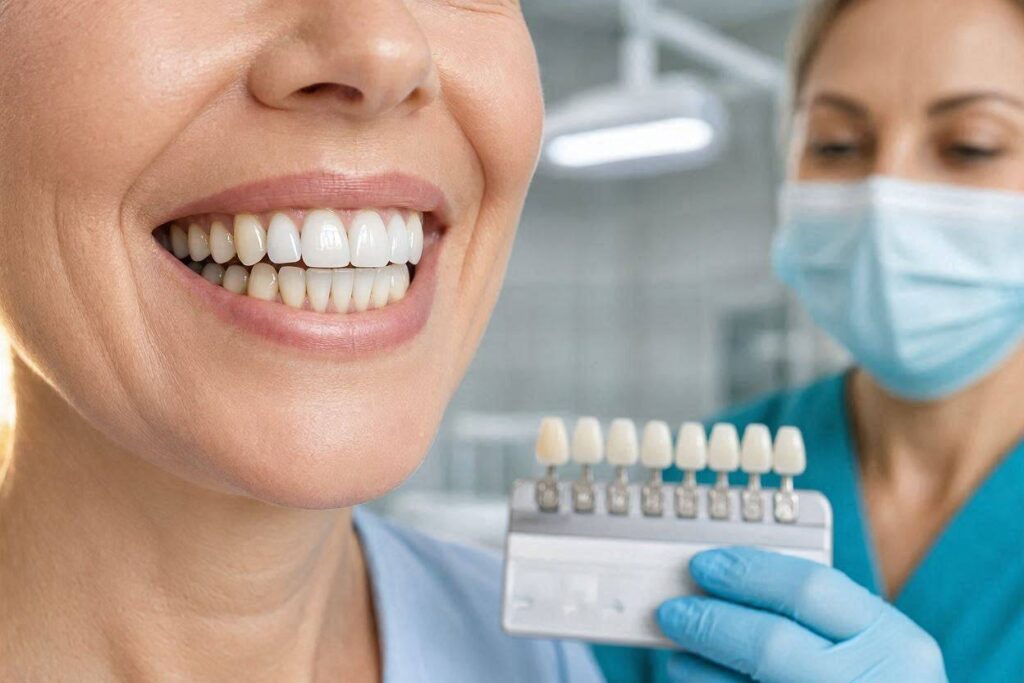
First, the lighting must be correct. Color-corrected, 5000-Kelvin daylight bulbs are the dental industry standard. Standard overhead fluorescent lights have a green or yellow cast that distorts color perception. Second, your teeth must be hydrated. A dry tooth is lighter and chalkier than a hydrated one. Third, you should remove any bright lipstick or distracting clothing. Fourth, the dentist or ceramist should take digital photographs with a calibrated camera and a shade tab held directly next to your tooth. A shade tab is a physical sample of a ceramic color. The most common shade guide is the VITA Classical or VITA 3D-Master system. The 3D-Master system is more precise, organizing shades by value (lightness), chroma (intensity of color), and hue (reddish or yellowish). This digital photograph, viewed on a calibrated monitor, is the data sent to the lab, along with a detailed prescription. A skilled laboratory ceramist will use not just one shade tab, but a map of your tooth, noting that the body of the tooth is an A2, the neck near the gum is an A3, and the incisal edge has a translucent blue-grey effect. This level of detail is what produces a match that vanishes into your smile.
Important Note: If you are even considering whitening your natural teeth in the future, you must do it before the shade-matching appointment. Bleach your teeth to your desired level of whiteness, then wait a period of two weeks for the shade to stabilize, as freshly bleached teeth can slightly relapse in color as they rehydrate. Only then should the final shade be taken for the implant crown. This sequence is non-negotiable for a predictable result.
The “Denture White” Trap and How to Avoid It
A specific aesthetic pitfall is known as “denture white.” This is the flat, unnaturally white, perfectly uniform shade that is commonly seen on economy-grade dentures. It is the color of a whiteboard marker or a plastic spoon. This shade is a cultural signal of a false tooth. It is the exact opposite of what a premium implant crown should look like.
This shade typically results from the use of a low-grade, fully synthetic, monolithic acrylic or composite material without any layered ceramic artistry. To avoid the denture white trap, you should explicitly discuss with your dentist the material from which your crown will be made. A custom-layered porcelain or a multi-layered, pre-shaded zirconia with a built-in incisal translucency will never look like denture white. These materials have a natural depth that a simple, monolithic white block of polymethyl methacrylate (PMMA) lacks. Ask your dentist, “Will my implant crown have a translucent incisal edge?” If the answer is yes, you are on the path to a natural-looking result. If the proposed crown is a solid, one-piece, full-contour zirconia with no layered porcelain, ask to see a sample of the exact material in the shade being proposed, because some full-contour zirconias can look beautifully natural in the hands of a good lab, while others can look flat and opaque.
Conclusion
Yes, a dental implant crown can absolutely be too white, and an unnatural, overly bright shade can brand the restoration as an obvious fake tooth. Because an implant crown cannot be chemically whitened after fabrication, the color you choose is permanent, making it essential to bleach your natural teeth to your desired shade before matching an implant. The most successful cosmetic outcome is not the whitest tooth, but the one that flawlessly mimics the translucency, value, and chroma of its neighbors, achieving a harmony that blends the restoration invisibly into your smile.
Frequently Asked Questions (FAQ)
Q: Can a dental implant be whitened with bleaching gel?
A: No. The materials used for implant crowns, porcelain and zirconia, are non-porous ceramics that are chemically unaffected by hydrogen peroxide or carbamide peroxide whitening gels. The crown will remain its original color.
Q: I want a very white smile. What should I do before getting an implant?
A: You must undergo a full course of professional teeth whitening (either in-office, take-home, or both) and wait two weeks for your natural teeth to reach a stable, final shade. Only then should your dentist take the shade for the implant crown.
Q: What is the most natural-looking shade for a dental implant?
A: The most natural shade is the one that precisely matches the adjacent natural tooth. For a full-arch restoration, a shade like VITA A1 or B1 is a light, natural white that is not unnaturally achromatic. The naturalness comes from the translucency and subtle color variation within the ceramic, not just the base shade.
Q: If I am replacing all my teeth, can I choose any shade of white I want?
A: Technically yes, but a good cosmetic dentist will guide you toward a shade that harmonizes with your skin tone, age, and the whites of your eyes. A shade that is too white will overpower your face and look like a costume, not a restoration.
Additional Resource:
To better understand the VITA shade guide system used by dentists and ceramists worldwide, you can explore the official VITA Zahnfabrik website, which includes detailed color science resources: VITA Shade Guides.