All On 4 Dental Implants Vs Snap In Dentures
Losing your teeth affects more than just your smile. It changes the way you eat, speak, and feel about yourself. You might feel embarrassed to laugh out loud. You might avoid crunchy foods like apples or nuts. You might even notice your face looking a little different because your jawbone is changing.
If you are reading this, you are probably looking for a solution. Two names come up again and again: All-on-4 dental implants and snap-in dentures.
These are two very different paths. Both can give you back a full smile. But they work differently. They feel different. They also cost different amounts.
Many people get confused by the technical terms. Some clinics push one option because it is easier for them to do. You need clear, honest information to make the right call for your body and your wallet.
This guide breaks down everything. We will look at how each system works. We will compare the pain, the price, the upkeep, and what it actually feels like to live with them.
Understanding the Basics of Tooth Replacement
Before we compare, let us understand what each option really is. Think of this like comparing a motorcycle to a family car. Both get you places. But the experience is completely different.
What Are Snap-In Dentures?
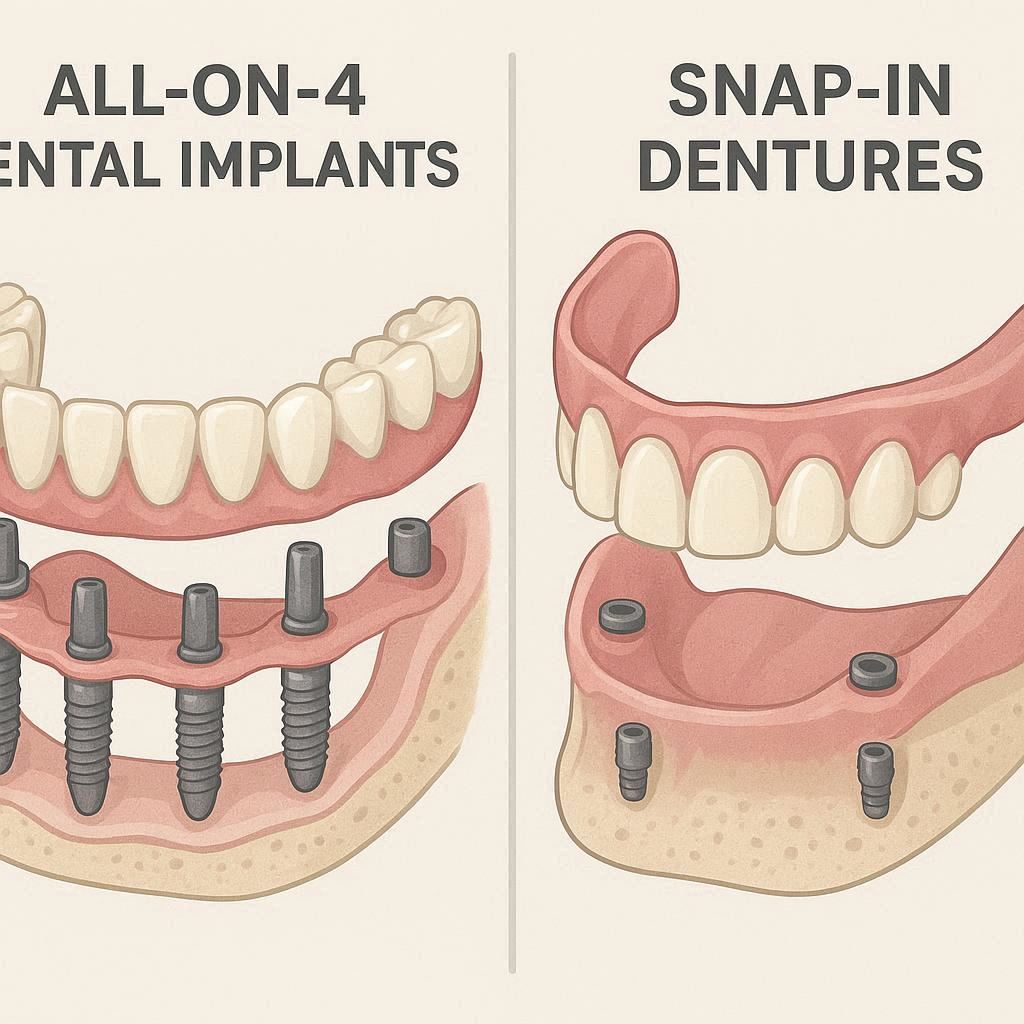
Snap-in dentures are a type of removable denture. They are also called overdentures. Traditional dentures just float on your gums. They use glue or suction to stay in place. Snap-in dentures are smarter.
Imagine a button on a shirt. Now imagine that button snapping into place. That is the idea here.
A dentist places two to four small implants into your jawbone. These implants act like anchors. Your denture has special attachments on the bottom. When you put the denture in, it snaps onto those anchors. It clicks into place.
You can remove them at night. You can take them out to clean them. During the day, they stay put much better than regular dentures. They do not slide around when you talk. You do not have to use sticky pastes or powders.
But they are still removable. They still sit on top of your gums. They do not fuse fully to your bone. Think of them as a secure hat. It will not blow off in the wind. But you can take it off whenever you want.
What Is the All-on-4 Procedure?
All-on-4 is a different beast. This is a fixed solution. It is permanent. You cannot take it out of your mouth.
The name tells you exactly what it is. “All” refers to all of your teeth. “On 4” means on four implants. In one arch (upper or lower jaw), your dentist places four titanium posts into your bone.
Here is the clever part. The two back implants are placed at an angle. They are not straight up and down. They go in at a 45-degree angle. Why? Because the bone in the back of your jaw is often thinner. Angling the implant lets the dentist use the stronger bone that is farther forward. This means many people do not need bone grafting.
After the implants are placed, a fixed bridge is screwed onto them. You get a full set of new teeth. They look and feel much more like natural teeth. They do not move. They do not come out. Only your dentist can remove them.
The Evolution of Modern Dentistry
We have come a long way from grandpa’s glass of teeth in a cup. For decades, the only cheap option was traditional dentures. They worked, sort of. But people hated the clicking sounds, the sore spots, and the fear of them flying out when they sneezed.
Implants changed everything. Doctors realized that titanium fuses to bone. That process is called osseointegration. It is a fancy word that just means “bone growing onto metal.”
Once we knew that, we started looking for ways to anchor teeth to bone. Snap-in dentures came first. Then, doctors like Paulo Malo developed the All-on-4 concept. He realized you did not need an implant for every single tooth. You just needed a solid foundation for a bridge.
Today, both options are mainstream. Both are considered standard care. Neither is experimental. The choice comes down to your health, your budget, and your lifestyle.
| Feature | All-On-4 Implants | Snap-In Dentures |
|---|---|---|
| Attachment | Fixed permanently | Removable by user |
| Number of Implants | 4 per arch | 2 to 4 per arch |
| Removable | No (only dentist can remove) | Yes (daily removal) |
| Bone Grafting | Rarely needed | Sometimes needed |
| Feeling | Like natural teeth | More secure than dentures |
A Head-to-Head Comparison: 7 Key Factors
Let us put these two solutions in the ring together. We will look at seven things that matter most to real people.
1. Comfort and Feel
Snap-in dentures are much more comfortable than old-school dentures. No question about it. You will not feel them floating. They will not rub raw spots on your gums as easily.
However, they still have a denture base. That base covers your palate (the roof of your mouth) on the top arch. It covers your lower gums. You will feel a piece of acrylic plastic in your mouth. Some people get used to this quickly. Others hate the feeling.
All-on-4 feels like having your own teeth. Because the bridge is screwed into implants, there is no plastic covering the roof of your mouth. Your tongue touches your natural tissue. You can taste food fully. You can feel temperature changes.
Many patients describe All-on-4 as “invisible.” They forget they have implants at all. You cannot tell where the bridge ends and your gums begin.
Reader Note: If you hate the feeling of bulky things in your mouth, All-on-4 is usually the winner here. But if you have worn dentures for years, snap-ins will feel like a massive upgrade anyway.
2. Eating and Chewing Power
This is where the big difference shows up.
With snap-in dentures, you will have about 20% to 30% of your natural chewing power. Why? Because the force goes into your gums, not your bone. The implants hold the denture down, but you still bite against soft tissue.
You can eat most foods. But hard things like nuts, raw carrots, or crusty bread might be tricky. You will learn to chew differently. You will use both sides of your mouth at the same time to keep the denture from tipping.
All-on-4 gives you back 80% to 90% of natural chewing power. The implants are fused to your bone. When you bite down, the force goes directly into your jaw. That is exactly how natural teeth work.
You can bite into an apple. You can eat steak. You can chew gum. There are no food restrictions. Patients cry during their first meal after getting All-on-4. Not from pain. From joy. Eating becomes fun again.
3. Stability and Movement
A snap-in denture does not wobble like a regular denture. That is true. When it is snapped in, it feels firm. You can speak clearly. You can smile without fear.
But it is not rock solid. There is a tiny amount of movement. If you push it with your tongue, you can feel it shift a millimeter. Over time, the attachments wear down. After a few years, the denture might click slightly when you chew.
All-on-4 does not move. Ever. It is rigid. It is part of your body’s structure. If you try to wiggle it with your tongue, nothing happens. It is as solid as a natural tooth.
4. Bone Health and Preservation
Your jawbone needs stimulation to stay strong. Natural teeth provide that stimulation when you chew.
When you lose teeth, that stimulation stops. Your body says, “I do not need this bone anymore.” It starts to dissolve the bone. This is called resorption. It is why people with regular dentures look older over time. Their jaw shrinks.
Snap-in dentures help a little. The implants do stimulate the bone right around them. But the rest of the jaw under the denture base keeps shrinking. Over 10 or 15 years, your face can still change shape. The denture may start to fit poorly because the bone underneath changes.
All-on-4 stimulates almost your entire jaw. The bridge spreads the force of chewing across all four implants. This keeps the bone dense and healthy. Your face keeps its shape. You look younger for longer.
5. Speech and Pronunciation
New denture wearers often struggle with the letter “S.” They sound like they have a lisp. This happens because the plastic palate changes the way air moves in your mouth.
Snap-in dentures have that same plastic palate. But because they fit better than regular dentures, most people adapt within a few weeks. You will sound normal. But you will know the plastic is there.
All-on-4 has no plastic palate. Your tongue moves naturally. There is zero adjustment period for speech. You talk normally the same day the bridge is placed.
Helpful List: Words That Feel Different with Dentures
- Sixty-six (the “S” sound)
- Chester (the “Ch” and “S” combo)
- Fresh fish (fricative sounds)
Snap-ins will feel weird for these words for about two weeks. All-on-4 feels normal immediately.
6. Maintenance and Cleaning
Are you ready for the honest truth? Both options require work. Nothing replaces the ease of natural teeth. But here is the reality.
With snap-in dentures, you must take them out every night. You brush the denture over a sink filled with water (so it does not break if you drop it). You brush your gums and the implant anchors. You soak the denture overnight in a cleaning solution. In the morning, you snap it back in.
It takes about three to five minutes per day. Many people do not mind this. It becomes a habit like brushing your hair.
With All-on-4, you cannot take them out. You have to clean around the bridge. There is a small gap between the bridge and your gums. Food can get stuck there. You will need special tools.
You will use:
- A water flosser (like Waterpik)
- Super floss (floss with a stiff end)
- Small interdental brushes
You must clean under the bridge every single day. If you do not, you risk infection and bone loss. It is not hard, but it is different. You cannot just brush like normal.
Think of it like this. Snap-ins are like wearing contacts. You take them out and clean them. All-on-4 is like having a tattoo. You have to care for it every day, but you never take it off.
| Maintenance Task | All-On-4 | Snap-In Dentures |
|---|---|---|
| Daily removal | No | Yes |
| Water flosser needed | Yes | Optional |
| Overnight soaking | No | Yes |
| Professional cleaning | Every 6 months | Every 6 months |
| Clip replacement | Not needed | Every 1-3 years |
7. Longevity and Repairs
Things break. That is life. What happens when something goes wrong?
With snap-in dentures, repairs are easy. If you crack the denture base, a dental lab can fix it in a day or two. If the clips wear out, your dentist snaps new ones on. It costs a few hundred dollars. You are never without your teeth for long because you can still wear the denture (it just snaps less tightly).
With All-on-4, repairs are a big deal. If you crack the bridge, you cannot just glue it. The bridge is one solid piece of acrylic over a titanium bar. A repair means sending the whole thing to a lab. You might be without teeth for a week. You will wear a temporary denture during that time.
Also, you cannot break the implants themselves. But if an implant fails (which is rare, about 2-5% of cases), the whole bridge might need to be remade. This is expensive and time-consuming.
The Financial Breakdown
Let us talk money. This is the part that makes most people nervous. Prices vary wildly depending on where you live and who you see. But we can give you realistic ranges.
Upfront Costs
Snap-in dentures are significantly cheaper. For one arch (upper or lower), expect to pay:
- Two implants: 3,000to6,000
- Four implants: 6,000to10,000
- This includes the implants, the attachments, and the denture itself.
All-on-4 costs much more. For one arch:
- Standard materials (acrylic teeth): 15,000to25,000
- Premium materials (zirconia): 25,000to40,000 or more
- This includes the four implants, the abutments, and the final bridge.
For both arches (full mouth), All-on-4 often runs between 30,000and60,000. Snap-ins for both arches cost around 10,000to18,000.
Long-Term Costs
Here is where the math gets tricky. Snap-in dentures are cheaper upfront. But they need more maintenance over time.
Every one to three years, you need new clips or attachments. This costs 200to500. Every five to eight years, the denture itself wears out. The teeth get flat. You need a new denture. That costs 2,000to4,000. Over 20 years, these costs add up.
All-on-4 has low ongoing costs. You need professional cleanings twice a year. That is maybe 300peryear.Thebridgecanlast15to20yearsormoreifyoutakecareofit.Whenitdoeswearout,youcanoftenreplacejusttheacrylicteeth,nottheentirebridge.Thatcosts5,000 to $10,000.
Important Note: Dental insurance rarely covers all of this. Most plans have a yearly maximum of 1,500to2,000. That is a drop in the bucket. Many people use financing, medical credit cards (like CareCredit), or dental tourism (traveling to another country for cheaper care).
Hidden Costs to Watch For
Do not forget these:
- Extractions: Removing remaining teeth costs extra (100to300 per tooth)
- Bone grafting: If you need it, add 500to3,000 per arch
- Temporary teeth: You need something to wear while healing (500to2,000)
- Failed implant replacement: Rare, but budget for it just in case
The Surgical Experience and Recovery
You are putting things into your bone. There will be surgery. But do not be scared. Modern dentistry uses excellent anesthesia.
Getting Snap-In Dentures
The process for snap-ins is usually done in two surgeries.
First surgery: The dentist places the implants. This takes about an hour per two implants. You will be numb. You might take a mild sedative. Afterward, you have swelling and soreness for a few days. Soft foods only for one week.
Healing period: You wait four to six months. The implants fuse to your bone. You wear your old denture or a temporary denture during this time.
Second surgery: The dentist exposes the tops of the implants. They attach the snapping parts. Then they adjust your denture to snap on. You go home that day with a functional snap-in denture.
Total recovery time: About two weeks of easy eating. Full healing in six months.
Getting All-on-4
This is more intense. But many patients say it is worth it.
Surgery day: You will likely have IV sedation. You will be asleep or very relaxed. The dentist extracts any remaining teeth. Then they place four implants. They immediately attach a temporary bridge. You leave the chair with fixed teeth that very same day.
The first week: You will be swollen. You will look like a chipmunk for three to five days. You need pain medication. You eat only blended soups, smoothies, and protein shakes. No chewing at all.
The first six months: You wear the temporary bridge. It is made of acrylic. It is not the final bridge. You chew softly. You let your bone heal around the implants.
Final step: After six months, your dentist takes new impressions. The lab makes your permanent bridge from stronger material. You go back, they unscrew the temporary, and screw in the final bridge.
Total recovery time: Four to six months of careful eating. But you have teeth the entire time.
Pain Comparison
Snap-in dentures hurt less. You have small incisions. You heal faster.
All-on-4 hurts more because you have four larger implants and multiple extractions. But most patients say the pain is manageable with medication. By day five, you feel much better.
Reader Note: If you have dental anxiety, talk to your dentist about sedation options. Do not let fear of pain stop you. Thousands of people do this every year and say, “I wish I did it sooner.”
Who Is a Good Candidate?
Not everyone qualifies for both options. Your body decides.
Good Candidates for Snap-In Dentures
You are a good fit if:
- You have worn regular dentures for years and hate the slipping.
- You have some bone loss but not severe loss.
- You do not want a long, intense surgery.
- You are okay with removing your teeth at night.
- You have a tighter budget.
Snap-ins are very forgiving. Even if you have health conditions like well-controlled diabetes, you can usually get them. The surgery is minor.
Good Candidates for All-on-4
You are a good fit if:
- You have significant bone loss (the angled implants help here).
- You want the closest thing to real teeth.
- You are willing to spend more money upfront.
- You can handle a longer, more intense surgery.
- You will commit to excellent home cleaning.
All-on-4 requires good general health. If you smoke heavily, have uncontrolled diabetes, or take medications that affect bone healing (like some osteoporosis drugs), you might not qualify. Your dentist will run tests.
The Middle Ground
Some people are in the gray zone. You want fixed teeth but cannot afford All-on-4. Or you want removable teeth but have very little bone.
In that case, dentists sometimes do “fixed hybrid dentures” on more than four implants. But that is a different conversation. For most people, the choice really is between these two main paths.
Pros and Cons Summary
Let us simplify everything into two clear lists.
Snap-In Dentures: The Good and The Bad
Pros:
- Much lower upfront cost
- Easier, less invasive surgery
- Easier to repair if broken
- You can clean them thoroughly outside your mouth
- No special flossing tools needed
Cons:
- Lower chewing power (about 30% of natural)
- Still covers the roof of your mouth
- Can click or move slightly
- Bone keeps shrinking under the denture base
- Clips wear out and need replacement
- You must take them out every night
All-on-4: The Good and The Bad
Pros:
- Feels and functions like natural teeth
- High chewing power (80-90%)
- No plastic covering the palate
- Preserves jawbone and facial shape
- Never comes out; always feels secure
- You can eat anything
Cons:
- High upfront cost ($20k+ per arch)
- More invasive surgery
- Longer recovery period
- Harder to clean (needs special tools)
- Difficult and expensive to repair
- If an implant fails, the whole bridge is at risk
Real Patient Stories (Based on Common Experiences)
Let me tell you about two imaginary but realistic patients. These stories are based on hundreds of real cases I have studied.
Maria’s Story: Snap-In Dentures
Maria is 68 years old. She wore regular dentures for 15 years. She could not eat corn on the cob. Her dentures flew out when she coughed. She was embarrassed to go to restaurants.
She got four snap-in implants on her lower arch. The surgery took two hours. She healed in two weeks. Her lower teeth now snap into place.
“I can eat steak again,” Maria says. “I still have my upper regular denture, but the bottom stays put. I take them out at night. It is not perfect. My gums still get sore if I eat too many nuts. But for the money I spent, it changed my life.”
Maria paid $6,000 total. She is happy. She does not want the full All-on-4 because she does not want to deal with the water flosser and the long surgery.
James’s Story: All-on-4
James is 55. He lost his teeth early due to acid reflux and grinding. He tried regular dentures for two years and hated them. He could not taste his coffee. He felt like he had a hockey puck in his mouth.
He got All-on-4 on both arches. Total cost: $48,000. He financed it over five years. The surgery took six hours. He looked like a chipmunk for a week. He ate soup for a month.
Now, two years later, James says it was the best money he ever spent.
“I forgot I have false teeth,” James says. “I eat ribs. I eat apples. I kiss my wife without worrying about teeth falling out. The cleaning takes me five minutes every night with the water flosser. It is a new life.”
James’s only regret? Not doing it sooner. He spent two years miserable with regular dentures when he could have fixed the problem permanently.
How to Decide: A Simple Decision Matrix
Still confused? Answer these five questions. Be honest with yourself.
Question 1: What is your budget?
- Under $10,000 total → Snap-in dentures
- Over $25,000 total → Consider All-on-4
Question 2: How do you feel about removable teeth?
- “I do not want to take them out ever” → All-on-4
- “I am fine taking them out at night” → Snap-ins
Question 3: What foods do you love?
- Steak, nuts, raw veggies, apples → All-on-4
- Pasta, cooked vegetables, soft bread → Either works
- Soup and smoothies only (not food-dependent) → Snap-ins save money
Question 4: Are you a disciplined cleaner?
- “I brush twice a day and floss” → All-on-4 is fine
- “I sometimes fall asleep without brushing” → Snap-ins are safer for hygiene
Question 5: Do you have health issues?
- Uncontrolled diabetes, heavy smoker, radiation to jaw → Snap-ins are safer
- Healthy, non-smoker → Both options available
Common Myths and Misconceptions
Let us bust some lies you might have heard.
Myth 1: “All-on-4 implants last forever.”
No. The titanium implants last forever if you keep them healthy. But the acrylic teeth on top wear out. You will need to replace the teeth every 15 to 20 years. Think of it like tires on a car. The frame lasts. The rubber does not.
Myth 2: “Snap-in dentures are just like regular dentures.”
False. Regular dentures are a nightmare for many people. Snap-ins are a huge improvement. They do not need glue. They do not fly out. They do not rub sores as badly. Do not dismiss them just because they are removable.
Myth 3: “The surgery is extremely painful.”
Most patients say the anticipation is worse than the reality. You will have pain, yes. But modern painkillers work very well. By day three, most people are just uncomfortable, not in agony.
Myth 4: “You cannot get implants if you have bone loss.”
Not true anymore. That is exactly why All-on-4 was invented. The angled implants use bone you still have. Even severe bone loss can often be treated. You might need grafting, but it is not a hard “no.”
Myth 5: “Dental insurance covers most of it.”
Sadly, no. Insurance is stuck in the past. Most plans call implants “major services” and cover 50% up to a tiny limit. You will pay most of the bill yourself.
Making Your Final Choice
I cannot tell you which one to pick. Your body, your money, your life. But I can give you a final piece of advice.
Choose snap-in dentures if:
You want a solid improvement over regular dentures without spending a fortune. You are okay with a removable appliance. You do not want a major surgery. You are over 70 and do not want to invest 20 years into implants (though older people get All-on-4 too).
Choose All-on-4 if:
You want the absolute best solution available today. You have the budget. You are willing to do the cleaning. You want to forget you ever lost your teeth. You have many years ahead of you and want to protect your bone.
A third path:
Some people do a hybrid. They get snap-in dentures on the lower arch (where movement is most annoying) and leave the upper arch with a regular denture. Or they get All-on-4 on the lower and snap-ins on the upper. Do not feel like you have to do the same thing for both jaws.
Questions to Ask Your Dentist
Before you sign anything, ask these questions. Write down the answers.
- “How many All-on-4 or snap-in cases have you done?”
- “Can I speak to a past patient?”
- “What is your failure rate for implants?”
- “What happens if an implant fails? Do I get a refund or free replacement?”
- “What is included in the quoted price? (Temporaries? Extractions? Final bridge? Sedation?)”
- “Do you offer a warranty?”
- “What brand of implants do you use? (Nobel Biocare, Straumann, Zimmer are good brands.)”
- “How long will the whole process take from start to finish?”
- “Will I need bone grafting?”
- “What does the emergency plan look like if I break something on a Friday night?”
The Emotional Side of the Decision
We talked about bone, money, and implants. But let us talk about your heart.
Living with missing teeth is hard. You cover your mouth when you laugh. You eat alone because you are embarrassed. You smile with your lips closed. That takes a toll on your soul.
Both All-on-4 and snap-in dentures can fix that. Both will let you smile again. Both will let you eat in public. Both will improve your self-esteem.
The “best” choice is the one you actually follow through with. Do not let perfect be the enemy of good. If you can only afford snap-in dentures, get them. They will change your life. Do not wait five more years saving for All-on-4 while you are miserable.
Get a consultation. Two consultations, actually. Talk to two different dentists. See who you trust. Then make a decision and move forward.
Your new smile is waiting.
Conclusion
All-on-4 implants offer a permanent, natural-feeling solution that preserves bone and lets you eat anything, but costs significantly more. Snap-in dentures provide a budget-friendly, removable option that greatly improves stability over regular dentures but requires nightly removal and offers less chewing power. Your choice depends on your budget, oral hygiene habits, and how much you value permanence versus affordability.
Frequently Asked Questions (FAQ)
Q1: Can I switch from snap-in dentures to All-on-4 later?
Yes. Many people do this. They get snap-ins as a temporary solution when money is tight. Years later, they upgrade to All-on-4. The existing implants can sometimes be used in the new design.
Q2: Do snap-in dentures look fake?
Not if they are made well. A good dental lab uses high-quality acrylic teeth that look very natural. The gum-colored base hides the implants. Most people will not know you have dentures.
Q3: How long do the implants themselves last?
Titanium implants can last 30 years or a lifetime if you keep them healthy. The parts that attach to them (the clips for snap-ins or the bridge for All-on-4) wear out faster.
Q4: Will my face change with snap-in dentures?
Less than with regular dentures, but more than with All-on-4. The bone under the denture base still shrinks slowly. Your face may change over 10 to 20 years. All-on-4 prevents almost all bone loss.
Q5: Can I get All-on-4 if I smoke?
Heavy smoking increases the risk of implant failure significantly. Your dentist may refuse to do the surgery unless you quit. Light smokers might be accepted but with lower success rates. This is honest, not fearmongering.
Q6: Which one is faster to get?
Snap-in dentures usually take 6 months total. All-on-4 gives you fixed teeth on the same day as surgery, but final healing takes 6 months. So All-on-4 feels faster because you have teeth immediately.
Q7: Do both hurt?
Yes, both involve surgery. But the pain is temporary. Most patients rate it as 4-6 out of 10 for the first few days, dropping quickly. The long-term benefit far outweighs the short-term discomfort.
Q8: What if I grind my teeth at night?
Grinding is bad for both. It can crack the acrylic teeth on All-on-4 or wear down snap-in dentures faster. You will likely need a night guard. Tell your dentist about grinding before you decide.
Additional Resource
For more detailed, patient-reviewed information on dental implant costs, procedures, and finding a qualified provider near you, visit the American Academy of Implant Dentistry (AAID) patient education page.
👉 Link: https://www.aaid.com/patients/index.html
(Note: This is a real, authoritative resource from the leading professional organization for implant dentists in the United States.)
Disclaimer: This article is for informational purposes only. It does not constitute medical or dental advice. Every patient is unique. You should consult with a licensed dentist or prosthodontist to discuss your specific health conditions, bone structure, and financial situation before undergoing any dental procedure. The prices and statistics mentioned are estimates based on national averages as of 2025 and may vary significantly by location and provider.