What Is Hybridge Implant Dentistry?
The landscape of full-arch tooth replacement has evolved dramatically over the past two decades, moving from removable dentures to fixed, life-changing prosthetic solutions. Within this advanced field, a specific protocol and brand name has emerged that combines the precision of dental implants with a unique, highly functional prosthetic design. That name is Hybridge. If you have been researching options for replacing all your teeth and have come across the term “Hybridge Implant Dentistry,” you are likely wondering what makes it different from the familiar “All-on-4” or a traditional implant-supported denture. You may be asking, “What is Hybridge, exactly, and is it the right path for me?”
Hybridge is a defined, full-arch dental implant treatment protocol that uses a minimum number of implants—typically five or six in the lower jaw and six to eight in the upper jaw—to support a fixed, custom-milled, metal-reinforced prosthetic bridge. It is not a single product but a comprehensive system of diagnosis, planning, and restoration. The Hybridge protocol is designed to address the biomechanical and aesthetic shortcomings of both removable dentures and conventional, acrylic-based implant bridges. It is built on the principles of structural durability, ease of maintenance, and a streamlined, standardized treatment process that allows a patient to transition from failing teeth to a fully fixed, functional smile in a predictable timeline.
Understanding Hybridge requires a deep dive into its origins, its material science, its clinical workflow, and its candidacy requirements. This article will serve as your exhaustive guide to Hybridge Implant Dentistry. We will compare it directly with the All-on-4 concept, break down the costs, and explain the biological reasoning behind its specific implant positions and prosthetic design. By the end, you will have a clear, nuanced understanding of what Hybridge is, how it works, and whether it represents the ultimate solution for your tooth replacement needs.
The Origins and Philosophy of the Hybridge Protocol
Hybridge was not developed in a corporate boardroom as a marketing gimmick. It emerged from clinical necessity. The protocol was created by Dr. Arnie Binder, a prosthodontist, who recognized a consistent pattern of failures in full-arch implant prosthetics. Patients were receiving implant-supported bridges made entirely of acrylic resin, which would fracture under the immense forces of chewing. The screws that held the bridge to the implants would loosen repeatedly, requiring inconvenient and costly maintenance visits. The bulky, convex contours of the acrylic bridges made them difficult to clean, leading to mucosal inflammation and peri-implantitis. Patients, who had invested tens of thousands of dollars, were disappointed and frustrated.
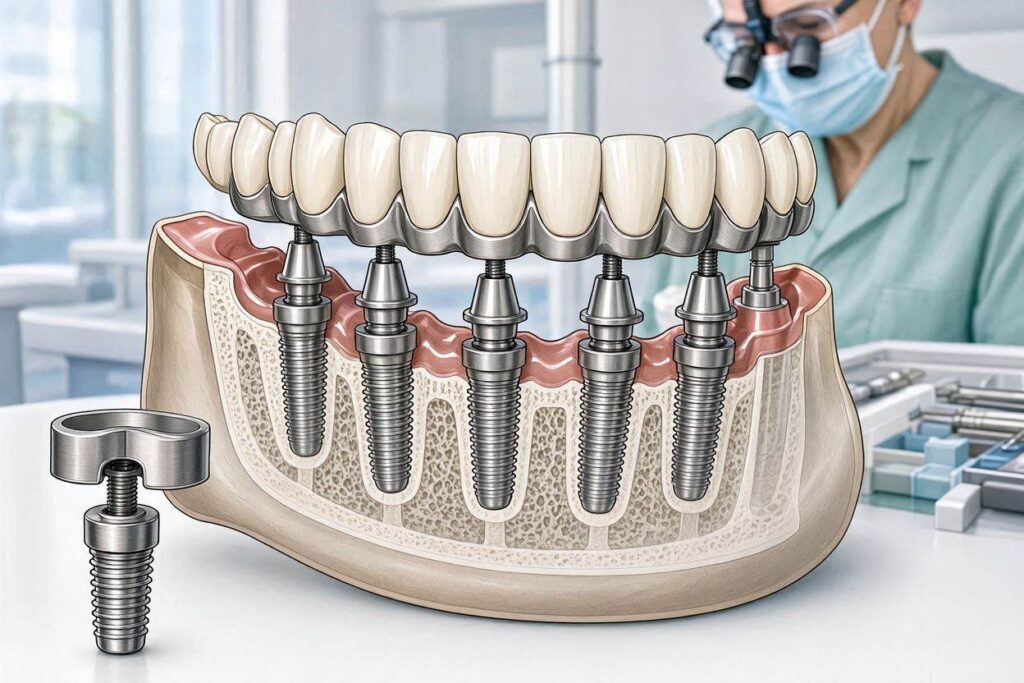
The Hybridge philosophy solves these structural and hygienic problems by integrating three key engineering principles. First, the framework is a precision-milled metal bar, typically made of a cobalt-chromium alloy or titanium. This metal substructure provides an unbreakable skeleton that distributes occlusal forces evenly across all the supporting implants. Second, the visible teeth and the gum-colored aesthetic portions are made from high-impact, cross-linked acrylic or composite that is bonded to the metal framework, but the design allows for individual replacement of teeth if wear occurs. Third, and perhaps most critically, the design is “hygienic.” The underside of the bridge is convex, smooth, and polished, leaving space between the implants for easy access with a water flosser and interdental brushes. The goal is a prosthesis that does not just replace teeth but actively protects the underlying implants from disease.
The Hybridge protocol is licensed to a network of certified dentists and oral surgeons who undergo specific training. It is not an open-source technique that any dentist can claim to perform. When a practice offers “Hybridge,” they are using a specific treatment planning matrix, a specific set of surgical guides, and a specific dental laboratory authorized to fabricate the Hybridge prosthesis. This standardization is a core part of its value proposition.
Hybridge vs. All-on-4: A Detailed Comparison
The All-on-4 concept, pioneered by Nobel Biocare and Dr. Paulo Malo, is the most recognized full-arch implant solution globally. It uses four implants in the jaw, with the two posterior implants angled at up to 45 degrees to avoid the sinus in the upper jaw and the inferior alveolar nerve in the lower jaw. The bridge is typically a hybrid acrylic denture reinforced with a milled titanium bar. All-on-4 is an excellent, scientifically validated treatment that has restored smiles for hundreds of thousands of patients.
So how does Hybridge differ? The distinctions are in the number of implants, the prosthetic material, and the maintenance philosophy.
The number of implants is the most immediate difference. Hybridge advocates for a higher implant count: typically five or six in the mandible and six to eight in the maxilla. The biomechanical rationale is force distribution. With more implants, the stress on each individual implant during chewing is reduced. The metal framework design on a Hybridge connects these implants with a rigid, precision-milled bar that will not flex or fatigue over time. This reduces the risk of screw loosening and implant overload, especially in patients with strong jaw muscles or a history of bruxism.
The prosthetic material in a traditional All-on-4 is often an acrylic tooth bonded to an acrylic denture base, sometimes reinforced with a minimal metal bar. Acrylic teeth wear down over time, losing their anatomical shape and vertical dimension. A Hybridge restoration places a heavy emphasis on the hybrid composite or porcelain denture teeth bonded to a metal framework. The chewing surfaces are designed for durability. When they do wear, the prosthesis can often be reconditioned or the teeth replaced in the laboratory without needing to fabricate an entirely new bridge.
Hygiene is the third pillar. A conventional full-arch bridge often has a concave, ridge-lap design on the underside, which rests directly on the gum tissue. This creates a bacterial trap. The Hybridge design specifically contours the underside to be convex, raised off the soft tissue, and highly polished. The patient is instructed to clean under it daily with a water flosser and a narrow brush. This reduces the risk of peri-implantitis, the number one long-term killer of dental implants.
| Feature | Hybridge Protocol | Traditional All-on-4 |
|---|---|---|
| Implant Count (Lower Jaw) | 5 – 6 | 4 |
| Implant Count (Upper Jaw) | 6 – 8 | 4 – 6 |
| Framework Material | Milled Cobalt-Chrome or Titanium Bar | Milled Titanium Bar (often minimal) |
| Tooth Material | Hybrid Composite or Porcelain | Acrylic |
| Underside Design | Convex, raised, fully polished (“hygienic”) | Often concave, rests on tissue |
| Maintenance Goal | Easy home care, reduced peri-implantitis risk | Requires frequent professional cleanings |
| Cost (per arch) | $30,000 – $50,000+ | $20,000 – $35,000 |
This table highlights the practical differences. Hybridge is positioned as a premium, “heavy-duty” full-arch solution. It is more expensive up front, but the argument is that its longevity and reduced maintenance costs make it more economical over a 20 or 30-year period.
The Hybridge Candidacy and Diagnostic Process
Not every patient is a candidate for a Hybridge restoration. The protocol begins with a meticulous diagnostic phase. The surgeon must confirm that you have sufficient bone volume in the specific locations required by the Hybridge implant template. These positions are not arbitrary; they are predetermined to optimize force distribution and to allow the prosthesis to be properly cantilevered. A cantilever is the portion of the bridge that extends past the last implant to replace the molars. Hybridge carefully limits the length of the cantilever to prevent mechanical overload.
A 3D Cone Beam CT scan is mandatory. The surgeon virtually plans the surgery, placing the implants in the exact positions within the bone and at the precise angulations required by the prosthetic design. If you have severe bone atrophy in the molar regions, a Hybridge plan might require additional bone grafting or zygomatic implants, which are long implants anchored in the cheekbone. The protocol can incorporate these advanced techniques.
The protocol also requires the patient to be medically stable. Uncontrolled diabetes, heavy smoking, active chemotherapy, and bisphosphonate therapy are relative or absolute contraindications, just as they are for any implant surgery. The patient must commit to a strict hygiene regimen. A Hybridge bridge is an advanced medical device, and it demands a high level of personal responsibility. The clinician will assess your manual dexterity and motivation. If you are unwilling or unable to clean under the bridge daily, you are not a good Hybridge candidate, regardless of your bone volume.
The financial investment is substantial. A single arch Hybridge can range from $30,000 to $50,000, and a full-mouth rehabilitation can approach $80,000 to $100,000. This typically includes the surgical extractions, the implants, the temporary fixed bridge delivered on the day of surgery, and the final, custom-fabricated Hybridge prosthesis. It is an all-inclusive package, but you must verify exactly what the fee covers.
The Surgical and Restorative Workflow
The Hybridge process is broken into a series of appointments that follow a strict timeline. Understanding this timeline will alleviate the anxiety of the unknown.
The first appointment is the diagnostic session. Records, including photographs, X-rays, the CBCT scan, and intraoral digital scans, are taken. The case is planned digitally. The surgical guide is designed and 3D printed. This guide fits over your gums or your remaining teeth and directs the surgeon’s drills to the exact planned location.
The surgery day is a major event. You will undergo either IV sedation or general anesthesia. Any remaining hopeless teeth are extracted. The bone is smoothed and leveled to create a flat platform. The surgical guide is seated, and the implants are placed precisely. Multi-unit abutments—angled connectors that screw into the implants—are attached. These abutments correct the angle of the implant to a common path of insertion for the bridge. A pre-fabricated, temporary fixed bridge is then screwed onto the multi-unit abutments. You leave the office with a fixed set of teeth on the day of surgery. This immediate load protocol is possible because the multiple implants are rigidly splinted together, distributing the bite forces.
You will spend the next four to six months on a soft diet, allowing the implants to osseointegrate. The temporary bridge is adjusted periodically for comfort and bite. After the healing period, the final impression is taken. This is a hyper-accurate transfer of the implant positions using a rigid impression material or a digital scan body. The master dental laboratory then fabricates the final Hybridge metal framework. This framework is tried in your mouth to verify a passive, stress-free fit. A poorly fitting framework that places tension on the implants will cause bone loss and failure.
Once the framework fit is confirmed, the final teeth are set in wax, tried in for your approval of the aesthetics and phonetics, and then processed onto the metal framework. The final Hybridge prosthesis is delivered and torqued to the manufacturer’s specifications. The access holes are sealed. You receive detailed instructions on how to clean underneath the bridge with a water flosser and specialized brushes. You will return for a final bite adjustment and a hygiene review.
Living With a Hybridge: The Daily Reality
Waking up with a Hybridge is a radical psychological shift for someone who has lived with failing teeth or a removable denture. The bridge is fixed. It does not move, click, or come out. You do not use adhesives. You do not soak it in a glass at night. You brush it as you would your natural teeth, twice a day, and you water-floss under it every single night without fail.
The feel of a Hybridge is substantial. It is a solid, rigid arch of teeth. Your palate is usually not covered, or only partially covered, which is a huge sensory relief for patients who have worn full upper dentures. You can taste food again. The palate coverage of a removable denture blocks the taste buds and triggers the gag reflex in many people. The Hybridge, being fixed on implants, often has a horseshoe shape in the upper jaw, leaving the center of the palate open. This is a massive quality-of-life upgrade.
Eating is a rediscovery. You will progress from soft foods to a normal diet over several months. With a Hybridge, because of the multiple implants and the rigid metal frame, you will eventually be able to eat steak, crunchy vegetables, and chewy bread with confidence. The biting force is far greater than with a denture. However, you are still biting on a prosthesis, not natural teeth. The proprioceptive feedback is different. You must learn to moderate your bite force. The cantilevered back teeth are not designed for extreme, focused loads. Biting directly into a hard, raw carrot with the very back tooth is discouraged. Cut it into pieces and chew it over the implant-supported areas.
Speech adapts quickly. Because the bridge is fixed and the volume of material in the mouth is less than a bulky denture, the tongue adapts its movements in a week or two. You will practice speaking aloud, perhaps reading a book to yourself, to regain your crisp diction.
Conclusion
Hybridge Implant Dentistry is a premium, prosthetically-driven full-arch restoration protocol that uses a higher number of implants and a robust metal framework to create a fixed, highly durable, and hygienically designed set of teeth. It is a direct response to the mechanical and biological failures seen in traditional implant bridges, prioritizing long-term stability and ease of home care over the lower initial cost of simpler acrylic prostheses. For the candidate who has sufficient bone and budget, Hybridge offers a complete physical and psychological transformation, delivering a non-removable smile that is engineered to withstand the forces of a lifetime.
FAQ
What is the difference between Hybridge and dentures?
A denture is removable and rests on the gums. A Hybridge is a fixed, non-removable bridge screwed into multiple dental implants. It feels like having natural teeth back and does not require removal for cleaning.
How many implants are required for a Hybridge?
The Hybridge protocol typically uses five or six implants in the lower jaw and six to eight implants in the upper jaw to support the rigid metal framework and distribute chewing forces.
Can a Hybridge be removed by the patient?
No. The Hybridge prosthesis is fixed in the mouth with tiny screws. It can only be removed by the dentist during a maintenance appointment for deep cleaning or repair.
How do you clean under a Hybridge bridge?
You use a water flosser with a specialized tip and a narrow interdental brush to flush and wipe the polished, convex underside of the bridge daily, preventing plaque accumulation.
Is Hybridge worth the extra cost compared to All-on-4?
For many patients, yes. The higher implant count and metal framework reduce the risk of screw loosening and acrylic fracture over time. The hygienic design can prevent the bone loss and implant failure associated with difficult-to-clean traditional bridges.
Additional Resources
To learn more about full-arch implant solutions and find a specialist, visit the American College of Prosthodontists website: https://www.gotoapro.org/