Is It Normal for Dental Implants to Fuse in a Year?
You have been waiting. The implant surgery was many months ago. You expected a new tooth in three to six months, but the calendar pages have turned, and you are approaching the one-year mark. A gnawing anxiety sets in. Is something wrong? Did the implant fail? Is your body rejecting it? The standard healing timelines you read online all say “3-6 months.” So when your dentist tells you to wait longer, or when you find yourself at month eight, nine, or ten with no final crown, it’s natural to feel alarmed. The truth is nuanced. While a healthy, straightforward implant in good bone does fuse within that standard window, a healing period extending to a year is not automatically a sign of failure. In certain complex, heavily reconstructed cases, a one-year timeline is not only normal—it is the planned, deliberate, and biologically necessary path to success. This article will explain when a year-long fusion is acceptable, when it is a red flag, and how to understand exactly what your body and your implant are doing during that extended time.
The Standard of Care: The 3-6 Month Rule
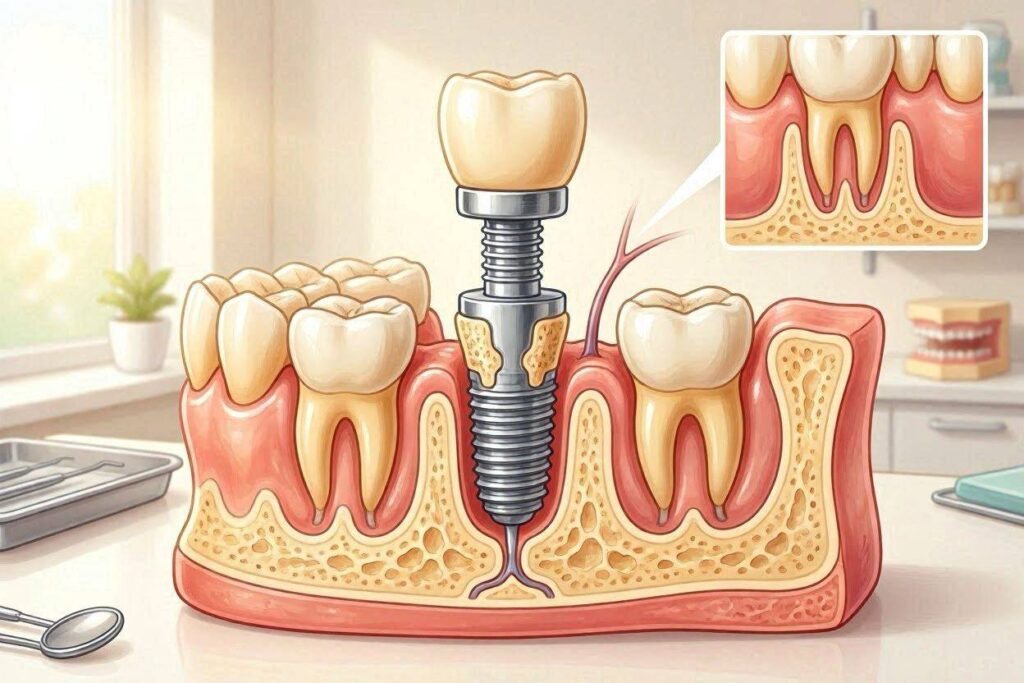
To understand the exception of a year, you must first firmly grasp the rule. Modern implant dentistry is built on the predictability of osseointegration occurring within a known window. For a routine single implant placed into a healed, healthy jawbone with adequate volume and density, the standard healing times are well-established. The lower jaw (mandible) typically requires 3 to 4 months. The upper jaw (maxilla) typically requires 4 to 6 months. These timelines were established by decades of clinical studies and are what the major implant manufacturers recommend in their protocols for conventional loading. At the end of this period, a dentist performs a series of diagnostic checks—clinical percussion, mobility testing, and radiographic assessment—and if the implant passes, a crown is attached. For the vast majority of straightforward cases, the implant is indeed fused and functional well within six months.
What Happens Biologically During Those Months
During the first 3-6 months, a precisely choreographed cellular ballet takes place. The first few weeks are about forming a blood clot, attracting osteoblasts, and laying down a weak, primitive woven bone. The subsequent weeks are about remodeling. The weak woven bone is resorbed by osteoclasts and replaced with strong, organized lamellar bone. By month 3 in dense bone, and month 4-6 in softer bone, this lamellar bone has matured enough to handle the controlled forces of a final crown. The biological clock is reliable when the starting conditions are ideal.
When a Year-Long Timeline Is the Planned, Correct Protocol
A one-year timeline is not a failure; it is a strategy. In several specific, complex clinical scenarios, the implant surgeon proactively plans for an extended, often year-long, integration period. The bone is not “slow to heal”; it is waiting for the biological materials placed alongside the implant to fully transform into living bone.
The Bone Graft Scenario: Simultaneous Implant and Major Graft
This is the most common reason for a one-year timeline. A patient presents with a tooth that was extracted years ago. The bone has atrophied. The ridge is too thin or too short. To place a standard-sized implant in a prosthetically correct position, a significant bone grafting procedure is performed at the same time as the implant surgery. The implant is placed into the available native bone, and the defect around it is packed with bone graft particles. These particles are not living bone; they are a scaffold. The body must infiltrate this scaffold with blood vessels, break down the graft particles, and replace them with new, living bone. This process, called creeping substitution, is slow. It takes months. The implant surface in contact with the native bone will osseointegrate in the standard 3-6 months. But the grafted portion needs much longer—often 6 to 9 months—to fully consolidate into load-bearing bone. If a crown is placed at 4 months, the graft is still soft and unmineralized, and the forces of chewing can crush the immature bone, leading to graft failure and implant loss. In these cases, the surgeon prescribes a 9 to 12-month healing period from the start. This is a sign of excellent biological thinking, not a complication.
The Major Sinus Lift Augmentation
For an implant in the posterior upper jaw where the sinus floor is low, a sinus lift is performed. The sinus membrane is elevated, and a significant volume of bone graft material is placed into the created space. If the residual native bone is less than 4-5mm, the implant cannot be placed simultaneously with a high degree of predictability. The surgeon will perform the sinus graft and allow it to heal for 9 months before placing the implant. This alone pushes the timeline to over a year. If the implant is placed simultaneously with a smaller graft, the surgeon will still often wait 8-10 months to load the implant, to ensure the graft in the sinus has matured into cortical bone capable of supporting the apical forces on the implant.
Compromised Systemic Health
As discussed in previous articles, a patient with poorly controlled diabetes, a heavy smoking habit, or a history of radiation to the jaws is a compromised healer. The cellular machinery of bone repair is sluggish. In these patients, a responsible surgeon will build in an extended safety margin. An implant in a heavy smoker’s lower jaw, which normally would be loaded at 3 months, might be scheduled for loading at 6 months. A maxillary implant in the same smoker might be pushed to 8-9 months. This is a clinical decision to compensate for the biologically slower repair processes and reduced blood supply.
The Red Flag: When a One-Year Timeline Signals a Problem
Not all year-long waits are planned. Sometimes, an implant that was supposed to be ready at 4 or 6 months fails to integrate on schedule, and the waiting becomes diagnostic. This is a different scenario, and it requires a critical evaluation.
The Stagnant Stability Curve
The dentist placed the implant, and it achieved good primary stability. At the 4-month mark, they tested it. The implant was not mobile, but it felt “soft” on percussion—a slightly dull sound instead of a clear ring. The Resonance Frequency Analysis (RFA) ISQ value was borderline, maybe 58, where it should have been above 68. The X-ray showed a slightly wider radiolucent line than expected. In this scenario, the implant is not an outright failure, but it is not solidly integrated. The wise clinical decision is to wait. The dentist gives it another 2-3 months, re-tests, and hopes the secondary stability curve is just slow to rise. If at the 8-month or 12-month mark the implant finally achieves a solid ISQ and clear ring, it can be loaded. This is a delayed osseointegration. It is not the ideal, but it can still end in success. If, however, the implant is still borderline at a year, it is likely a slow failure—a fibrous encapsulation that is progressively taking over. The implant should be removed.
The Undiagnosed Infection
An implant that lingers, with a dull ache, persistent gum redness, and slow, creeping bone loss on serial X-rays, is not fusing; it is failing. A low-grade, subclinical infection, a peri-implantitis during the healing phase, is destroying the bone as fast as it is being formed. The implant may feel rigid due to the remaining mechanical interlock, but the biological seal is compromised. Waiting a year in this case does not help. It allows the infection to destroy more bone, making the eventual reconstruction more difficult. This is why a good surgeon does not just passively wait; they monitor with serial X-rays and ISQ measurements to distinguish a slow-but-progressing integration from a stagnant or regressing one.
Comparing Timelines: Standard vs. Extended
| Scenario | Standard Healing Time | When a Year Is Normal | Diagnostic Indicator |
|---|---|---|---|
| Single implant in dense anterior mandible | 3 months | No, a year would be abnormal | Quick rise in ISQ, clear percussion ring |
| Single implant in posterior maxilla | 6 months | No, unless with simultaneous major graft | Steady ISQ rise to >68 by 6 months |
| Implant with simultaneous large ridge augmentation | 9-12 months (planned) | Yes, this is the correct protocol | Serial radiographs showing graft maturation |
| Staged sinus lift, then implant | 12-15 months total (graft + implant) | Yes, this is a two-stage protocol | Graft consolidates, then implant integrates in standard 4-6 months after placement |
| Heavy smoker, maxillary implant | 6-8 months (often planned) | Approaching a year is a cautious clinical decision | Close monitoring for vascular compromise |
What Should You Do If You Are Approaching a Year Without a Crown?
If you are in this situation, do not panic. Instead, become an informed, assertive participant in your care. Schedule a specific appointment with your dentist to discuss the timeline. Do not just ask “Is it ready yet?” Ask pointed, specific questions.
- “Can we measure the ISQ value today and compare it to the reading from my last visit?”
- “Can you show me on the X-ray how the bone level around the implant has changed compared to the baseline X-ray taken at surgery?”
- “Is this extended timeline the plan we originally discussed, or is this a departure from the expected healing rate?”
- “Do you see any signs of infection or peri-implantitis that are causing the delay?”
A good dentist will welcome these questions. They will have the records. They will show you the evidence. A vague answer of “let’s just wait a bit more” without objective data is not acceptable when a year of your life has been invested. Your dentist should be able to clearly articulate if the delay is a pre-planned biological strategy due to a graft, or if they are concerned about a slow healing trajectory and are monitoring it with caution.
The Psychological Toll of Extended Waiting
Waiting a year for a tooth is a significant emotional burden. The initial excitement of the surgery has long faded. You may be wearing a temporary flipper or Essix retainer that feels flimsy. You may be chewing on one side. You see the gap or the temporary every day. It is easy to become frustrated, depressed, and to catastrophize: “It’s never going to work. I’ve wasted my money.” These feelings are valid. Acknowledge them, but do not let them drive you to demand a crown before the biological foundation is solid. A premature crown that leads to a failed implant will cost you far more in time, money, and emotional energy than the extra few months of waiting. Communicate your frustration to your dentist. They may be able to provide a better temporary, a more aesthetic retainer, or simply a clear explanation that gives you the peace of mind to endure the final stretch.
Important Note: A successful implant that took 12 months to integrate is just as successful as one that took 3 months. The final outcome—a stable, functioning, lifelong tooth—is what matters. The healing period is a blip in the decades of service that implant will provide. Do not conflate a long healing time with a poor outcome. Conflate the quality of the final diagnostic tests with the long-term prognosis.
Conclusion
While the standard timeline for dental implant osseointegration is 3 to 6 months, a planned healing period extending to a year is entirely normal and biologically necessary in cases involving major bone grafting, staged sinus lifts, or compromised patient health. The critical distinction is whether the extended timeline was a proactive clinical decision for a complex case or a reactive response to a slow or stalled integration. Objective monitoring with radiographs and stability measurements is the only way to distinguish a slow success from a quiet failure.
FAQ
1. If my implant takes a year to fuse, will it be weaker than a fast-fusing implant?
No. The final strength of mature lamellar bone around an implant is the same, regardless of whether it took 4 months or 12 months to fully mature. The end point is a solid bone-implant interface. The speed of the journey does not determine the strength of the destination.
2. Can I speed up a slow-fusing implant with calcium supplements?
If you are genuinely deficient in Vitamin D or calcium, then correcting that deficiency with supplements under a physician’s care is beneficial for your overall bone metabolism. However, mega-dosing supplements will not accelerate a localized, slow osseointegration process that is already receiving adequate systemic nutrition.
3. Should I get a second opinion if my implant hasn’t been loaded at a year?
Yes, if your dentist is not providing clear, objective data to explain the delay, a second opinion from another implant surgeon or a periodontist is a reasonable step. They can review your records and provide an independent assessment of the implant’s status.
Additional Resource
To learn more about bone grafting and complex implant timelines, visit the Institute for Dental Implant Awareness: https://www.implantawareness.com/