Are Dental Implants Separate Teeth?
The language patients use to describe dental implants often reveals a fundamental uncertainty about the very nature of the restoration. A question like “Are dental implants separate teeth?” may sound simple, but it cuts to the core of what an implant is, how it functions, and how it lives in the mouth alongside the natural dentition. The answer is both a clear yes and a nuanced explanation of structural independence and biological integration. A dental implant is a separate tooth in the sense that it is a completely independent, self-supporting replacement for a single missing tooth. It does not attach to, rely on, or derive support from the adjacent natural teeth. It stands alone in the bone, just as a natural tooth stands alone in its socket. It is cleaned individually. It is restored with its own crown. It is, in every functional and aesthetic sense, a separate tooth.
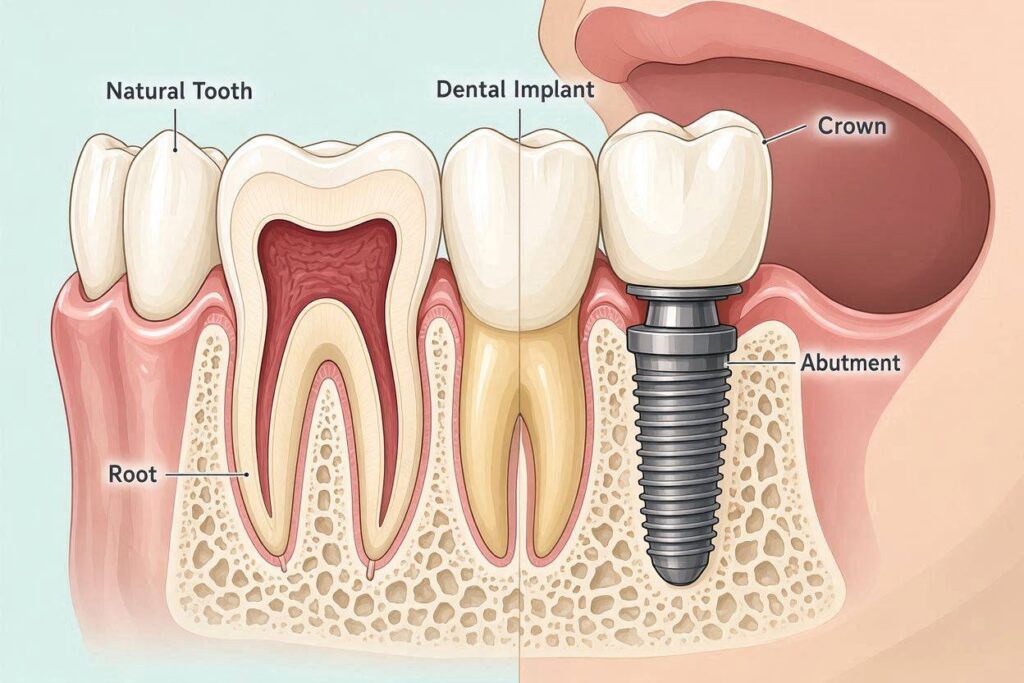
But the implant is also profoundly different from a natural tooth in its internal anatomy and its connection to the body. It is a titanium root with a ceramic crown screwed or cemented onto it. It lacks the periodontal ligament, the biological shock absorber that surrounds a natural root. It is fused directly to the bone, an ankylotic relationship that has no natural analogue. So while it is a “separate tooth” in the dental arch, it is a separate, synthetic organ that behaves differently than its natural neighbors. This guide will explore the structural independence of the implant, its relationship to the adjacent teeth, and the critical clinical implications of this separateness for your daily function, your hygiene routine, and your long-term oral health.
The Standalone Nature of the Implant Restoration
The defining clinical feature of a single-tooth dental implant is that it is a freestanding restoration. When a patient has a single missing tooth, the traditional method of replacement is a tooth-supported fixed bridge. In a bridge, the dentist prepares the two adjacent teeth by grinding them down. A three-unit prosthesis is fabricated: two crowns that fit over the prepared anchor teeth, and a false tooth, the pontic, suspended between them. The missing tooth is replaced, but the three teeth are now physically connected. They are splinted together. Flossing under the pontic requires a floss threader. The load of chewing on the pontic is transferred to the two anchor teeth.
An implant disrupts this paradigm entirely. The surgeon places the implant fixture in the exact center of the missing tooth’s space. The bone heals around it. An abutment is attached to the implant, and a single, individual crown is placed on the abutment. This crown touches the adjacent teeth at the contact points, just as a natural tooth touches its neighbors. But it is not cemented or bonded to them. The contact is a passive, tight, static relationship. The implant crown and the adjacent natural tooth move independently. When you bite down, the natural tooth compresses its periodontal ligament and sinks slightly into the socket. The implant does not move perceptibly; it transmits the force directly to the rigid bone. This differential movement is a critical design feature. If the implant were rigidly splinted to a natural tooth, the natural tooth would be prevented from its normal, microscopic movement, and the implant would be subjected to unphysiological leverage, potentially leading to the failure of one or the other.
The crown on the implant is a separate, individual unit. If the implant crown chips or fails, it can be removed and replaced without affecting the adjacent teeth. If the adjacent natural tooth needs a filling or a crown, it can be treated without affecting the implant. This separateness is a profound long-term advantage. In a tooth-supported bridge, if one anchor tooth decays under the bridge, the entire three-unit bridge must often be cut off and replaced. The implant preserves the autonomy of each tooth in the arch.
The Soft Tissue Architecture: Separate but Connected
While the implant and the adjacent tooth are structurally separate, the gum tissue, the gingiva, connects them in a continuous, flowing arch. The interdental papilla, the small, triangular piece of gum that fills the space between two teeth, is the most delicate and aesthetically critical component. In a natural dentition, the papilla is supported by the bone and the connective tissue attachment of the two adjacent teeth. When a tooth is lost, the papilla is lost with it.
An implant can support a papilla on one side, but the papilla between an implant and a natural tooth is a delicate biological construct. It relies on the bone height on the natural tooth’s side. The surgeon and the restorative dentist must meticulously preserve the bone and the gum contour on the adjacent tooth during the implant surgery. If the papilla is lost, a “black triangle” appears between the implant crown and the natural tooth, a food trap and an aesthetic failure. The implant crown and the natural tooth are physically separate, but they share a biological environment, a continuous oral ecosystem. Disease in one—cavities in the natural tooth or peri-implantitis around the implant—can spread to the other through the shared gum pocket. The separateness of the structures does not imply an impermeable biological barrier.
The Full-Arch Implant Bridge: When Implants Support a Continuous Structure
The concept of implants as “separate teeth” becomes more complex when we move to a full-arch implant-supported bridge, such as an All-on-4 or Hybridge prosthesis. In this scenario, four to six implants are placed in the jaw. A single, continuous, rigid bridge of 12 to 14 teeth is fabricated from a metal framework and acrylic or zirconia. This bridge is screwed into all the implants simultaneously.
The individual teeth on the bridge are not separate. They are part of one monolithic or one-piece prosthesis. The bridge is a single unit. If you damage one tooth on the bridge, you cannot simply remove that one tooth. The entire bridge may need to be removed and sent to the laboratory for repair. The implants themselves are separate fixtures in the bone, but the prosthetic teeth they support are rigidly connected. This design is intentional. The splinting of the implants together distributes the chewing forces across all the implants, creating a biomechanically stable, strong platform. A single implant supporting a single molar crown is a separate tooth. A full-arch bridge on multiple implants is a separate, singular prosthesis that replaces an entire arch of separate teeth.
This distinction is critical for patient understanding. A patient with a full-arch bridge does not have “twelve separate implant teeth.” They have one implant bridge. They floss under the entire bridge with a water flosser. They do not floss between individual teeth on the bridge because there are no gaps between them. The cleaning protocol is completely different from the cleaning of multiple individual implant crowns. The single-implant crown is the closest analogue to a separate, natural tooth. The full-arch bridge is a different class of restoration, a prosthetic arch, not a set of individual teeth.
Conclusion
Yes, a single dental implant is a completely separate, freestanding tooth that does not attach to, rely on, or mechanically connect to the adjacent natural teeth, preserving their autonomy and allowing independent function and hygiene. However, while structurally separate, the implant crown and the neighboring natural teeth share a continuous oral ecosystem of gum tissue and bone, making the health of each dependent on the health of the whole. In a full-arch implant bridge, the individual teeth are part of a single, rigid prosthesis and are not separate from one another, a critical distinction for both function and daily maintenance.
FAQ
Do I floss between my implant crown and my natural tooth?
Yes. You use implant-specific floss or an interdental brush to clean the contact point between the implant crown and the adjacent natural tooth, just as you would between two natural teeth.
Can an implant be connected to a natural tooth?
No. An implant and a natural tooth move differently. Connecting them with a fixed bridge is considered a poor biomechanical design that can lead to failure of the implant or the natural tooth.
Is an implant a tooth or a screw?
An implant is a titanium screw that replaces the root of a tooth. The visible, white part that you see in the mouth is the crown, which is attached to the implant. The complete restoration is a bionic tooth.
Does a dental implant touch the adjacent teeth?
Yes, the implant crown touches the adjacent teeth at a precise contact point. This contact keeps food from wedging between the teeth and maintains the natural alignment of the arch.
Can a dental implant get a cavity?
No. Titanium and porcelain cannot decay. However, the implant can develop peri-implantitis, a destructive infection of the gum and bone, which is the implant equivalent of gum disease.
Additional Resources
For visual and educational resources on the anatomy and maintenance of single and full-arch implant restorations, visit the American College of Prosthodontists: https://www.gotoapro.org/