What Materials Go Into Making Implant Dentures?
An implant denture is a remarkable hybrid of surgical precision and advanced dental laboratory craftsmanship. It is not simply a standard denture with holes drilled into it. It is a custom-engineered prosthesis designed to snap securely onto dental implants or be permanently screwed into place. You have a right to know exactly what materials are inside this life-changing device. This guide will provide a detailed, material-by-material breakdown of the components that make up an implant-retained overdenture and a fixed, screw-retained full-arch hybrid bridge. We will explore the denture base, the teeth, the reinforcement framework, and the attachment housings. This is your in-depth, technical resource for understanding the sophisticated construction of your new smile.
The Two Main Types of Implant Dentures
To understand the materials, you must first distinguish between the two fundamentally different types of implant-supported full-arch prostheses. The first is the implant-retained overdenture. This is a removable prosthesis. The patient takes it out at night for cleaning. It is retained by snapping onto a bar or onto individual ball or locator abutments on two to four implants. It is primarily supported by the gum tissue and secondarily retained by the implants. The second is the fixed, screw-retained full-arch bridge, often called a hybrid prosthesis. This is a permanent set of teeth that is screwed directly into four or more implants. The patient does not remove it. Only a dentist can take it out for professional maintenance. The material requirements for these two distinct designs are different, driven by the forces they must withstand and their relationship to the implants and gums.
The Denture Base: Acrylic, Composite, and Zirconia
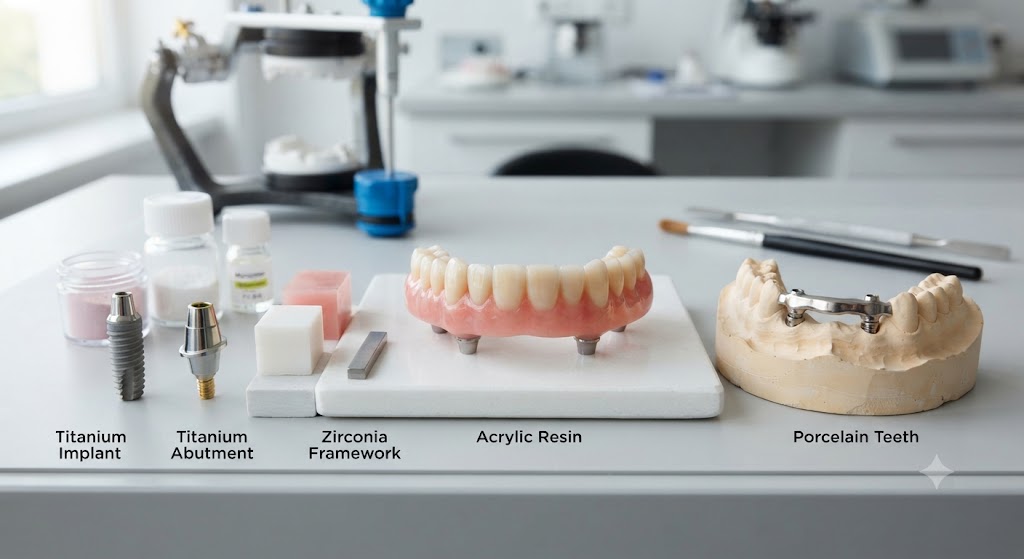
The base of the prosthesis is the pink-colored platform that simulates the gum tissue and holds the teeth. In a conventional removable implant overdenture, the base material is the same high-quality, heat-cured polymethyl methacrylate (PMMA) acrylic that is used in premium conventional dentures. It is a dense, durable, biocompatible plastic that can be perfectly color-matched to the patient’s natural gum tissue tone. The acrylic base is carefully processed to ensure a passive, stress-free fit onto the underlying bar or implant attachments. For an added layer of esthetic realism, the laboratory technician often layers the acrylic with fine, pink fibers that mimic the natural stippling and vascularity of gum tissue.
For the provisional or transitional fixed bridge that is delivered on the day of surgery, the base material is often a high-impact, fiber-reinforced PMMA or a heat-cured dental acrylic that is precisely milled or processed around a metal framework. The final, permanent fixed hybrid bridge has two primary material pathways. The first is an acrylic-titanium hybrid. This consists of a precision-milled, CAD/CAM titanium metal framework that is screwed directly to the implants. This metal bar provides the structural strength and rigidity. The pink acrylic gum and the denture teeth are processed onto this titanium skeleton. The metal bar is completely encased in acrylic and is not visible. This is a proven, durable, and slightly more cost-effective final option.
The premium, state-of-the-art final material is a monolithic, screw-retained zirconia bridge. This is a single, solid, highly aesthetic piece of high-strength zirconia ceramic. The pink gum and the white teeth are milled from a single block of layered zirconia and then individually characterized with porcelain stains by a master ceramist. This prosthesis is the strongest, most wear-resistant, and most profoundly beautiful option in implant dentistry. It is not a denture; it is a solid ceramic bridge.
The Teeth: Acrylic Resin, Composite, and Porcelain
The teeth on an implant denture are a critical material choice. For a removable implant overdenture, the teeth are typically high-quality, cross-linked acrylic resin denture teeth. These teeth have a chemical bond to the acrylic base material, making them highly durable and resistant to debonding. They are softer than porcelain, which is an advantage: they are gentler on the opposing natural teeth or the opposing prosthesis, and they are quieter. Composite resin denture teeth, often made of nanohybrid composite, are a premium upgrade. They are significantly harder, more wear-resistant, and more color-stable than standard acrylic teeth.
For a fixed acrylic-titanium hybrid bridge, the teeth are almost always high-grade composite resin or acrylic denture teeth that are mechanically locked into the acrylic base. The lab can also mill the entire bridge—teeth and pink base—from a single puck of reinforced nano-ceramic composite, a process that creates a monolithic, durable, and repairable bridge. For a zirconia fixed bridge, the teeth are milled from the same block of zirconia and layered with feldspathic porcelain, which is the same material used in the finest single dental crowns. This provides unmatched natural translucency, color depth, and the hardest biting surface, but it is more aggressive to opposing teeth if not carefully adjusted.
The Framework: The Hidden Skeleton
The framework is the internal skeleton that gives the fixed prosthesis its strength and prevents it from fracturing. In a removable overdenture, if a bar is used, it is a custom-milled metal bar, either a titanium alloy or a cobalt-chromium alloy, that is screwed onto the implants. The denture clips over this bar using specialized, replaceable retention clips embedded in the denture base.
In a fixed acrylic hybrid bridge, the structural framework is a solid, precision-milled bar of titanium or cobalt-chromium that connects all the implants together. This bar is an absolutely passive fit on the multi-unit abutments of the implants, a technical requirement that demands extreme precision from the dental laboratory. The pink acrylic and the teeth are then built around this rigid metal core. This metal reinforcement is the strength of the prosthesis. In a full-zirconia bridge, there is no separate metal framework. The monolithic zirconia itself provides the complete structural strength.
The Attachment Housings: The Connection
The attachment mechanisms are the tiny, highly engineered components that create the snap connection in a removable overdenture. For a Locator attachment system, the abutment on the implant is a titanium post with a specific male contour. The housing embedded in the denture base is a metal denture cap housing, which contains a small, round nylon or PEEK insert. This insert is the functional heart of the retention. It provides the exact amount of friction and retention to hold the denture securely, and it is color-coded by retention strength. These nylon inserts are consumable. They wear out over time and are replaced by the dentist in seconds during a routine maintenance visit. For a bar overdenture, the denture contains metal retention clips or a nylon insert that snaps over the bar. For a fixed screw-retained bridge, there are no housings. The bridge has small, precision-drilled chimneys in the teeth through which the tiny titanium prosthetic retaining screws are inserted and torqued directly into the implant’s multi-unit abutment.
Conclusion
Implant dentures are sophisticated prostheses built from a carefully selected combination of biocompatible materials: a durable pink acrylic base or a solid monolithic zirconia structure that forms the simulated gum tissue, reinforced internally by a precision-milled titanium or cobalt-chromium framework for structural integrity. The visible teeth are constructed from cross-linked acrylic, wear-resistant nanohybrid composite, or hand-layered porcelain, depending on the desired balance of function, aesthetics, and long-term durability. The connection to the implants is achieved through either precision-engineered, replaceable nylon retention inserts for removable overdentures, or directly through tiny, torqued titanium prosthetic screws in a fixed, non-removable bridge.
Frequently Asked Questions
Can the pink gum part of my implant denture be repaired if it chips?
Yes. A pink acrylic base is absolutely repairable. A dental laboratory technician can add new acrylic and rebond it chemically. A chipped monolithic zirconia bridge, however, is extremely difficult to repair and may require a very specialized, costly laboratory service.
Which material is best for a patient who grinds their teeth?
For a severe bruxer, a monolithic zirconia fixed bridge is the strongest and most wear-resistant option for the prosthesis. However, this must be paired with a professionally fabricated, hard acrylic protective night guard to protect the opposing natural teeth or the opposing prosthesis from accelerated wear.
Do the denture teeth stain over time?
Acrylic denture teeth are somewhat porous and will gradually absorb stain from coffee, tea, and red wine over years. Composite teeth are more color-stable. Porcelain teeth on a zirconia bridge are glazed and are virtually stain-proof.
How often do the snap-in inserts need to be replaced?
The nylon or PEEK retention inserts in a Locator overdenture are a maintenance item. They typically provide optimal retention for 12 to 24 months, depending on the patient’s chewing force and how often the denture is inserted and removed. Replacement is a quick, inexpensive office procedure.
Is there a metal-free option for a fixed implant bridge?
Yes. A full-contour, monolithic zirconia bridge is completely metal-free. It is screwed directly onto the implants using titanium screws, but there is no metal framework inside the prosthesis. It is a solid ceramic restoration, ideal for patients with proven metal sensitivities or those demanding the absolute highest aesthetic result.
Additional Resource: Link
To learn more about the laboratory processes and materials used in modern implant prosthetics, you can explore the resources of the National Board for Certification in Dental Laboratory Technology. Visit the NBC CDT Page