Do Dental Implants Look Like Fakes?
You stand in front of the mirror, studying your reflection. The new implant crown sits among your natural teeth. You turn your head slightly, smile, then look more critically. Does it look real? Can other people tell? Will it ever feel natural to you, or will you always be aware that it is not your original tooth?
These questions touch on something deeper than technical specifications. They are about identity, confidence, and how you present yourself to the world. A dental implant that looks fake undermines the very reason you invested in it. This guide answers honestly: do dental implants look like fakes, and what determines whether they blend seamlessly or stand out as artificial?
The Short Answer
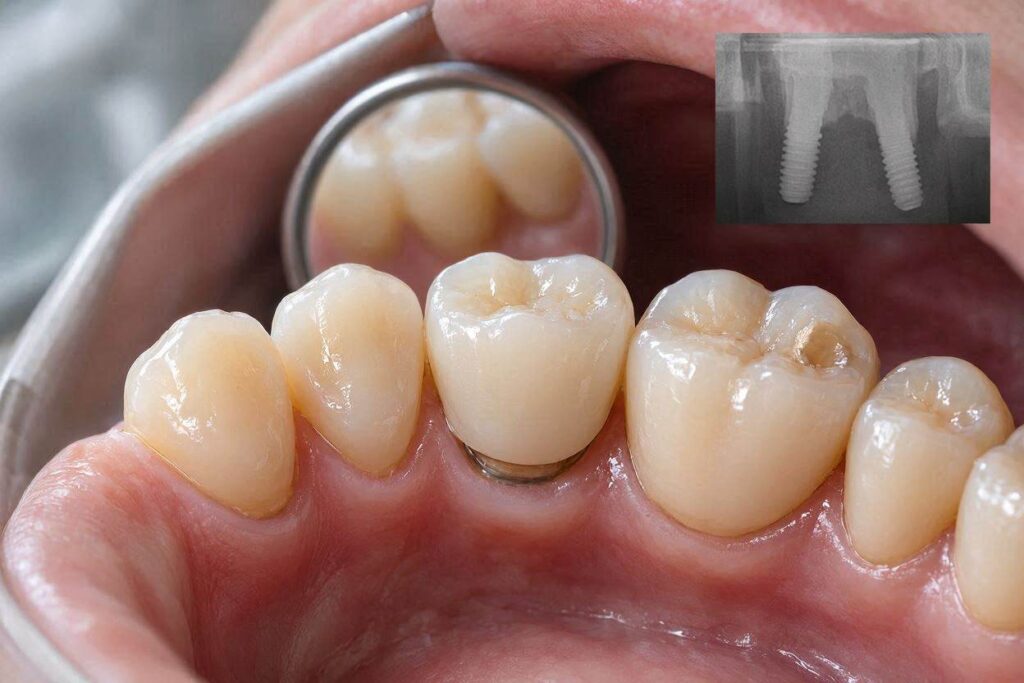
When properly designed, fabricated, and placed by skilled professionals, dental implants do not look fake. They can be virtually indistinguishable from natural teeth. However, achieving this result depends on multiple factors: the quality of the crown material, the skill of the dental laboratory technician, the management of the surrounding gum tissue, and the implant’s positioning. A well-executed implant restoration should fool even a dental professional at conversational distance.
The critical distinction is between what is possible and what is consistently achieved. Excellent aesthetics are possible. Mediocre aesthetics are also possible. The difference lies in the details.
The Components That Determine Appearance
Several elements must work together to create a natural-looking implant restoration.
The Implant Crown
The visible crown is the most obvious determinant of appearance.
Material quality:
| Crown Material | Aesthetic Potential | Notes |
|---|---|---|
| Layered porcelain | Excellent | Multiple layers of porcelain mimic natural enamel translucency and opacity |
| Monolithic zirconia | Very good | Strong; can appear slightly opaque in some light conditions |
| Porcelain-fused-to-metal (PFM) | Good to very good | Metal substructure can block light transmission; may appear slightly duller than natural teeth |
| Full zirconia with porcelain overlay | Excellent | Combines strength with superior aesthetics |
| Lithium disilicate (e-max) | Excellent | Exceptional translucency and color matching |
| Acrylic/composite (temporary) | Fair to good | Adequate for temporary use; lacks depth and translucency of ceramic |
Color matching:
The crown must match the adjacent teeth in:
- Base shade (hue)
- Intensity of color (chroma)
- Brightness (value)
- Translucency (how light passes through)
- Surface texture and gloss
A skilled technician considers all of these factors, often using multiple shades of porcelain to create a natural gradient from the neck of the crown to the incisal edge.
The Emergence Profile
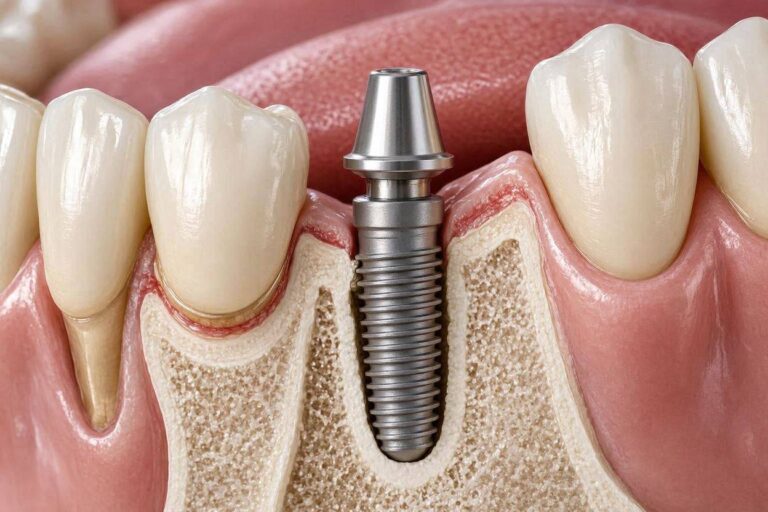
The emergence profile is how the crown appears to emerge from the gum tissue. Natural teeth emerge from the gum with a specific contour. Implant crowns must replicate this.
| Emergence Profile Feature | Natural Tooth | Well-Designed Implant Crown |
|---|---|---|
| Width at gum level | Narrower than the widest part of the crown | Narrower than the widest part of the crown |
| Contour | Gentle, convex flare | Same |
| Transition zone | Smooth, gradual | Same |
| Tissue adaptation | Gum hugs the tooth tightly | Gum should hug the crown tightly |
A poor emergence profile, where the crown emerges too abruptly or at the wrong angle, is one of the most common reasons an implant crown looks artificial.
The Gum Tissue
The pink tissue around the implant crown is as important as the white crown material.
Critical gum factors:
| Factor | Ideal | Problem if Absent |
|---|---|---|
| Papillae | Gum tissue filling the triangular space between teeth | Black triangles that look unnatural |
| Tissue color | Pink, matching surrounding gum | Redness or paleness draws attention |
| Tissue thickness | Adequate to hide the metal or abutment underneath | Gray show-through |
| Tissue contour | Scalloped shape matching adjacent teeth | Flat or uneven gum line |
Implant Position
The three-dimensional position of the implant in the bone determines much of what is aesthetically possible.
Ideal implant positioning:
| Dimension | Ideal Position | Consequence of Poor Position |
|---|---|---|
| Mesial-distal | Centered between adjacent teeth | Crown too narrow or wide; asymmetrical |
| Buccal-lingual | Slightly toward the palate/lingual | Crown too far forward (bulky) or too far back (sunken) |
| Apical-coronal | Platform 3–4 mm below the planned gum margin | Crown too short (platform too shallow) or excessive gum (too deep) |
| Angulation | Following the long axis of the planned crown | Abutment angle visible or crown shape compromised |
What Makes Implant Crowns Look Fake
Understanding common aesthetic failures helps you recognize what to avoid.
The “Chiclet” Look
An implant crown that is too opaque, too uniform in color, and lacking the subtle variations of natural enamel can look like a piece of gum, flat and artificial. This typically results from poor material selection or inadequate laboratory technique.
The “Plunger” Look
When the emergence profile is too straight or cylindrical, the crown looks like it was pushed through a hole in the gum rather than growing naturally from it. The transition from crown to root is missing.
The “Floating” Crown
If the gum tissue has receded or the crown margins are not properly adapted, a gap or shadow appears between the crown and the gum. The crown looks like it is hovering above the tissue rather than emerging from it.
Black Triangles
When the gum papilla between teeth is missing, a dark triangular space appears. This is immediately recognizable as unnatural and is one of the hardest aesthetic problems to correct after the fact.
Gray Margins
With porcelain-fused-to-metal crowns, the metal margin at the gum line can become visible, especially if the gum recedes even slightly. A gray line at the gum is a telltale sign of a dental restoration.
Mismatched Texture
Natural teeth have subtle surface texture: vertical striations, perikymata (horizontal growth lines), and variations in gloss. A crown that is perfectly smooth or has an unnatural texture pattern stands out from adjacent teeth.
The Role of the Dental Laboratory
The dental laboratory technician is the unseen artist behind every implant crown.
What Skilled Technicians Do
| Technique | Purpose |
|---|---|
| Layering porcelain | Building multiple layers of different translucency and shade to mimic natural enamel |
| Internal staining | Adding subtle color variations within the crown |
| Surface texturing | Creating micro-texture that matches adjacent teeth |
| Custom staining | Applying external stains to match unique characteristics of neighboring teeth |
| Glazing | Achieving the right level of surface gloss |
The Difference Between Average and Exceptional Laboratories
| Average Lab | Exceptional Lab |
|---|---|
| Uses standard shade guide matching | Takes custom shade photos; may do in-person shade matching |
| Produces crown from a single shade of porcelain | Layers multiple porcelains for depth |
| Standard contours | Custom contours based on adjacent teeth |
| Limited communication with dentist | Active collaboration on aesthetic cases |
The laboratory makes an enormous difference. Two crowns made from the same prescription can look completely different depending on the technician’s skill.
Single Implant vs. Multiple Implants: Aesthetic Challenges
Single Implant in an Aesthetic Zone
A single implant in the front of the mouth is the most challenging aesthetic situation. The crown must match one adjacent tooth on each side. The gum tissue must match the surrounding tissue. Any discrepancy is immediately visible because natural teeth provide a direct comparison.
Multiple Adjacent Implants
When several adjacent teeth are replaced with implants, the aesthetic challenge shifts. There are no immediately adjacent natural teeth for comparison on both sides, which can make minor discrepancies less noticeable. However, creating natural-looking papilla between adjacent implants is extremely difficult because there is no natural tooth root to support the gum tissue between them.
Full Arch Implant Restoration
When all teeth in an arch are replaced, the restoration does not need to match adjacent natural teeth because there are none. The aesthetic goal is to create a natural-looking set of teeth that suits the patient’s face, age, and personality. Gummy smile, tooth proportions, and lip support become the critical factors.
Photographic and Social Reality
Implant aesthetics exist in the real world, not in macro photographs.
The “Photographic Test”
Many implant before-and-after photos are taken with professional lighting, macro lenses, and ideal angles. They represent the best possible appearance under the most favorable conditions. Real life is different.
Social Distance Reality
| Distance | What People See |
|---|---|
| Intimate (less than 18 inches) | Fine details, minor color discrepancies may be visible |
| Personal (18 inches to 4 feet) | Overall shape and color; minor imperfections not noticeable |
| Social (4 to 12 feet) | General appearance; only major aesthetic problems visible |
| Public (more than 12 feet) | Smile line and tooth visibility; no detail visible |
At normal social and conversational distances, a well-made implant crown is indistinguishable from a natural tooth. The person would need to be uncomfortably close and specifically looking for it to detect subtle differences.
What Patients Report
Patients who have received high-quality implant restorations consistently report:
- They forget which tooth is the implant
- Friends and family cannot tell even when told there is an implant
- Dental professionals at routine check-ups sometimes do not notice
- They feel confident smiling, speaking, and eating in public
- The implant feels like a natural part of their mouth
How to Ensure Your Implant Looks Natural
Choose the Right Team
The most important decision is selecting a skilled restorative team:
- An implant surgeon experienced in aesthetic zone placement
- A restorative dentist with an aesthetic focus
- A high-quality dental laboratory with implant expertise
Communicate Your Expectations
- Bring photos of your smile before tooth loss
- Discuss what you like and dislike about your existing teeth
- Be specific about your aesthetic priorities
- Ask to see examples of the dentist’s previous implant cases
Consider Provisional Restorations
A provisional (temporary) restoration allows you to evaluate the aesthetics before the final crown is made. You can provide feedback on shape, size, and color that the technician incorporates into the final restoration.
Invest in Quality
| Cost-Saving Measure | Aesthetic Consequence |
|---|---|
| Basic laboratory | Less natural appearance |
| Stock abutment | May not support ideal emergence profile |
| Single-shade crown | Flat, artificial appearance |
| No provisional | Less opportunity for refinement |
The aesthetic difference between an adequate implant crown and an exceptional one often comes down to laboratory quality and time invested in customization.
When Implants May Look Less Natural
Certain situations present greater aesthetic challenges.
Thin Gum Tissue
Patients with naturally thin gum tissue are more likely to see gray show-through from titanium abutments. Zirconia abutments or pink ceramic at the neck of the crown can help mask this.
Significant Bone Loss
When bone and gum tissue have been lost, recreating natural contours is more difficult. Surgical grafting to restore tissue volume before or during implant placement improves outcomes.
Adjacent Natural Teeth with Unique Characteristics
Heavily characterized teeth (deep staining, unusual shapes, wear patterns) are harder to match perfectly than teeth with average characteristics.
Old Implant Systems
Older implant designs with external hex connections and limited abutment options make achieving ideal aesthetics more challenging than modern systems with platform switching and custom abutment capabilities.
Conclusion
Dental implants do not look fake when they are properly planned, precisely placed, and expertly restored by a skilled team using high-quality materials. A well-executed implant crown matches adjacent teeth in shade, translucency, shape, and surface texture, and emerges from healthy, well-contoured gum tissue in a way that mimics nature. At conversational distances, a quality implant restoration is virtually indistinguishable from a natural tooth, even to dental professionals. The keys to a natural appearance are correct three-dimensional implant positioning, a custom-designed emergence profile, excellent laboratory craftsmanship, and healthy surrounding gum tissue. While cost-saving shortcuts can produce restorations that look artificial, investing in quality at every stage produces results that allow patients to smile, speak, and eat with complete confidence.
Frequently Asked Questions
Can people tell I have a dental implant?
With a high-quality implant restoration, people cannot tell at normal social distances. Even close friends and family typically cannot identify which tooth is the implant unless you tell them.
Do dental implants look different from natural teeth up close?
At very close inspection, a trained eye might notice subtle differences in light transmission or surface characteristics between an implant crown and a natural tooth. For the average person, even at close range, a well-made implant crown is indistinguishable.
Why do some dental implants look obvious?
Obvious implant restorations typically result from poor implant positioning, inadequate abutment or crown design, mismatched shade or translucency, unhealthy or receded gum tissue, or use of lower-quality materials and laboratories.
Can you see the metal in a dental implant?
With modern ceramic or zirconia abutments and all-ceramic crowns, no metal is visible. With older porcelain-fused-to-metal crowns, a gray line may become visible at the gum margin if the gum recedes.
How can I make sure my dental implant looks natural?
Choose an experienced implant team, invest in a high-quality dental laboratory, consider custom abutments, use provisional restorations to preview the result, and communicate your aesthetic expectations clearly.
Additional Resources
- American Academy of Cosmetic Dentistry: www.aacd.com
- American College of Prosthodontists: www.prosthodontics.org
- International Congress of Oral Implantologists: www.icoi.org