What Specialist Treats Dental Implants?
The journey to getting a dental implant can feel like navigating a maze of medical titles. You hear terms like oral surgeon, periodontist, prosthodontist, and endodontist. It is enough to make your head spin. When you are facing a significant investment and a surgical procedure, you want to know that you are in the right hands.
So, which specialist actually treats dental implants?
The answer is that several different types of dental specialists are qualified to treat dental implants, each bringing a unique perspective and skill set to the table. The “right” specialist for you depends on your specific needs, the complexity of your case, and the type of care you require.
This guide will break down the roles of each specialist involved in the implant process, so you can understand who does what and why.
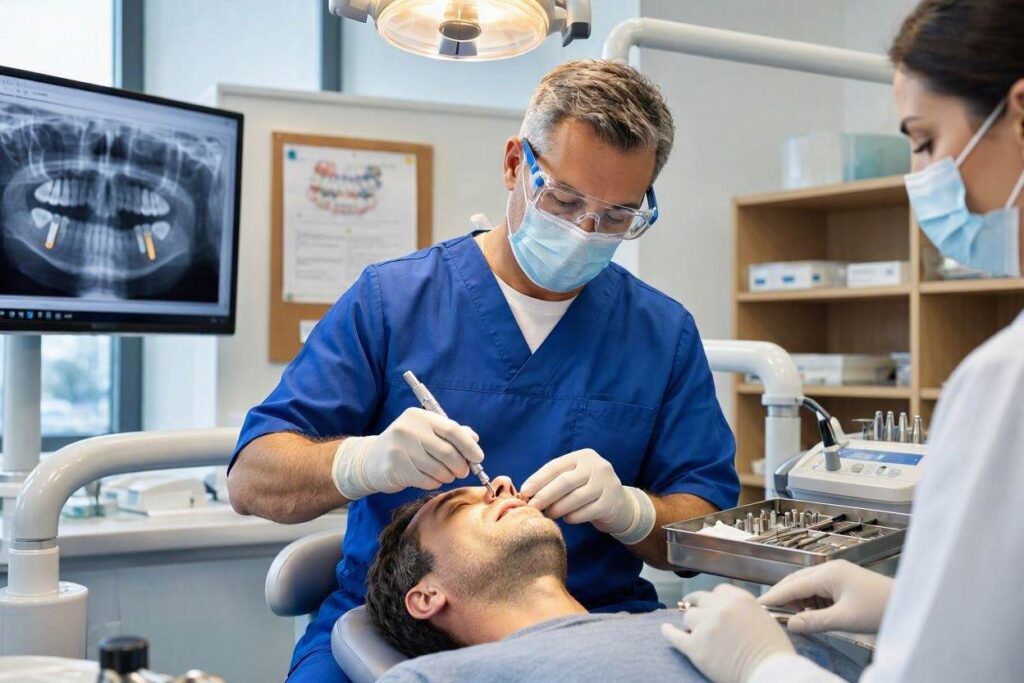
The Key Players: Who Does What?
The implant process is often divided into two main phases: the surgical phase (placing the implant in the bone) and the restorative phase (placing the crown on the implant). Different specialists excel at different phases.
1. The Oral and Maxillofacial Surgeon (The Bone Expert)
This is the specialist most people associate with implant surgery.
- Training: After dental school, an oral surgeon completes a 4-to-6-year hospital-based surgical residency. This is the most extensive surgical training in dentistry. They train alongside medical residents in anesthesia, general surgery, and emergency medicine.
- What They Do: They are experts in the hard and soft tissues of the face, mouth, and jaw. They handle complex extractions (like impacted wisdom teeth), jaw surgery, and facial trauma.
- Role in Implants: They are the go-to specialist for complex implant cases. They excel at:
- Bone grafting (rebuilding lost bone).
- Sinus lifts.
- Placing implants in areas with compromised bone.
- Managing patients with complex medical histories.
- Administering IV sedation and general anesthesia.
2. The Periodontist (The Gum Expert)
This specialist is often overlooked by patients, but they are highly skilled in implant placement.
- Training: After dental school, a periodontist completes a 3-year residency focused on the supporting structures of the teeth: the gums and the bone.
- What They Do: They are experts in diagnosing and treating gum disease (periodontitis). They perform gum grafts, bone grafts, and deep cleanings.
- Role in Implants: Periodontists are deeply invested in the aesthetics of the implant. They understand how to manage the gum tissue to create a beautiful, natural-looking result. They are an excellent choice for:
- Implants in the front of the mouth (the “smile zone”).
- Patients with a history of gum disease.
- Cases where the gums are thin or receded.
3. The Prosthodontist (The Architect)
This specialist is the master of restoring and replacing teeth.
- Training: After dental school, a prosthodontist completes a 3-year residency focused on crowns, bridges, dentures, and implants.
- What They Do: They are the experts in the “hardware” that goes on top of the implant. They design the abutment and the crown. They are the architects of the final smile.
- Role in Implants: While some prosthodontists do place the surgical implant, their primary strength is the restorative phase. They are the best choice for:
- Full-mouth reconstruction.
- Complex cases involving multiple missing teeth.
- Patients who want the highest level of aesthetic perfection.
The Team Approach: The Gold Standard
In many cases, you will not be treated by just one specialist. You will be treated by a team.
The best implant outcomes often come from a collaborative approach where:
- A prosthodontist or a general dentist designs the final result. They determine where the crown needs to be and how the bite should function.
- An oral surgeon or a periodontist performs the surgical placement of the implant.
- A dental lab technician fabricates the custom crown.
This team approach ensures that every aspect of your care is handled by an expert in that specific field.
The General Dentist’s Role
As discussed in the previous article, a general dentist can also place and restore implants. For a straightforward case, an experienced general dentist can do both the surgery and the crown. This can be more convenient and sometimes more affordable. However, for complex cases, a specialist is recommended.
How to Choose the Right Specialist for You
The best way to determine the right specialist is to start with a consultation.
Step 1: See a Restorative Dentist
Start with a general dentist or a prosthodontist. This is the “architect” who will plan your treatment. They will examine your mouth, take X-rays, and discuss your goals.
Step 2: Get a Referral
Based on your case, the restorative dentist will recommend a surgical specialist. They will tell you if you need to see an oral surgeon or a periodontist. They will often refer you to a trusted colleague they have worked with for years.
Step 3: Do Your Research
Once you have the name of a specialist, do your homework. Check their credentials online. Read patient reviews. Do not be afraid to ask them about their experience during your consultation.
A Summary Table
| Specialist | Primary Focus | Best For |
|---|---|---|
| Oral Surgeon | Bone, Surgery, Anesthesia | Complex cases, Bone grafts, Sinus lifts, Anxious patients |
| Periodontist | Gums, Bone, Aesthetics | Front teeth, History of gum disease, Soft tissue management |
| Prosthodontist | Restoration, Crowns, Bridges | Full-mouth cases, Complex restorations, Aesthetic perfection |
| General Dentist | All aspects of general care | Simple cases, Convenience, Lower cost |
Conclusion
There is no single “implant specialist.” Instead, there is a team of specialists, each with a unique role. Oral surgeons and periodontists are the surgical experts. Prosthodontists are the restorative architects. By understanding their roles, you can navigate the system with confidence and ensure you receive the best possible care for your specific situation.
Frequently Asked Questions (FAQ)
Q: Who is better for an implant: a periodontist or an oral surgeon?
A: Both are excellent. Oral surgeons are experts in bone and surgery. Periodontists are experts in gums and aesthetics. The best choice depends on the specific needs of your case. Your restorative dentist can advise you.
Q: Do I need a prosthodontist for a single implant?
A: Not necessarily. A skilled general dentist can often restore a single implant beautifully. A prosthodontist is particularly valuable for complex cases involving multiple implants or a full-arch restoration.
Q: Can an oral surgeon make the crown for my implant?
A: It is uncommon. Oral surgeons focus on the surgery. They typically do not make the final crown. They will place the implant and then send you back to your restorative dentist for the crown.
Q: What is a dental anesthesiologist?
A: This is a dentist who has completed a residency in anesthesiology. They may be brought in to provide sedation or general anesthesia for complex cases, allowing the surgeon to focus entirely on the implant placement.
Q: How do I know if a specialist is board-certified?
A: In the US, you can verify a specialist’s board certification through the American Board of Oral and Maxillofacial Surgery (ABOMS) or the American Board of Periodontology (ABP). A board-certified specialist has passed rigorous exams demonstrating their expertise.
Additional Resource:
To find a board-certified specialist in your area, you can use the “Find a Surgeon” tool on the American Association of Oral and Maxillofacial Surgeons (AAOMS) website: https://myoms.org/