What Else Is Dental Implant Called?
You are sitting in a dental office, listening to the dentist explain your tooth replacement options. The term “dental implant” is familiar, but then the dentist starts using other words: fixture, endosseous implant, root form, abutment. The terminology shifts, and you find yourself nodding along without fully understanding whether these words all mean the same thing or refer to different parts of the procedure.
This linguistic confusion is common and entirely understandable. Dental implants go by many names, some technical, some colloquial, some referring to specific components, and some referring to the entire system. This guide clarifies every term you might encounter in connection with dental implants. You will learn the precise definitions, the contexts in which different terms are used, and how to understand what your dentist, your insurance company, or an online article is actually talking about when they use one of these alternative names.
By the end of this article, you will be able to read a dental treatment plan, an insurance explanation of benefits, or a clinical research paper and understand exactly what each term means. You will also understand the historical evolution of implant terminology and why multiple names for the same thing persist in modern dentistry.
The Primary Terminology
The core term “dental implant” is the standard, widely understood name for the titanium or zirconia post that replaces a tooth root. However, dental professionals use several equivalent terms, each with a slightly different emphasis or context.
Dental Implant
This is the umbrella term used by the general public and the profession alike. It refers to the entire concept of replacing a missing tooth root with an artificial device that integrates with the jawbone and supports a prosthetic tooth. When a dentist says, “I recommend a dental implant,” they are referring to the complete treatment, which will eventually include the implant fixture, the abutment, and the crown.
In everyday conversation, “dental implant” is the term you should use. It is universally recognized and will be understood by every dental professional, insurance representative, and patient you encounter.
Endosseous Implant or Endosteal Implant
Endosseous and endosteal are technical terms that describe where the implant is placed. “Endo” means within, and “osseous” or “osteal” refers to bone. An endosseous implant is one that is placed within the jawbone. This is the standard type of dental implant used in modern dentistry.
The distinction matters because, historically, other types of implants were used. Subperiosteal implants rested on top of the bone under the gum tissue. Transosteal implants passed entirely through the jawbone. These older designs have largely been abandoned, and when your dentist talks about an implant today, they almost certainly mean an endosseous implant. The terms endosseous and endosteal appear in clinical literature, surgical consent forms, and insurance coding, but you will not often hear them in casual conversation with your dentist.
Root Form Implant
A root form implant is an endosseous implant shaped like a natural tooth root. It is cylindrical or tapered, often with threads similar to a screw, and it is designed to mimic the shape of the root it replaces. This is the standard design for modern dental implants.
The term root form distinguishes this type of implant from blade implants, which were flat and knife-like, and from other historical designs that did not resemble natural tooth roots. Blade implants are obsolete, and root form implants are the universal standard. If your dentist says “root form implant,” they are simply being technically precise about the shape of the implant they will place.
Fixture
Fixture is a term used frequently in clinical dentistry to refer specifically to the implant body that is placed into the bone. In a surgical context, the dentist might say, “The fixture was placed with good primary stability.” The term emphasizes the implant as an anchored, fixed object, distinct from the prosthetic components that attach to it.
You will encounter fixture in surgical notes, in implant research, and sometimes in insurance documentation. It is synonymous with the implant body or the implant screw. When a dental professional uses the word fixture, they are almost always talking about the part that goes into the bone, not the abutment or the crown.
The Component Parts and Their Names
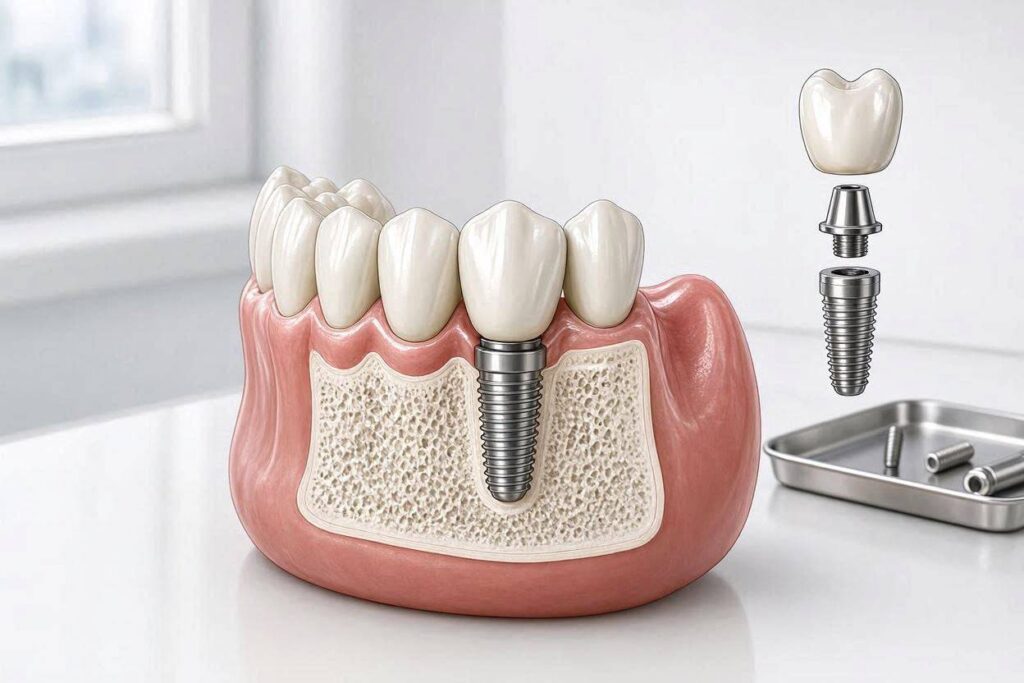
A dental implant is not a single piece. It is a system of components, each with its own name. Understanding these component names helps you understand exactly what your treatment plan involves and what you are paying for.
The Implant Body
The implant body, also called the implant fixture, the implant screw, or simply the implant, is the part surgically placed into the jawbone. It is typically made of commercially pure titanium or a titanium alloy, though zirconia ceramic implants are also available. The implant body is threaded on the outside to engage the bone and has an internal connection to receive the abutment.
The implant body remains completely beneath the gum tissue during the healing phase. Once osseointegration has occurred and the implant has fused with the bone, the gum is opened to expose the top of the implant and the restorative process begins. The implant body is the permanent, non-removable foundation of the entire restoration.
The Abutment
The abutment is the connector piece that attaches to the implant body and protrudes through the gum to support the crown. It is sometimes called an implant post, a connector, or a transmucosal abutment. The last term, transmucosal, means that it passes through the mucosa or gum tissue.
Abutments can be stock abutments, which are prefabricated in standard shapes and sizes, or custom abutments, which are fabricated specifically for your mouth. Custom abutments are designed by a laboratory technician or milled from a digital scan to match the specific angle, height, and contour needed for your restoration.
The abutment is secured to the implant body with an abutment screw. This is a small screw that passes through the abutment and threads into the internal connection of the implant. In some implant systems, the abutment and the crown are separate pieces, and a second screw secures the crown to the abutment. In others, the abutment and crown are cemented together, or the crown screws directly into the implant without a separate abutment.
The Crown or Prosthesis
The crown is the visible tooth that attaches to the abutment. It is also called the restoration, the prosthetic tooth, the implant crown, or the prosthesis. For a single-tooth implant, the crown is fabricated from ceramic, porcelain-fused-to-metal, or zirconia. For multiple-tooth restorations, the prosthesis might be a bridge, a hybrid denture, or an overdenture.
The crown is the only part of the implant system that you see above the gum line. It is designed to match the color, shape, and contour of your natural teeth. When people say, “My dental implant looks great,” they are usually talking about the crown.
The Healing Abutment or Healing Cap
During the healing period after implant placement, a healing abutment or healing cap is often placed on top of the implant body. This small, temporary component protrudes slightly through the gum and shapes the gum tissue into a natural emergence profile. It is also called a gingival former or a permucosal extension.
The healing abutment is removed after the gum has healed and is replaced by the permanent abutment during the restorative phase. It is a temporary component that serves a biological purpose, guiding the gum tissue to heal into a shape that will look natural around the final crown.
The Cover Screw
If the implant is placed using a two-stage surgical protocol, the implant body is completely buried under the gum tissue after placement. A cover screw, also called a closure screw, is placed into the top of the implant to protect the internal connection during the submerged healing period. The cover screw is a tiny, flat screw that seals the implant.
After the implant has integrated with the bone, a second minor surgery is performed to expose the implant and replace the cover screw with a healing abutment. In a one-stage protocol, the implant is placed with a healing abutment from the start, and no cover screw is used.
Historical and Obsolete Implant Terms
Dentistry has experimented with various implant designs over the past century. Many of these are now obsolete, but you may encounter the terms in older literature or in conversations with older dentists.
Blade Implants
Blade implants, also called plate-form implants, were flat, knife-like pieces of metal with slots or holes that were tapped into a groove cut into the jawbone. They were popular in the 1970s and 1980s but have been largely abandoned. Blade implants had higher failure rates than modern root form implants and were difficult to remove when they failed. Some patients still have functioning blade implants placed decades ago, but no reputable dentist places them today.
Subperiosteal Implants
A subperiosteal implant was a custom-fabricated metal framework that rested on top of the jawbone, under the gum tissue. Posts extended through the gum to support a prosthesis. Subperiosteal implants were used when the jawbone was too resorbed for endosseous implants and bone grafting was not available or not desired.
Like blade implants, subperiosteal implants are now obsolete. Modern bone grafting techniques allow placement of endosseous implants in sites that would have required a subperiosteal implant in the past. A patient who still has a subperiosteal implant from decades ago may need to have it evaluated, as these implants have a limited lifespan and are difficult to maintain.
Transosteal Implants
A transosteal implant passed entirely through the jawbone from top to bottom, with a plate on the underside of the mandible. The most common transosteal system was the mandibular staple implant. These were used for the edentulous lower jaw when bone was extremely deficient. They are now almost entirely historical.
Terms Used in Specific Contexts
Different contexts call for different terminology. Understanding the preferred terms in each context helps you navigate the healthcare system.
Insurance Terminology
Dental insurance companies use specific codes and terms to describe implant procedures. The Current Dental Terminology codes used in the United States include D6010 for surgical placement of an implant body, D6056 for a prefabricated abutment, D6057 for a custom abutment, and D6058 for an implant-supported crown.
Insurance policies often refer to implants as “endosteal implants” and may classify them under “major restorative services” or “prosthodontic services.” The annual maximum and the waiting period for implant coverage are typically separate from or more restrictive than those for basic restorative care.
Surgical Terminology
In a surgical context, the dentist may use terms like osteotomy, which is the hole drilled into the bone to receive the implant, primary stability, which is the mechanical engagement of the implant immediately after placement, and osseointegration, which is the biological fusion of bone to the implant surface.
The surgical guide, also called a surgical stent or a drill guide, is a template that directs the implant drill to the planned position. Flapless surgery refers to implant placement without reflecting the gum tissue, a minimally invasive approach possible when the bone is adequate and the anatomy is favorable.
Restorative Terminology
The restorative dentist uses terms like impression coping, which is a component that transfers the implant position to a dental model, and emergence profile, which is the contour of the crown as it emerges from the gum. These terms relate to the fabrication of the final prosthesis rather than to the implant body itself.
Brand Names and Proprietary Terms
Dental implant manufacturers brand their products, and these brand names sometimes enter common usage as generic terms for implants, much as “Kleenex” is used for facial tissue.
Major Implant Brands
Nobel Biocare, a pioneer in implant dentistry, markets the NobelActive, NobelParallel, and Brånemark System implants. Straumann, a Swiss company, produces the BLX and TLX implant lines. Other major manufacturers include Dentsply Sirona with the Astra Tech and Xive systems, Zimmer Biomet, BioHorizons, and MegaGen.
A dentist might say, “I use the Straumann system,” or “This is a Nobel implant.” This refers to the specific brand and design of the implant body being placed. The brand matters for compatibility of components; the abutment and impression copings must match the implant system.
When Brand Names Become Shorthand
Some patients and even some dentists use brand names as shorthand for a type of implant or a treatment concept. “All-on-Four” is a trademarked term from Nobel Biocare for a specific full-arch rehabilitation technique using four implants, but it is often used generically to describe any full-arch implant rehabilitation, regardless of brand or number of implants.
“Teeth in a Day” is a marketing term used by various practices to describe immediate-load protocols where a temporary prosthesis is attached to implants on the same day as surgery. It is not a specific product or system but a treatment concept.
Colloquial and Patient Terms
Patients often develop their own language for describing dental implants, and dentists hear these terms regularly.
Common Patient Terms
Patients often refer to implants as “posts,” “screws,” “pegs,” or “studs.” A patient might say, “I have a screw in my jaw,” or “They put posts in and then the teeth snap on.” These terms are imprecise but generally understood in context.
“Screw-in teeth” is a common colloquial description of implant-supported crowns or bridges. “Permanent dentures” is often used to describe implant-supported full-arch prostheses, though technically these prostheses are not permanent and will eventually need replacement due to wear.
“Snap-on dentures” is the colloquial term for implant-retained overdentures, which are removable by the patient but snap onto implant abutments for retention. The technical term is implant-retained overdenture or implant-stabilized overdenture.
Terms to Avoid
Some colloquial terms can create confusion. Calling an implant a “post” can blur the distinction between an implant and a post used in root canal therapy. Referring to an implant crown as a “cap” can blur the distinction between an implant crown and a traditional crown on a natural tooth. Precise communication with your dentist is aided by using the standard terminology, even if approximate.
International Variations in Terminology
English-speaking countries use slightly different dental vocabulary, and understanding these variations is helpful for patients researching treatment abroad or reading international sources.
United Kingdom and Commonwealth Usage
In the United Kingdom, Australia, and New Zealand, the terminology is largely identical to that used in North America. “Dental implant” is the standard term. Some minor variations exist. UK dentists may be more likely to use “implant-retained” rather than “implant-supported” for overdentures, and “bridgework” is more common than “bridge” in some Commonwealth contexts.
Non-English Terminology
In German, a dental implant is a Zahnimplantat. In Spanish, it is an implante dental. In French, implant dentaire. These direct translations are straightforward, but patients seeking care abroad should ensure they understand the specific terms used in the treatment plan and consent forms, ideally with the assistance of a translator who understands dental terminology.
Digital and Modern Terminology
As implant dentistry evolves, new terminology emerges from digital workflows and new technologies.
Computer-Guided Implant Terms
Digital implant planning uses cone beam computed tomography and intraoral scanning to create a virtual model of the patient’s anatomy. Terms like digital workflow, guided surgery, and navigated surgery describe this approach. The surgical guide, also called a stereolithographic guide, is a physical template produced from the digital plan.
Immediate Implant Terms
An immediate implant is one placed at the same appointment as a tooth extraction. Immediate loading refers to attaching a provisional restoration to the implant on the same day as placement. Delayed placement occurs weeks or months after extraction, and delayed loading occurs after the implant has integrated.
Zirconia Implants
Most dental implants are made of titanium, but zirconia ceramic implants are an alternative for patients with metal allergies or aesthetic concerns in the anterior region. Zirconia implants are sometimes called metal-free implants or ceramic implants. They have a different surface chemistry and osseointegration profile from titanium implants.
Summary Table of Dental Implant Terminology
| Term | Refers To | Context |
|---|---|---|
| Dental Implant | The entire tooth replacement system | General, patient-facing |
| Endosseous/Endosteal Implant | Implant placed within the bone | Technical, surgical, insurance |
| Root Form Implant | Implant shaped like a tooth root | Technical, historical distinction |
| Fixture | The implant body in the bone | Surgical, clinical |
| Implant Body | The part surgically placed | Component-specific |
| Abutment | The connector between implant and crown | Restorative, component-specific |
| Implant Crown | The visible prosthetic tooth | Patient-facing, restorative |
| Healing Abutment | Temporary component shaping gum | Surgical, healing phase |
| Cover Screw | Protects implant during submerged healing | Surgical, two-stage protocol |
| Osseointegration | The biological fusion process | Biological, scientific |
Conclusion
A dental implant is known by many names depending on context. The general term is dental implant. In surgical and technical contexts, it is called an endosseous implant, root form implant, or fixture. The complete system consists of the implant body surgically placed in the bone, the abutment that connects through the gum, and the crown that provides the visible chewing surface and aesthetics. Historical designs like blade and subperiosteal implants are obsolete. Brand names, patient colloquialisms, and digital workflow terms add layers to the vocabulary, but the core concepts remain consistent across all contexts and English-speaking countries.
Frequently Asked Questions
Is a dental post the same as a dental implant?
In casual conversation, patients sometimes use “post” to mean an implant. However, in dentistry, a post is a small rod placed inside a root canal-treated tooth to retain a core and crown, not a replacement for the tooth root. Clarify with your dentist whether they are talking about an implant or a post inside a natural tooth.
What is the difference between a fixture and an implant?
Fixture is a synonym for the implant body, the part placed into the bone. There is no meaningful difference. Some dentists prefer “fixture” in surgical contexts.
Are All-on-Four and dental implants the same thing?
All-on-Four is a specific treatment concept that uses four dental implants to support a full arch of fixed replacement teeth. The implants are standard dental implants. The term refers to the technique and the prosthesis design, not to a different type of implant.
What does endosteal mean on my insurance paperwork?
Endosteal means the implant is placed within the bone. This is the standard type of dental implant. The term appears on insurance forms for coding and classification purposes.
Is a zirconia implant the same as a regular implant?
A zirconia implant serves the same function as a titanium implant but is made of a ceramic material instead of metal. The terminology is the same; the material differs. Zirconia implants are sometimes called ceramic or metal-free implants.
Additional Resource:
For a comprehensive glossary of dental implant terminology, visit the American Academy of Implant Dentistry at https://www.aaid.com.