Can Dental Implants Cause Chest Pain?
You are recovering from dental implant surgery, or perhaps you have had implants for some time, and you experience a troubling new symptom: chest pain. The pain may be sharp or dull, localized or radiating. It may worsen when you take a deep breath or when you move in a certain way. Your mind immediately connects the two events. The implant surgery involved your jaw, not your chest, but the body is a connected system, and you wonder whether the procedure could have triggered something more serious. The question is urgent because chest pain is not a symptom to ignore: can dental implants cause chest pain?
The answer requires an immediate and critical distinction between chest pain that originates from the implant and surgical site, which is generally musculoskeletal or referred in nature and not life-threatening, and chest pain that signals a cardiac or pulmonary emergency, which may be coincidental to the implant treatment but demands immediate medical attention. Dental implant surgery does not directly cause cardiac ischemia, myocardial infarction, or pulmonary embolism. However, the stress of surgery, the medications administered, the presence of infection, and the phenomenon of referred pain can all contribute to chest discomfort that, while not cardiac in origin, is genuinely felt in the chest.
This guide explores the potential pathways from dental implant treatment to chest pain. We will explain the musculoskeletal causes, including muscle strain from prolonged mouth opening and referred pain from the jaw muscles. We will discuss the role of postoperative infection and the rare but serious risk of mediastinal spread. We will address the anxiety-related chest pain that can accompany the stress of surgery. And, most importantly, we will provide clear guidance on when chest pain should be treated as a medical emergency, regardless of its perceived connection to the implant.
Musculoskeletal Chest Pain: The Most Common Implant-Related Cause
The most common cause of chest pain that a patient associates with dental implant surgery is musculoskeletal, originating from the muscles of mastication, the neck, or the chest wall. This pain is not dangerous, but it can be alarming because the location and quality of the pain can mimic more serious conditions.
During implant surgery, particularly when multiple implants are placed or when the procedure is lengthy, the patient’s mouth is held open for an extended period. This places sustained tension on the muscles of mastication—the masseter, the temporalis, and the medial and lateral pterygoids—as well as on the accessory muscles of the neck and jaw. The patient may unconsciously brace against the forces being applied, tensing the muscles of the neck, shoulders, and even the chest. This sustained muscular contraction can lead to post-exertional muscle soreness that manifests a day or two after the procedure.
The temporalis muscle, a broad, fan-shaped muscle on the side of the head, is a frequent source of referred pain. Myofascial trigger points in the temporalis can refer pain to the temple, behind the eye, and down into the upper chest. The patient experiences chest discomfort that is actually originating from a jaw muscle fatigued during surgery. Similarly, the sternocleidomastoid muscle, which runs from behind the ear to the sternum and clavicle, can be strained during prolonged mouth opening and positioning. Trigger points in this muscle can refer pain to the sternum and the upper anterior chest, closely mimicking the sensation of cardiac chest pain.
The chest wall muscles themselves, particularly the pectoralis muscles and the intercostal muscles between the ribs, can become sore from the unconscious guarding and tension held during the procedure. The patient may not realize they were tensing these muscles, but the postoperative soreness is real. The pain is typically reproducible with movement, palpation, or deep breathing, which distinguishes it from cardiac pain.
Referred Pain from Infection or Nerve Irritation
Postoperative infection at the implant site can, in rare and severe cases, spread along the fascial planes of the head and neck, potentially reaching the mediastinum, the central compartment of the chest. This is a dire complication, not a routine postoperative event. Descending necrotizing mediastinitis, discussed in the article on implant-related mortality, is a rapidly progressive, life-threatening infection that can present with chest pain, difficulty breathing, fever, and systemic toxicity. This condition is a medical emergency requiring immediate hospitalization, intravenous antibiotics, and surgical drainage. It is exceptionally rare in the context of routine, uncomplicated implant surgery, and it is virtually always preceded by obvious signs of severe oral infection: massive swelling, purulent drainage, trismus, and high fever.
More commonly, a localized postoperative infection or a dry socket at an extraction site can cause pain that radiates. The nerves that supply the teeth and jaws have connections to the cervical plexus and the upper thoracic nerves. Pain from an infected lower molar implant site can be referred along the distribution of the mylohyoid nerve or the cervical nerves, creating discomfort that is perceived in the upper chest or the clavicular region. This is neuropathic referred pain, not a sign of chest pathology. The diagnosis is made by identifying the source of the pain at the implant site, and the chest discomfort resolves when the local infection is treated.
Anxiety and Chest Pain
Anxiety is a powerful generator of physical symptoms, and chest pain is among the most common somatic manifestations of anxiety and panic. A patient undergoing implant surgery is subjected to multiple stressors: the anticipation of pain, the financial burden, the aesthetic concerns, and the vulnerability of being in a surgical setting. The body’s stress response activates the sympathetic nervous system, which can cause increased heart rate, elevated blood pressure, hyperventilation, and muscle tension.
Hyperventilation, or rapid, shallow breathing, can produce a sensation of chest tightness and discomfort. The chest wall muscles become fatigued from the rapid respiratory rate. The patient may also experience palpitations, a feeling that the heart is racing or pounding, which adds to the fear that something is wrong with the heart. This cycle of anxiety, hyperventilation, and chest pain can escalate into a full-blown panic attack, with a sense of impending doom that convinces the patient they are having a heart attack.
The chest pain of anxiety is typically sharp, fleeting, and located over the precordium, the area of the chest over the heart. It is often reproducible with palpation of the chest wall, a finding not typical of cardiac pain. It may be accompanied by other anxiety symptoms: sweating, trembling, shortness of breath, and a feeling of choking. Recognizing the role of anxiety does not mean the pain is not real; it means the treatment is directed at the anxiety, not the heart.
When Chest Pain Signals a Medical Emergency
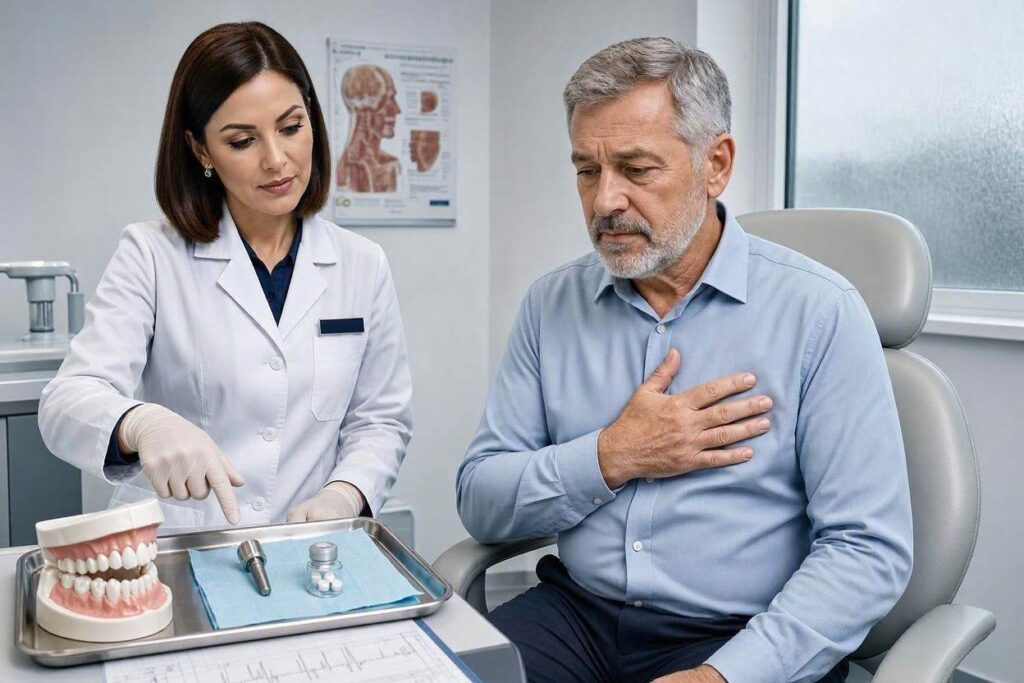
The critical clinical responsibility in evaluating a patient with chest pain after implant surgery is to rule out life-threatening conditions that may be coincidental to the dental procedure. A patient undergoing dental implant surgery is, by virtue of age and the underlying conditions that led to tooth loss, at some level of risk for cardiovascular disease. The stress of surgery can theoretically trigger a cardiac event in a susceptible individual.
The following features of chest pain are red flags that demand immediate emergency medical evaluation, regardless of the recent implant surgery:
- Crushing, squeezing, or pressure-like substernal chest pain, often described as an “elephant sitting on my chest.”
- Pain that radiates to the left arm, the jaw, the neck, or the back.
- Pain accompanied by shortness of breath, diaphoresis, nausea, vomiting, or lightheadedness.
- Pain that is not reproduced by palpation of the chest wall or by movement.
- Pain that progressively worsens over minutes to hours.
- A personal history of coronary artery disease, previous myocardial infarction, or significant cardiac risk factors.
If any of these features are present, the patient or their caregiver should call emergency services immediately. Do not delay to call the implant surgeon first. Do not drive yourself to the hospital. The implant can be evaluated later, after the cardiac emergency has been ruled out or treated. The implant is not the priority; the heart is the priority.
Another rare but potentially fatal condition that can present with chest pain is pulmonary embolism, a blood clot that travels to the lungs. Prolonged sitting during lengthy dental procedures, combined with the hypercoagulable state induced by surgery, theoretically increases the risk of deep vein thrombosis and subsequent pulmonary embolism. The chest pain of pulmonary embolism is often sharp, pleuritic, and accompanied by sudden shortness of breath. This is a medical emergency.<div style=”border-left: 4px solid #e76f51; padding: 15px; margin: 25px 0; background-color: #fff5f3;”> <p style=”font-weight: bold; margin-bottom: 5px;”>⚠️ Chest Pain Requires Medical Evaluation</p> <p style=”margin: 0;”>Never dismiss chest pain as “probably just muscle soreness from the dental surgery” without a medical evaluation. The implant surgeon can evaluate the surgical site for local causes of referred pain, but if there is any suspicion of cardiac or pulmonary origin, the patient must be evaluated in an emergency department. The consequences of missing a myocardial infarction are catastrophic and irreversible. When in doubt, seek emergency care.</p> </div>
Conclusion
Dental implant surgery can cause chest pain through musculoskeletal strain from prolonged mouth opening, referred myofascial pain from the jaw and neck muscles, localized infection with radiating pain, and the somatic manifestations of anxiety, all of which are generally benign and self-limiting. However, chest pain must never be automatically attributed to the implant without ruling out life-threatening cardiac or pulmonary conditions, which may coincide with but are not caused by the implant surgery. When chest pain presents with the classic features of cardiac ischemia or pulmonary embolism, emergency medical evaluation takes absolute precedence over any dental concern.
Frequently Asked Questions
Q: Can the local anesthetic injection cause chest pain?
A: The local anesthetic used in implant surgery, particularly if it contains epinephrine to prolong numbness and reduce bleeding, can cause transient palpitations, a sensation of a racing heart, and mild chest tightness if it is inadvertently injected into a blood vessel. This effect is short-lived, typically lasting a few minutes, and resolves as the anesthetic is distributed and metabolized. True chest pain from the local anesthetic is rare and self-limiting.
Q: How can I tell if my chest pain is from muscle soreness or my heart?
A: Musculoskeletal chest pain is typically reproducible by pressing on the chest wall, by moving the arms or torso, or by taking a deep breath. Cardiac chest pain is generally not affected by these maneuvers and is often accompanied by other symptoms such as shortness of breath, sweating, and nausea. However, this distinction is not always reliable, and any chest pain that concerns you should be evaluated by a medical professional.
Q: Should I take aspirin if I have chest pain after implant surgery?
A: Do not self-medicate with aspirin for chest pain. Aspirin is an antiplatelet medication that can increase bleeding, which is a concern after oral surgery. If you are experiencing chest pain that you believe may be cardiac in origin, call emergency services and follow the dispatcher’s instructions. Do not take aspirin unless specifically instructed to do so by emergency medical personnel.
Q: Can an infected dental implant spread to my heart?
A: The bacteria from an infected implant can enter the bloodstream, a condition called bacteremia. In patients with certain pre-existing heart conditions, such as prosthetic heart valves, a history of infective endocarditis, or certain congenital heart defects, this bacteremia can seed the heart valves and cause infective endocarditis, a serious and potentially life-threatening infection. This is why antibiotic prophylaxis before dental procedures is recommended for high-risk patients. The chest pain associated with endocarditis is typically a late symptom, not an acute postoperative event.
Additional Resource:
For information on heart attack symptoms and emergency response, visit the American Heart Association: https://www.heart.org/