What Are Dental Implants?
A missing tooth is more than a gap in a smile. It is a functional loss that affects how a person chews, speaks, and feels about themselves. For most of human history, the options for replacing a lost tooth were limited to removable dentures or bridges that required grinding down healthy neighboring teeth. The advent of dental implants changed everything. They represent a fundamentally different approach to tooth replacement, one that mimics nature rather than working around it. This article provides a thorough, clear explanation of what dental implants are, the components that make up the system, the biological basis for their success, and the different types available.
The Core Concept: A Replacement for the Root
A natural tooth consists of two main parts. The crown is the visible white portion above the gum. The root is the hidden portion that extends into the jawbone, anchoring the tooth in place. When a tooth is lost, the root is lost along with the crown. This loss is significant because the root does more than hold the tooth in place. It transmits chewing forces into the bone, providing the mechanical stimulation that signals the body to maintain the bone. Without this stimulation, the jawbone begins to resorb, shrinking in height and width over time.
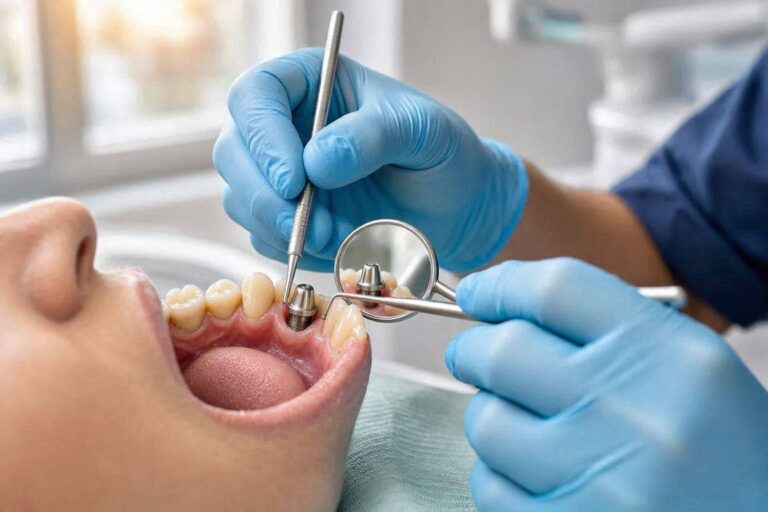
A dental implant is, at its essence, an artificial tooth root. It is a small post, most commonly made of titanium, that is surgically placed into the jawbone in the exact position of the missing natural root. Once the bone heals against the implant surface, a replacement crown is attached to it. The implant replicates the function of the natural root, providing both a stable anchor for the visible tooth and the crucial mechanical stimulation that preserves the jawbone. No other tooth replacement option achieves this.
The Components: A Three-Part System
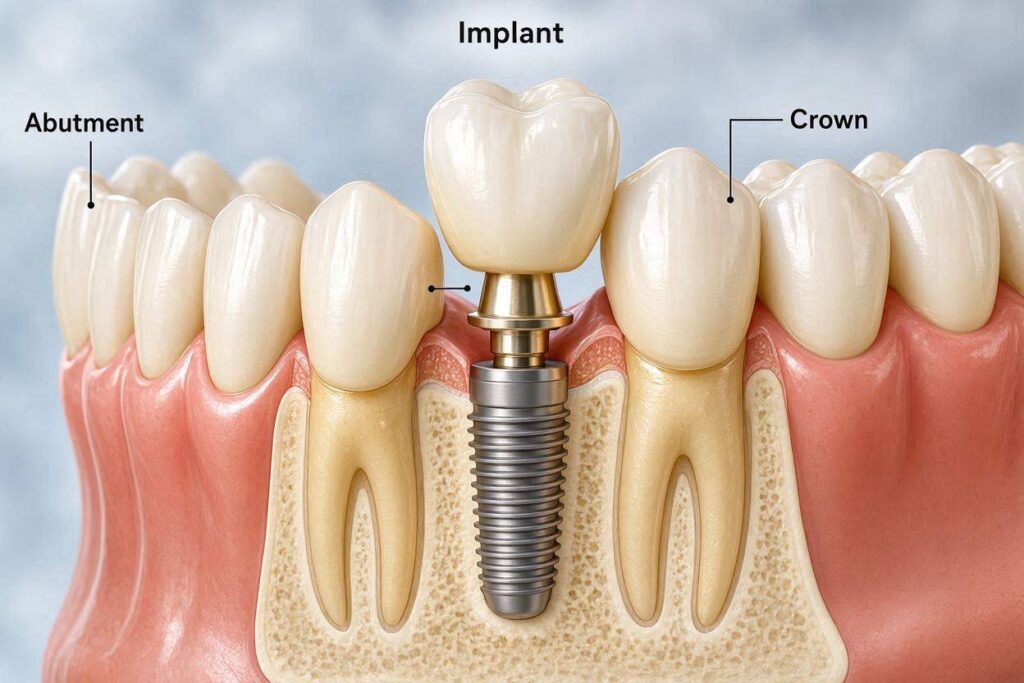
A dental implant is not a single object. It is a system of three distinct components, each with a specific function.
The Implant Fixture
The implant fixture, also called the implant body or screw, is the portion that is surgically placed into the jawbone. It is a cylindrical or tapered post with external threads, resembling a small screw. It is typically made of commercially pure titanium or a titanium alloy. The threads provide initial mechanical stability immediately after placement. The surface of the fixture is treated at the microscopic level to create a texture that encourages bone cells to attach and grow. The fixture is placed below the gum and is completely hidden once healing is complete. It functions as the new root.
The Abutment
The abutment is a connector piece that attaches to the implant fixture and projects through the gum into the mouth. It serves as the transition between the root-like fixture and the visible crown. Abutments can be made from titanium, titanium alloy, zirconia ceramic, or precious metal alloys. They can be stock abutments, which are prefabricated in standard shapes and sizes, or custom abutments, which are designed specifically for the individual patient’s anatomy using computer-aided design and manufacturing. Custom abutments allow the dentist to shape the emergence profile—the way the restoration seems to grow out of the gum—for optimal aesthetics.
The Restoration
The restoration is the visible part of the system. For a single missing tooth, the restoration is a crown made of ceramic. The crown can be cemented onto the abutment or screwed directly into the abutment, depending on the retention method chosen by the dentist. The crown is custom-made in a dental laboratory to match the shape, size, and color of the adjacent natural teeth. In a well-executed implant case, the crown is indistinguishable from the natural teeth.
The Biological Miracle: Osseointegration
The reason dental implants work is a biological process called osseointegration. The term was coined by Per-Ingvar Brånemark, the Swedish orthopedic surgeon who discovered the phenomenon in the 1950s. He found that titanium placed in contact with living bone could not be removed because the bone had fused directly to the metal surface. This was not a chemical bond or an adhesive process. It was a living, cellular integration.
Osseointegration occurs when osteoblasts, the bone-forming cells, migrate to the implant surface and lay down new bone directly against the titanium oxide layer. The bone interlocks with the microscopic surface roughness of the implant. Over several months, this woven bone remodels into mature lamellar bone. The implant becomes mechanically locked in place. It can then withstand the forces of chewing without moving. This process is predictable and durable. Implant survival rates in healthy patients exceed 95% at ten years and beyond.
Types of Dental Implants
Not all dental implants are the same. Different clinical situations call for different implant designs.
Endosteal Implants
Endosteal implants are placed directly into the jawbone. They are the most common type of dental implant, accounting for the vast majority of implants placed worldwide. They come in various sizes and shapes, including tapered, cylindrical, and hybrid designs. When people refer to “dental implants” without qualification, they are almost always referring to endosteal implants.
Subperiosteal Implants
Subperiosteal implants sit on top of the jawbone but under the gum tissue. A metal framework is custom-fabricated to fit the contours of the bone. Posts attached to the framework project through the gum to support the restoration. Subperiosteal implants were used historically when patients had insufficient bone for endosteal implants and bone grafting was not feasible. They have largely been replaced by modern bone grafting techniques that make endosteal implants possible even in atrophic jaws. They are rarely used today but remain a niche option in select cases.
Zygomatic Implants
Zygomatic implants are much longer than standard implants. They anchor not in the jawbone but in the zygomatic bone, or cheekbone. They are used in cases of extreme bone loss in the upper jaw where conventional implants are impossible even with grafting. Zygomatic implant placement is a highly specialized procedure performed by trained oral and maxillofacial surgeons. It is not a routine treatment.
Mini Implants
Mini implants are narrower in diameter than standard implants, typically less than 3 millimeters. They are used primarily to stabilize removable lower dentures in patients with insufficient bone for standard implants who do not wish to undergo grafting. They are less expensive and involve a less invasive placement procedure. Their long-term survival data is less robust than standard implants, and they are generally considered a compromise rather than a first-line treatment.
Implant Placement Protocols
The timing of implant placement relative to tooth extraction varies.
Immediate Implant Placement
The implant is placed into the extraction socket at the same appointment as the tooth removal. This reduces the number of surgeries and the total treatment time. It is appropriate only when the extraction site is free of active infection, the surrounding bone is intact, and primary stability of the implant can be achieved.
Early Implant Placement
The implant is placed four to eight weeks after extraction. This allows for some soft tissue healing while minimizing the bone resorption that occurs with longer delays.
Delayed Implant Placement
The implant is placed three to six months or more after extraction. The site is fully healed, with mature bone and soft tissue. This is the traditional protocol and remains appropriate when there was significant infection, when grafting was performed, or when the dentist prefers to place implants into fully healed ridges.
Implant Restoration Options
Implants can support a wide range of restorations, depending on how many teeth are missing.
Single Tooth Replacement
A single implant supports a single crown. This is the ideal treatment for a single missing tooth. It replaces the tooth without involving the adjacent teeth in any way.
Implant-Supported Bridge
When several adjacent teeth are missing, two or more implants can support a fixed bridge. This avoids the need to prepare healthy teeth as bridge abutments. The implants bear the load entirely.
Implant-Retained Overdenture
A removable denture is stabilized by two to four implants with special attachments. The denture snaps onto the implants, providing far greater stability than a conventional denture. The patient removes the denture for cleaning. This is a common and life-changing treatment for patients who struggle with loose lower dentures.
Full-Arch Fixed Restoration
Four to eight implants support a fixed, non-removable bridge of teeth. This is often called All-on-Four, All-on-Six, or full-arch implant rehabilitation. The patient cannot remove the prosthesis. It is cleaned similarly to natural teeth. This is the most comprehensive implant treatment for patients missing all teeth in an arch.
The Materials: What Implants Are Made Of
The overwhelming majority of dental implants are made from titanium or titanium alloys. Titanium is biocompatible, strong, lightweight, and capable of osseointegration. The surface is modified through processes like sandblasting and acid etching to create micro-roughness that enhances bone healing.
Zirconia implants are a ceramic alternative. Zirconia, or zirconium dioxide, is white in color and can be an aesthetic advantage in patients with thin gum tissue. Zirconia also osseointegrates, though the long-term clinical data is less extensive than for titanium. Zirconia implants are a valid option for patients with confirmed metal allergies or strong preferences for metal-free materials.
Who Is a Candidate for Dental Implants?
Most adults who are missing teeth and in reasonable general health are candidates for dental implants. The key requirements include adequate bone volume and density, healthy gums, good general health sufficient for elective surgery, and a commitment to excellent oral hygiene and regular professional maintenance.
Specific factors that increase risk and may modify the treatment plan include smoking, which impairs healing and increases the risk of implant failure and peri-implantitis. Uncontrolled diabetes is another concern, as elevated blood glucose impairs wound healing and increases infection risk. Well-controlled diabetics have success rates similar to non-diabetics. Certain medications, particularly high-dose intravenous bisphosphonates and other antiresorptive drugs, are strong contraindications. A history of radiation therapy to the jaws elevates the risk of osteoradionecrosis and makes implant surgery high-risk.
The Procedure: What to Expect
The implant process is a journey, not a single event. It begins with a comprehensive evaluation, including a medical history review, clinical examination, and advanced imaging, typically a Cone Beam CT scan. The dentist develops a detailed treatment plan.
The surgical placement appointment involves local anesthesia, an incision to expose the bone, precise drilling to prepare the implant site, and insertion of the implant fixture. The gum is sutured closed, and a healing period of three to six months follows.
Once osseointegration is confirmed, the implant is uncovered, and an impression is taken for the fabrication of the final crown. The crown is delivered and adjusted. The total timeline for a straightforward implant without grafting is typically four to eight months.
The Importance of Maintenance
A dental implant requires lifelong care. The tissues around the implant are susceptible to a condition called peri-implantitis, a destructive inflammatory process that causes bone loss. Peri-implantitis is caused by bacterial plaque and is more difficult to treat than periodontitis around natural teeth. Prevention is paramount.
Daily home care includes brushing, flossing with implant-specific floss, and the use of interdental brushes or water flossers. Regular professional maintenance visits allow the dentist or hygienist to monitor the implant, measure probing depths, take periodic radiographs, and perform professional debridement. An implant is an investment that repays diligent care with decades of service.
Conclusion
Dental implants are artificial tooth roots placed into the jawbone to replace missing teeth. They consist of a titanium fixture, a connector abutment, and a custom ceramic crown. Through the biological process of osseointegration, the bone fuses directly to the implant surface, providing stability that mimics a natural tooth root. Implants can replace a single tooth, multiple teeth, or an entire arch, and they are the only tooth replacement option that preserves the jawbone and does not involve adjacent teeth. They have become the standard of care for tooth replacement because they deliver predictable, long-lasting, and life-changing results.
Frequently Asked Questions
How are dental implants different from dentures?
Dental implants are fixed in the bone and do not come out. Dentures are removable. Implants preserve bone; dentures do not. Implants function more like natural teeth.
How long does a dental implant last?
With proper care, the implant fixture can last a lifetime. The crown may need replacement after 15 to 20 years due to wear.
Is the implant placement procedure painful?
The procedure is performed under local anesthesia and is not painful. Post-operative discomfort is similar to a tooth extraction and is managed with medication.
What if I do not have enough bone for implants?
Bone grafting procedures can regenerate bone volume. Even patients with significant bone loss can often become implant candidates after grafting.
Can dental implants fail?
Yes, though the failure rate is low. Early failure is often due to failed osseointegration. Late failure is often due to peri-implantitis. Risk factors include smoking and poor oral hygiene.
Are dental implants safe?
Dental implants are among the safest and most predictable surgical procedures. Serious complications are rare when proper planning and technique are used.
Additional Resource:
American Academy of Periodontology – Dental Implant Information
https://www.perio.org/consumer/dental-implants