Dental Implants vs Crowns
When a tooth is damaged, the number of options can feel overwhelming. You might have heard your dentist mention two very common solutions: a dental crown or a dental implant. At first glance, they seem to do the same thing—fix a tooth. But in reality, they are completely different procedures with unique timelines, costs, and long-term outcomes.
Think of it this way: a crown is like a helmet for an existing tooth. An implant is like building a new mountain from scratch.
Choosing the right path depends on your specific situation. How damaged is your tooth? Is the root still healthy? What is your budget? How long are you willing to wait?
This guide will walk you through everything you need to know. We will look at the science, the pain factor, the price tags, and the pros and cons of each option. By the end, you will feel confident talking to your dentist about what is best for you.
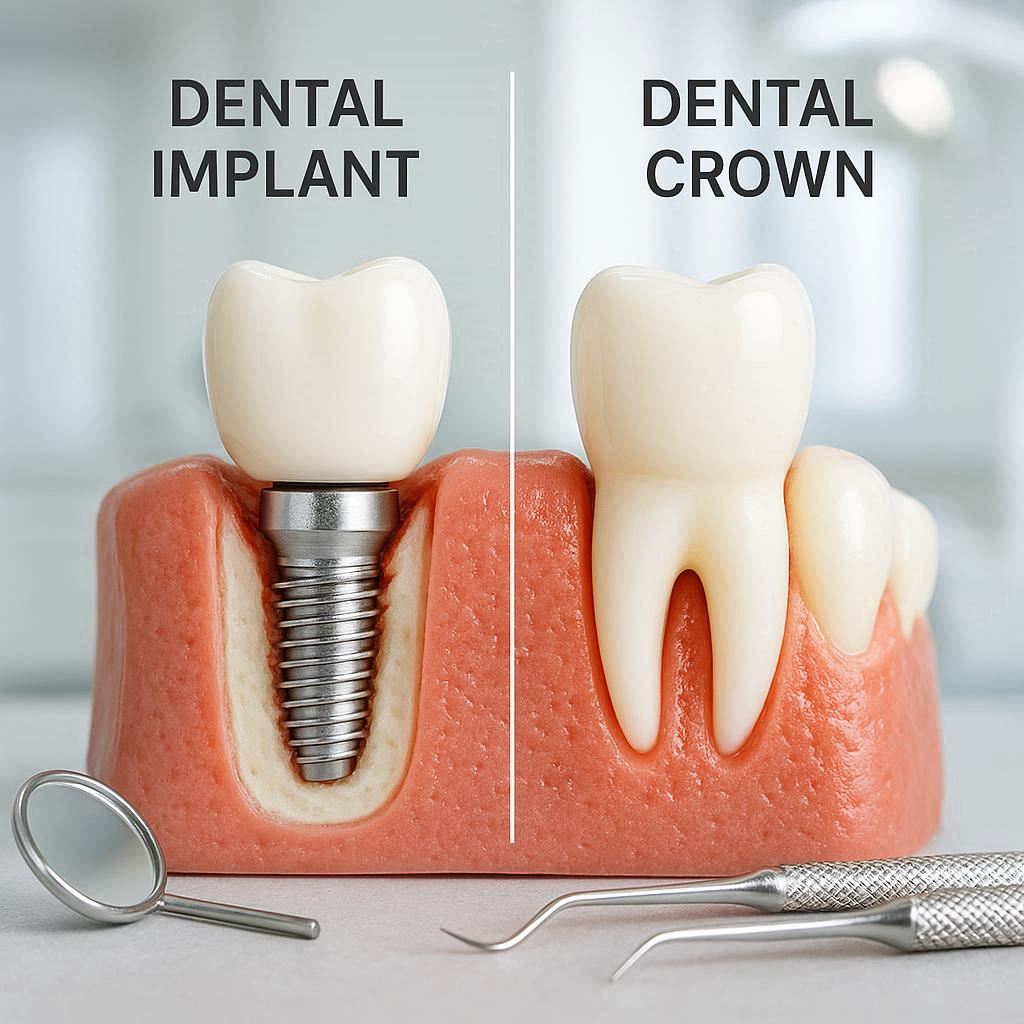
Understanding the Basics: What Are We Actually Talking About?
Before we compare them side-by-side, we need to understand what each device actually is. Many people confuse the two because they look similar above the gum line.
What is a Dental Crown?
A dental crown is a hollow, tooth-shaped “cap” that sits over your existing natural tooth. Imagine a thimble on a finger, or a winter hat on your head. The crown covers the entire visible part of the tooth down to the gum line.
Why do you need a crown?
You usually need a crown when the natural tooth is still there, but it is too weak or damaged to survive on its own. Common reasons include:
- A large cavity that took up more than half the tooth.
- A cracked or fractured tooth (where the crack does not go below the gum line).
- After a root canal treatment (the tooth becomes brittle and needs protection).
- To hold a dental bridge in place.
How it works: The dentist shaves down your original tooth to make it smaller. Then, they glue the permanent crown over the top. The root of your natural tooth stays alive underneath.
What is a Dental Implant?
A dental implant is a complete replacement for the entire tooth—both the root and the crown. It has three parts.
- The Post (Root): A small titanium screw that the dentist places into your jawbone.
- The Abutment: A small connector piece that screws into the post.
- The Crown: The fake tooth that attaches to the abutment.
Why do you need an implant?
You need an implant when the natural tooth is missing entirely, or when the root is too damaged to save. Common reasons include:
- The tooth fell out due to trauma (sports accident, fall).
- Severe decay destroyed the tooth down to the gum line.
- An old root canal failed, and the tooth cannot be repaired.
- You have a gap you want to close without affecting neighboring teeth.
How it works: The dentist places the titanium screw into the bone. Over several months, the bone grows around the screw (a process called osseointegration). Once the screw is stable, the dentist attaches the crown on top.
Important Note: You can actually have a crown on top of an implant. This is where people get confused. A crown is the top part. An implant is the whole system. When dentists say “implants vs crowns,” they usually mean “replacing the whole tooth (implant) vs repairing the existing tooth (crown).”
The Head-to-Head Comparison Table
To make things crystal clear, here is a direct comparison of the two procedures. Keep this table handy for reference.
| Feature | Dental Crown (on a natural tooth) | Dental Implant (full replacement) |
|---|---|---|
| What it replaces | Only the visible part of the tooth (the crown). | The entire tooth: root + visible crown. |
| Natural tooth requirement | Requires a natural tooth underneath. | Requires no natural tooth (for a missing tooth). |
| Procedure length | 2 visits (about 2-3 weeks total). | 3 to 9 months (due to bone healing). |
| Surgery required? | No. It is a restorative procedure. | Yes. Minor oral surgery to place the screw. |
| Average lifespan | 5 to 15 years (varies by care). | 20+ years to lifetime (with good care). |
| Cost (USA average) | $800 – $1,500 per crown. | $3,000 – $4,500 per implant + crown. |
| Impact on neighbors | May require shaving down adjacent teeth. | Does not touch or harm neighboring teeth. |
| Insurance coverage | Usually covers 50% of the cost. | Often limited or has a waiting period. |
| Recovery time | Minimal (a day or two of sensitivity). | Several months for bone healing. |
A Deep Dive into Dental Crowns
Let’s look closer at the crown procedure. This is the most common restorative procedure in dentistry. If you have ever had a root canal, you almost certainly have a crown.
The Step-by-Step Crown Process
Step 1: Diagnosis and Prep
Your dentist takes X-rays to check the root and bone around your tooth. They confirm there is enough healthy tooth left to support a crown.
Step 2: Shaping the Tooth (The “Shave Down”)
This is the most intimidating part, but it is painless with local anesthetic. The dentist files down the outer layers of your tooth. They remove about 1.5 to 2 millimeters of enamel. This makes room for the crown so it sits flush with your other teeth.
Step 3: Impressions
The dentist takes a mold (digital or putty) of your shaved tooth and the neighboring teeth. They send this mold to a dental lab.
Step 4: Temporary Crown
You leave the office with a plastic temporary crown. This protects the sensitive shaved tooth while you wait. You must avoid sticky or hard foods (no caramel or nuts) for two weeks.
Step 5: Permanent Placement
Two to three weeks later, the permanent crown arrives from the lab. The dentist removes the temporary crown, cleans the area, and cements the permanent crown onto your tooth. They check your bite to ensure it feels natural.
Types of Crown Materials
Not all crowns are equal. The material affects the price and the look.
- Porcelain-Fused-to-Metal (PFM): A metal core with a porcelain outside. Very strong, but the metal can show as a dark line at the gum over time.
- All-Ceramic or All-Porcelain: Best for front teeth. Looks exactly like natural enamel. Very aesthetic, but slightly less strong than metal.
- Zirconia: The strongest material currently available. It is a white metal that looks good and lasts a very long time. It is also the most expensive.
- Gold Alloy: Extremely durable and gentle on opposing teeth. Most dentists will tell you gold lasts the longest, but patients dislike the color.
Pros of Dental Crowns
- Faster treatment: You are done in three weeks.
- Lower upfront cost: Significantly cheaper than an implant.
- No surgery: No cutting into the gums or drilling into the bone.
- Preserves natural root: You keep the natural ligament that gives you feeling and feedback when chewing.
Cons of Dental Crowns
- Weakening the original tooth: Shaving down enamel is permanent. You can never go back.
- Future failure: If the root gets a cavity or cracks, the crown comes off, and you might lose the tooth anyway.
- Lifespan limit: Most crowns need replacement after 10-15 years.
- Potential for root canal later: Sometimes the tooth becomes sensitive years later and requires a root canal through the crown.
A Deep Dive into Dental Implants
Implants are the gold standard for missing teeth. They are modern, effective, and have a success rate above 95%. However, they require patience.
The Step-by-Step Implant Process
Step 1: Consultation and Imaging
The dentist (often a specialist called a periodontist or oral surgeon) takes a 3D CT scan of your jaw. They need to measure the bone height and width. If you do not have enough bone, you will need a bone graft first.
Step 2: Tooth Extraction (If needed)
If the damaged tooth is still in your mouth, the dentist removes it. You then wait 4-6 weeks for the gum tissue to heal.
Step 3: The Surgery (Placement)
This is done under local anesthesia (you are awake but numb). The surgeon cuts the gum, drills a precise hole into the jawbone, and screws the titanium post into the hole. The gum is stitched closed over the top or around a healing cap.
Step 4: Osseointegration (The Long Wait)
This is the most critical phase. You wait 3 to 6 months. During this time, your bone cells grow onto the titanium surface. The implant becomes fused to the bone like a natural root. You will have a gap or a temporary partial denture during this time.
Step 5: Abutment Placement
Once the implant is solid, a small second surgery exposes the top of the implant. The dentist screws on the abutment (the connector piece). The gum heals around it for two weeks.
Step 6: The Crown
Finally, the dentist takes impressions for the final crown. Two weeks later, they screw or cement the crown onto the abutment.
Do You Need a Bone Graft?
This is very common. If you have been missing a tooth for a long time, the bone in that spot shrinks because it has no root to stimulate it. A bone graft involves taking bone powder (from a donor or synthetic source) and packing it into the hole. This adds 3-6 months to your timeline.
Pros of Dental Implants
- Saves neighboring teeth: You do not touch the healthy teeth next to the gap.
- Prevents bone loss: The titanium screw keeps the jawbone healthy and dense.
- Long lifespan: With good hygiene, 90% of implants last over 20 years. Many last a lifetime.
- Feels natural: Because it is anchored in bone, it feels more like a real tooth than a bridge or partial denture.
- High success rate: 95-98% for lower jaw, slightly lower for upper jaw.
Cons of Dental Implants
- Expensive: Three to five times the cost of a crown.
- Time consuming: The process takes 6 to 9 months (or longer with a graft).
- Surgery risks: Infection, nerve damage (rare), or implant failure (the bone rejects the screw).
- Requires healthy gums: You cannot get an implant if you have active gum disease.
- Not for smokers: Smoking dramatically increases the failure rate.
Crown vs Implant: Which One Hurts More?
Pain is a major concern for readers. Let’s be realistic.
The Crown Procedure Pain:
- During the procedure: Zero pain. You are completely numb.
- After the numbness wears off: Mild to moderate soreness. Your gum might feel bruised because the dentist pushed on it. The shaved tooth might be sensitive to cold air for a few days. Most people take over-the-counter ibuprofen (Advil) for one day.
- Verdict: Low pain. You can go back to work the same day.
The Implant Procedure Pain:
- During the surgery: Zero pain. You are numb.
- After the numbness wears off: Moderate to significant pain for 24-72 hours. Because the dentist drilled into your bone, you will feel deep pressure and throbbing. You will likely need prescription painkillers for two days. Swelling is common. You should eat soft foods (soup, yogurt) for a week.
- Verdict: Moderate pain. Plan to take two days off work or rest over a weekend.
Reader Note: Do not let the pain of an implant scare you away. The first three days are the hardest. After that, the pain disappears. Most patients say the waiting is worse than the actual recovery.
Cost Breakdown: The Honest Financial Talk
Money is the biggest deciding factor for most people. Let’s look at the real numbers.
The Cost of a Crown
- Without insurance: $800 to $1,500 per tooth.
- With insurance: You pay 20% to 50% coinsurance. You might pay $300 to $700 out of pocket.
- Extra costs: If you need a root canal first, add $700 to $1,200.
The Cost of an Implant
- Without insurance: $3,000 to $4,500 for the entire package (surgery + abutment + crown).
- With insurance: Most plans do not cover implants, or they cover only the crown part. You might pay $2,500 to $3,500 out of pocket.
- Hidden costs:
- Extraction: $200 – $500.
- Bone graft: $500 – $1,500.
- CT Scan: $250 – $500.
- Temporary tooth during healing: $300 – $600.
- Total potential cost for one implant: $4,500 to $7,000.
Which is cheaper in the long run?
This is the trickiest question.
- Crowns are cheaper today. If you pay $1,200 for a crown, it lasts 10 years. You might need three crowns over 30 years (total $3,600).
- Implants are cheaper over a lifetime. If you pay $4,500 for an implant, it might last 30 years without any work. You save money on future dental visits.
If you are 25 years old, an implant is financially smarter. If you are 65 years old, a crown might be the better value.
When to Choose a Crown (And When to Avoid It)
Choose a Crown if:
- Your natural tooth is damaged but the root is healthy.
- The decay or crack is above the gum line.
- You have already had a root canal on that tooth.
- You need a quick solution (you cannot wait 6 months).
- You have a limited budget right now.
- You have medical issues that make surgery dangerous (uncontrolled diabetes, blood thinners, immune disorders).
Avoid a Crown if:
- The tooth is broken below the gum line (not enough tooth left to hold the crown).
- The tooth root has a vertical crack (this is not fixable).
- You grind your teeth heavily at night (you will crush the crown and the tooth under it).
- The tooth has already had two or three crowns (there is nothing left to shave down).
When to Choose an Implant (And When to Avoid It)
Choose an Implant if:
- The tooth is completely missing.
- The natural tooth is beyond repair (large vertical fracture).
- You want to avoid damaging the healthy teeth next to the gap.
- You are looking for a permanent, lifetime solution.
- You have healthy bone and healthy gums.
Avoid an Implant if:
- You are a heavy smoker (quitting is required for success).
- You have untreated gum disease (the infection will attack the implant).
- You take bisphosphonates (bone-building drugs for osteoporosis – ask your doctor).
- You are under 18 (your jaw is still growing).
- You cannot afford the time or money required.
The Verdict: Which is Right for You?
Let’s be blunt. This is not a competition. They fix different problems.
- You need a crown if you have a broken tooth.
- You need an implant if you have a missing tooth.
The confusion happens when the tooth is so broken that you cannot save it. In that case, the crown is no longer an option. You must extract the tooth. Once extracted, you have three choices: an implant, a bridge, or a partial denture.
The best advice from dentists: Save the natural tooth if you can. A crown on a living natural tooth is better than any implant because the natural ligament provides shock absorption. However, if the natural tooth is dying or dead, do not throw money at a crown. Remove the tooth and get the implant.
The Impact on Adjacent Teeth (A Hidden Factor)
One detail many articles miss is how these options affect the teeth next door.
How crowns affect neighbors:
Generally, they do not. A crown only touches the tooth it is on. However, if you are getting a bridge (which uses crowns on neighboring teeth), those healthy neighbors get shaved down by 70%. That is permanent damage to healthy teeth.
How implants affect neighbors:
Implants are independent. They do not touch the neighbors. This is the biggest advantage. You keep 100% of your natural enamel on the adjacent teeth.
If you have the choice between a bridge (crowns on neighbors) and an implant, the implant is almost always the healthier choice for your neighboring teeth.
Real Patient Scenarios
Let’s look at three common cases.
Case 1: Sarah, Age 34
Problem: A large cavity in her lower molar. The tooth is still solid, but the filling would be huge.
Decision: Crown. The root is healthy. The dentist shaved the tooth and placed a zirconia crown. Total cost: $1,200 with insurance. Total time: 3 weeks.
Outcome: Sarah is happy. The tooth lasts 12 years before needing a replacement.
Case 2: Mark, Age 45
Problem: His front tooth died after a sports accident 10 years ago. The tooth is gray and cracked vertically.
Decision: Implant. The tooth is beyond saving. The dentist extracted it, placed a bone graft, waited 4 months, placed the implant, waited another 4 months, then placed the crown. Total cost: $5,000. Total time: 8 months.
Outcome: Mark is thrilled. The implant looks exactly like his natural tooth. It has been 15 years with no issues.
Case 3: Linda, Age 68
Problem: A back molar cracked in half. Linda has high blood pressure and takes blood thinners. She does not want surgery.
Decision: Crown. Even though the crack is deep, the dentist tries to save it. If the crown fails in 5 years, Linda will just extract the tooth and leave the gap (she does not need a back tooth to chew).
Outcome: The crown works for 7 years. Linda never needed surgery. She made the right choice for her age and health.
Frequently Asked Questions (FAQ)
1. Can an implant get a cavity?
No. Titanium and porcelain do not decay. However, the gum around an implant can get infected (peri-implantitis). You must floss and brush implants just like real teeth.
2. Can a crown get a cavity?
Yes. The crown itself does not decay, but the natural tooth underneath can decay at the margin (where the crown meets the tooth). This is called marginal decay. It is the #1 reason crowns fail.
3. Which looks more natural?
Both can look perfect. A high-quality porcelain crown or implant crown is indistinguishable from a real tooth. The difference is the gum line. Implants sometimes show a tiny gray metal edge if the gum recedes.
4. Is the implant surgery dangerous?
For healthy people, no. It is one of the safest oral surgeries. The risks are low (infection, bleeding, nerve bruising). The nerve injury risk is under 1% for lower jaw implants.
5. How long do I have to wait after extraction to get an implant?
It depends. Immediate implants (placed the same day as extraction) are possible for front teeth. For molars, dentists usually wait 4-6 weeks for gum healing, or 4-6 months for bone healing.
6. Can I get an implant if I have gum disease?
No. You must treat the gum disease first. Active gum disease will attack the bone around the implant and cause it to fail within 2-3 years.
7. Will my insurance pay for an implant?
Most dental insurance plans exclude implants or have a “missing tooth clause” (they will not pay to replace a tooth that was missing before the policy started). Always call your insurance company before booking surgery.
8. What hurts more: crown prep or implant surgery?
Implant surgery hurts significantly more for the first three days. Crown prep is mild discomfort.
9. Can I replace an old crown with an implant?
Yes. If the natural tooth under the crown fails (root fracture or deep decay), the dentist extracts the tooth and places an implant. This is very common.
10. Which lasts longer?
Implants last longer than crowns on natural teeth. The average crown lasts 10-15 years. The average implant lasts 25 years to a lifetime.
Additional Resource
For a visual guide to the surgical process and to see real before-and-after photos of both procedures, visit the patient education library at the American Academy of Implant Dentistry (AAID) website. Search for “AAID patient education” to find reliable, non-commercial information about implant safety and success rates.
Recommended link: aaid.com/patients
A Quick Checklist for Your Dentist Appointment
Before you go to your consultation, write down these questions:
- Is my natural tooth savable, or is the root dead?
- Do I have enough bone for an implant?
- Do I have any signs of gum disease?
- How long would the implant process take in my specific case?
- Can you show me the cost breakdown for both options?
- Do you recommend a crown or an implant for my age and health?
Conclusion
Dental crowns are the best choice for saving a damaged but living natural tooth, offering a faster and more affordable fix. Dental implants are the superior lifetime solution for completely missing teeth, protecting your jawbone and neighboring teeth. Your final decision depends on the health of your current tooth, your budget, and how long you are willing to wait for the final result.