How To Clean Implant Full Dentures?
An implant-supported full denture is a transformative restoration. It restores the ability to eat, speak, and smile with confidence. It is also a significant financial and personal investment. Protecting that investment requires a commitment to meticulous daily care. Cleaning an implant full denture is not the same as cleaning natural teeth. It is not even exactly the same as cleaning a conventional removable denture. The presence of the implant attachments, the materials of the prosthesis, and the critical importance of maintaining the health of the peri-implant tissues all demand a specific, intentional cleaning protocol. This article provides a comprehensive guide to keeping your implant denture and the supporting implants clean, healthy, and functional for the long term.
Understanding What You Are Cleaning
Before discussing technique, it is essential to understand the anatomy of an implant full denture. There are two main types, and the cleaning protocol differs slightly for each.
Fixed Implant Full Dentures
A fixed implant denture, often called an All-on-Four, All-on-Six, or fixed hybrid prosthesis, is screwed or cemented onto the implants and cannot be removed by the patient. It is a permanent restoration. The prosthesis consists of a metal framework, usually titanium, supporting acrylic or porcelain teeth and gum-colored acrylic. The underside of the prosthesis rests on the gum tissue, and there is a space between the prosthesis and the gum that must be cleaned daily.
Cleaning a fixed implant denture is conceptually similar to cleaning a bridge on natural teeth, but it is more involved because the prosthesis is larger and the implants beneath it are critical to its survival.
Removable Implant Overdentures
A removable implant overdenture snaps onto the implants using special attachments, such as Locator abutments, ball attachments, or bars. The patient removes the denture daily for cleaning. The denture itself is similar to a conventional denture but has housings on the underside that contain the attachment inserts. The implants have abutments that project through the gum and mate with the denture attachments.
Cleaning a removable overdenture involves cleaning the denture itself, cleaning the abutments on the implants, and cleaning the gum tissue around the abutments. Each component requires specific attention.
The Tools You Need
Effective implant denture cleaning requires the right tools. Fortunately, they are readily available and not expensive.
Soft-Bristled Denture Brush
A brush designed specifically for dentures, with softer bristles than a standard toothbrush. This is used for cleaning the prosthesis outside the mouth.
Soft Toothbrush
A separate, soft-bristled toothbrush for cleaning the abutments and gum tissue inside the mouth. A compact brush head makes it easier to reach the back areas.
Water Flosser
An invaluable tool for implant denture care. The pulsating water stream flushes debris and bacteria from the space under a fixed prosthesis and around abutments. Use a non-metal tip to avoid scratching titanium surfaces.
Interdental Brushes
Small, cone-shaped brushes that fit into tight spaces. Proxy-brushes or interdental brushes are used to clean around individual abutments and under the framework of a fixed prosthesis.
Implant-Specific Floss or Floss Threaders
For fixed prostheses, specialized floss with a stiff threader end and a fuzzy cleaning section can be threaded under the framework and used to wipe the underside of the prosthesis and around the abutments.
Super Floss
A type of floss with a stiff end for threading, a spongy middle section for cleaning wide spaces, and regular floss on the other end. Excellent for cleaning under fixed prostheses.
Denture Cleanser
Effervescent tablets or soaking solutions specifically formulated for dentures. Used for daily soaking of removable dentures. For fixed dentures, non-abrasive antibacterial mouth rinses may be recommended.
Non-Abrasive Liquid Soap or Denture Paste
For manual brushing of the denture. Regular toothpaste is often too abrasive and can scratch the acrylic surface.
Cleaning a Removable Implant Overdenture
The removable overdenture requires a two-part cleaning routine: care of the denture outside the mouth and care of the implants inside the mouth.
Denture Care Outside the Mouth
Remove the denture. Always clean it over a sink filled with water or over a soft towel. A dropped denture can fracture or chip on a hard surface.
Rinse the denture under lukewarm water. Never use hot water. Hot water can warp the acrylic and ruin the fit of the denture.
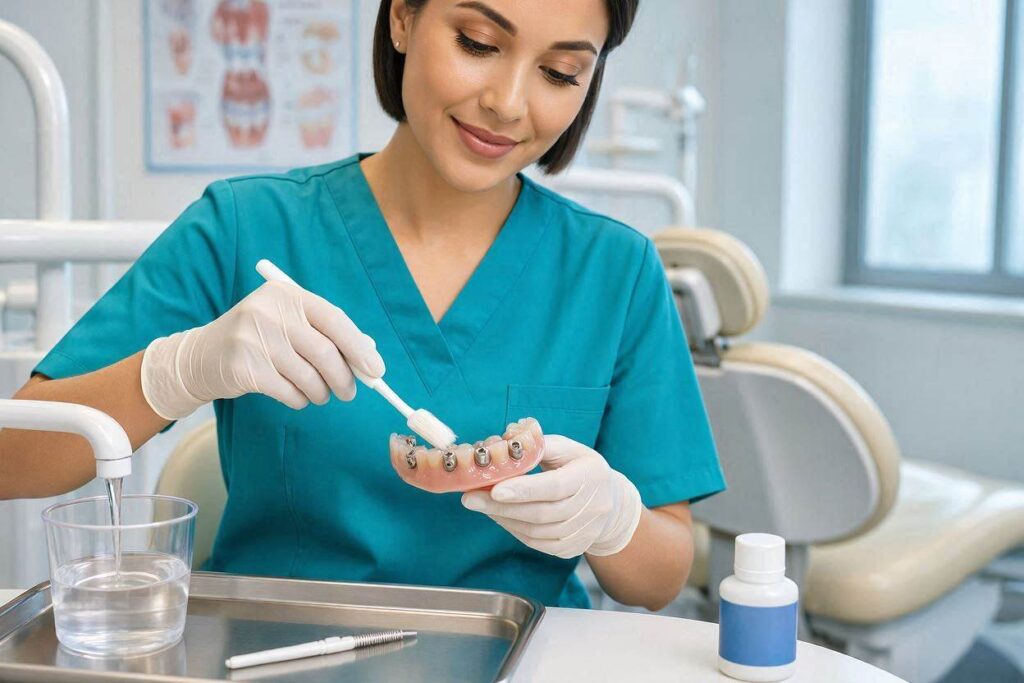
Apply a small amount of liquid soap or denture paste to a soft denture brush. Brush all surfaces of the denture thoroughly. Pay special attention to the underside, where the attachment housings are located. Plaque and food debris accumulate around these housings. Use an interdental brush or a small denture brush to clean inside the attachment housings gently.
Rinse the denture thoroughly with clean water. Inspect the attachment inserts, the small plastic or nylon pieces inside the housings. These wear over time and need periodic replacement. If an insert looks cracked, flattened, or worn, inform your dentist.
Soak the denture in a denture cleansing solution according to the product instructions. Soaking helps remove stains, kill bacteria, and keep the denture fresh. It is typically done overnight or for a specified period during the day.
Implant and Abutment Care Inside the Mouth
With the denture removed, you can see the implant abutments projecting through the gum. These are small metal cylinders or balls. The gum tissue around them must be kept clean and healthy.
Use a soft toothbrush to gently brush the abutments and the surrounding gum tissue. Use a small, circular motion. The goal is to remove soft plaque from the metal surfaces and stimulate the gum tissue.
Use an interdental brush or a water flosser to clean thoroughly around each abutment. The water flosser is particularly effective at flushing debris from the gum cuff around the abutment. Use a non-metal tip and set the water flosser to a comfortable pressure.
Rinse with an alcohol-free antibacterial mouthwash if recommended by your dentist. This helps reduce the bacterial load around the implants.
Do not use toothpaste containing abrasive ingredients on the abutments. Abrasive toothpaste can scratch the titanium surface, creating roughness where bacteria can adhere.
The Daily Rhythm
Most patients clean their removable overdenture twice daily. The denture is removed after meals for rinsing and is thoroughly brushed and soaked at least once daily. The abutments are cleaned every time the denture is removed. The denture should not be worn overnight unless specifically instructed by your dentist. The gum tissue needs time to rest and be exposed to saliva, which has natural antibacterial properties.
Cleaning a Fixed Implant Full Denture
A fixed implant denture presents a different challenge. The prosthesis stays in the mouth permanently. The patient must clean around and under it while it is in place.
Daily Brushing
Use a soft toothbrush and a non-abrasive toothpaste or gel recommended by your dentist. Brush all accessible surfaces of the prosthesis: the teeth, the gum-colored acrylic, and the junction where the prosthesis meets the natural gum tissue. Angle the brush to clean the gumline, just as you would with natural teeth. Use gentle, circular motions.
Cleaning Under the Prosthesis
The space between the fixed denture and the gum is the critical zone. Food debris and plaque accumulate here. If not removed daily, inflammation and infection of the underlying gum tissue and, more seriously, the peri-implant tissues will develop.
Thread super floss or implant-specific floss under the prosthesis. Use the stiff end to guide the floss through the space between the prosthesis and the gum. Once the floss is in position, use the spongy middle section to wipe the underside of the prosthesis. Move the floss back and forth, cleaning the acrylic surface that contacts the gum. Then guide the floss around each implant abutment, wiping the metal surface.
A water flosser is, for many patients, the most practical and effective tool for cleaning under a fixed prosthesis. Use a non-metal tip. Set the water flosser to a comfortable pressure. Direct the water stream under the prosthesis from both the cheek side and the tongue side. Move systematically around the arch, flushing every section. The water flosser dislodges food particles and disrupts bacterial plaque in areas that floss and brushes cannot reach.
Interdental brushes are used to clean around individual abutments and under the prosthesis framework. Select a brush size that fits the space. Insert the brush gently and move it in and out to dislodge debris.
The Recommended Routine
Most patients with fixed implant dentures brush at least twice daily with a soft brush. Water flossing is performed once daily, typically in the evening. Floss or interdental brush cleaning is done at least once daily. An alcohol-free antibacterial mouthwash may be used as a final rinse.
Professional Maintenance: The Essential Partner to Home Care
Home care, no matter how diligent, is not enough. Professional maintenance is an essential component of long-term implant success.
Patients with implant full dentures should see their dentist or hygienist for professional maintenance at intervals recommended by their clinician, typically every three to six months. More frequent visits may be indicated for patients with a history of periodontal disease or peri-implantitis.
During a professional maintenance visit, the dentist or hygienist removes the prosthesis if it is removable and cleans it professionally. Fixed prostheses are cleaned around and under with specialized instruments. The implant abutments are inspected and cleaned. The peri-implant tissues are probed to assess pocket depths and detect inflammation. Radiographs may be taken to evaluate bone levels around the implants. The attachment inserts in a removable overdenture are examined and replaced if worn.
The professional cleaning uses instruments specifically designed for implants. Plastic or titanium scalers are used to remove calculus without scratching the implant surfaces. Conventional stainless steel scalers must never be used on implants, as they scratch the titanium and create surface roughness that promotes bacterial adhesion.
The Consequences of Inadequate Cleaning
Poor cleaning of an implant full denture does not result in cavities, as the prosthetic teeth are not natural. It results in something potentially more serious: peri-implant disease.
Peri-implant mucositis is inflammation of the soft tissue around the implants. It is characterized by redness, swelling, and bleeding on probing. It is the precursor to peri-implantitis. It is reversible with improved home care and professional cleaning.
Peri-implantitis is the destructive inflammatory process that affects both the soft tissue and the supporting bone around the implants. It is caused by bacterial plaque. It results in progressive bone loss, deepening of pockets, suppuration, and eventual implant mobility and failure. It is more difficult to treat than periodontitis around natural teeth and can lead to the loss of the implants and the entire prosthesis.
The investment of time, money, and hope in an implant full denture can be lost to neglect. The daily cleaning routine is the insurance policy on that investment.
Special Considerations for Different Prosthesis Materials
The materials of the prosthesis influence the cleaning approach.
Acrylic-Based Prostheses
Most implant full dentures have an acrylic base with acrylic or composite teeth. Acrylic is somewhat porous and can absorb stains and odors. It is also susceptible to scratching by abrasive cleaners. Use only denture-specific cleansers and soft brushes. Avoid bleach, which can whiten the pink gum portion and weaken the acrylic.
Porcelain-Titanium Prostheses
Some high-end fixed prostheses use a titanium framework with individually cemented porcelain teeth. Porcelain is more stain-resistant and harder than acrylic, but it can still fracture under excessive force. Gentle cleaning is essential. Avoid dropping the prosthesis during cleaning.
Metal Frameworks
The metal framework underlying the prosthesis must be cleaned gently. Abrasive cleaners can scratch the metal. Scratched surfaces harbor more bacteria.
The Psychological Dimension of Implant Denture Care
The transition from natural teeth to an implant denture involves a psychological adjustment. The prosthesis feels foreign at first. The cleaning routine feels burdensome. Some patients feel a sense of loss or frustration.
These feelings are normal and usually transient. As the cleaning routine becomes habitual, it ceases to feel like a chore. As the patient experiences the functional benefits of the implant denture—eating comfortably, smiling without self-consciousness—the motivation to maintain it grows stronger. Support from the dental team, including clear demonstrations of cleaning techniques and positive reinforcement at maintenance visits, helps patients integrate their new reality.
Conclusion
Cleaning an implant-supported full denture is a daily discipline that protects a significant investment. For removable overdentures, the routine includes brushing the denture outside the mouth, soaking it in a denture cleanser, and carefully cleaning the implant abutments and surrounding gum tissue with a soft brush, interdental aids, and a water flosser. For fixed implant dentures, the routine involves brushing all accessible surfaces, threading specialized floss or using a water flosser to clean thoroughly under the prosthesis, and attending regular professional maintenance visits. The consequence of neglect is peri-implant disease, which can lead to implant failure and loss of the restoration. Diligent home care, combined with professional maintenance, can help an implant denture last for decades.
Frequently Asked Questions
Can I use regular toothpaste on my implant denture?
No. Regular toothpaste is too abrasive for the acrylic surface of a denture. Use a denture-specific paste or liquid soap with a soft denture brush. For the abutments in the mouth, use a non-abrasive gel recommended by your dentist.
How often should I soak my removable denture?
Soak it daily, typically overnight, in a denture cleansing solution. This removes stains, kills bacteria, and keeps the denture fresh.
Is a water flosser safe to use on my implants?
Yes. A water flosser with a non-metal tip is an excellent tool for cleaning around implants and under fixed prostheses. Use a comfortable pressure setting.
Can I sleep with my removable implant denture in place?
Generally, no. The gum tissue needs rest, and the denture needs to be cleaned and soaked. Your dentist will provide specific instructions.
How often do I need professional cleanings for my implant denture?
Most patients need professional maintenance every three to six months, as determined by their dentist based on their individual risk factors.
What happens if I do not clean under my fixed implant denture?
Plaque and food debris will accumulate, leading to inflammation of the gum tissue, peri-implant mucositis, and eventually peri-implantitis with bone loss and potential implant failure.
Additional Resource:
American College of Prosthodontists – Implant Denture Care Guidelines
https://www.gotoapro.org/