Should Dental Implants Feel Weird?
The human mouth is exquisitely sensitive. The tongue is a restless explorer, constantly mapping the terrain of teeth, gums, and palate. When something new appears in that landscape—a crown, a bridge, a dental implant—the brain registers it immediately. It feels foreign. It feels different. It feels, in a word, weird. Patients often worry that this strange sensation means something is wrong. In the vast majority of cases, it does not. This article explains what sensations are normal after dental implant treatment, why they occur, and how to distinguish the expected weirdness of healing and adaptation from the abnormal sensations that signal a problem.
The Baseline Reality: An Implant Is Not a Natural Tooth
The first and most important concept to absorb is that a dental implant is fundamentally different from a natural tooth. A natural tooth is attached to the jawbone by the periodontal ligament, a network of elastic collagen fibers that act as a shock absorber. This ligament is rich with nerve endings that provide proprioceptive feedback. When you bite down on a natural tooth, you feel pressure and can sense how hard you are biting. The tooth has a subtle, cushioned give.
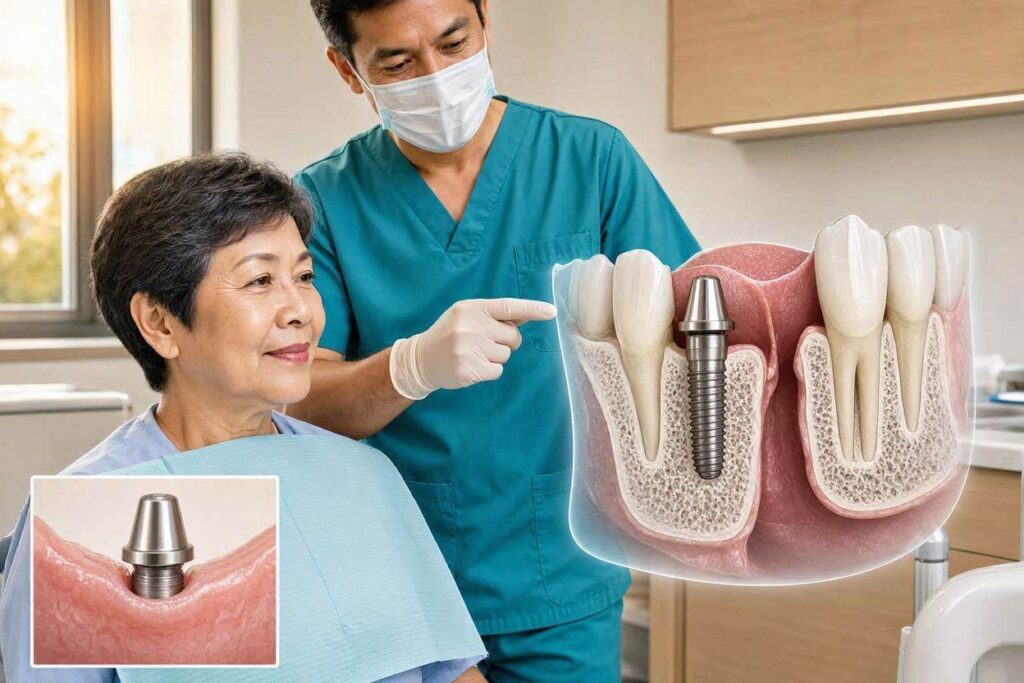
A dental implant is fused directly to the bone through osseointegration. There is no periodontal ligament. There is no elastic cushion. The implant is rigidly anchored. The nerve supply around an implant is different. Some of the proprioceptive nerve endings that served the natural tooth are gone. The brain receives different sensory information from an implant than it did from the natural tooth.
This biological difference explains why an implant feels different. It is not merely a subjective impression. It is a physiological reality. The implant will not feel exactly like the natural tooth it replaced. It will feel like a well-integrated, healthy implant. The patient who expects an implant to feel indistinguishable from a natural tooth in every sensory dimension may be disappointed. The patient who understands that “different” does not mean “wrong” will adapt more comfortably.
The Early Healing Phase: What Feels Weird and Why
The weeks and months following implant placement involve a cascade of healing events. The body is adapting to the presence of the implant, and this adaptation produces sensations.
The Presence of a Healing Abutment
If the implant was placed with a healing abutment, a small metal cylinder projects through the gum. The tongue will find it. Constantly. For the first several days or weeks, the patient may be unable to stop touching it. This is normal. The brain is mapping a new object in the oral environment. The sensation of a smooth metal dome where a tooth or a gap used to be is strange. The tongue’s obsession with it is involuntary and universal. Over time, as the brain habituates, the awareness fades. The patient forgets the healing abutment is there.
The Tightness of Healing Tissue
As the gum heals around the implant or healing abutment, it can feel tight. This is the normal sensation of tissue contracting and remodeling as collagen matures. It is not pain. It is a mild, persistent awareness of tautness in the gum. It resolves as the tissue fully adapts over several weeks.
The Absence of Sensation in the Gap
If the implant is buried under the gum and no healing abutment is present, the surgical site heals, and the patient waits. The gap where the tooth was feels empty. The gum over the implant site may feel slightly firm or lumpy compared to the surrounding tissue. This is the implant fixture under the gum, covered by healing tissue. The sensation is normal. The patient should not press on the area to feel the implant, as this can disturb healing.
Phantom Tooth Sensations
Some patients report feeling as though the missing tooth is still there. This is a phantom limb phenomenon, well-documented in amputation literature and reported in dental contexts. The brain’s sensory map still holds a representation of the tooth, and it can generate sensations that feel real. Phantom tooth sensations are benign and fade with time.
The Restorative Phase: The New Crown Arrives
When the final crown is delivered, a new wave of weird sensations begins. The patient has been living with a gap, a healing abutment, or a temporary prosthesis. Now there is a permanent, tooth-shaped object in the mouth. It occupies space. It contacts the opposing tooth. It touches the adjacent teeth. Everything feels prominent and intrusive.
The Feeling of Fullness
The most common description is that the implant crown feels “too big.” It feels like it is pushing against the adjacent teeth. It feels like it is the first thing that hits when biting down. The patient may be convinced that the crown is incorrectly sized or positioned.
In most cases, the crown is dimensionally correct. The sensation of fullness arises because the brain had adapted to the absence of the tooth. The gap had become normal. The restoration of the space feels like an addition, even though it is merely a return to the original pre-extraction anatomy. The brain needs time to re-adapt. This process takes days to weeks. Gradually, the implant crown ceases to feel prominent and begins to feel like part of the mouth.
The Occlusal Contact Sensation
When the dentist adjusts the bite on the new crown, the goal is light contact or very slight clearance in maximum intercuspation. The patient may still feel the crown as “high” initially. This can be because the opposing tooth has over-erupted into the gap over the months or years the tooth was missing, and the new crown is re-establishing contact that feels unfamiliar. If the bite truly is high, the patient will feel discomfort when chewing, and the tooth may be tender to percussion. This requires an adjustment. A quick return visit to the dentist resolves it. If the sensation is merely awareness without pain or functional interference, it is likely normal adaptation.
The Food Impaction Sensation
The patient may feel that food is getting stuck between the implant crown and the adjacent tooth. This can be a sign of an open contact, a gap between the crown and the adjacent tooth that allows food to pack. An open contact is a problem and requires correction. But the sensation of food trapping can also be normal. The implant crown lacks the slight physiological mobility of a natural tooth. During chewing, natural teeth move microscopically, allowing food to be cleared. The rigid implant crown can create a sensation of food stagnation even when the contact is properly adjusted. The patient should report the sensation so the dentist can check the contact. If the contact is correct, the patient adapts their oral hygiene technique to keep the area clean.
The Tongue’s Obsession: A Universal Phenomenon
Nearly every implant patient experiences a phase where the tongue cannot leave the new restoration alone. The tongue explores the contours, the junction with the gum, the biting surface, and the sides. This is not a sign of anxiety or a problem with the implant. It is a hardwired neurological response. The mouth is one of the most densely innervated parts of the body. The tongue is a muscular hydrostat with exquisite sensory capabilities. A new object in the oral environment triggers an exploratory reflex that is involuntary and powerful.
The tongue will eventually grow bored. Habituation occurs. The implant crown becomes background sensory information, no more remarkable than the adjacent natural teeth. This process takes weeks, not days. The patient who expects it and accepts it as normal will find it less distressing.
The Phonetic Adjustment
Speech is a finely coordinated motor skill that depends on precise interactions between the tongue, teeth, lips, and palate. When a tooth is replaced, especially in the anterior region, the tongue must relearn where to position itself for certain sounds. The patient may notice a temporary lisp, a whistle on “s” sounds, or a difficulty with “th” and “f” sounds.
This phonetic weirdness is almost always temporary. The brain adapts. The tongue finds new positions. Speech normalizes within a few weeks. Reading aloud, practicing troublesome words, and speaking consciously can accelerate the adaptation. If a speech issue persists, the dentist should evaluate the contour and position of the crown.
When Weird Is a Warning Sign
Not all unusual sensations are benign. Certain symptoms should prompt a call to the dentist.
Persistent Pain
Soreness after surgery and mild tenderness after crown delivery are normal. Pain that persists, worsens, or develops weeks or months after treatment is not. Pain on biting, throbbing pain at rest, or pain that radiates to the ear or jaw requires evaluation.
Mobility
An integrated dental implant should be rigidly fixed. Any sensation of movement, wobbling, or give is abnormal. Mobility can indicate failed osseointegration, a loose abutment screw, or a fractured component. This requires immediate dental attention.
Numbness or Altered Sensation
Some altered sensation after implant surgery is expected due to local anesthesia. Numbness that persists beyond 24 hours, particularly in the lower lip and chin, may indicate nerve injury. This is a known complication of implant surgery in the posterior mandible. It requires prompt evaluation.
Pressure or Swelling
A sensation of pressure, fullness, or throbbing in the implant area weeks after surgery, especially if accompanied by swelling, redness, or pus, suggests infection. This is not normal healing and requires treatment.
Metal Taste or Galvanic Sensation
A persistent metallic taste or a sensation of electrical shock when the implant crown contacts another metal restoration can indicate galvanic activity between dissimilar metals. This is uncommon but may require adjustment of the restorations.
The Emotional Adaptation
The sensory weirdness of dental implants has an emotional dimension. The patient has invested time, money, and hope. They want the implant to feel perfect, and when it feels strange, anxiety follows. Every odd sensation is a potential harbinger of failure. The patient may become hypervigilant, constantly checking the implant with their tongue, worrying that each meal will damage it.
This emotional response is normal. The dental team should anticipate it and provide reassurance. The patient should know that adaptation takes time and that the brain’s initial rejection of the “foreign” object is a temporary phase. If anxiety persists or interferes with daily life, the patient should discuss it with their dentist. A simple conversation, a reassurance that the sensations are expected, can be profoundly calming.
Conclusion
Dental implants should feel weird initially. The sensation of a new object in the mouth, the rigidity of an implant compared to a natural tooth, the tightness of healing tissue, and the brain’s sensory re-mapping all contribute to a period of strangeness that is entirely normal. The tongue will obsess. The bite will feel off. Speech may be altered. These sensations fade as the brain and body adapt over days to weeks. Persistent pain, mobility, numbness, or signs of infection are not normal and require professional evaluation. The key is patience and communication. Time, and the remarkable plasticity of the human nervous system, will transform the weird into the familiar.
Frequently Asked Questions
How long will my dental implant feel strange?
Most patients adapt within two to four weeks after crown delivery. The initial acute awareness fades within days. Residual awareness may persist for a month or two.
Why does my implant feel higher than my other teeth?
The sensation of height is common and often reflects the brain adapting to the new contact. If the bite feels uncomfortable when chewing, a quick adjustment by the dentist can resolve a true high spot.
Is it normal to feel the implant screw under my crown?
A screw-retained crown has an access hole filled with composite. The tongue may feel a slight texture difference. This is normal. There should be no sharpness or movement.
Why does food get stuck around my implant crown?
Some food trapping sensation is normal due to the implant’s rigidity. However, true food impaction from an open contact requires correction. Report the sensation so the dentist can verify the contact.
Can my implant feel loose even if it is not?
Sometimes a loose sensation is caused by the crown or abutment, not the implant fixture. Any feeling of movement should be evaluated immediately, but the problem may be a simple screw tightening rather than implant failure.
Will I ever stop noticing my dental implant?
Yes. For the vast majority of patients, the implant becomes fully integrated into their body image and conscious awareness fades. It becomes just another tooth.
Additional Resource:
American College of Prosthodontists – Adjusting to Dental Implants
https://www.gotoapro.org/