Do Dental Implants Resemble Dentures?
The question of whether dental implants resemble dentures reflects a common concern among patients considering tooth replacement. The two treatment options differ fundamentally in design, function, feel, and the patient experience they provide. While both replace missing teeth, the similarities largely end there. This article provides a detailed comparison between dental implants and dentures, clarifying the distinctions that matter most to patients making treatment decisions.
Fundamental Design Differences
Understanding the structural differences between implants and dentures is essential.
What Dental Implants Are
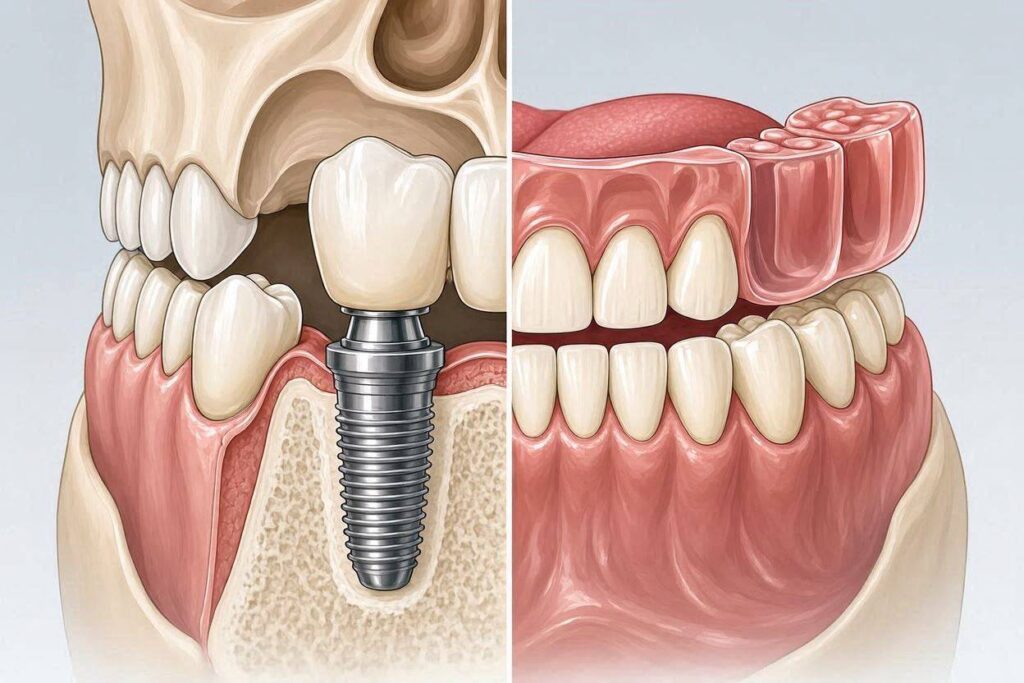
A dental implant is a titanium or zirconia post surgically placed into the jawbone. It replaces the root of a missing tooth. A crown, bridge, or fixed prosthesis attaches to the implant via an abutment. The implant is fixed in the bone, not removable by the patient. It functions independently or in combination with other implants, depending on the number of missing teeth and the restoration design.
What Dentures Are
A denture is a removable prosthesis that replaces multiple missing teeth. A complete denture replaces all teeth in an arch. A partial denture replaces some missing teeth and clasps onto remaining natural teeth for retention. Dentures rest on the gum tissue and underlying bone. They are removed for cleaning and during sleep. Retention comes from suction, adhesion, muscle control, and in the case of partial dentures, clasps around natural teeth.
Comparison of Key Patient Experience Factors
The differences between implants and dentures manifest in daily life.
Stability and Security
Dental implants are fixed in the bone. They do not move during eating, speaking, or laughing. An implant-supported restoration provides stability indistinguishable from healthy natural teeth for most patients.
Conventional dentures, particularly lower complete dentures, move during function. The lower ridge resorbs over time, reducing the surface area for support. The tongue and floor of the mouth musculature constantly challenge denture stability. Adhesives provide some additional retention, but movement is common. Upper dentures perform better due to the palatal seal, but even these can become loose with advanced bone resorption.
Chewing Efficiency
Implant-supported restorations restore chewing efficiency to levels approaching natural dentition. Patients with implant-supported fixed restorations report minimal dietary restrictions. They can bite into apples, chew steak, and enjoy crunchy vegetables.
Conventional denture wearers experience significantly reduced chewing efficiency. Studies demonstrate that denture wearers generate only a fraction of the biting force of patients with natural teeth or implant-supported restorations. Many foods become difficult or impossible to manage. Dietary choices narrow, potentially affecting nutrition.
Comfort
Well-integrated implants are comfortable. The restoration is supported by the implant, not by pressure on the gum tissue. There are no sore spots from denture borders rubbing. The palate is not covered by an acrylic plate, preserving normal sensation and taste.
Denture wearers frequently experience discomfort. Sore spots develop where the denture base rubs against irregular bone contours. The acrylic covering the palate reduces taste sensation and can trigger the gag reflex in some patients. Food particles trapped under the denture cause irritation. Relines and adjustments provide temporary relief but do not address the fundamental instability.
Speech
Implant restorations, particularly fixed restorations, do not interfere with speech. The patient speaks normally once acclimated to the new teeth.
Conventional dentures alter speech. The thickness of the denture base changes the oral cavity volume. Certain sounds, particularly sibilants, may be difficult to produce clearly. Most patients adapt with time, but some never achieve completely natural speech with dentures.
Aesthetics
Modern implant restorations are virtually indistinguishable from natural teeth when well-executed. The crown emerges from the gum naturally. There are no visible clasps. The restoration is fixed and stable during smiling.
Conventional dentures can provide good aesthetics at rest. However, the bulk of the denture flange may be visible at the gum line. Clasps on partial dentures may show when smiling. Denture movement during function can produce aesthetic embarrassment. Over time, as bone resorbs, the denture teeth appear to sink inward, and the face develops a characteristic collapsed appearance.
Bone Preservation
Dental implants transmit functional forces to the bone, stimulating bone maintenance. Bone around a functioning implant is preserved. This preservation extends to the facial bone that supports the lips and cheeks, maintaining facial contours.
Conventional dentures accelerate bone resorption. The pressure of the denture on the ridge, combined with the absence of functional stimulation within the bone, causes progressive bone loss. Over years, the ridge flattens, the denture becomes increasingly difficult to wear, and facial support diminishes.
Longevity and Maintenance
Well-maintained implants can last decades or a lifetime. The crown may require replacement due to wear after 15 to 20 years, but the implant fixture often survives indefinitely. Maintenance involves daily home care and regular professional evaluation.
Conventional dentures require relining every few years to adapt to changing ridge contours. They may need replacement every five to ten years. They require daily removal and cleaning. Denture teeth wear and lose aesthetics over time. Clasps on partial dentures fatigue and loosen.
Cost Considerations
The cost comparison between implants and dentures is complex and must consider the time factor.
| Factor | Dental Implants | Conventional Dentures |
|---|---|---|
| Initial Cost | Higher ($3,000-$6,000 per tooth) | Lower ($1,500-$3,000 per arch) |
| Replacement Frequency | Crown every 15-20 years | Denture every 5-10 years |
| Maintenance Costs | Professional cleaning, occasional component replacement | Relines, adjustments, adhesive purchases |
| 20-Year Cost Estimate | $4,000-$7,000 per tooth | $4,500-$9,000 per arch (multiple replacements) |
| Adjunctive Benefits | Bone preservation, stable function | None |
When analyzed over decades, the cost difference narrows significantly. Implants often prove more economical in the long term when considering replacement costs and the value of bone preservation.
Implant-Supported Overdentures: A Middle Ground
There exists a treatment option that combines elements of both approaches: the implant-supported overdenture.
What an Implant Overdenture Is
An implant overdenture is a removable denture that snaps onto supporting implants. Typically, two to four implants are placed in the arch. Locator attachments or other retention systems connect the denture to the implants. The patient removes the denture for cleaning but enjoys significantly improved stability and retention compared to a conventional denture.
How It Differs from Both
Compared to conventional dentures, implant overdentures are dramatically more stable and retentive. Chewing efficiency improves substantially. The denture is still removed for cleaning and during sleep. Bone preservation is improved because implants stimulate the bone, though not to the same degree as a fixed restoration.
Compared to fixed implant restorations, overdentures are less expensive. They require fewer implants. They are easier to clean because they can be removed. However, they are still removable prostheses with the bulk and palatal coverage of a denture. They do not provide the same psychological sense of permanence as fixed teeth.
The Psychological Dimension
The subjective experience of wearing a removable denture versus having fixed implant teeth differs profoundly.
The Emotional Impact of Dentures
Many denture wearers report feeling older than their chronological age. They may avoid social situations involving eating. They worry about denture movement during intimate moments or public speaking. The nightly ritual of removing teeth and placing them in a cup reinforces a sense of loss and aging.
The Psychological Benefit of Fixed Implants
Patients with fixed implant restorations describe feeling that they have their own teeth back. They eat, speak, and smile without the background anxiety of denture instability. The permanence of fixed teeth restores not just function but confidence and self-image. This psychological benefit, while difficult to quantify in dollars, is significant.
Conclusion
Dental implants do not resemble dentures in any meaningful way beyond the fact that both replace missing teeth. Implants are fixed in bone, stable during function, preserve bone, and provide a psychological sense of permanence. Conventional dentures are removable, rest on gum tissue, lose stability as bone resorbs, and carry significant functional and psychological burdens. Implant-supported overdentures bridge the two categories, offering improved stability over conventional dentures at lower cost than fixed implant restorations. Patients considering their options should understand these fundamental differences to make informed decisions aligned with their goals and resources.
Frequently Asked Questions
Can I sleep with my implant denture in?
Implant overdentures should be removed for sleeping to allow the tissues to rest and to facilitate cleaning. Fixed implant restorations remain in place at all times.
Do implant teeth feel like real teeth?
Fixed implant restorations feel very similar to natural teeth. They are stable, comfortable, and functional. The absence of the periodontal ligament means slightly different tactile feedback when biting, but most patients adapt quickly.
Can dentures be converted to implant-supported dentures later?
In many cases, yes. An existing denture can be retrofitted with attachments to connect to implants, provided the denture is in good condition and has adequate thickness.
Are implant dentures more comfortable than regular dentures?
Dramatically so. The stability provided by implant retention eliminates much of the movement that causes denture sore spots and discomfort.
Additional Resource
For comprehensive comparisons of tooth replacement options, visit the American College of Prosthodontists at www.gotoapro.org. The ACP provides patient education on fixed, removable, and implant-supported prostheses.