The Operation Of Dental Implants Reston?
The question “The Operation Of Dental Implants Reston?” appears to seek information about how dental implant procedures are performed, possibly with specific reference to Reston, Virginia. This article addresses both the procedural aspects of dental implant surgery and the considerations relevant to patients seeking implant treatment in the Reston area. It provides a thorough, step-by-step explanation of how implant surgery is performed, from initial consultation through final restoration, while contextualizing the information for patients in Northern Virginia.
Understanding the Phases of Implant Treatment
Dental implant treatment is not a single event but a process occurring over several months. Understanding the phases helps patients appreciate the complexity and the reasons for the timeline.
Phase One: Consultation and Planning
The journey begins with a comprehensive evaluation. The implant dentist or surgeon reviews your medical and dental history, performs a clinical examination, and obtains necessary imaging. Cone beam computed tomography is standard for implant planning, providing three-dimensional visualization of bone volume, nerve locations, and sinus anatomy.
During this phase, the dentist discusses treatment goals, explains options, and develops a preliminary treatment plan. If you have medical conditions such as diabetes or take medications that affect healing, these are factored into the plan. The consultation also addresses financial considerations, insurance coverage, and scheduling.
Phase Two: Preparatory Procedures
Some patients require procedures to prepare the implant site before implant placement can occur. These may include tooth extraction with or without socket preservation grafting, bone augmentation procedures to rebuild deficient ridges, sinus lift surgery for maxillary posterior implants, or periodontal treatment to establish oral health before implant surgery.
Healing from preparatory procedures may take several months before the site is ready for implant placement. This waiting period tests patience but is essential for long-term success.
Phase Three: Implant Surgical Placement
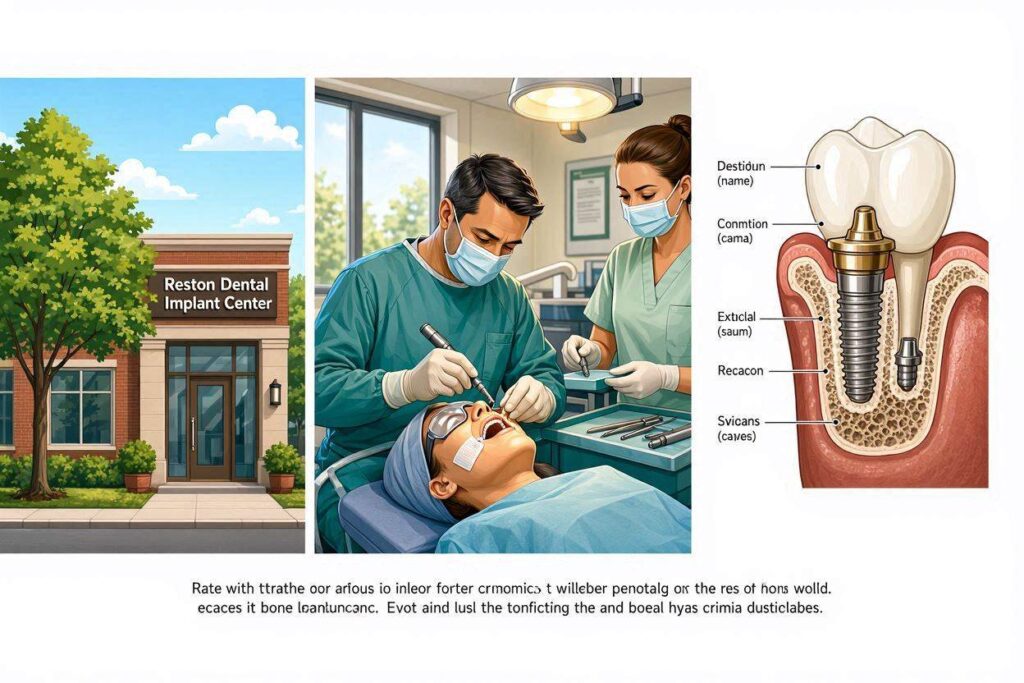
This is the procedure most patients think of when they hear “dental implant surgery.” It involves placing the titanium or zirconia implant fixture into the prepared bone site. The details of this phase are described extensively below.
Phase Four: Osseointegration
After implant placement, a healing period allows the bone to integrate with the implant surface. This period typically lasts three to six months, depending on bone quality, implant type, and patient factors. During this time, the implant must remain undisturbed.
Phase Five: Restoration
Once osseointegration is confirmed, the restorative phase begins. The implant is uncovered if buried, a healing abutment shapes the gum tissue, impressions are taken, and the final crown, bridge, or prosthesis is fabricated and delivered.
The Implant Surgery Procedure in Detail
The surgical placement of a dental implant follows a standardized sequence while being customized to each patient’s anatomy.
Anesthesia Administration
The procedure begins with local anesthesia to numb the surgical site completely. Most implant surgeries are performed under local anesthesia alone. Sedation options, including nitrous oxide, oral conscious sedation, or intravenous sedation, are available for anxious patients or extensive procedures. The choice depends on patient preference, procedure complexity, and the surgeon’s training and facility accreditation.
Flap Elevation or Flapless Approach
In a traditional approach, the surgeon makes an incision in the gum tissue and reflects a flap to expose the underlying bone. This provides direct visualization of the surgical site. The surgeon can assess bone contours, identify anatomical landmarks, and place the implant with full visual guidance.
In a flapless approach, used with surgical guides and in cases with adequate keratinized tissue and bone volume, the surgeon creates an opening through the gum directly to the bone without elevating a flap. This technique reduces post-operative discomfort and speeds healing but requires precise planning and guided surgery.
Implant Site Preparation
Using a series of progressively larger drills, the surgeon prepares an osteotomy, a precisely shaped hole in the bone, to receive the implant. Drilling occurs at controlled speeds with copious irrigation to prevent overheating, which can damage bone cells and compromise osseointegration.
The drilling sequence is specific to the implant system being used. Each drill corresponds to a specific diameter and depth. Surgical guides, fabricated from digital planning data, direct the drills into the exact planned position, angle, and depth when guided surgery is employed.
The surgeon verifies the osteotomy depth and angulation throughout the process. Parallelism pins or directional indicators confirm alignment. In critical anatomical areas, such as near the inferior alveolar nerve or maxillary sinus, the surgeon may take a radiograph with a direction indicator in place to verify safe distance from vital structures before final implant placement.
Implant Placement
The implant fixture is removed from its sterile packaging and inserted into the prepared osteotomy. It is threaded into place using a hand ratchet or a surgical motor with torque control. The surgeon achieves primary stability, meaning the implant is firmly anchored in the bone at the time of placement. Adequate primary stability is a prerequisite for successful osseointegration.
Insertion torque is measured and recorded. Values typically range from 30 to 50 Newton-centimeters for standard protocols. Higher insertion torque values indicate good primary stability and may allow immediate or early loading protocols.
Healing Abutment or Cover Screw Placement
After implant placement, the surgeon decides between a one-stage or two-stage protocol.
In a one-stage protocol, a healing abutment is placed on the implant and protrudes through the gum. The tissue is sutured around the healing abutment. No second surgery is needed to expose the implant. This approach works well when primary stability is excellent and the patient is compliant with post-operative care.
In a two-stage protocol, a cover screw is placed on the implant, and the gum tissue is sutured completely over it. The implant heals buried beneath the gum. A second minor surgery, performed three to six months later, exposes the implant and places a healing abutment. This approach is used when additional protection of the implant during healing is desired, when simultaneous grafting was performed, or when immediate loading is not planned.
Closure
The surgeon closes the incision with sutures. Resorbable sutures dissolve over one to three weeks. Non-resorbable sutures require removal at a follow-up appointment, typically seven to fourteen days post-operatively.
Immediate Post-Operative Care
The surgeon provides specific post-operative instructions covering bleeding management, pain control, diet, activity restrictions, oral hygiene, and follow-up appointments. A post-operative radiograph confirms implant position.
Technology Used in Modern Implant Surgery
The operation of dental implants in Reston and other sophisticated markets incorporates advanced technology.
Cone Beam CT Imaging
CBCT provides three-dimensional images of the jaw with low radiation dose compared to medical CT. The scan reveals bone volume and density, nerve canal position, sinus floor location, adjacent tooth root positions, and any pathology. Implant planning software uses CBCT data to simulate implant placement virtually before surgery.
Intraoral Scanning
Digital impressions capture the dentition and soft tissue contours without conventional impression materials. The digital data merges with CBCT data for comprehensive virtual planning.
Computer-Guided Surgery
Virtual implant planning translates into a physical surgical guide. The guide is 3D-printed or laboratory-fabricated to fit precisely over the patient’s teeth or bone. It directs implant drills and placement with accuracy measured in fractions of a millimeter. Guided surgery improves safety, reduces surgical time, and allows flapless approaches in appropriate cases.
Piezosurgery
Piezoelectric surgical units use ultrasonic micro-vibrations to cut bone selectively while preserving soft tissue. This technology is particularly valuable for sinus lift procedures, ridge splitting, and atraumatic extractions adjacent to implant sites.
Implant Surgery in the Reston Context
Reston, Virginia, situated in Fairfax County, is part of the greater Washington, DC metropolitan area. This location shapes the implant treatment landscape.
Provider Availability
The Northern Virginia and DC metro area hosts a high concentration of dental specialists including oral and maxillofacial surgeons, periodontists, and prosthodontists. Many general dentists in the area also offer implant placement with advanced training. This provider density creates a competitive market with options for patients.
Cost Considerations
Implant fees in Reston and Northern Virginia reflect the elevated cost of doing business in the DC metro area. Commercial rents, staff wages, and professional liability insurance costs are higher than national averages. Complete single implant costs typically range from $3,500 to $5,500 in the area. University clinics and residency programs in the broader region offer reduced-fee options.
Technology Adoption
Practices in the Reston area tend to adopt advanced technology, including CBCT and guided surgery protocols. Patients should inquire about the technology used by potential providers.
Conclusion
The operation of dental implants involves a multi-phase process beginning with comprehensive planning, proceeding through any necessary preparatory procedures, the surgical placement of the implant fixture, an osseointegration healing period, and finally restoration with a crown, bridge, or prosthesis. Modern implant surgery uses cone beam CT imaging, digital planning, surgical guides, and precise instrumentation to place implants safely and predictably. In areas like Reston, Virginia, patients have access to well-trained providers employing advanced technology. Understanding the procedure demystifies the process and helps patients approach implant treatment with confidence.
Frequently Asked Questions
How long does the actual implant surgery take?
Placement of a single implant typically takes 30 to 60 minutes. Multiple implants or concurrent grafting extend the surgical time.
Is implant surgery painful?
The procedure itself is painless under local anesthesia. Post-operative discomfort is usually mild to moderate and managed with over-the-counter analgesics.
Can the implant be placed immediately after tooth extraction?
In many cases, yes. Immediate implant placement into a fresh extraction socket is possible when adequate bone remains and infection is absent. Your surgeon determines if this protocol is appropriate.
How do I choose an implant surgeon in Reston?
Evaluate credentials, experience, technology use, before-and-after cases, and patient reviews. Consultations with multiple providers allow comparison of treatment plans and rapport.
Additional Resource
For finding qualified implant providers in Northern Virginia, visit the Virginia Dental Association at www.vadental.org. The VDA provides a member directory and patient resources.