Can You Put Braces On Dental Implants?
The question arises more often than you might think. A patient who previously invested in a dental implant now finds their remaining natural teeth shifting. Perhaps an old retainer was lost years ago. Perhaps age and gum changes are causing gradual crowding. Or a younger patient with a congenitally missing tooth replaced by an implant now needs comprehensive orthodontic treatment as their jaws finish growing. The natural instinct is to ask the orthodontist, “Can you just put braces on all my teeth, including the implant, and straighten everything together?”
The short and definitive answer is no, you cannot move a dental implant with braces. The implant is rigidly fused to the jawbone through osseointegration. It has no periodontal ligament. Braces work by applying controlled pressure to teeth, which stimulates the periodontal ligament cells to remodel the bone socket, allowing the tooth to move. An implant has no such ligament. Apply orthodontic force to an osseointegrated implant, and one of two things happens: nothing, if the force is light, or damage to the bone and potential implant failure if the force is heavy and sustained. The implant will not move through healthy bone.
However, this does not mean orthodontic treatment is impossible for patients with dental implants. It means the treatment plan must be designed intelligently around the implant. The implant becomes a fixed, immovable landmark. The orthodontist moves the natural teeth relative to that fixed point. In many cases, a well-integrated implant can serve as a perfect anchor, providing stable anchorage to help move other teeth predictably. The key is careful planning, clear communication between the orthodontist and the restoring dentist, and realistic expectations from the patient.
This guide will explore the biomechanical reality of why implants resist orthodontic force, the strategic ways orthodontists incorporate existing implants into treatment plans, the specific risks and precautions, and the ideal sequencing when you know you need both implants and braces. Armed with this knowledge, you can approach your treatment team with informed questions and a clear understanding of what is possible.
The Biomechanical Reality: Why Implants Don’t Move
We established the biological distinction between a natural tooth root and an implant fixture in the previous article. That distinction forms the foundation of this entire discussion. Let’s quickly reinforce the critical point. A natural tooth sits within a bony socket, suspended by a network of collagen fibers called the periodontal ligament. This ligament is a dynamic, living tissue. When an orthodontist places a bracket on the tooth and engages an archwire, the wire applies a sustained, light force to the tooth. On the pressure side, the periodontal ligament compresses, and specialized cells called osteoclasts are recruited to resorb bone. On the tension side, the ligament stretches, and osteoblasts are stimulated to lay down new bone. The tooth glides through the jawbone, its socket remodeling continuously.
An osseointegrated dental implant has none of this apparatus. There is no periodontal ligament. The bone is in direct contact with the titanium or zirconia surface at a microscopic level. There are no cells between the implant and the bone to orchestrate bone resorption and deposition. The implant is ankylosed, meaning it is rigidly fused. Apply a light orthodontic force, and the implant simply absorbs the stress without moving. Apply a heavier force, or sustain the light force for a prolonged period, and you risk exceeding the physiologic tolerance of the bone. The bone may respond not by remodeling in a healthy way, but by undergoing sterile necrosis or by developing microfractures at the bone-implant interface, leading to loss of osseointegration and implant failure.
Orthodontists learn this principle early in their training. The dental literature contains case reports of well-intentioned but misguided attempts to move implants with orthodontic forces, almost uniformly resulting in implant mobility and failure. The titanium surface, once covered in bone, becomes exposed. Bacteria colonize the threads. The implant becomes a loose, failing foreign body that must be surgically removed. Therefore, any orthodontic treatment plan involving an existing implant must respect its absolute immobility.
The Implant as an Absolute Anchor
Interestingly, the very property that prevents an implant from being moved makes it extraordinarily valuable in orthodontics when used correctly. Anchorage is a fundamental concept in orthodontics. Newton’s third law applies: for every action, there is an equal and opposite reaction. When you push or pull on a tooth to move it, the force has a reciprocal effect on the anchor unit you are pushing or pulling from. Managing this anchorage is a core clinical challenge. Sometimes, teeth you do not want to move start to drift because they are serving as anchors.
A successfully osseointegrated implant provides what orthodontists call “absolute anchorage.” It does not move at all. You can push or pull against it with confidence, knowing the reactive forces will move only the desired teeth. In complex cases where maximum anchorage is required—closing large spaces, correcting severe bite discrepancies, or moving teeth in a patient with compromised bone support—an existing implant can be a tremendous asset. The orthodontist may attach springs, elastics, or even temporary anchorage devices (TADs) to the implant restoration or directly to the implant fixture itself to harness this absolute stability.
This strategy transforms the implant from an orthodontic obstacle into an orthodontic ally. The key is that the implant must be fully integrated, periodontally healthy, and strategically located. The orthodontist must precisely control the magnitude and direction of the forces applied from the implant.
Treatment Strategies When You Have Existing Implants
Let’s move from theory to practical clinical scenarios. You are a patient with one or more dental implants and you desire orthodontic treatment. How does the orthodontist approach your case? The process begins with a thorough diagnostic workup, including a cone-beam CT (CBCT) scan to assess the precise three-dimensional position of the implants, the quality of the surrounding bone, and the root positions of the natural teeth. The orthodontist, often in consultation with your general dentist and the original implant surgeon, then develops a treatment strategy based on the specific clinical findings.
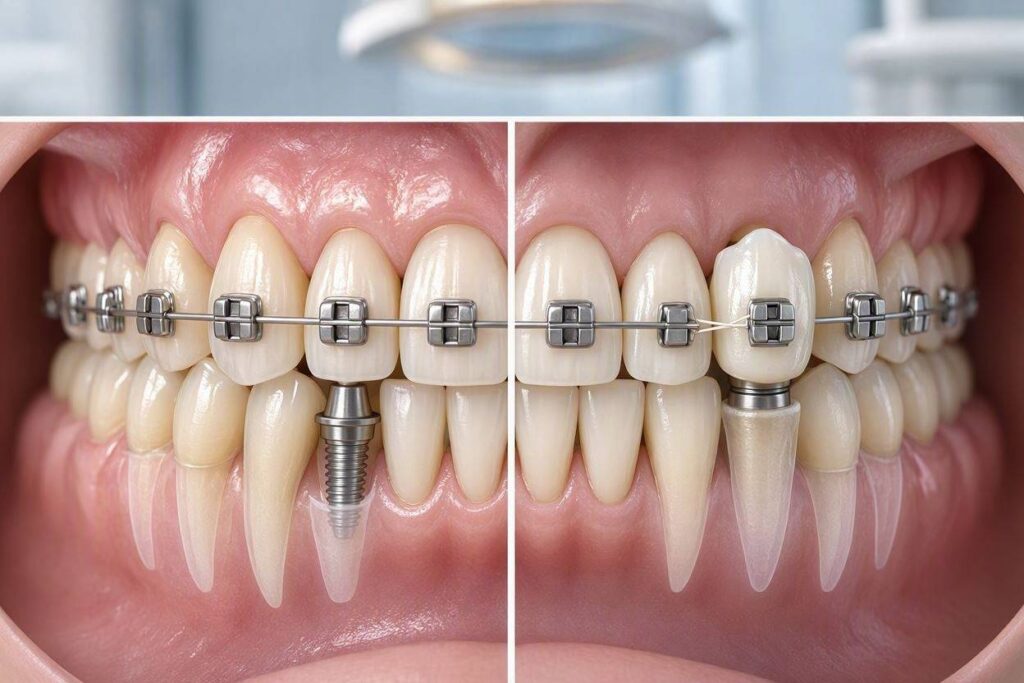
Scenario one involves an implant perfectly positioned and osseointegrated. The adjacent teeth have drifted or the opposing teeth have shifted, creating a localized malocclusion. The orthodontist’s goal is to move the natural teeth back into harmony with the implant crown. The implant crown itself may need to be removed during treatment and replaced with a provisional restoration, or the orthodontist may bond a bracket directly to the existing crown. Brackets bond less reliably to porcelain or zirconia than to natural enamel, so the orthodontist uses a specialized bonding protocol involving hydrofluoric acid etching (for porcelain) and a silane coupling agent. If the implant crown is in the ideal final position, the orthodontist moves everything else to match it.
Scenario two involves an implant that is functional but positioned less than ideally. Perhaps the implant was placed years ago when esthetic standards were different. The implant is too far buccally (toward the cheek), too far lingually, or at an incorrect angle. Orthodontics cannot change this position. The treatment plan must accept the implant’s position as fixed. The orthodontist aligns the natural teeth as well as possible around the implant, and the restorative dentist may need to replace the implant crown with a new restoration that compensates for the positional compromise. In severe cases of poor implant positioning, the only option may be to surgically remove the implant, perform orthodontic correction, and then place a new implant in the ideal position.
Scenario three involves a patient who needs comprehensive orthodontic treatment and is missing multiple teeth replaced by implants or an implant-supported bridge. The orthodontist evaluates whether the existing implant prosthesis can be temporarily removed to allow full bonding of brackets on natural teeth. The spaces occupied by the implants are maintained. The natural teeth are moved into alignment within the arches, and at the conclusion of treatment, the implant prosthesis is either replaced or re-inserted and adjusted to fit the new occlusion.
The Role of Temporary Removal of the Implant Crown
A critical clinical decision during orthodontic treatment around implants involves what to do with the implant crown. Leaving the existing porcelain or zirconia crown in place and bonding brackets to it is possible but carries certain drawbacks. The bond strength is lower than on enamel, leading to frequent bracket pop-offs. The crown’s contour may make bracket placement difficult. The occlusion of the existing crown may interfere with the desired tooth movements.
For these reasons, many orthodontists and restorative dentists collaborate to remove the existing implant crown before orthodontic treatment begins. The crown is unscrewed (if screw-retained) or carefully cut off and the abutment removed. The implant fixture remains safely buried under the gum or a low-profile healing abutment is placed. The orthodontist then bonds brackets only to the natural teeth. There is no implant crown to interfere with tooth movement, bite planes, or archwire placement.
Once orthodontic treatment is complete and the patient is in retention, the restorative dentist fabricates a new implant crown that precisely fits the corrected alignment and occlusion. This approach adds the cost of a new implant crown but yields a superior final result. The patient must factor this additional restorative cost into the overall treatment plan budget.
Ideal Sequencing: Implants First or Braces First?
The previous scenarios assumed the implant already existed. But what if you are planning ahead? You know you need both orthodontic treatment and one or more dental implants. The sequence in which you undergo these treatments profoundly impacts the final outcome, the complexity of care, and the long-term stability. The general rule, with few exceptions, is that orthodontic treatment should come first, and implant placement should follow.
The logic is clear. Orthodontic treatment creates the ideal space, alignment, and occlusal relationships for the implant restoration. The orthodontist can precisely position the adjacent and opposing teeth to provide the exact mesiodistal (front-to-back) space needed for the implant crown, correct the bite plane, upright tilted teeth, and open or close spaces. Once the natural teeth are in their final, stable positions, the implant surgeon places the implant in the ideal location dictated by the new occlusion and bone availability. The restorative dentist then places the crown on the integrated implant, and the entire system—natural teeth, implant, and occlusion—is harmonious.
Placing an implant before orthodontic treatment, as discussed, effectively sets an immovable post in the middle of a landscape that needs to shift. The orthodontist is forced to work around this fixed point. If the implant was placed in the “best available” position before orthodontics, that position is almost certainly suboptimal after orthodontics. The space may end up too wide or too narrow. The bone may have been better positioned elsewhere. The implant angle may clash with the new occlusal scheme. The patient often ends up needing a new implant crown at best, or implant removal and replacement at worst.
There is a single notable exception. In some cases of congenitally missing lateral incisors, the treatment plan calls for orthodontic space opening to create room for an implant. The orthodontist moves the canine and central incisor apart, creating the ideal space. However, in young patients who have finished jaw growth, the space tends to collapse rapidly without something holding it. An implant cannot be placed yet because the alveolar bone is still maturing, or the patient needs to wait until a certain age. In these cases, the orthodontist may place a temporary anchorage device (TAD) and a provisional composite or acrylic tooth, or simply a well-fitted retainer with a pontic (false tooth), to maintain the space until implant surgery.
The Critical Role of the Diagnostic Wax-Up and Digital Planning
For any patient facing combined orthodontic and implant treatment, a comprehensive diagnostic workup is non-negotiable. Modern digital dentistry makes this process remarkably precise and collaborative. The orthodontist begins with digital intraoral scans, photographs, and a CBCT scan. These data sets are merged using specialized software. The orthodontist can then simulate the final tooth positions digitally. This is the digital treatment plan.
The digital plan is then shared with the restorative dentist and the implant surgeon. Together, the team evaluates where the natural teeth will end up, what spaces will be created, and what the ideal implant positions should be. A virtual implant is placed on the screen in the ideal restorative position, and the software evaluates the underlying bone volume. If the bone is sufficient, great. If not, the need for bone grafting is identified and planned before orthodontic treatment even begins. This collaborative digital approach eliminates guesswork and ensures that when the braces come off, the patient transitions seamlessly to the implant and restorative phase with a predictable, pre-planned outcome.
Risks and Complications of Combining Braces and Implants
Combining these two sophisticated dental disciplines is not without risk. The patient must be aware of potential complications to provide true informed consent. The primary risk is damage to the existing implant during orthodontic treatment. Even with careful planning, excessive or misdirected forces transmitted to the implant could theoretically cause micromotion at the bone-implant interface, leading to a failure of osseointegration. This risk is relatively low with modern light-force orthodontic techniques, but it is not zero.
Root resorption is a concern for natural teeth adjacent to an implant. If the orthodontist applies significant force to close a space next to an implant, the root of the adjacent tooth may experience blunting or shortening, a common and usually minor side effect of orthodontic treatment that can be more pronounced in these localized pressure zones.
Periodontal complications can arise. An implant crown often has a different emergence profile and contour than a natural tooth. Maintaining optimal oral hygiene around brackets and wires is already challenging. Adding the complex contours of an implant prosthesis increases the difficulty. The patient must demonstrate exceptional hygiene commitment to prevent peri-implant mucositis from developing during treatment.
Temporomandibular joint (TMJ) issues can be triggered or exacerbated if the orthodontic treatment significantly alters the bite and the implant crown does not adapt smoothly to the new scheme. Careful occlusal monitoring throughout treatment, and prompt adjustment of the provisional or final implant restoration, mitigates this risk.
Ankylosis of adjacent natural teeth is a rare but recognized phenomenon. Prolonged immobilization or altered force distribution near an ankylosed implant could, in theory, contribute to the ankylosis of a nearby natural tooth, though a causal relationship is difficult to establish definitively.
Communication Between Specialists Is Non-Negotiable
Every risk listed above is magnified when the treating clinicians operate in silos. The orthodontist who does not communicate with the implant surgeon before bonding brackets, the restorative dentist who is not involved in the orthodontic finishing phase—these are recipes for compromised outcomes. The patient must choose a treatment team that demonstrates a willingness and a systematic process for interdisciplinary communication.
A patient starting combined treatment should expect a formal treatment conference, either in person or virtually, where all treating clinicians review the digital treatment plan. A clear written plan should document the sequence of procedures, the responsibilities of each clinician, and the expected timeline. The patient should know who to contact for each specific type of problem that might arise. Is a loose bracket near the implant the orthodontist’s responsibility or the implant dentist’s? Is pain around the implant during treatment an orthodontic emergency or a surgical one? These questions should be answered in advance.
“Interdisciplinary care is not just about being in the same building. It is about sharing a unified vision for the final result and a clear protocol for getting there. The patient suffers when specialists treat their segment of the mouth in isolation.” This principle guides modern comprehensive dental care.
Conclusion
You cannot put braces on a dental implant to move it, because an osseointegrated implant lacks the periodontal ligament that mediates orthodontic tooth movement and will either resist the force or fail catastrophically if overloaded. However, an existing implant can serve as an invaluable fixed anchor point around which the orthodontist moves the natural teeth, with careful planning, potential temporary removal of the implant crown, and meticulous interdisciplinary communication. For optimal results, orthodontic treatment should always precede implant placement whenever possible, allowing the braces to create the ideal position and space into which the implant is then surgically and restoratively placed with precision.
Frequently Asked Questions
Can a dental implant be removed if it’s in the way of braces?
Yes. An osseointegrated implant can be surgically removed by an oral surgeon or periodontist. The procedure involves cutting away the bone around the implant and using specialized instruments to remove the fixture. It is more invasive than placing the implant and results in bone loss at the site. Removal is a last resort but is sometimes the best option for a poorly positioned implant that blocks essential orthodontic movement.
What happens to my implant crown during braces?
It can either remain and have a bracket bonded to it, though bond failure is common, or it is ideally removed for the duration of orthodontic treatment. A new implant crown is fabricated after braces are removed to fit the new bite and tooth positions perfectly.
Will my dental insurance cover orthodontics if I have implants?
Yes, having implants does not disqualify you from orthodontic coverage, provided your dental plan includes an orthodontic rider and you meet any age or medical necessity criteria. However, the insurance will not pay for replacing an existing implant crown that must be redone as part of the orthodontic plan. That is considered a restorative procedure, not orthodontic.
Can I get a temporary tooth on my implant during braces?
If the implant crown is removed, a simple temporary healing abutment or a custom temporary acrylic shell can be placed over the implant to maintain the gum contour and provide some aesthetics. This temporary is not used for chewing. It is a placeholder. The restorative dentist manages this.
Additional Resource
For more on the interplay between orthodontics and restorative implant dentistry, the American Academy of Implant Dentistry offers patient-focused educational content: AAID Patient Resources