Can Dental Implants Cause Drooling?
You have recently received a new dental implant crown or a full-arch implant restoration. You expected some soreness and an adjustment period, but you did not anticipate this. You find yourself swallowing more frequently. You wake up with a damp spot on your pillow. You are more conscious of the saliva pooling in your mouth, and on occasion, a small droplet escapes the corner of your lips. The experience is embarrassing and disconcerting. You wonder: is the implant causing me to drool?
The answer is that a temporary increase in salivation, and in some cases a sensation of excessive saliva that can lead to minor drooling, is a normal and expected response to the introduction of a new dental restoration. The implant itself does not cause the salivary glands to overproduce fluid, but the brain perceives the new prosthesis as a foreign object and responds with a physiological reflex that increases salivary flow. This phenomenon, technically called sialorrhea or hypersalivation when severe, is almost always transient. The body adapts, the brain accepts the new restoration as part of the oral landscape, and the salivary flow returns to normal. True, persistent drooling caused directly by an implant is rare and typically indicates a complication such as nerve injury, poor prosthetic fit, or an unrelated neurological condition.
This guide explains the physiology of salivation and the brain’s response to new oral prostheses. We will distinguish between the common, temporary increase in saliva that accompanies any new dental restoration and the rare, persistent drooling that warrants investigation. Understanding this process can replace embarrassment and concern with patience and confidence that the phase will pass.
The Brain’s Response to a Foreign Object in the Mouth
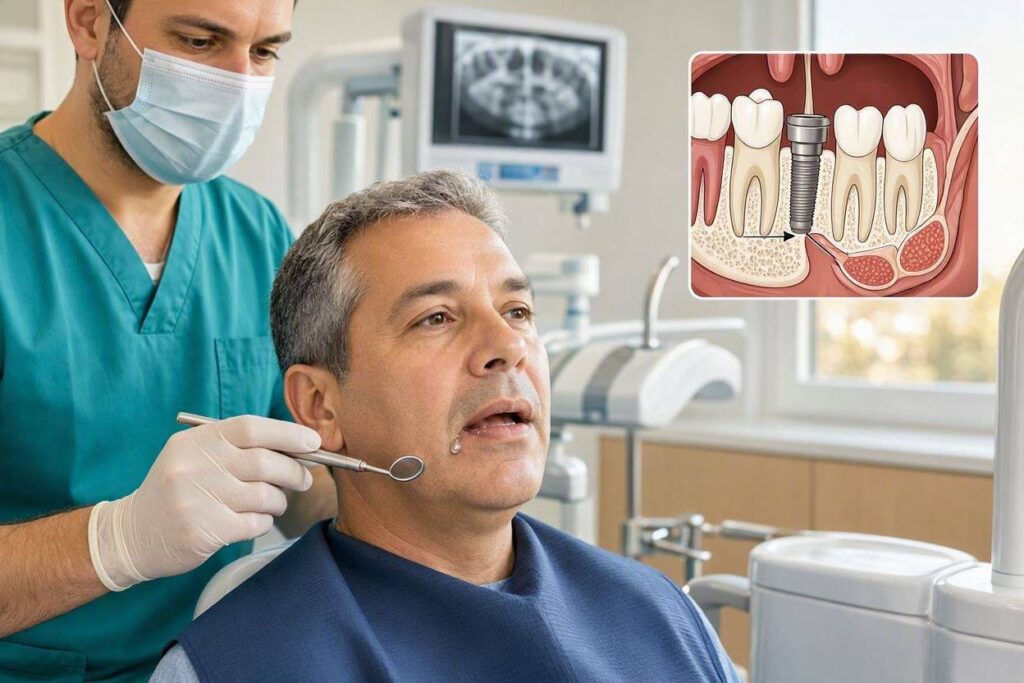
The oral cavity is one of the most densely innervated regions of the body. The tongue, lips, cheeks, and gums are packed with sensory receptors that send a constant stream of information to the brain about the position, texture, temperature, and movement of everything in the mouth. This sensory feedback is essential for speech, chewing, swallowing, and protecting the airway.
When a new object is introduced into the mouth—a new crown, a bridge, a denture, or an implant restoration—the sensory receptors immediately detect its presence. To the brain, this new object is, at least initially, a foreign body. The brain has not yet categorized it as a normal part of the oral anatomy. The reflex response to a foreign body in the mouth is to increase salivary flow, an attempt to lubricate and flush the object, and to prepare for potential ingestion or expulsion.
This is the same reflex that causes your mouth to water when you place a bite of food on your tongue. The food is a temporary foreign body, and the salivary response prepares it for digestion. The implant crown is a permanent foreign body, but the brain does not know this immediately. It responds as it would to any new oral stimulus, with an increase in parasympathetic stimulation to the salivary glands, producing a watery, copious saliva.
The sensation of excessive saliva is often out of proportion to the actual increase in volume. The brain is hyper-aware of the new restoration, and it directs attention to the oral cavity. Saliva that was previously swallowed unconsciously is now noticed. The patient becomes conscious of swallowing, and the act of swallowing becomes deliberate rather than automatic. This heightened awareness creates the perception of excessive saliva, even when the measured flow rate is only mildly elevated.
The Adaptation Period: When the Brain Accepts the Implant
The good news is that the brain is remarkably adaptable. Through a process called sensory adaptation, the constant sensory input from the implant restoration gradually fades from conscious awareness. The brain learns that the object is not a threat, that it is not going to be swallowed, and that it does not require a special salivary response. The salivary flow returns to its baseline level, and the patient stops noticing every swallow.
This adaptation period typically lasts from a few days to a few weeks. For a single implant crown, the adjustment is rapid because the object is small and occupies a familiar position in the dental arch. The tongue and cheek quickly accommodate to its contours. For a full-arch implant restoration, such as an All-on-4 bridge, the adaptation period is longer because the prosthesis is larger, covers more oral surfaces, and represents a more dramatic change from the preoperative state, which may have been edentulous or involved failing teeth.
The patient can facilitate adaptation by wearing the prosthesis continuously, rather than removing it for extended periods if it is a fixed restoration. The constant presence of the restoration gives the brain the uninterrupted sensory input it needs to habituate. Chewing sugar-free gum, once the surgical site has healed sufficiently, stimulates normal salivary function and helps integrate the prosthesis into the functional oral environment.
When the Prosthesis Itself Stimulates Excess Saliva
In some cases, the implant restoration itself has physical characteristics that mechanically stimulate salivary flow or that trap saliva, creating the sensation and reality of excessive wetness. These issues are related to the prosthetic design, not to the implant fixture, and they can be corrected by the restorative dentist.
A full-arch implant bridge that extends too far posteriorly, encroaching on the retromolar pad region or the soft palate, can stimulate the gag reflex and the salivary reflex. The distal extension of the prosthesis should end before the sensitive trigger zones. A bridge that is too thick in the palatal or lingual area reduces the space for the tongue, and the constant contact of the tongue against the prosthesis stimulates salivation.
A prosthesis with a rough, unpolished surface, or with ledges and crevices at the implant-abutment junction, can trap saliva and food debris. The patient feels the accumulation and responds by moving the tongue and cheeks to dislodge it, which in turn stimulates more saliva. A well-polished, smooth, hygienic prosthesis minimizes this effect.
The vertical dimension of occlusion, the height at which the teeth come together, can also influence salivary flow. A full-arch restoration that opens the bite excessively can strain the lips, making it difficult to maintain a lip seal. The patient may drool slightly, particularly at night when muscle tone is reduced. This is a prosthetic design issue that should be identified and corrected during the treatment planning and provisional restoration phases.
Nerve-Related Causes of Drooling
While rare, nerve injury during implant surgery can disrupt the normal neuromuscular control of the lips, cheeks, and tongue, leading to drooling. The facial nerve, cranial nerve VII, controls the muscles of facial expression, including the orbicularis oris muscle that purses the lips. Injury to the facial nerve is an extremely rare complication of implant surgery, as the nerve is not in the usual surgical field, but it can occur with very posterior implant placement or with surgical approaches that extend into the ramus of the mandible.
More commonly, injury to the mental nerve or the inferior alveolar nerve, as discussed in previous articles, causes numbness of the lower lip and chin. The patient cannot feel the lip, and saliva may escape without their awareness. This is not true drooling from excess saliva production, but rather a failure of the normal lip seal due to sensory loss. The patient does not feel the saliva pooling or escaping.
Lingual nerve injury can affect the sensation and motor control of the tongue. The tongue plays an essential role in gathering saliva and directing it posteriorly for swallowing. A tongue with altered sensation or movement may not perform this function efficiently, leading to saliva accumulation in the anterior floor of the mouth and potential drooling.
These nerve-related causes of drooling are accompanied by other obvious signs of nerve injury: numbness, tingling, altered taste, and difficulty with speech or swallowing. They are not subtle or isolated to a minor increase in saliva. They warrant immediate specialist evaluation.
Unrelated Causes That May Coincide with Implant Treatment
As with dry mouth, the timing of implant treatment may coincide with the onset or exacerbation of other conditions that cause drooling. The patient attributes the drooling to the implant because of the temporal association, but the implant is not the cause.
Gastroesophageal Reflux Disease: GERD can cause a reflex increase in salivation, known as water brash, as the body attempts to neutralize the acid that has refluxed into the esophagus. This can manifest as a sudden, noticeable increase in oral fluid. The stress of surgery and changes in diet during the postoperative period can exacerbate GERD symptoms.
Medications: Some medications, including certain antipsychotics, anticonvulsants, and cholinergic agonists, can increase salivary flow as a side effect. A new medication started around the time of implant surgery may be the true cause of the hypersalivation.
Neurological Conditions: Parkinson’s disease, amyotrophic lateral sclerosis, cerebral palsy, and stroke can all impair the neuromuscular control of swallowing, leading to drooling. A patient with undiagnosed early-stage Parkinson’s disease may notice drooling as one of the initial symptoms, coincident with but unrelated to the implant surgery.
Pregnancy: The hormonal changes of pregnancy, particularly during the first trimester, can cause a marked increase in salivation, known as ptyalism gravidarum. A pregnant patient who receives an implant may attribute the drooling to the surgery rather than to the pregnancy.<div style=”border-left: 4px solid #0077b6; padding: 15px; margin: 25px 0; background-color: #f0f8ff;”> <p style=”font-weight: bold; margin-bottom: 5px;”>💡 When to Be Concerned About Drooling</p> <p style=”margin: 0;”>Occasional minor drooling during the first few weeks after implant restoration is normal and will pass. Seek evaluation if drooling persists beyond two months, is accompanied by numbness or weakness of the face or tongue, interferes significantly with speech or swallowing, or is associated with other neurological symptoms such as tremor, stiffness, or balance problems. These signs suggest a condition that requires medical, not dental, investigation.</p> </div>
Conclusion
A temporary increase in salivation and a heightened awareness of oral fluid after receiving a dental implant restoration is a normal physiological response to a new object in the mouth, driven by the brain’s sensory adaptation process, and it resolves within days to weeks. Persistent, bothersome drooling may be related to prosthetic design issues, such as an overextended or poorly contoured restoration, or, rarely, to nerve injury affecting lip or tongue control. When drooling persists, a comprehensive evaluation distinguishes between the common, benign, self-limiting response and the rare, serious underlying condition.
Frequently Asked Questions
Q: How long will I drool after getting my implant crown?
A: The heightened salivary awareness after a single implant crown typically lasts only a few days. You will likely notice it most during the first 48 to 72 hours, and it should fade significantly within a week. If you are still bothered by excess saliva after two to three weeks, consult your restorative dentist to check the fit and contour of the crown.
Q: Is drooling more common with full-arch implant bridges?
A: Yes, because the prosthesis is larger and represents a more dramatic change to the oral environment. The brain requires more time to adapt to a full-arch restoration than to a single crown. The adaptation period may last several weeks, and the patient should expect a gradual, not immediate, return to normal salivary awareness.
Q: Can the implant be removed if it is causing me to drool excessively?
A: Removing a healthy, osseointegrated implant because of drooling is an extreme and rarely justified measure. The cause of the drooling should be thoroughly investigated first. Prosthetic modifications, such as adjusting the contour or polish of the restoration, can resolve many saliva-related issues. If the drooling is due to an unrelated medical condition, removing the implant will not solve the problem.
Q: Will a zirconia implant cause less drooling than a titanium implant?
A: The implant material has no bearing on salivary flow or the brain’s sensory response. The adaptation process is related to the size, shape, and position of the final restoration, not to the chemical composition of the implant fixture buried in the bone.
Additional Resource:
For information on salivation and swallowing disorders, visit the American Speech-Language-Hearing Association: https://www.asha.org/