In Canada How Much Does A Dental Implant Cost?
Dental implants are the gold standard for replacing missing teeth. They look, feel, and function like natural teeth. They preserve bone, protect your remaining teeth, and can last a lifetime with proper care. But they come with a significant price tag. If you live in Canada, you might be wondering: How much does a dental implant cost?
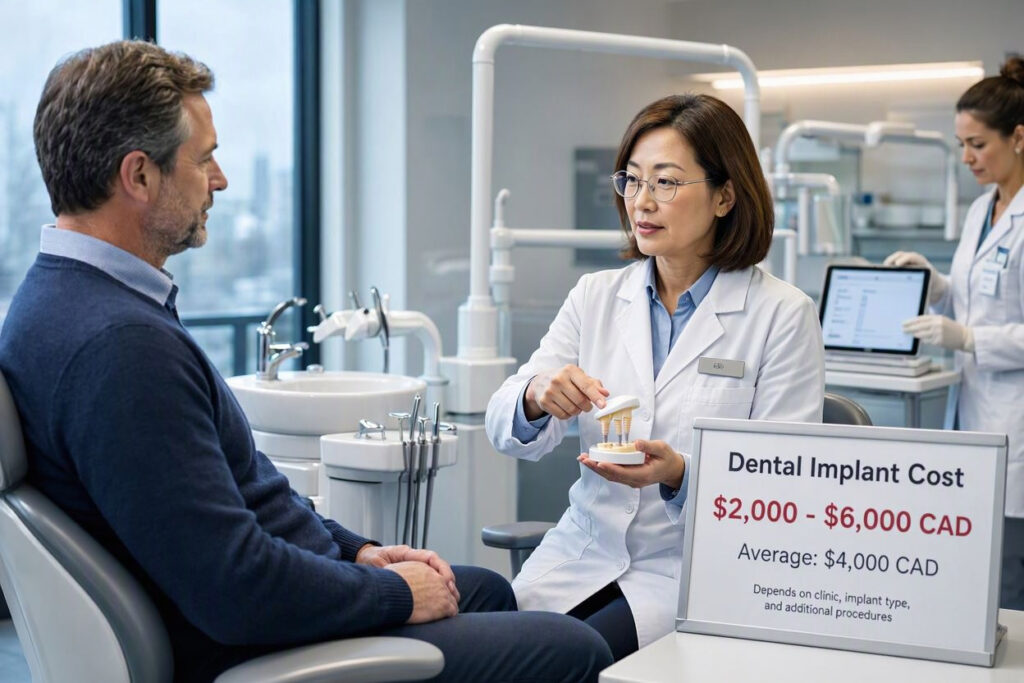
The answer is not a single number. The cost of a dental implant in Canada ranges from $3,000 to $6,000 for a single tooth. In some cases, it can be even higher. The price depends on where you live, the dentist or specialist you choose, and whether you need additional procedures like a bone graft or sinus lift.
This guide will break down the real costs of dental implants in Canada. We will cover the components of the implant, the fees by province, what insurance covers, and how to find affordable care. By the end, you will have a clear picture of what to expect and how to budget for your new smile.
What Is A Dental Implant?
A dental implant is a titanium post that is surgically placed into your jawbone. It acts as an artificial tooth root. Over a period of 3 to 6 months, the bone grows around the implant in a process called osseointegration. Once the implant is stable, an abutment (a connector) is attached. Finally, a custom crown is placed on top.
The implant is made of three parts:
- The Implant Fixture: The titanium post that goes into the bone.
- The Abutment: The connector that sits on top of the implant.
- The Crown: The visible tooth that is attached to the abutment.
Sometimes, the implant and crown can be placed on the same day. This is called an immediate implant. But in most cases, the process takes several months.
The Cost Of A Dental Implant In Canada
The total cost of a single dental implant in Canada is typically between $3,000 and $6,000. This includes the implant fixture, the abutment, and the crown. However, this range can be higher in major cities like Toronto or Vancouver.
The cost is usually broken down into separate fees. Here is a typical breakdown.
Table: Average Cost Breakdown For A Single Dental Implant In Canada
| Component | Average Cost Range (CAD) | Who Provides It |
|---|---|---|
| Consultation And Imaging | $100 – $500 | Dentist or Specialist |
| Implant Fixture Placement | $1,500 – $3,000 | Oral Surgeon or Periodontist |
| Abutment | $300 – $800 | Dentist or Prosthodontist |
| Crown | $1,000 – $2,000 | Dentist or Prosthodontist |
| Total | $3,000 – $6,000+ |
Important Note: These prices are in Canadian dollars. They do not include additional procedures like bone grafts or sinus lifts, which can add $500 to $3,000 or more.
Cost Of Dental Implants By Province
Dental fees vary across Canada. Each provincial dental association publishes a fee guide, but dentists are not required to follow it. They can charge more or less. Here is a general idea of what you can expect in different provinces.
Table: Average Cost Of A Single Dental Implant By Province (CAD)
| Province | Average Cost Range (CAD) | Notes |
|---|---|---|
| Ontario | $3,500 – $6,500 | Higher in Toronto and Ottawa |
| British Columbia | $3,200 – $6,000 | Higher in Vancouver |
| Alberta | $3,000 – $5,500 | Higher in Calgary and Edmonton |
| Quebec | $2,800 – $5,500 | Higher in Montreal |
| Manitoba | $2,800 – $5,000 | |
| Saskatchewan | $2,800 – $5,000 | |
| Nova Scotia | $3,000 – $5,500 | |
| New Brunswick | $2,800 – $5,000 | |
| Newfoundland | $3,000 – $5,500 | |
| Prince Edward Island | $3,000 – $5,500 |
Important Note: These are average ranges. Always get a written quote from your dentist before starting treatment.
What Affects The Cost Of Dental Implants In Canada?
Several factors influence the price of dental implants.
1. Geographical Location
As with all healthcare, prices are higher in big cities. A dental implant in rural Manitoba might cost $3,000. The same implant in downtown Toronto could cost $6,500. Rent, staff wages, and taxes are higher in cities, and those costs are passed on to patients.
2. The Type Of Specialist
A general dentist may charge less than a specialist. Oral surgeons and periodontists have advanced training in surgical procedures. They often charge more, but they also have more experience with complex cases.
- General Dentist: $3,000 – $5,000
- Oral Surgeon: $3,500 – $6,000
- Periodontist: $3,500 – $6,000
- Prosthodontist: $4,000 – $7,000
3. The Need For Additional Procedures
Many patients need additional procedures before the implant can be placed. These add to the cost.
- Bone Graft: $500 – $3,000
- Sinus Lift: $1,500 – $3,000
- Tooth Extraction: $150 – $500
- CT Scan (if needed): $200 – $500
4. The Type Of Implant
There are different types of implants. Standard titanium implants are the most common. Zirconia implants are metal-free and more expensive. Mini implants are smaller and cheaper, but they are not suitable for all cases.
- Standard Titanium: $3,000 – $6,000
- Zirconia: $4,000 – $7,000
- Mini Implants: $1,500 – $3,000
5. The Type Of Crown
The crown is the visible part of the implant. Crowns can be made of different materials.
- Porcelain-Fused-To-Metal: $1,000 – $1,500
- Full Porcelain: $1,200 – $1,800
- Zirconia: $1,500 – $2,500
6. The Dentist’s Experience
A dentist who has been placing implants for 20 years may charge more than a recent graduate. You are paying for their expertise and track record.
Does Insurance Cover Dental Implants In Canada?
Dental insurance in Canada is usually provided through employer-sponsored plans. Coverage for implants varies widely.
Typical Coverage
- Basic Plans: Usually do not cover implants. They may cover extractions and dentures.
- Comprehensive Plans: May cover 50% of the implant cost, up to an annual maximum. The maximum is often $1,000 to $2,000 per year.
- Premium Plans: May cover 50% to 80% of the implant cost, with a higher annual maximum.
How The Math Works
Let’s say your implant costs $5,000. Your insurance covers 50% up to $1,500 per year.
- Total Cost: $5,000
- Insurance Pays: $1,500
- Your Out-of-Pocket: $3,500
If your treatment spans two calendar years, you may be able to use two years of maximums. For example, you could have the implant placed in December and the crown placed in January. This allows you to claim $1,500 each year.
What About The Canadian Dental Care Plan (CDCP)?
The Canadian Dental Care Plan (CDCP) is a federal program that began rolling out in 2024. It provides dental coverage for eligible Canadian residents who do not have dental insurance and have a family income under $90,000.
- Coverage: The CDCP may cover dental implants if they are deemed medically necessary. However, coverage is subject to pre-authorization and may not cover the full cost.
- Eligibility: You must be a Canadian resident, have no access to dental insurance, and have a family income under $90,000.
- How To Apply: Apply through the Government of Canada website.
Important Note: The CDCP is new and evolving. Check the official website for the most up-to-date information on coverage and eligibility.
What If You Don’t Have Insurance?
If you are paying out of pocket, the cost of a dental implant can feel overwhelming. Here are several strategies to reduce the cost.
1. Dental Schools
Dental schools offer implants at reduced rates. The work is done by residents who are supervised by experienced specialists. A single implant at a dental school might cost $2,000 to $3,500. The trade-off is time. Appointments are longer, and the process takes more visits.
Examples of dental schools in Canada:
- University of Toronto Faculty of Dentistry
- University of British Columbia Faculty of Dentistry
- McGill University Faculty of Dental Medicine
- University of Alberta School of Dentistry
2. Payment Plans
Most dental offices offer in-house payment plans. You pay a down payment and then monthly installments. Some offer interest-free plans for 6 to 12 months.
3. Third-Party Financing
Companies like Dentalcard and Medicard offer loans for dental procedures. You can apply online and get a decision quickly. Be aware of interest rates.
4. Dental Tourism
Some Canadians travel abroad for dental implants. Popular destinations include Mexico, Costa Rica, and Hungary. The savings can be 50% to 70%. However, you must consider travel costs, the risk of complications, and the difficulty of getting follow-up care. If something goes wrong when you return home, you may have to pay a Canadian dentist to fix it.
5. Negotiate
Do not be afraid to ask for a discount. Some offices offer a 5% to 10% discount for cash payment. It never hurts to ask.
The Cost Of Not Getting An Implant
Skipping an implant to save money can lead to bigger problems.
- Bone Loss: The jawbone in the gap will shrink. This can change the shape of your face and make future implants more difficult.
- Shifting Teeth: Your remaining teeth will drift into the gap. This can cause bite problems and difficulty cleaning.
- Gum Disease: The shifting teeth create hard-to-reach spaces where plaque accumulates. This increases the risk of gum disease.
- Loss Of More Teeth: If gum disease progresses, you may lose more teeth.
The Math:
- Implant: $5,000
- Bridge (every 10-15 years): $3,000 x 2 = $6,000 over 30 years
- Denture (every 5-10 years): $1,500 x 4 = $6,000 over 30 years
An implant is often the most cost-effective option in the long run because it can last a lifetime.
What Do Patients Say?
We spoke to three Canadians about their experiences with dental implants.
Michael, 58, from Ontario:
“I had a molar that cracked and had to be extracted. I chose an implant because I did not want a bridge. The total cost was $5,200. My insurance covered $1,500. I paid the rest out of pocket. It was expensive, but it feels just like a real tooth. I would do it again.”
Sarah, 42, from British Columbia:
“I needed a bone graft before my implant. The graft cost $1,200, and the implant cost $4,500. I paid for it with a payment plan. I pay $250 a month for 18 months. It is manageable.”
David, 65, from Quebec:
“I looked into dental tourism. I could have gotten the implant in Mexico for $2,000. But I was worried about complications. I decided to pay more and get it done here. I am glad I did. The follow-up care was excellent.”
Frequently Asked Questions
Q: How much does a dental implant cost in Canada?
A: A single dental implant costs between $3,000 and $6,000 in Canada. The price includes the implant fixture, abutment, and crown. Additional procedures like bone grafts cost extra.
Q: Does Canadian insurance cover dental implants?
A: Some employer-sponsored plans cover 50% of the cost up to an annual maximum. The Canadian Dental Care Plan (CDCP) may cover implants for eligible residents. Check your plan for details.
Q: Are dental implants cheaper in Mexico?
A: Yes, they can be 50% to 70% cheaper. However, you must consider travel costs, the risk of complications, and the difficulty of getting follow-up care in Canada.
Q: How long do dental implants last?
A: With good oral hygiene and regular dental visits, dental implants can last a lifetime. The crown may need to be replaced every 10 to 15 years.
Q: Is the implant procedure painful?
A: The procedure is done under local anesthesia, so you will not feel pain. Afterward, you may have some soreness and swelling. This is managed with over-the-counter pain relievers.
Q: Can I get a dental implant if I have gum disease?
A: You need to have healthy gums before getting an implant. If you have gum disease, it must be treated first. Otherwise, the implant may fail.
Q: How long does the implant process take?
A: The entire process takes 3 to 6 months or longer. This includes the implant placement, healing time, and crown placement.
Conclusion
The cost of a dental implant in Canada ranges from $3,000 to $6,000 for a single tooth. The price depends on your location, the specialist you choose, and whether you need additional procedures. Insurance may cover part of the cost, and the new Canadian Dental Care Plan may help eligible residents. If you are paying out of pocket, dental schools, payment plans, and financing can make implants more affordable. While the upfront cost is high, implants are often the most cost-effective option in the long run because they can last a lifetime. Your smile is worth the investment.
Additional Resources
For more information on dental implants and finding a certified specialist, visit the Canadian Dental Association at cda-adc.ca. You can also learn more about the Canadian Dental Care Plan at canada.ca.