Can Dental Implants Cause Dry Mouth?
You have noticed a persistent dryness in your mouth since your dental implant surgery. Your tongue sticks to the roof of your mouth. You reach for a glass of water more frequently than before. Speaking for extended periods leaves your mouth feeling parched. The dryness is uncomfortable, and it worries you because you know that saliva is essential for protecting your teeth and your implant from decay and infection. You trace the onset of this dryness back to the implant procedure, and the question forms logically: did the implant surgery cause my dry mouth?
The answer is that dental implant surgery itself is rarely the direct, long-term cause of dry mouth, known medically as xerostomia. However, several factors directly related to the surgical experience can trigger temporary dry mouth, and the implant restoration can, in specific circumstances, contribute to altered salivary function or oral comfort. More commonly, the implant surgery coincides with other causes of dry mouth—medications, stress, dehydration, or underlying medical conditions—and the temporal association is mistaken for causation. Unraveling these overlapping factors is essential for identifying the true cause and finding effective relief.
This guide explores the relationship between dental implants and dry mouth. We will explain the normal function of the salivary glands, the mechanisms by which surgery and medications can temporarily reduce salivary flow, the rare instances where implant position can affect salivary ducts or nerves, and the diagnostic steps to determine whether your implant is the culprit or an innocent bystander. Understanding the salivary system empowers you to address dry mouth at its source.
The Salivary System: A Vital Oral Defense
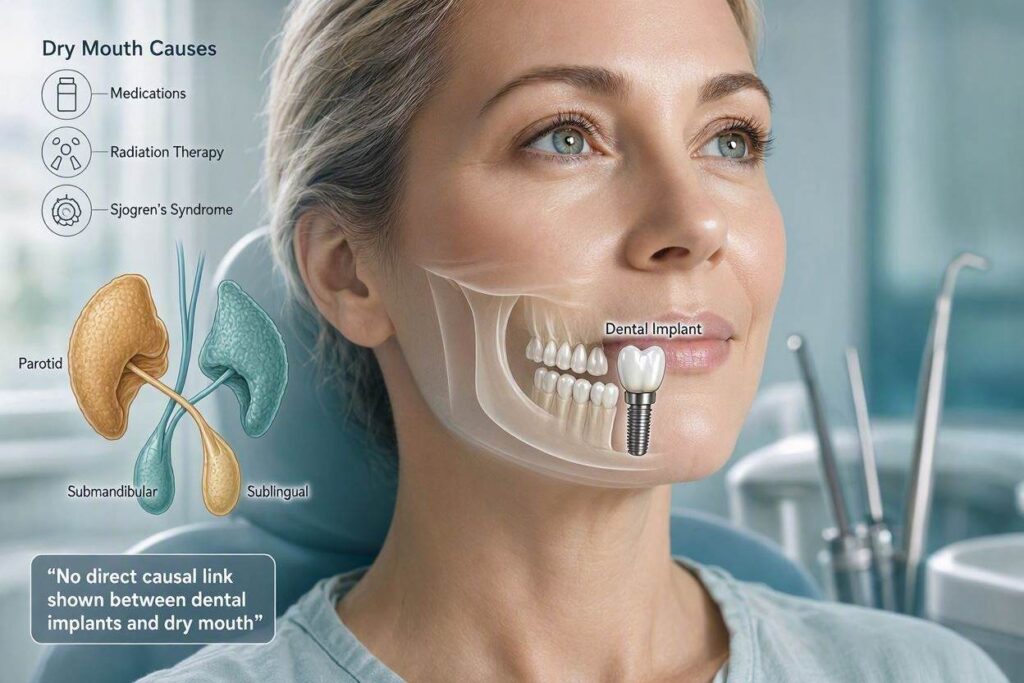
Saliva is far more than water. It is a complex, biologically active fluid produced by three pairs of major salivary glands—the parotid glands in the cheeks, the submandibular glands under the jaw, and the sublingual glands under the tongue—as well as hundreds of minor salivary glands distributed throughout the oral mucosa. Saliva performs multiple essential functions: it lubricates the oral tissues for comfortable speech and swallowing, it initiates the digestion of starches, it buffers acids produced by plaque bacteria to prevent tooth decay, and it contains antimicrobial enzymes and antibodies that control the oral microbiome.
The salivary glands are innervated by the autonomic nervous system. Parasympathetic stimulation, the “rest and digest” state, produces a copious, watery saliva. Sympathetic stimulation, the “fight or flight” state, produces a smaller volume of thicker, more mucinous saliva. Medications that interfere with autonomic nerve signaling, particularly anticholinergic drugs, can dramatically reduce salivary flow. The glands are also sensitive to hormonal changes, systemic hydration status, and radiation exposure.
The implant surgical sites in the maxilla and mandible are located near, but generally do not directly involve, the major salivary glands. The parotid gland is located on the side of the face, near the ear, and its duct opens into the cheek opposite the upper second molar. The submandibular and sublingual glands are located in the floor of the mouth. Implant surgery in the posterior mandible approaches the floor of the mouth and the sublingual space, and a perforation of the lingual cortical plate can create a hematoma that compresses the sublingual gland. This is a rare but recognized complication that can transiently affect salivary flow from that gland.
Medications: The Most Common Postoperative Culprit
The most common cause of dry mouth in the period following implant surgery is medication, not the surgery itself. The medications prescribed or recommended in the perioperative period are a pharmacological assault on the salivary glands.
Antibiotics: Broad-spectrum antibiotics, such as amoxicillin or clindamycin, are frequently prescribed after implant surgery to prevent infection. While dry mouth is not the most prominent side effect of these drugs, they can alter the oral microbiome and contribute to a sensation of oral dryness or altered taste.
Analgesics: Non-steroidal anti-inflammatory drugs, such as ibuprofen, and opioid pain relievers, such as codeine or hydrocodone, can both cause dry mouth. Opioids, in particular, are known to reduce salivary flow through central nervous system mechanisms.
Chlorhexidine Mouthwash: The gold standard antiseptic rinse prescribed after implant surgery, chlorhexidine, has a well-documented side effect of causing a temporary alteration in taste and a sensation of dryness. The rinse can also cause a slight burning sensation of the oral mucosa. These side effects resolve when the rinse is discontinued, typically after one to two weeks of use.
Anesthetic Agents: The local anesthetic used during the surgery, particularly when a nerve block is administered, temporarily disrupts the autonomic nerve supply to the salivary glands on that side. The patient may notice a dry mouth on the side of the surgery for several hours until the anesthetic fully wears off. This effect is self-limiting.
If you experience dry mouth after implant surgery, review your medication list with your surgeon or pharmacist. The dry mouth often resolves when the postoperative medications are completed. If the dryness persists beyond the medication period, other causes must be investigated.
Surgical Trauma and Salivary Function
Direct surgical trauma to the salivary glands or their ducts is an uncommon but possible complication of implant surgery, particularly in the posterior mandible. The sublingual gland and the submandibular duct, known as Wharton’s duct, are located in the floor of the mouth, beneath the thin mucosa lingual to the lower molars. An implant drill that perforates the lingual cortical plate can enter the sublingual space, causing bleeding, hematoma formation, and potential compression or injury to the sublingual gland or Wharton’s duct.
If the duct is damaged or obstructed, saliva produced by the submandibular gland cannot empty into the mouth. The gland may swell, a condition called sialadenitis, and the patient experiences a dry mouth sensation, particularly under the tongue. This is a rare complication, and the implant surgeon takes specific precautions to avoid perforating the lingual plate. The lingual concavity is assessed on the preoperative CBCT scan, and the implant is planned with a safe zone of bone on the lingual side.
Nerve injury can also indirectly affect salivary function. The chorda tympani, which carries taste fibers and parasympathetic secretomotor fibers to the submandibular and sublingual glands, travels with the lingual nerve. An injury to the lingual nerve, as discussed in previous articles, can therefore affect not only taste and general sensation but also the neural stimulation of salivary secretion from these glands. The result is a reduced salivary flow on the affected side, contributing to a sensation of oral dryness. This is a rare and usually partial effect, as the other salivary glands continue to function.
The Implant Prosthesis and Oral Sensation
In some patients, the sensation of dry mouth is not due to a true reduction in salivary flow but to an altered oral perception created by the implant restoration. The implant crown, abutment, and the associated changes in the oral contours create a new sensory environment. The tongue and the oral mucosa explore these new surfaces, and the sensation can be interpreted as dryness, roughness, or a foreign body awareness.
A full-arch implant bridge, such as an All-on-4 restoration, occupies significant space in the oral cavity. The acrylic or zirconia prosthesis covers a portion of the palate or the lingual surfaces of the ridge. This can alter the normal wetting of the oral tissues and the distribution of saliva. The patient may feel that their mouth is drier because the prosthesis feels different from natural teeth and gums. This sensation typically diminishes over weeks to months as the brain adapts to the new oral environment, a process called sensory adaptation.
Unrelated Causes That Coincide with Implant Treatment
The population of patients seeking dental implants overlaps significantly with the population at risk for dry mouth from other causes. Age is a risk factor for both tooth loss and xerostomia. As people age, the salivary glands undergo degenerative changes, and the prevalence of systemic diseases and medications that cause dry mouth increases.
Medications for Chronic Conditions: Many adults take one or more medications that list dry mouth as a side effect. Antihypertensives, antidepressants, anti-anxiety medications, antihistamines, and proton pump inhibitors are among the most common. A patient who starts a new medication around the same time as their implant surgery may attribute the resulting dry mouth to the surgery rather than the medication.
Systemic Diseases: Sjögren’s syndrome, an autoimmune disease that attacks the salivary and lacrimal glands, causes severe dry mouth and dry eyes. Diabetes mellitus, thyroid disorders, and HIV/AIDS can also affect salivary function. A patient with undiagnosed or progressing Sjögren’s syndrome may notice an increase in dry mouth symptoms coincident with their implant treatment.
Dehydration and Lifestyle Factors: Simple dehydration, often from inadequate water intake, excessive caffeine or alcohol consumption, or mouth breathing, particularly at night, are common causes of dry mouth that can easily be mistaken for a surgical complication.
Diagnostic Steps for Persistent Dry Mouth
If dry mouth persists beyond the initial postoperative period and after the discontinuation of short-term medications, a systematic diagnostic approach is warranted. Your implant surgeon or general dentist can perform an initial evaluation, which may include measuring your salivary flow rate by collecting saliva over a timed period. A significantly reduced flow rate confirms true hyposalivation, as opposed to a subjective sensation of dryness with normal flow.
A thorough medication review with your physician is essential. A change in medication or a dose adjustment may resolve the dry mouth without any intervention related to the implant. A medical evaluation for underlying systemic conditions, including blood tests for autoimmune markers and diabetes screening, may be indicated.
If the implant is suspected of impinging on a salivary duct or gland, a CBCT scan can evaluate the implant’s position relative to the floor of the mouth and the submandibular duct. If a duct obstruction is identified, referral to an oral and maxillofacial surgeon or an ENT specialist for management is appropriate. In the vast majority of cases, however, the implant is found to be well clear of the salivary structures, and the cause of the dry mouth lies elsewhere.
Conclusion
Dental implant surgery is rarely the direct, permanent cause of dry mouth; the more common culprits are temporary postoperative medications, the lingering effects of anesthesia, and the normal sensory adaptation to a new oral prosthesis. In rare cases, surgical trauma to the salivary glands or ducts in the floor of the mouth, or nerve injury affecting salivary stimulation, can contribute to reduced salivary flow on the affected side. Persistent dry mouth warrants a comprehensive evaluation of medications, systemic conditions, and hydration status, as the implant is most often an innocent bystander rather than the cause.
Frequently Asked Questions
Q: How long does dry mouth last after implant surgery?
A: Dry mouth caused by the local anesthetic typically resolves within hours. Dry mouth caused by postoperative medications resolves within days to a week after those medications are discontinued. The sensation of dryness related to adapting to a new implant crown or bridge usually fades over several weeks. Dry mouth that persists beyond a month should be investigated for other causes.
Q: Can a dental implant cause Sjögren’s syndrome?
A: There is no evidence that dental implants cause or trigger Sjögren’s syndrome, which is a systemic autoimmune disease. The onset of Sjögren’s symptoms around the time of implant surgery is coincidental, not causal. The presence of a dental implant does not affect the progression or management of Sjögren’s syndrome, though the dry mouth associated with the disease increases the risk of peri-implantitis and requires meticulous oral hygiene.
Q: Will a zirconia implant reduce dry mouth compared to titanium?
A: The material of the implant fixture has no known effect on salivary gland function or salivary flow. Dry mouth is caused by factors affecting the salivary glands or their nerve supply, not by the chemical composition of the implant. Zirconia and titanium implants have an equivalent relationship to salivary function, which is essentially neutral.
Q: What can I do to manage dry mouth while I wait for it to resolve?
A: Increase your water intake and sip water frequently throughout the day. Use alcohol-free artificial saliva sprays or lozenges. Avoid caffeine, alcohol, and tobacco, which are drying. Chew sugar-free gum or suck on sugar-free candies to stimulate salivary flow. Use a humidifier in your bedroom at night. Maintain meticulous oral hygiene, as reduced saliva increases the risk of decay around natural teeth and peri-implant disease around implants.
Additional Resource:
For information on dry mouth causes and management, visit the American Dental Association: https://www.ada.org/