Do Dental Implants Need To Be Crowned?
A dental implant is a titanium or zirconia post surgically placed into the jawbone. It replaces the root of a missing tooth. An implant without a crown is a buried, non-functional device. The question of whether dental implants need to be crowned has a straightforward answer: yes, a dental implant that is intended to replace a visible missing tooth must be restored with a crown, bridge, or denture attachment. However, there are specific clinical scenarios where an implant is placed and intentionally left uncrowned, either temporarily or permanently. This guide explains the relationship between the implant body and its prosthetic restoration, the exceptions to the rule, and the consequences of not restoring an implant.
The Purpose of the Crown on an Implant
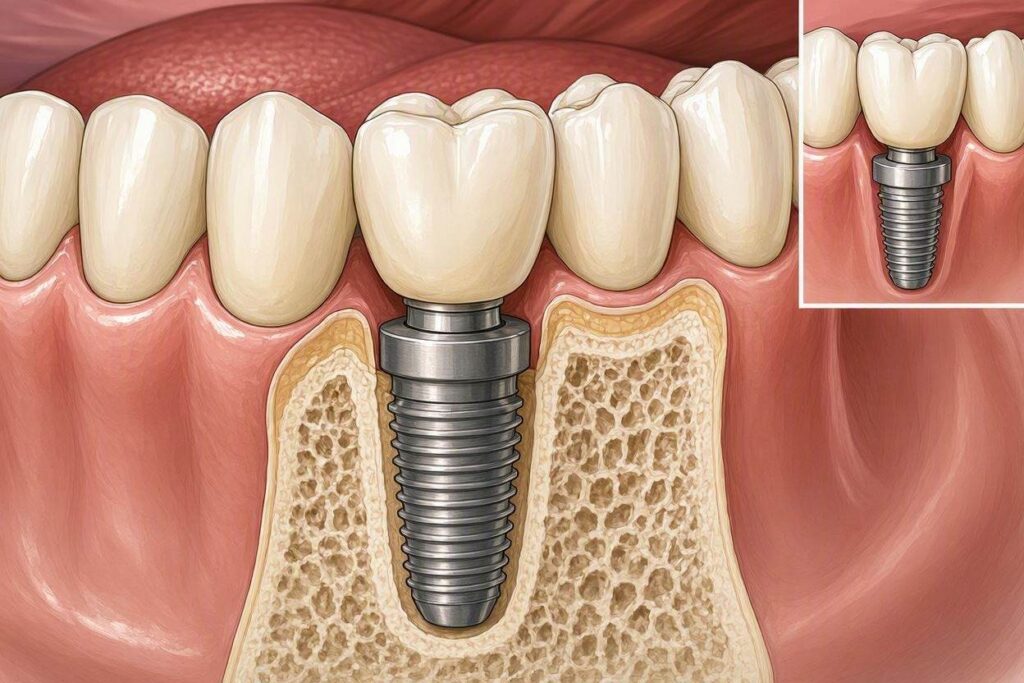
The implant body is a root replacement. It is a mechanical anchor embedded in the bone. It has no visible tooth structure above the gumline. The implant body alone does not restore the ability to chew, speak, or smile. The crown—the visible, tooth-shaped restoration—is the functional and aesthetic component of the implant complex. It fills the space in the dental arch, makes contact with the opposing teeth for chewing, and restores the natural contour of the smile.
The crown attaches to the implant via an abutment, a connector that screws into the implant body and emerges through the gum tissue. The abutment provides the foundation for the crown. Together, the implant body, abutment, and crown form a complete tooth replacement system.
What Happens If an Implant Is Not Crowned?
An implant that is placed and not restored with a crown has no functional purpose. The implant body sits under the gum tissue or protrudes through the gum with a healing abutment. The space in the dental arch remains empty. The adjacent teeth can drift into the space, tilting and rotating. The opposing tooth can supra-erupt, moving down or up into the empty space because there is no contact to stabilize it. The patient continues to chew on the other side of the mouth. The bone around the implant, although the implant is integrated, can undergo disuse atrophy if no functional forces are transmitted through it over an extended period.
A healing abutment left in place for years without a crown can accumulate plaque and become a site of chronic inflammation. The implant body is not designed to remain exposed to the oral cavity indefinitely without a properly contoured, polished restoration that creates a maintainable soft tissue seal.
The Standard Pathway: Implant Placement to Crown Delivery
The standard implant treatment sequence leads directly to a crown.
- Implant Placement: The implant body is surgically placed into the jawbone.
- Osseointegration Healing Period: The implant heals, and the bone fuses to the implant surface. This takes 3 to 6 months.
- Abutment Placement: A healing abutment or a definitive abutment is placed on the implant.
- Impression: A digital scan or physical impression captures the implant position and the surrounding soft tissue architecture.
- Crown Fabrication: The dental laboratory fabricates the custom crown.
- Crown Delivery: The crown is screwed or cemented onto the abutment.
This sequence results in a functional, aesthetic tooth. The implant was placed specifically to support this crown.
Scenarios Where an Implant Is Not Immediately Crowned
There are legitimate clinical reasons to delay the crown delivery after implant placement.
Delayed Loading Protocol
In some cases, the surgeon elects to bury the implant completely under the gum tissue (two-stage, submerged protocol) and allow it to heal without any exposure to the oral cavity. The implant is not crowned for the three- to six-month healing period because it is completely covered by mucosa. This submerged approach is used when the surgeon wants to protect the implant from bacterial contamination, when bone grafting was performed simultaneously and a closed environment is desired, or when the patient’s oral hygiene is poor and the implant would be at risk during healing. The implant needs a crown, but it is not placed until healing is complete.
Temporary Abutment for Soft Tissue Shaping
After the healing period, the surgeon may place a healing abutment and then wait several more weeks before taking the impression. The healing abutment shapes the soft tissue, creating a natural emergence profile. During this time, the implant is not crowned. A crown is planned and will be delivered after the soft tissue is mature.
Financial or Scheduling Delay
The patient may need time to finance the restorative phase. The implant is successfully integrated, and the healing abutment is in place. The patient schedules the impression and crown delivery when funds are available. A delay of a few months is generally acceptable, provided the healing abutment is kept clean and the space is monitored.
The Sleep Implant: An Uncrowned Implant by Design
A “sleep implant” or “sleeper implant” is an implant that is placed and intentionally left uncrowned, buried under the gum tissue, as a reserve for future use. This is a strategic, planned decision, not an omission.
Indications for a Sleep Implant
- Strategic Reserve for a Young Patient: A young adult has a congenitally missing lateral incisor. An implant is placed, but the adjacent teeth are still erupting slightly, and the final aesthetic position is evolving. The implant is buried and left to “sleep” until full maturation, when the crown can be placed in the ideal aesthetic position.
- Future-Proofing a Denture Patient: A patient with a complete denture has two implants placed in the anterior mandible to serve as future overdenture abutments. The denture currently functions adequately without the implants. The implants are buried and left to osseointegrate. Years later, when the denture retention becomes poor due to ridge resorption, the implants are uncovered and used to support an overdenture.
- Compromised Adjacent Teeth: A patient has a missing tooth and compromised adjacent teeth that may be lost in the future. An implant is placed at the missing tooth site and left buried. If the adjacent teeth eventually require extraction, the sleeping implant is available to support a larger bridge or as a standalone restoration.
A sleep implant is a healthy, integrated implant that serves no immediate function. It is a long-term strategic asset. It must be monitored radiographically to ensure that it remains stable and that no pathology develops.
When an Implant Cannot Be Crowned
In some unfortunate scenarios, an implant that was intended to be crowned is non-restorable.
Malpositioned Implant
An implant placed in a prosthetically unacceptable position—too far facially, too far lingually, at an excessive angle, or too close to an adjacent tooth—may be non-restorable. The crown cannot be fabricated in an aesthetic or functional position. The implant must be removed or left as a sleeping, uncrowned fixture.
Fractured or Stripped Implant Threads
If the internal threads of the implant body are stripped or fractured, no abutment or prosthetic screw can be securely retained. The implant is non-restorable. It must be removed or left buried.
Failed Osseointegration
An implant that has not osseointegrated is mobile and cannot support a crown. It is failing and must be removed. It is not left uncrowned; it is removed.
The Consequences of Not Crowning an Implant That Should Be Crowned
If an implant is exposed in the mouth with a healing abutment and the patient simply does not return for the crown for an extended period—years—several problems can arise.
- Peri-Implant Mucositis and Tissue Overgrowth: The healing abutment is a temporary, simple cylinder. It is not contoured to guide food away from the gum tissue or to be easily cleaned by the patient. Plaque accumulates, the tissue becomes inflamed, and the gum can overgrow the healing abutment. The tissue can become hyperplastic, requiring surgical excision before the final impression.
- Occlusal Drift: The opposing tooth can supra-erupt into the empty space. When the patient finally returns for the crown, there may no longer be sufficient space for a properly contoured crown. The opposing tooth may require reduction or even root canal and crown to recreate the space.
- Bone Resorption: Without functional loading, the bone around the implant can slowly resorb over years, reducing the support and potentially creating an aesthetic or functional problem when the crown is finally placed.
Conclusion
Dental implants intended to replace visible missing teeth must be crowned with a custom abutment and a porcelain or zirconia restoration to restore function, aesthetics, and occlusal stability. The standard treatment sequence leads directly from implant placement to crown delivery after a 3- to 6-month osseointegration healing period. A sleep implant is a strategically buried, uncrowned implant reserved for future use, and it is the only intentional, long-term exception to the rule. Exposing an implant to the oral cavity without restoring it invites soft tissue inflammation, occlusal drift, and bone disuse atrophy.
Frequently Asked Questions
Can I leave my implant without a crown for a few years?
You should not. If the implant is exposed in the mouth with a healing abutment, the soft tissue can become chronically inflamed and overgrow the abutment. The adjacent and opposing teeth can drift, compromising the space for the future crown. The bone around the implant can resorb without functional loading. If you have a financial or scheduling constraint, discuss a submerged sleep protocol with your surgeon, where the implant is completely buried under the gum tissue for long-term storage.
Is the crown included in the implant cost?
Sometimes. Some practices quote an all-inclusive fee that covers the implant body, abutment, and crown. Other practices bill the surgical phase (implant body and placement) and the restorative phase (abutment and crown) separately. You must read your treatment plan carefully. The total fee is the sum of all three components.
Can a dental implant support a bridge instead of a single crown?
Yes. Implants can support bridges. Two implants can support a three-unit fixed bridge, replacing three or four missing teeth. An implant-supported bridge avoids the need to grind down the adjacent natural teeth, which is required for a conventional tooth-supported bridge.
What is the difference between a healing abutment and a definitive abutment?
A healing abutment is a temporary, cylindrical component placed during the healing phase to shape the soft tissue. It is not designed to support a crown long-term. A definitive abutment is the final, custom or stock component that is precisely fitted to the implant and supports the final crown. The definitive abutment is torqued to the manufacturer’s specification and is intended to remain in place for years.
Additional Resource
The American College of Prosthodontists provides a patient education section at gotoapro.org that explains the restorative phase of implant treatment in detail. Prosthodontists are the dental specialists who design and deliver the crowns, bridges, and dentures that attach to implants. The site helps patients understand the importance of the restorative phase and find a qualified prosthodontist.