Do Dental Implants Need To Be Brushed?
A common misconception among patients considering dental implants is that artificial teeth require less maintenance than natural teeth. After all, titanium and porcelain cannot develop cavities. This dangerous assumption has led to countless cases of peri-implantitis, bone loss, and implant failure that could have been prevented with proper oral hygiene. The truth is that dental implants demand meticulous care, in some ways even more than natural teeth.
Yes, dental implants absolutely need to be brushed daily, just like natural teeth. While the implant post and crown materials cannot decay, the gum and bone tissues supporting the implant are vulnerable to bacterial infection. Without thorough and consistent brushing and cleaning, plaque accumulates around the implant, causing inflammation that can progress to peri-implantitis and eventual bone loss. Implant survival depends directly on the quality of daily oral hygiene.
Why Implants Require Brushing
Understanding the biological vulnerability of implants explains why brushing is non-negotiable.
Implants Cannot Get Cavities, But They Can Fail
The implant post is made of titanium, and the crown is typically porcelain or zirconia. None of these materials are susceptible to the bacterial decay process that causes cavities in natural teeth. This fact leads some patients to believe that implants are maintenance-free.
The critical vulnerability lies in the tissues surrounding the implant. The gum tissue attaches to the implant surface differently than it attaches to natural teeth. Around natural teeth, collagen fibers insert perpendicularly into the root surface, creating a strong barrier against bacterial invasion. Around implants, these fibers run parallel to the implant surface, creating a weaker seal.
The bone supporting the implant is living tissue susceptible to inflammation-triggered resorption. When bacteria accumulate at the implant-gum interface, the body’s inflammatory response destroys bone. This process, peri-implantitis, is the leading cause of late implant failure.
“Patients sometimes tell me they thought implants didn’t need much care because they’re artificial. I explain that the implants themselves won’t rot, but the foundation they’re anchored in is very much alive and vulnerable. Lose the foundation, and you lose the implant. Brushing isn’t optional; it’s what keeps the foundation intact.” — Periodontist and Implant Specialist
Plaque Accumulates on Implants Just Like Teeth
The same bacterial biofilm that forms on natural teeth forms on implant surfaces. In fact, some research suggests that rough implant surfaces may accumulate plaque more readily than smooth natural tooth surfaces. The bacteria are the same, the inflammatory response is the same, and the consequence of neglect is the same: progressive bone destruction.
Proper Brushing Technique for Dental Implants
Brushing implants requires attention to specific areas and techniques that differ slightly from natural tooth brushing.
Choosing the Right Toothbrush
The toothbrush you select matters for effective implant cleaning without causing damage.
Soft-Bristled Brush Recommended:
Soft bristles clean effectively while minimizing trauma to the delicate gum tissue surrounding implants. Medium or hard bristles can cause gum recession and scratch acrylic or composite components of implant restorations. Electric toothbrushes with pressure sensors are excellent for implant patients, providing consistent cleaning without excessive force.
Avoid Abrasive Toothpastes:
Some whitening toothpastes and those containing baking soda or silica abrasives can scratch the surface of implant crowns, particularly acrylic or composite components. Use low-abrasion toothpaste formulated for sensitive teeth or specifically recommended by your dentist.
Interdental Brushes:
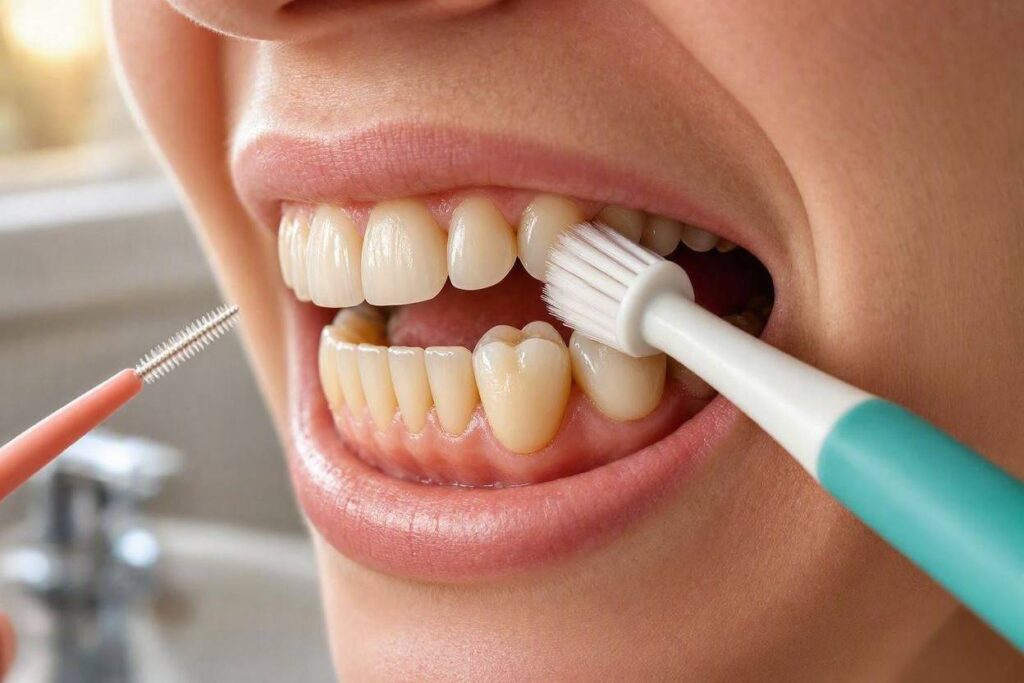
Small brushes designed to clean between teeth are essential for implant patients. They access areas where the implant crown meets the gum tissue and between adjacent teeth. Your dental hygienist can recommend the appropriate size for your specific implant restoration.
Step-by-Step Brushing Protocol for Implants
Effective implant brushing goes beyond a quick once-over. A systematic approach ensures all vulnerable areas receive attention.
1. Brush the Crown Surface Thoroughly:
Angle the toothbrush at 45 degrees to the gum line. Use gentle circular or sweeping motions. Clean all surfaces of the implant crown: the cheek side, the tongue side, and the chewing surface. Spend at least 30 seconds per implant, if not more.
2. Focus on the Gum Line:
The junction where the implant crown meets the gum tissue is the most critical area. Plaque that accumulates here triggers the inflammatory response that leads to bone loss. Direct brush bristles into this junction at a 45-degree angle. Gentle pressure allows bristles to enter the sulcus (the shallow space between gum and implant) for effective cleaning.
3. Clean the Interproximal Areas:
The spaces between the implant crown and adjacent teeth require special attention. Use floss, interdental brushes, or water flossers to clean these areas. Implant crowns are often wider at the gum line than natural teeth, creating ledges where plaque accumulates.
4. Address the Lingual and Palatal Surfaces:
The tongue side of lower implants and the palate side of upper implants are often neglected. These surfaces accumulate plaque just as readily as the visible front surfaces. Tilt the brush vertically to access these hard-to-reach areas.
5. Clean Around Multi-Unit Restorations:
Full-arch implant bridges present unique cleaning challenges. The junction between the prosthesis and gum tissue must be cleaned along its entire length. The space beneath the bridge requires special cleaning tools. Water flossers with specialized tips are particularly valuable for these restorations.
Frequency of Brushing
The minimum standard for implant patients matches the recommendation for natural teeth: brush at least twice daily. Morning brushing removes plaque that accumulated overnight. Evening brushing is the most critical session, removing the day’s accumulation before sleep when salivary flow decreases and bacterial growth accelerates.
Many implant dentists and hygienists recommend brushing after every meal, particularly during the first year after implant restoration while patients develop their hygiene routine.
Additional Cleaning Tools for Implant Care
Brushing alone is insufficient for complete implant hygiene. Additional tools address areas the toothbrush cannot reach.
Dental Floss and Floss Threaders
Traditional floss works well for cleaning between natural teeth and between natural teeth and implants. However, implant crowns often have different contours than natural teeth, and the space between the implant and adjacent tooth may require special attention.
Floss Threaders:
These flexible plastic needles thread floss beneath implant bridges and through tight spaces. They are essential for patients with implant-supported bridges where the restoration spans multiple teeth.
Implant-Specific Floss:
Some manufacturers produce floss with a stiff threader end and a thicker, more textured middle section designed specifically for implant cleaning. These products simplify access to difficult areas.
Interdental Brushes
Small, cone-shaped brushes on thin wires reach between teeth and into the space where the implant meets the gum. These are often more effective than floss for cleaning around implant restorations with concave or irregular contours.
Your dentist or hygienist selects the appropriate brush size based on the specific dimensions of the spaces around your implant. Using a brush that is too large can traumatize tissue; too small is ineffective.
Water Flossers
Water flossers (oral irrigators) use a stream of pulsating water to remove plaque and debris from between teeth and beneath restorations. They are particularly valuable for implant patients.
Advantages for Implant Care:
Water reaches beneath implant bridges where brushes and floss cannot access. The pulsating action massages gum tissue and may improve circulation. Antimicrobial solutions can be added to the water reservoir for enhanced bacterial control. Water flossers are easier to use than floss for patients with limited dexterity.
Recommended Technique:
Use a low to medium pressure setting to avoid tissue trauma. Direct the stream at the gum line and between teeth. Pause briefly between each tooth. Pay special attention to the junction between the implant crown and gum tissue.
Rubber Tip Stimulators and Soft Picks
Rubber tip stimulators and soft picks gently clean along the gum line and between teeth. They are excellent for dislodging food particles and stimulating gum tissue around implants. These tools are gentle enough for daily use and particularly helpful for patients with tender or inflamed tissues.
Antimicrobial Mouth Rinses
Your dentist may recommend specific mouth rinses to reduce bacterial load around implants. Chlorhexidine rinse is sometimes prescribed for short-term use during healing or when peri-implant inflammation is present. Alcohol-free formulations are preferred because alcohol can dry oral tissues and cause discomfort.
Long-term use of antimicrobial rinses should be guided by your dental professional. Routine use of over-the-counter alcohol-free mouthwashes is generally safe and may provide additional bacterial control.
Brushing Different Types of Implant Restorations
The specific implant restoration you have determines the exact cleaning requirements.
Single Implant Crowns
Individual implant-supported crowns are the most straightforward to clean. The crown is brushed like a natural tooth, with special attention to the gum line and the spaces on either side. Floss or interdental brushes clean the mesial and distal contacts.
The junction between the implant crown and abutment sometimes creates a small ledge that traps plaque. Your hygienist will identify this area and demonstrate specific cleaning techniques during maintenance visits.
Implant-Supported Bridges
Bridges on implants replace multiple teeth and connect to implants at either end. The pontic (false tooth suspended between implants) rests against or close to the gum tissue.
Cleaning Under the Pontic:
The space beneath the pontic must be cleaned daily. Floss threaders or specialized bridge floss pass beneath the pontic and clean the tissue surface. Water flossers with specialized tips effectively flush this area.
Cleaning Around Implant Abutments:
The implants supporting the bridge require the same meticulous care as single implants. The abutment-gum junction must be cleaned thoroughly at each implant site.
Full-Arch Implant Bridges (All-on-4, All-on-6)
Full-arch fixed restorations present the greatest hygiene challenge because the continuous bridge covers the entire arch.
Daily Care Protocol:
Brush all accessible surfaces of the bridge, including the cheek side, chewing surfaces, and the tongue or palate side. Use a water flosser with a specialized tip to flush the space between the bridge and gum tissue along its entire length. Super floss or interdental brushes clean between the bridge and any remaining natural teeth. A rubber tip stimulator traces the gum line around the entire restoration.
Professional Maintenance:
Full-arch bridges often require professional removal for thorough cleaning. The prosthesis is unscrewed, the implants and tissue are evaluated and cleaned, and the bridge is replaced. This procedure may be recommended annually or as determined by your dentist.
Implant-Retained Overdentures
Removable overdentures that snap onto implants combine the cleaning requirements of dentures and implants.
Denture Cleaning:
The overdenture is removed and brushed with a denture brush and non-abrasive cleanser. It should be soaked overnight in water or denture cleaning solution.
Implant and Tissue Cleaning:
With the denture removed, the implant attachments and surrounding gum tissue are brushed with a soft toothbrush. Interdental brushes clean around the attachment housings. The gum tissue is gently massaged to stimulate circulation.
| Restoration Type | Cleaning Challenge | Recommended Tools |
|---|---|---|
| Single Implant Crown | Gum line and interproximal spaces | Soft toothbrush, floss, interdental brush |
| Implant Bridge | Space under pontic, multiple abutments | Super floss, floss threaders, water flosser |
| Full-Arch Bridge | Continuous prosthesis, space under bridge | Soft toothbrush, water flosser, super floss |
| Implant Overdenture | Dual cleaning: denture and implants | Denture brush, soft toothbrush, interdental brushes |
Consequences of Inadequate Implant Brushing
Understanding what happens when implants are not properly cleaned motivates daily diligence.
Peri-Implant Mucositis
This is the earliest stage of implant-related inflammation. Bacteria accumulate at the gum line, triggering an inflammatory response. The gum tissue becomes red, swollen, and bleeds easily when brushed or probed.
Peri-implant mucositis is reversible with improved oral hygiene and professional cleaning. It is the implant equivalent of gingivitis and serves as the critical warning that intervention is needed.
Peri-Implantitis
When mucositis is not addressed, inflammation extends deeper, and bone loss begins. Peri-implantitis is characterized by bleeding on probing, increased probing depths, pus formation, and progressive bone loss visible on X-rays.
Unlike mucositis, peri-implantitis is not fully reversible. Lost bone does not grow back predictably, though surgical treatment can arrest disease progression. This is the point where neglect begins to threaten implant survival.
Implant Loss
Untreated peri-implantitis eventually destroys so much bone that the implant loses support. The implant becomes mobile and must be removed. The bone defect left behind complicates future replacement. A neglected implant that could have lasted decades with proper care may be lost in just a few years.
The Cost of Neglect:
Removal of a failed implant: $500-$1,500
Bone grafting to rebuild the defect: $800-$3,000
Replacement implant after healing: $1,500-$3,000
New restoration: $1,200-$2,500
Total to replace a single neglected implant: $4,000-$10,000+
The cost of a toothbrush, floss, and professional cleanings that could have prevented this loss: a tiny fraction of that amount.
Professional Maintenance: The Essential Complement to Home Care
Even the most diligent home care cannot replace professional implant maintenance.
Recommended Recall Intervals
Most implant patients benefit from professional cleanings every 3-6 months. Patients with a history of periodontitis, smokers, and those with multiple implants or complex restorations typically require the shorter interval.
During these visits, the hygienist uses specialized instruments that clean implant surfaces without scratching them. Metal instruments that would scratch titanium or porcelain are replaced with plastic, graphite, or specially coated instruments designed for implant maintenance.
What Happens During an Implant Maintenance Visit
The hygienist probes around each implant, measuring pocket depths and checking for bleeding. This data is compared to previous measurements to detect changes over time. Increasing pocket depths or new bleeding are early warning signs of developing problems.
The implant surfaces, abutments, and restorations are professionally cleaned and polished. The patient’s home care technique is evaluated and reinforced. The dentist examines the implants, restorations, and surrounding tissues for signs of complications.
X-rays are taken at appropriate intervals (typically annually or every other year for stable implants) to evaluate bone levels.
Frequently Asked Questions
Do I need to brush my dental implants?
Yes, absolutely. Implants require the same thorough brushing as natural teeth, with special attention to the gum line where plaque triggers inflammation.
Can I use an electric toothbrush on implants?
Yes. Electric toothbrushes with soft heads and pressure sensors are excellent for implant cleaning. Avoid hard-bristled heads and excessive pressure.
What happens if I don’t brush my implants?
Plaque accumulation causes peri-implant mucositis, which progresses to peri-implantitis, bone loss, and eventual implant failure if not addressed.
Can I use regular toothpaste on implant crowns?
Low-abrasion toothpaste is recommended. Avoid highly abrasive whitening toothpastes that can scratch restoration surfaces.
How do I clean under my implant bridge?
Floss threaders, super floss, and water flossers effectively clean beneath implant bridges. Your dentist will demonstrate the appropriate technique for your specific restoration.
Do I still need professional cleanings with implants?
Yes. Professional maintenance every 3-6 months is essential for implant longevity. Hygienists use specialized instruments and can detect problems that patients miss.
Can implants get cavities?
No, the materials cannot decay. However, the tissues supporting the implant are vulnerable to bacterial infection, which is why brushing is essential.
Is bleeding around implants normal when I brush?
No. Bleeding indicates inflammation (mucositis or peri-implantitis). Healthy tissues around implants do not bleed with proper brushing. Report persistent bleeding to your dentist.
Additional Resources
For more information about dental implant care:
- American Academy of Implant Dentistry: www.aaid.com
- American College of Prosthodontists: www.gotoapro.org
- American Dental Hygienists’ Association: www.adha.org
- International Congress of Oral Implantologists: www.icoi.org