Who Makes Full Arch Dental Implants?
You have seen the before-and-after photographs. A patient with a failing, hopeless dentition, or a mouth full of loose, uncomfortable dentures, is transformed. In the “after” photo, they have a stunning, fixed, complete arch of gleaming teeth. This is the full arch dental implant restoration, the All-on-4, the Teeth-in-a-Day, the implant-supported fixed bridge. It looks like a miracle. It is, in fact, a complex, multi-stage engineering and biological project. The question you may not have thought to ask, but which is central to understanding the cost and quality of this procedure, is: who makes full arch dental implants?
The answer is that no single person makes them. A full arch restoration is not a product. It is a collaborative work of art, science, and precision manufacturing, created by a tightly coordinated team of distinct specialists. This article will introduce you to each member of that team, explaining their role, their training, and the specific piece of the puzzle they contribute to your final smile.
The Oral and Maxillofacial Surgeon or Periodontist: The Surgical Architect
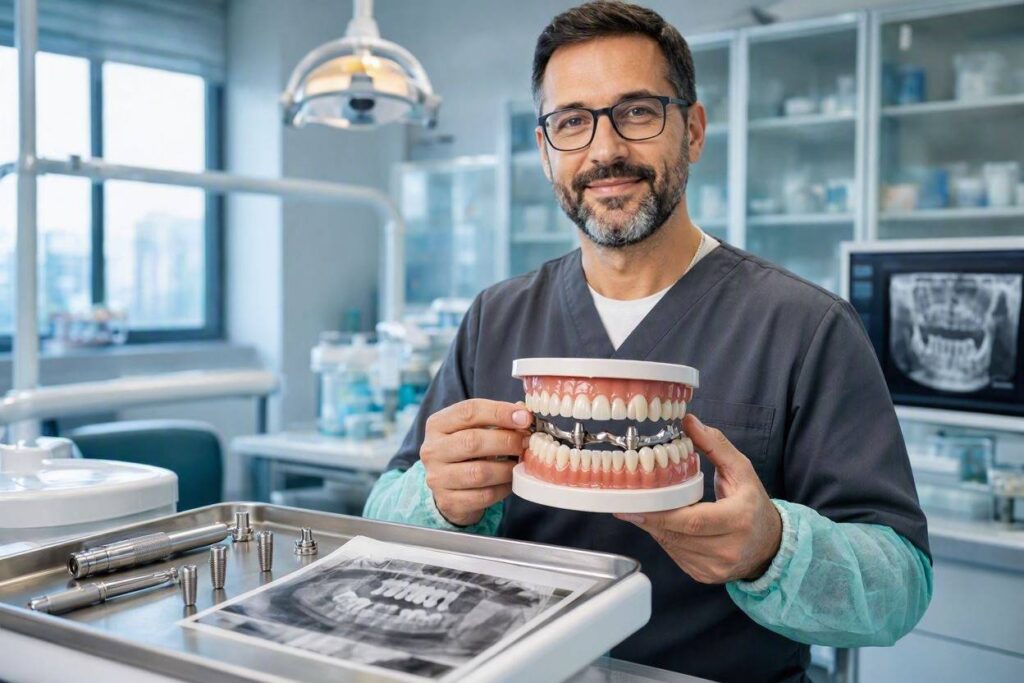
The journey begins with the surgeon. This is the specialist who places the dental implants into your jawbone. For a full arch case, this is almost always an oral and maxillofacial surgeon or a periodontist with advanced surgical training. They are the foundation builder. Their work is hidden beneath the gums, but it determines the entire structural integrity of the final restoration.
The surgeon’s role begins long before the day of surgery. They review your 3D CBCT scan, a sub-millimeter 3D X-ray of your jaws, sinuses, and nerves. They assess the volume, density, and quality of your available bone. They make the critical strategic decisions: how many implants per arch (usually four to six), where to place them, and at what angles. The posterior implants are often tilted at 30 to 45 degrees to avoid the maxillary sinuses in the upper jaw and the inferior alveolar nerve in the lower jaw, while maximizing the use of the dense, available bone.
On the day of surgery, the surgeon performs any necessary extractions of failing teeth, smoothes and levels the bony ridge, and precisely places each implant according to a 3D-printed surgical guide. They achieve a high insertion torque, a measure of the implant’s mechanical stability in the bone. This primary stability is what allows a temporary fixed bridge to be attached to the implants on the same day. The surgeon then places multi-unit abutments, which are angled connectors that screw into the implants and correct for the tilted implant angles, providing a level platform for the bridge to sit on. The surgeon is the master of the biological and surgical phase. Their precision and judgment dictate whether the implants will osseointegrate successfully and whether the final bridge will emerge from the gums in the correct, cleansable position.
The Restorative Dentist or Prosthodontist: The Smile Designer
While the surgeon is the foundation builder, the restorative dentist or prosthodontist is the architect of the visible smile. A prosthodontist is a dental specialist with an additional three years of residency training focused exclusively on the restoration and replacement of teeth, including complex full-mouth reconstructions. This specialist is the quarterback of the restorative phase.
The restorative dentist’s role begins with the end in mind. Before the surgery, they work backward from the desired aesthetic and functional outcome. They analyze your facial structure, your lip line, your smile dynamics, and your phonetics. They design the ideal shape, size, color, and position of your new teeth. This design is translated into a diagnostic wax-up, a physical or digital model of your new smile. This wax-up is then converted into a surgical guide and a provisional bridge, ensuring that the implants are placed in positions that support the desired final smile, not just where the bone is most abundant. This is prosthetically driven implant placement, and it is the defining characteristic of a high-quality full arch result.
After the implants have healed and integrated with the bone, the restorative dentist takes a master impression or digital scan of the implant positions. They perform a try-in appointment where you approve the shape and color of your new teeth in a wax form before the final bridge is made. They manage the laboratory communication, ensuring the ceramist understands the specific shade, translucency, and surface texture required. Finally, they deliver the finished bridge, carefully adjusting the bite so that the forces of chewing are evenly distributed and do not overload any single implant. The restorative dentist is the guardian of aesthetics, phonetics, and long-term functional harmony.
The Dental Laboratory Technician: The Master Ceramist
The third, and often invisible, member of the team is the dental laboratory technician, specifically a master ceramist specializing in implant prosthetics. This person does not see you in the chair, but their hands and eyes shape every visible surface of your new teeth. They are the artisans who transform the dentist’s prescription and the surgical model into a physical, beautiful, and precision-fitting bridge.
The technician receives the master cast or digital file of your healed jaw with the implant analogs in place. They receive the restorative dentist’s detailed prescription, including the chosen shade, the material (acrylic, monolithic zirconia, or layered porcelain over a metal framework), and the specific contouring of the gum tissue. If the bridge is a precision-milled monolithic zirconia, the technician uses a high-end CAD/CAM software program to design the bridge, including the titanium interface that will screw onto the implants and the full contour of the teeth and gums. A multi-million dollar milling machine then carves the bridge from a solid block of medical-grade zirconia.
After milling, the real art begins. The technician applies surface stains to create the subtle color gradients, incisal translucency, and natural-looking texture of real teeth. They carefully shape and stain the pink porcelain or acrylic to mimic the appearance of natural gum tissue, complete with stippling and realistic color variation. The final result is a prosthesis that is not only strong and functional but a genuine work of anatomical art. The laboratory technician’s fee represents a significant portion of the total cost of a full arch case, and the difference between a good technician and a great one is immediately visible in the final smile.
The Patient: The Keeper of the Work
There is a fourth member of the team, and that is you, the patient. You are not a passive recipient. You are the keeper of the work. The surgical, restorative, and laboratory team can deliver a flawless result, but its long-term survival depends entirely on your daily care and your commitment to professional maintenance.
A full arch implant bridge requires meticulous home care. Food debris and bacterial plaque must be cleaned from underneath the bridge, around the implant abutments, and between the bridge and the gum tissue. This requires specialized tools: a water flosser with a non-metal tip, soft interproximal brushes, and floss threaders designed for implant bridges. It requires patience and a daily commitment of several minutes of focused hygiene. The patient who neglects this care will develop peri-implantitis, an infection of the bone around the implants, which can lead to the catastrophic loss of the entire prosthesis.
Professional maintenance is equally critical. The bridge should be removed by the restorative dentist at least once a year for a thorough, professional cleaning of the abutments and the intaglio surface of the bridge. The implants are probed, the occlusion is checked, and any minor wear or looseness of the screws is addressed. A patient who commits to this annual maintenance schedule can expect their full arch restoration to last for decades. A patient who disappears after delivery and fails to maintain the work is on a predictable path to failure. The team makes the restoration; the patient keeps it alive.
The Integrated Team Model: The highest quality full arch outcomes are produced when all three professional team members—the surgeon, the restorative dentist, and the master technician—work within an integrated model, often under one roof or in a close, long-term collaborative relationship. They communicate directly, review cases together, and share a unified standard of care. A clinic where the surgery is done by a distant, unaffiliated surgeon, and the laboratory is a low-cost, third-party mail-order facility, introduces communication gaps and quality control risks that can compromise the final result.
Conclusion
A full arch dental implant restoration is not made by a single individual. It is created by a closely integrated team of the surgical architect, the restorative smile designer, and the master laboratory ceramist. Each contributes an essential, specialized layer of expertise, from the deeply buried titanium post to the visible, gleaming ceramic tooth. The patient is the fourth and final member of the team, the lifelong keeper of the biological and prosthetic investment. Understanding this collaborative process clarifies the cost and reveals the profound level of skill required to create a successful, lasting full arch smile.
Frequently Asked Questions
Who do I go to first, the surgeon or the restorative dentist?
Ideally, you should start with the restorative dentist or prosthodontist. They will perform the comprehensive smile design and create a prosthetically driven treatment plan. They will then refer you to a trusted surgical partner who will place the implants according to that plan. Starting with the surgeon without a restorative plan can lead to implants in positions that are difficult or impossible to restore ideally.
How long does it take for the laboratory to make the final bridge?
The fabrication of a final, precision-milled, and hand-finished zirconia full arch bridge typically takes the dental laboratory between three and six weeks from the time they receive the master impression or digital scan. This is not a mass-produced item. It is a custom, handcrafted medical device.
What is the difference between an acrylic and a zirconia full arch bridge?
An acrylic bridge is made of high-impact plastic, often reinforced with a metal bar. It is less expensive, faster to fabricate, and is typically used as the temporary bridge during the healing phase. A zirconia bridge is milled from a solid block of ceramic. It is significantly stronger, more durable, more stain-resistant, and more aesthetic. It is designed to be the long-term, permanent restoration.
Additional Resource:
For a patient-centered explanation of full arch implant treatment and the team involved, visit the American College of Prosthodontists: https://www.gotoapro.org/full-mouth-reconstruction/