When Can You Exercise After Dental Implant Surgery?
You just left the oral surgeon’s office. The procedure went smoothly. You feel surprisingly good. Maybe a little groggy from the sedation, but overall, not bad. The first thought that crosses your mind after “I need a smoothie” is often “When can I get back to the gym?”
You are an active person. Moving your body is how you manage stress, keep your energy high, and maintain your health. The idea of sitting on the couch for days, doing nothing, feels almost more painful than the surgery itself. I understand that completely.
But here is the honest truth. Dental implant surgery is a significant investment. You have invested time, money, and a commitment to your long-term health. The titanium post sitting in your jawbone right now needs peace and quiet to fuse with the bone successfully. Rushing back to the squat rack or the running trail too soon does not just risk a little pain. It risks the entire implant.
This guide is not about scaring you. It is about giving you a realistic, clear, and safe path back to your active life. We will break down the “why” behind the waiting, give you a day-by-day and week-by-week timeline, and explain exactly how different activities affect your healing. By the end, you will know precisely how to return to exercise safely, protecting both your body and your new smile.
The Critical First Days: Understanding the Biological Priority
Before we talk about timelines, we need to talk about what is happening inside your jaw right now. Exercise is a form of physical stress. Healing is a biological process. In the first few days after surgery, these two forces work against each other.
What Happens When an Implant Is Placed?
The dental surgeon drills a precise hole into your jawbone and screws in a titanium or zirconia post. This is not just a simple puncture. The bone around the implant experiences controlled trauma. Tiny blood vessels rupture. The surrounding tissue begins an immediate inflammatory response.
This inflammation is not a bad thing. It is the first step in a process called osseointegration. This is the biological magic where your living bone cells grow directly onto the surface of the implant, locking it in place permanently. For this to happen successfully, the implant must remain absolutely still. Even microscopic movements—what doctors call “micromotion”—can disrupt bone cell adhesion. If the body senses movement, it may form soft scar tissue around the implant instead of hard bone. This leads to implant failure.
Think of it like planting a delicate seedling. If you wiggle it every day, the roots will never take hold.
The Danger of Increased Blood Pressure
This is the main reason your surgeon tells you to skip the gym. Physical exertion raises your heart rate and blood pressure. Immediately after surgery, a protective blood clot forms over the surgical site. This clot is the foundation for new tissue growth. A spike in blood pressure can dislodge this clot.
When the clot gets lost, you get a dry socket. Even though dry socket is more commonly discussed with tooth extractions, the principle applies to implant sites as well. The underlying bone and sensitive nerve endings become exposed. The pain is intense and sharp. But more importantly for implant patients, losing the clot disrupts the healing cascade, inviting bacteria into the surgical site and potentially causing an infection called peri-implantitis.
Protecting that fragile clot during the first 48 to 72 hours is your number one job. Exercise can wait.
Phase 1: The Absolute Rest Period (Days 1 to 3)
This is your mandatory downtime. You do not negotiate with this phase. You simply accept it as a short, non-negotiable investment in your long-term health.
Day 1: The Day of Surgery
You will leave the office with gauze packed over the surgical site. You might feel numb for a few hours. Once the anesthesia fades, expect discomfort, swelling, and perhaps minor oozing.
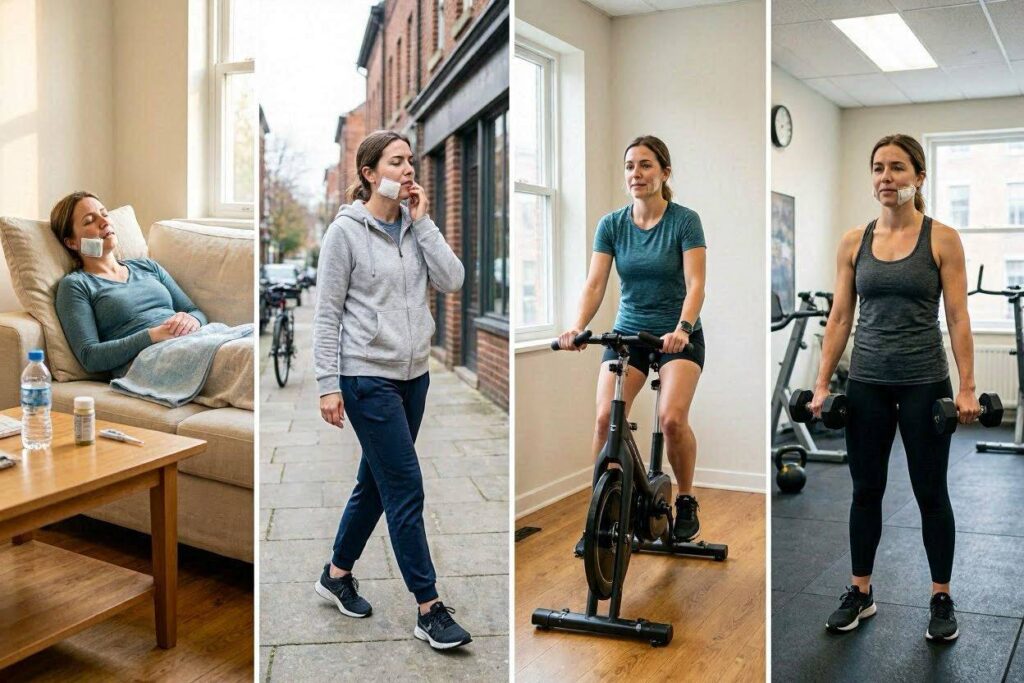
What should you do on Day 1? Nothing. Literally, rest. Lie on the couch or in bed with your head elevated on two or three pillows. Keeping your head above your heart reduces throbbing and minimizes swelling. Apply an ice pack to your cheek in 20-minute intervals—20 minutes on, 20 minutes off. This is the most effective thing you can do today.
Can you go for a walk? No. Not even a gentle walk around the block. Your body is in shock, even if you do not feel it emotionally. The sedatives or anesthesia are still clearing your system. Your balance may be off. A stumble, a fall, or even bending down to tie a loose shoelace could cause a jarring impact to your jaw. Stay home. Walk from the couch to the kitchen and back. That is all.
Why you must avoid bending over or lifting anything. Any action that makes your head go lower than your heart dramatically increases blood pressure in the vessels of your face and head. Picking up a heavy grocery bag, a toddler, or a laundry basket can trigger a sudden, throbbing pain and start bleeding. Treat your head like a fragile vase for the next 72 hours.
Important Note: Do not spit, do not use a straw, and do not aggressively rinse your mouth. Any suction motion can pull the blood clot right out.
Day 2: The Peak of Inflammation
You will wake up swollen. This is normal. Day two is often worse than day one in terms of swelling. The inflammatory response is at its peak.
Can you exercise? Still no. Your blood pressure regulation is not yet stable. The clot is very fresh. Any elevation in heart rate could be problematic. You are also probably on pain medication, which can make you drowsy and mask your body’s warning signals. Pain is an important communicator. If you dull it completely and then go for a walk, you might not notice that subtle “twinge” that tells you to stop until it is too late.
Mental health note for athletes. I know this is hard. For many active people, exercise is a drug. It clears anxiety and boosts your mood. Suddenly stopping can make you feel restless, irritable, and even depressed. Recognize this. Plan for it. Have a list of movies to watch or a stack of books ready. Do not sit there scrolling through social media, watching other people work out. That will only make you feel worse. This is a 72-hour pause, not a lifetime. Reframe it: you are actively healing, not just passively resting.
Day 3: Light Movement and Listening to Your Body
By day three, the severe, sharp pain should start transitioning to a dull ache. The swelling might still be very visible, but the plateau has been reached.
The “Restroom Test.” Here is a practical guide for day three. If you walk to the bathroom and back, and the implant site throbs with every heartbeat, you are not ready for anything more. If you walk to the bathroom and feel okay, you might be ready for a very short, indoor walk. I am talking about pacing slowly in your living room for five minutes. No hills. No stairs. No incline.
The 5-Minute Rule. If you feel the need to move, set a timer for five minutes. Walk slowly indoors. Stop immediately if you feel:
- A sudden increase in swelling or a “tight” feeling.
- Throbbing pain that syncs with your heartbeat.
- A metallic taste in your mouth (this could be slight bleeding).
- Dizziness or lightheadedness.
This is not a “workout.” This is a test to see if your body can handle being upright for a short period without a blood pressure spike. Do not elevate your heart rate intentionally.
| Activity | Day 1 | Day 2 | Day 3 |
|---|---|---|---|
| Walking (Slow, Indoor) | No | No | Yes (5 min max) |
| Lying Flat | No (Elevate head) | No (Elevate head) | Caution |
| Stretching (Neck/Shoulders) | No | No | No |
| Heavy Lifting | No | No | No |
| Cardio | No | No | No |
| Ice Therapy | Yes (20 min cycles) | Yes (20 min cycles) | Yes (if swelling persists) |
Phase 2: The Fragile Recovery Window (Days 4 to 7)
You have made it through the worst part. The risk of a simple, spontaneous clot loss is lower, but the risk from physical jarring and bacterial contamination remains high. During days four through seven, you are starting to feel more human. This is the danger zone where people overestimate their healing and do too much.
Day 4: Introducing Gentle, Short Walks
The swelling should start to visibly decrease. The bruising might turn yellow or green at the edges. This is a good sign. Your body is cleaning up the debris.
What activity is safe now? A gentle, outdoor walk on a flat, predictable surface is acceptable for many patients. We are talking about a 15 to 20-minute slow stroll. No power walking. No swinging your arms vigorously. Keep your mouth clean, but do not use mouthwash with alcohol.
The “Walk-Talk Test.” If you are walking, you should be able to hold a conversation easily without gasping for air. If your breathing is labored, you are pushing too hard and your blood pressure is climbing. Slow down.
Why still no stretching? You might be desperate to stretch your neck and shoulders, which have tightened up from sleeping upright. Be extremely cautious. Tilting your head back to stretch your neck can pull on the muscles connected to your jaw. Lowering your head below your knees to stretch your back is still completely forbidden. If you must stretch, keep your head completely neutral and upright. A gentle, seated hamstring stretch where you do not round your back or drop your head is a safer option.
Day 5: The False Sense of Security
You woke up feeling almost normal. The danger is here. On day five, the soft tissue starts to close, and the pain is minimal. You think, “I can do a few pushups.”
Do not do pushups. Do not do planks. Do not do yoga, even “gentle” yoga. Any position where you are inverted or facing the floor dramatically increases blood pressure in the head. A plank puts an immense amount of isometric pressure on the jaw and neck. A downward-facing dog is an absolute nightmare for a fresh implant site. You risk a throbbing, bleeding episode that sets you back a week.
Bone Graft Considerations. If you had a bone graft along with your implant, you must be even more cautious. The graft material is particulate. It is like wet sand packed into a hole. Vibration and pressure can displace these particles before the gum tissue has completely sealed them in. You might not feel pain, but you could compromise the foundation. Respect the 7-day minimum for complete rest if a graft was involved.
Day 6 & 7: Nearing the End of Week One
You are likely off the heavy painkillers, perhaps just using over-the-counter ibuprofen or acetaminophen. Your energy is returning.
The 30-Minute Rule. At the end of week one, a 30-minute flat-ground walk is a great target. This promotes healthy blood circulation throughout the body without the pulsatile pressure of high-intensity training. Good circulation brings oxygen and nutrients to the surgical site. Poor exercise choice (high intensity) sends a jackhammer of pressure to it. We want the gentle stream, not the jackhammer.
Can I swim yet? Absolutely not. Swimming pools are chemical soups. Chlorine is an irritant. Lakes and oceans carry bacteria that could cause catastrophic infections. The soft tissue closure at one week is still fragile, and suture lines are not fully sealed. Submerging your head is out of the question. Even if you keep your head above water, the risk of a splash or accidentally getting water in your mouth is too high. Wait until your sutures are removed or dissolved and your surgeon gives the green light.
A Note on Professional Athletes: A 2023 review in the Journal of Oral Implantology discussed accelerated recovery protocols for elite athletes using advanced platelet-rich fibrin (PRF) techniques. These athletes sometimes begin light, highly monitored lower-body isometrics after 96 hours. However, they have full-time medical teams monitoring their blood pressure and surgical sites. For the rest of us, the standard protocol remains the safest.
Phase 3: The Osseointegration Onset (Weeks 2 to 4)
You have passed the acute wound-healing stage. The gum tissue is sealing. The stitches are likely dissolving or coming out. The body is now transitioning from “repairing the hole” to “fusing to the metal.” This is a long, slow process. Exercise can gradually return, but with significant modifications.
Week 2: Returning to Light Resistance
If you had a post-operative check-up around day 10 to 14, and your surgeon says the site looks beautiful, you can begin to reintroduce very light resistance training.
The New Rules of the Gym (Week 2):
- Weight Limit: Do not lift anything that requires you to strain. A good limit is 10 to 15 pounds for upper body exercises. Straining equals holding your breath, which equals a Valsalva maneuver. The Valsalva maneuver spikes your intracranial and intraoral blood pressure dangerously high. No grunting. No heavy breathing.
- Seated Exercises Only: Stay upright. Keep your head above your heart at all times. A recumbent bike is excellent. A standard upright bike is good if you sit tall and avoid the hunched-over, racing posture. Seated leg curls and leg extensions with very light weight are safe.
- No Running: The repetitive, high-impact vibration of jogging travels up the kinetic chain directly into your skull. Even if you run on soft grass, the jarring motion can disrupt the delicate cellular activity happening inside the bone. Long, brisk walks are your cardiovascular exercise for now. Walk at a pace of 3.5 to 4 miles per hour if you feel good, but keep it smooth.
Why the Jaw Hurts When You Lift. You might notice a strange phenomenon. You will be doing a light bicep curl, and you feel a sensation in your jaw. This is not in your head. When people exert force, they instinctively clench their teeth. This is called “masticatory muscle co-activation.” After surgery, even a tiny clenching pressure can cause inflammation around the implant. You need to train yourself to exercise with your jaw totally relaxed, lips gently together, teeth slightly apart. This is a mouthguard-less zone for now.
Week 3: Breaking a Sweat (Carefully)
Your energy levels are probably back to normal. You feel like you are losing fitness. It is time to gently increase the intensity, but with awareness.
What you can safely do in Week 3:
- Steady-State Cardio: You can now safely ride a bike outdoors on a flat, paved path. Avoid loose gravel or trails where a sudden bump could send a shock through your arms and into your jaw. The elliptical machine is a great option because it eliminates impact.
- Bodyweight Squats: Air squats are acceptable as long as you maintain perfect posture. Keep your chest up. Do not let your head flop forward. Controlled breathing is essential—inhale on the way down, exhale on the way up. No explosive jumps yet.
- Upper Body Weight Limit: You can probably move up to 20-25 pounds for curls or lateral raises, but watch for the jaw-clench reflex. If you feel any fullness or pressure at the implant site, stop.
The Danger of Overheating. Some evidence suggests that raising your core body temperature too high in the early stages of bone healing can slightly interfere with the biological process. While you do not need to avoid a light sweat, sitting in a sauna or steam room is a bad idea. Heat causes vasodilation, and in a recently traumatized vascular bed, this can cause a relapse in swelling. Stick to the workout, skip the hot room.
Week 4: Listening to the “Bone Drum”
By the end of the first month, the implant has some initial stability. It is not ready for high-torque forces, but it has a foothold.
The “Tap Test” Analogy. Your dentist checks implant stability using a device that essentially taps the implant. Imagine your bone is a drum. If you tap it and it sounds hollow, the connection is not tight. If it sounds solid, the bone is integrating well. High-impact exercise also “taps” the implant, but with the force of a sledgehammer. Even at week four, the implant needs a gentle tap, not a pounding. No jump squats, no burpees, no jumping rope.
| Exercise Type | Week 1 | Week 2 | Week 3 | Week 4 |
|---|---|---|---|---|
| Walking (Flat) | Caution | Yes (Brisk) | Yes | Yes |
| Stationary Bike | No | Yes (Light) | Yes | Yes |
| Jogging/Running | No | No | No | Caution (Short) |
| Bodyweight Squats | No | Caution (Slow) | Yes | Yes |
| Upper Body Weights | No | <15 lbs | <25 lbs | Caution |
| Planks/Pushups | No | No | No | No |
| Swimming | No | No | No | No |
Phase 4: The Bone Remodeling Stage (Months 2 to 3)
This is the period where people get into trouble. The implant looks healed from the outside. The gum tissue is pink and firm. The crown might not be on yet, but the healing cap looks clean. You feel 100%. You think you are cleared for everything.
You are not. The bone remodeling under the gum is a slow, hidden process. You feel no sensation because bone has no nerve endings that sense “integration.” You only feel pain when something goes wrong. So, your body has no “early warning system” here except the pain of failure.
Month 2: Reintroducing Impact and Heavier Weights
If your surgeon takes an X-ray at the two-month mark and sees good bone density around the threads of the implant, you will likely get the green light to return to more normal activities.
How to start running again. Start on a treadmill before you hit the asphalt. The treadmill has predictable give. Run for 5 minutes, then walk for 2 minutes. Pay attention. When your foot strikes the belt, does the vibration feel like it is radiating into your upper jaw? It shouldn’t, but if it does, stop. Do not run through soreness in the implant site. Soreness means micromotion is happening. You might need another two weeks of healing before the vibration stops causing sensation.
Returning to upper body strength. You can now start pushing harder. However, the “Valsalva” rule still applies. You can bench press, but you must breathe. Do not try for a one-rep max where you hold your breath and turn purple. The pressure build-up is still a risk factor for the tiny, delicate blood vessels deep in the bone. Use a weight you can lift for 12-15 reps with perfect breathing control. This builds fitness and protects the implant.
The Yoga and Pilates Conversation
Reformer Pilates, mat Pilates, and yoga pose specific challenges. Many positions, like the Plow Pose, Shoulder Stand, and Headstand, are the enemy of a healing upper jaw. Even if the implant is in the lower jaw, the systemic pressure increase is extreme.
You can return to most yoga around month two, but you must alert your instructor. Tell them, “I have had dental implant surgery. I cannot do inversions or prone positions where my head is below my heart yet.” A good instructor will give you modifications. Your rule remains: head above heart. It is a temporary modification. The mat will still be there in a few months when you can invert safely again.
Month 3: The Full-Body Return
For most single-tooth implant patients with a straightforward history, the three-month mark is the threshold for “loading” the bone. This is often when the dentist places the abutment and the final crown. If your bone has integrated well enough to take a chewing load, it can usually take an exercise load.
The All-Clear Activities (usually safe now):
- Running outdoors on varied terrain.
- Lifting heavy (with progressive overload, not ego-lifting).
- Contact sports (with a professionally fitted mouthguard—this is non-negotiable).
- Full, uninhibited yoga practice including gentle inversions.
The Mouthguard Mandate. If you lift weights, do CrossFit, play basketball, or do martial arts, you clench your jaw. The power transfer from your jaw to your core is involuntary and powerful. An implant does not have the same sensory feedback as a natural tooth. You can clench hard enough to fracture the porcelain crown or, worse, overload the bone. A custom-fitted sports mouthguard from your dentist is the best way to dissipate force and protect your implant during explosive movements. Boil-and-bite guards offer no real protection for implants.
“I see implant fractures almost exclusively in two groups: people who grind their teeth at night untreated, and athletes who returned to high-intensity weightlifting without a mouthguard.” – Dr. Michael Sonick, Periodontist (paraphrased insight from clinical observation)
A Deep Dive into Specific Activities
Let’s break down individual sports and exercises. Generic advice can be confusing. You need to know about your specific passion.
When Can I Swim After a Dental Implant?
As mentioned earlier, swimming is a unique risk due to infection. The chemicals in a chlorinated pool can irritate the delicate gum tissue trying to form a “cuff” around the implant healing cap. In a freshwater lake or ocean, bacteria like Pseudomonas or Vibrio can, in rare cases, enter the bloodstream through the not-yet-fully-keratinized gum tissue. Wait for a definitive “seal.” This takes at least 4 weeks. You need that gum tissue to be a watertight barrier. If you absolutely must swim for professional reasons before 4 weeks, discuss a custom-dental dam or temporary sealing with your periodontist.
When Can I Do Burpees or High-Intensity Interval Training (HIIT)?
HIIT is a minefield of blood pressure spikes and explosive movements. The burpee combines a squat, a plank, a pushup, and a jump. It is the perfect storm of everything you want to avoid. The transition from standing to the plank position, then jumping back up, sends intracranial pressure on a rollercoaster. Wait a minimum of 8 weeks, and perhaps longer if you have a history of bleeding issues. When you return, start with modified burpees. Step back instead of jumping back. Stand up instead of jumping up. Test the water for two weeks before going all out.
When Can I Play Wind Instruments?
This is a niche but important category. Playing a saxophone, trumpet, or clarinet generates significant intraoral air pressure. This pressure pushes against the surgical site from the inside. Wait 2 weeks for the soft tissue to seal. Then, start with 5-minute sessions. If you feel any air “bubbling” through the site or any ache, stop immediately. An air embolism is not a risk here as it is in other surgeries, but the mechanical pressure of air can dissect the tissue, creating a tunnel for bacteria between the implant and the bone. Wind instrument players should get their periodontist’s specific clearance, ideally around the 3-4 week mark.
The Silent Healer: Nutrition and Hydration’s Role in Exercise Recovery
You cannot talk about returning to exercise without talking about nutrition. You are what you eat, and your implant site is especially what you eat.
The First Week’s Diet and Energy Levels
You are on a soft diet. Smoothies, soup, yogurt, mashed potatoes. This often means a drastic drop in your protein intake and a spike in sugars if you rely on fruit smoothies. Your energy for exercise will be low because your glycogen stores deplete rapidly on a low-calorie, liquid diet.
How to keep energy up safely. Make savory smoothies. Blend bone broth, steamed vegetables, and a scoop of unflavored protein powder. This gives you the amino acids your body needs to rebuild the bone matrix without spiking your blood sugar. Sip it. Do not use a straw. The suction from a straw is just as dangerous as a vigorous swishing motion.
Bone-Building Nutrients
Your exercise places healthy stress on bones, making them denser. Your implant needs that same building-block support.
- Vitamin D: Crucial for calcium absorption. If your levels are low, osseointegration is slower. Get 15 minutes of sun or take a supplement as advised by your doctor.
- Calcium: The literal brick of the bone wall. Dairy, fortified milks, or leafy greens blended very finely.
- Vitamin C: Collagen synthesis. The gum tissue needs to knit strongly around the implant. Peppers, strawberries, and citrus fruits blended are good options.
- Protein: Bone is 30% protein (collagen). Without adequate dietary protein, your body cannot build the scaffold for mineralization.
Important Note on Pre-Workout Powders: Avoid pre-workout supplements in the first 3 weeks. The vasoconstriction from caffeine and other stimulants in these formulas theoretically reduces blood flow to the periphery, including your gums. Good blood flow is critical. Also, many pre-workouts contain ingredients that thin the blood, increasing bleeding risk.
The Psychology of the Rest Period
No one discusses this aspect enough. Taking forced time off from exercise is a mental battle. Your identity might be tied to being strong, fast, or fit. A 7-day (or longer) pause can feel like you are losing a part of yourself.
Managing the “Gym Guilt”
You are not losing your gains. Detraining in muscle strength takes about 3 to 4 weeks to begin. Your cardiovascular fitness drops a bit faster, but it bounces back fast. What you lose in two weeks, you can regain in two weeks.
Reframing the narrative. Your “workout” right now is not lifting. Your “workout” is sitting still. It is the disciplined act of allowing your body to direct 100% of its energy to your jaw. Elite athletes understand that recovery is training. This is the ultimate recovery day. Your only rep is staying calm.
Visualization Techniques
Athletes and performers use visualization to maintain neural pathways. You can do this too. Sit quietly, close your eyes, and visualize your perfect deadlift form. Imagine the weight. Imagine the smooth pull. Studies show that mental rehearsal activates the motor cortex in a way that can help with skill retention. It is not a substitute for physical work, but it is a powerful tool for the restless mind. Visualize the bone cells wrapping tightly around the implant threads. Visualize successful, strong osseointegration. This connects your mental drive to your physical healing.
Comparative Table of Activities Timeline
Use this table as your quick reference guide. Remember, this assumes a simple, single-implant case with no major complications like heavy bone grafts or sinus lifts. Always confirm with your oral surgeon.
| Activity | Earliest Safe Start | Modifications Required | Red Flags to Stop |
|---|---|---|---|
| Walking (Leisurely) | Day 3-4 | Flat surfaces, no hills | Throbbing, swelling increase |
| Walking (Brisk) | Week 2 | Keep heart rate moderate | Jaw tension, metallic taste |
| Jogging | Week 4-6 | Treadmill first, soft ground | Vibration sensation in jaw |
| Running (Fast/Outdoor) | Month 2-3 | Short intervals first | Pain on foot strike |
| Weight Lifting (Light) | Week 2 | <20 lbs, seated, breathe out | Jaw clenching, facial pressure |
| Weight Lifting (Heavy) | Month 2-3 | Custom mouthguard mandatory | Sharp pain at implant site |
| Yoga (Gentle Stretch) | Week 3 | Head above heart, no inversions | Dizziness, swelling in head |
| Yoga (Inversions/Full) | Month 3+ | Re-introduce slowly | Any instability sensation |
| Swimming | Month 1-2 | Clean, chlorinated pool preferred | Irritation, pus, foul taste |
| HIIT/Burpees | Month 2+ | Modified versions first | Throbbing, bleeding |
| Contact Sports | Month 3+ | Professional-grade mouthguard | Any direct facial impact |
| Cycling (Outdoor) | Week 3-4 | Avoid heavy vibration/chatter | Jaw fatigue, headache |
The Red Flag Checklist: When to Stop and Call Your Surgeon
You want to push through muscle soreness. “No pain, no gain.” That mantra does not apply here. Dental implant pain is a warning signal, not a marker of a good workout. Stop exercising immediately and contact your provider if you experience:
- Throbbing Pain in the Implant Site: Pain that pulses in sync with your heartbeat during or immediately after exercise suggests blood pressure is stressing the healing bone.
- Sudden Swelling: A return of swelling days or weeks after it had subsided, especially after a workout, signals inflammation from micromotion or infection.
- Pus or Foul Discharge: Any yellow or white discharge, or a consistently bad taste that is not just “healing mouth” taste. Infection has set in.
- Mobility: If you place a clean finger on the healing cap and it moves, do not wiggle it. Leave it alone and call the doctor immediately. Exercise may have fractured the initial bone bond.
- Fever: A systemic sign of infection.
- Looseness: A sensation that the implant is “lifting” or feels “higher” after a workout.
“If your body is sending you a message, listen. Nobody ever lost an implant by waiting another 48 hours to work out. People lose implants by ignoring pain for 48 hours.” – Common clinical wisdom in periodontics.
The Sleep and Exercise Connection
Sleep is your most potent recovery tool. Yet, exercising at the wrong time or intensity can ruin your sleep, and poor sleep ruins your healing.
Sleeping Position and Exercise Recovery
You must keep your head elevated for the first 3 to 5 nights. This is uncomfortable. Your neck gets stiff. You might wake up with headaches. Because you are sleeping poorly, your body produces more cortisol (stress hormone). Cortisol is catabolic to bone. It hinders healing. This creates a negative loop.
How to break the loop. Do not exercise late in the day during the first two weeks. Even a light walk at 8 PM can raise your core temperature just enough to make falling asleep upright even harder. Exercise in the morning. The gentle circulation boost from a morning walk helps flush inflammatory byproducts from the facial tissues, potentially reducing your nightly discomfort. Then, allow your body to wind down completely before bed.
Special Scenarios: Making the Timeline Fit Your Reality
Life does not fit into neat 7-day boxes. You might have a complication, an upcoming race, or a physically demanding job.
If You Had a Sinus Lift
A sinus lift is often performed when the upper back jaw has insufficient bone height. The surgeon lifts the sinus membrane and packs bone graft underneath. This creates a fragile, air-filled space. The rules for exercise after a sinus lift are even stricter.
- Do not blow your nose for at least 2 weeks. The air pressure can rupture the membrane.
- Do not exercise for 2 weeks minimum. Any elevation in blood pressure can cause a nosebleed or force air and blood into the graft site.
- Avoid altitude changes. Do not drive up steep mountains or fly if possible for the first week. Pressure changes in the cabin can severely stress the sinus. Once you resume exercise, avoid any strain that involves holding your breath or grunting.
If You Have a Physically Demanding Job
Firefighters, construction workers, warehouse staff—you face a dilemma. You need to return to earning a living, but your job involves the same physical stresses as the gym.
A Practical Return-to-Work Plan:
- Days 1-7: Off work. No negotiation if possible.
- Week 2: Return to work on “light duties.” If you must lift, use a strict 15-pound limit and wear a lifting belt to reduce the reflexive jaw-clench from core bracing. Explain to your supervisor why. A doctor’s note helps.
- Week 3-4: Return to normal duties with extreme mindfulness. When you lift a heavy box, consciously breathe out. Do not hold your breath. Keep your jaw slack.
The Upcoming Wedding or Race
Perhaps you scheduled your implant surgery 12 weeks before a marathon or a major life event where you want to look and feel your best. You might be tempted to cram all your training into the final 8 weeks after a 4-week rest. This is a recipe for overuse injuries and implant failure. The stress of a taper or race week suppresses the immune system. Your body must also support bone healing. A better strategy, if possible, is to do the surgery immediately after the big race. If the timing is fixed, you must compromise your performance goals. Your goal is to finish, not to set a personal record. The implant is permanent. The race time is just a number.
The Long-Term View: Your Implant as a Fitness Partner
Once the osseointegration is complete (3 to 6 months), your implant is incredibly strong. It is not going anywhere. But it requires maintenance, just like your fitness.
The Lifelong Mouthguard Habit
Make wearing a mouthguard a part of your gym uniform. You wear a belt for heavy squats. You wear a mouthguard for heavy lifts. It prevents not just tooth fractures but also protects the temporomandibular joint (TMJ) from the sheer forces of clenching. A dentist-fabricated guard ensures the force is distributed away from the implant crown.
Regular Implant Check-ups
An athlete’s high-force bite is powerful. Sometimes, the screws that hold the crown onto the abutment can loosen over years of heavy use. You might hear a slight “click” not from your jaw joint, but from the implant. Get annual check-ups. Your periodontist can check the torque on the screw. This is a 5-minute fix that prevents a catastrophic fracture.
Bruxism and the Athlete
Bruxism (night-time grinding) is more common in high-intensity athletes. The nervous system stays ramped up. If you wake with a stiff jaw or headaches, you might be grinding. Grinding with an implant puts 5 to 10 times the force of chewing on the bone. Get a night guard. This is essential. Uncontrolled grinding can cause late-term implant failure, even years after successful surgery.
Conclusion
Returning to exercise after dental implant surgery requires patience, but the timeline is straightforward. In the first 3 days, complete rest and head elevation are critical to protect the blood clot and prevent dry socket. From days 4 to 7, you can begin light indoor walking, but must avoid any heavy lifting or jarring movements. Long-term, the osseointegration of the implant into the bone guides your full return to running, strength training, and contact sports, usually safely reached around the 3-month mark with your surgeon’s clearance.
FAQ: When Can You Exercise After Dental Implant Surgery?
1. Can I do yoga with my head down 2 weeks after implant surgery?
No, any inversion or position where the head is below the heart increases blood pressure in the surgical site. Wait at least 3-4 weeks, and always check with your surgeon first.
2. When is heavy weightlifting allowed after dental implants?
Heavy weightlifting, where you strain and brace your core, is typically safe around the 2 to 3-month mark. You must use a custom-fitted mouthguard to absorb the clenching forces.
3. Is it safe to run a marathon 2 months after implant placement?
It depends on your healing X-ray. The repetitive impact of a marathon is intense. You need clear confirmation from your periodontist that the bone density is sufficient. For many, 3 months is safer.
4. Will sweating during exercise cause an infection in my implant?
Sweat itself is sterile and won’t cause an infection. The risk comes from high blood pressure dislodging the clot or bacteria from gym equipment getting into your mouth if you touch your face. Keep your hands clean and don’t wipe your mouth with a dirty towel.
5. I am a professional cyclist. How do I protect my implant during a crash?
A properly fitted, dentist-made sports mouthguard is non-negotiable. In the event of a crash, the mouthguard distributes impact forces and significantly reduces the risk of fracturing the implant or the surrounding jawbone.
Additional Resource Link:
For a deeper understanding of the science of osseointegration, visit the Academy of Osseointegration: https://www.osseo.org/
Disclaimer: This article is for informational purposes only and does not constitute medical advice. The timeline for exercise recovery varies based on individual health factors, the complexity of your surgery, and your surgeon’s specific protocols. Always consult directly with your dental surgeon or periodontist before resuming any physical activity after dental implant surgery.