Can You Replace Dentures With Implants?
Many people who wear dentures struggle with discomfort, instability, and difficulty eating. Traditional dentures rest on the gums and can slip, cause sore spots, and limit food choices. If you are tired of these problems, you may wonder if you can replace your dentures with dental implants.
The good news is that you can. Dental implants offer a stable, comfortable, and long-lasting alternative to traditional dentures. This guide explains your options for replacing dentures with implants, the process involved, and what to expect.
Understanding the Limitations of Traditional Dentures
Traditional dentures are removable prosthetics that replace missing teeth. While they are affordable and non-invasive, they have significant drawbacks.
Instability
Traditional dentures rest on the gums and rely on suction or adhesive for retention. They can slip, especially when eating or speaking. Lower dentures are particularly prone to movement because the tongue and floor of the mouth constantly push against them.
Discomfort
Dentures can cause sore spots and irritation. As the jawbone shrinks over time, the denture fit changes, leading to rubbing and discomfort.
Limited Diet
Many denture wearers avoid hard, chewy, or sticky foods because their dentures cannot handle them. This can lead to nutritional deficiencies.
Bone Loss
Traditional dentures do not stimulate the jawbone. Without stimulation, the bone continues to resorb, leading to further bone loss and changes in facial structure.
How Implants Can Replace Dentures
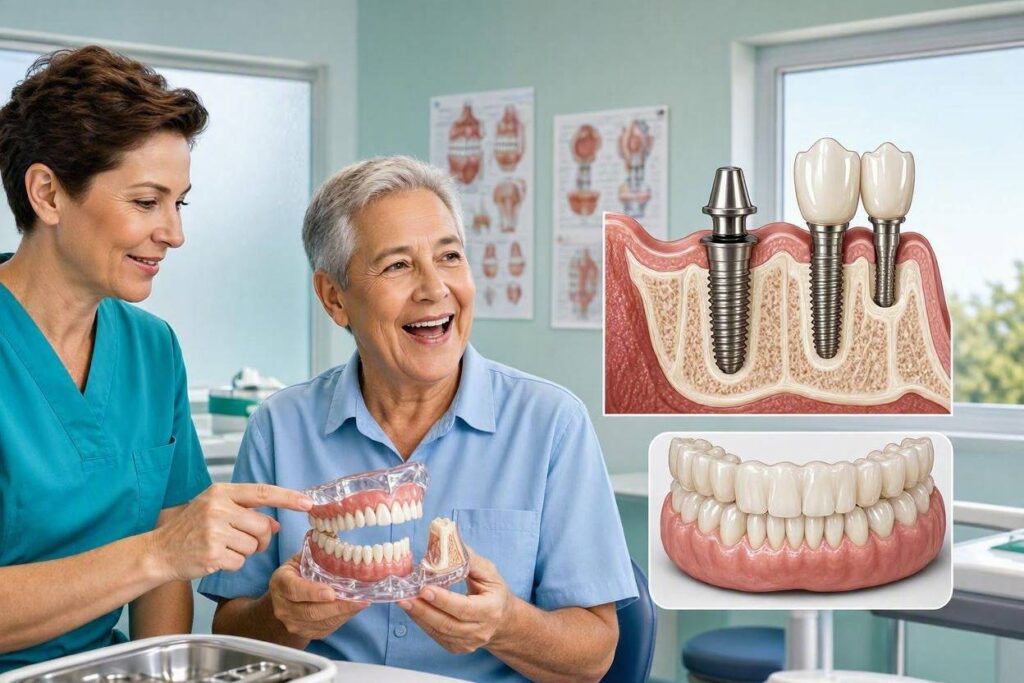
Dental implants address the limitations of traditional dentures by providing a stable, permanent foundation for tooth replacement.
Implant-Supported Overdentures
An implant-supported overdenture is a removable denture that snaps onto dental implants. It combines the stability of implants with the convenience of a removable prosthesis.
Most patients need two to four implants in the lower jaw or four to six implants in the upper jaw. The denture attaches to the implants using special attachments, providing much better retention than traditional dentures.
Fixed Implant Bridges
A fixed implant bridge, also known as a full arch restoration, is a permanent set of teeth that is screwed or cemented onto implants. It cannot be removed by the patient.
The All-on-4 and All-on-6 techniques are popular options. These use four or six implants to support a full bridge of teeth. The result looks and functions like natural teeth.
The Process of Replacing Dentures with Implants
The process of transitioning from dentures to implants involves several steps.
Step One: Evaluation
Your dentist evaluates your oral health, including the condition of your jawbone. X-rays and 3D scans help assess bone density and plan implant placement.
Step Two: Bone Grafting (If Needed)
If you have significant bone loss from years of denture wear, you may need bone grafting. The graft adds bone to the jaw, creating a stronger foundation for implants. Bone grafting requires three to six months of healing.
Step Three: Implant Placement
The implant posts are surgically placed into the jawbone. This is done under local anesthesia or sedation. The procedure takes one to two hours per arch.
Step Four: Temporary Restoration
In many cases, temporary teeth can be attached to the implants on the same day as surgery. This allows you to leave the office with a full set of teeth.
Step Five: Healing Period
The implants integrate with the bone over three to six months. During this time, you follow a soft food diet and avoid putting excessive pressure on the implants.
Step Six: Final Restoration
Once healing is complete, the final restoration is placed. For overdentures, this means a new denture that snaps onto the implants. For fixed bridges, the permanent bridge is attached.
Cost of Replacing Dentures with Implants
Replacing dentures with implants is a significant investment. Here is what to expect.
Implant-Supported Overdentures
Implant-supported overdentures cost between $15,000 and $30,000 per arch. This includes the implants, attachments, and denture.
Fixed Implant Bridges
Fixed implant bridges cost between $20,000 and $35,000 per arch for All-on-4. The All-on-6 technique costs slightly more.
Additional Costs
Bone grafting, if needed, adds $500 to $3,000 per site. Extractions add $150 to $600 per tooth. Sedation adds $300 to $1,000.
Comparison Table for Denture Replacement Options
Here is a quick reference table comparing traditional dentures, implant-supported overdentures, and fixed implant bridges.
| Option | Cost | Stability | Removability | Bone Preservation |
|---|---|---|---|---|
| Traditional Dentures | $600 – $8,000 | Low | Yes | No |
| Implant-Supported Overdentures | $15,000 – $30,000 | High | Yes | Partial |
| Fixed Implant Bridges | $20,000 – $35,000 | Highest | No | Yes |
Benefits of Replacing Dentures with Implants
The benefits of implant-supported restorations are significant.
Improved Stability
Implants provide a stable foundation that eliminates slipping and movement. You can eat, speak, and smile with confidence.
Better Comfort
Implant-supported restorations do not rub or cause sore spots. They feel more like natural teeth.
Expanded Diet
With implants, you can eat a wider variety of foods, including hard and chewy items that are difficult with traditional dentures.
Bone Preservation
Implants stimulate the jawbone, preventing the bone loss that occurs with traditional dentures. This helps maintain facial structure.
Improved Quality of Life
Many patients report significant improvements in their quality of life after transitioning from dentures to implants. They feel more confident and enjoy better overall health.
Who Is a Candidate for Replacing Dentures with Implants?
Most denture wearers are candidates for implant-supported restorations. However, certain factors must be considered.
Adequate Bone
You need sufficient bone to support implants. If you have significant bone loss, bone grafting may be necessary.
Good Overall Health
You should be in good enough health to undergo surgery. Conditions like uncontrolled diabetes can affect healing.
Commitment to Oral Hygiene
Implants require the same level of care as natural teeth. You must be willing to brush, floss, and visit your dentist regularly.
Smoking Status
Smoking increases the risk of implant failure. Many dentists recommend quitting before implant placement.
Important Notes for Patients
- You can replace traditional dentures with implant-supported restorations.
- The two main options are implant-supported overdentures and fixed implant bridges.
- Bone grafting may be needed if you have significant bone loss.
- The process takes several months from start to finish.
- The cost is significant but offers long-term benefits.
- Most denture wearers are candidates for implants.
Frequently Asked Questions
Can I replace my dentures with dental implants?
Yes, most denture wearers can transition to implant-supported restorations. An evaluation by a qualified dentist will determine your candidacy.
How many implants do I need to replace dentures?
For overdentures, you need two to four implants in the lower jaw or four to six in the upper jaw. For fixed bridges, you need four to six implants per arch.
Is it worth replacing dentures with implants?
For most patients, yes. Implants provide better stability, comfort, and function. They also prevent bone loss and improve quality of life.
How long does the process take?
The entire process takes three to six months, including the healing period. Some patients receive temporary teeth on the same day as surgery.
Can I get implants if I have been wearing dentures for years?
Yes, but you may need bone grafting if you have significant bone loss from years of denture wear.
How much does it cost to replace dentures with implants?
Implant-supported overdentures cost $15,000 to $30,000 per arch. Fixed implant bridges cost $20,000 to $35,000 per arch.
Will my insurance cover implant-supported dentures?
Some insurance plans cover a portion of the cost. Check with your specific plan for details.
What is the recovery like after implant surgery?
Most patients experience some swelling and discomfort for a few days. You will follow a soft food diet for several weeks while healing.
Conclusion
You can replace traditional dentures with dental implants, and most denture wearers are candidates for this transformation. The two main options are implant-supported overdentures and fixed implant bridges. Both provide significantly better stability, comfort, and function than traditional dentures. The process takes several months and requires a significant financial investment, but the long-term benefits are substantial. If you are tired of the limitations of traditional dentures, consult a qualified dentist to explore your options.
Additional Resource
For more information on implant-supported dentures and finding a qualified provider, visit the American Academy of Implant Dentistry at www.aaid.com. This professional organization offers patient education resources and a directory of credentialed implant dentists.