What is Implant Fixture? Types, Materials & Uses
The language of dental implants can feel like a foreign dialect. You hear terms like post, abutment, crown, and fixture, often used interchangeably, and it becomes confusing. Among these, the term “implant fixture” is one of the most fundamental, yet it is often misunderstood. Is it the same as the implant post? Is it a special type of implant? The implant fixture is the actual, surgically placed component that becomes the artificial tooth root. It is the anchor embedded in your jawbone. This article provides a definitive, in-depth exploration of the dental implant fixture. You will learn precisely what it is, the different types and shapes available, the materials it is made from, and the specific clinical uses for each design. By the end, you will have a clear, professional understanding of the component that is the very foundation of modern tooth replacement.
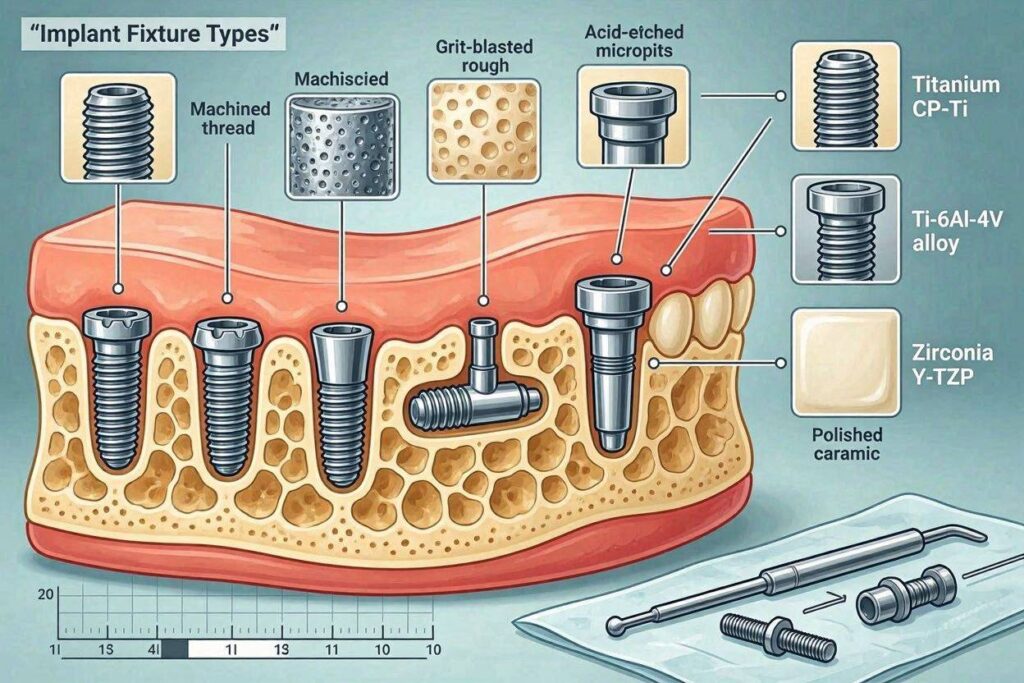
Defining the Implant Fixture
In strict dental terminology, the implant fixture is the component that is surgically placed into the bone of the maxilla or mandible. It is a biocompatible, alloplastic material—meaning it is a synthetic material placed into living tissue. The fixture is designed to osseointegrate, to fuse directly with the living bone without an intervening soft tissue layer. Once integrated, it serves as an anchorage point for the prosthetic components: the abutment and the final crown or bridge. The terms “implant body,” “implant post,” and “implant fixture” are synonymous in clinical practice. The fixture is the part that you do not see. It is buried under the gum or, in a tissue-level design, its collar emerges through the gum. It has an external thread, an internal connection chamber, and a precisely engineered surface. It is the root of your new tooth, and every other part of the restoration depends on its stability.
Fixture vs. Implant System
It is important to understand that the fixture is one component of a larger “implant system.” The system includes the surgical drills, the placement instruments, the fixture itself, the healing abutments, the impression copings, the definitive abutments, and the prosthetic screws. All components of a system are manufactured to precise tolerances by a single company and are designed to work exclusively together. You cannot use a Straumann fixture with a Nobel Biocare abutment. The fixture’s internal connection geometry is the proprietary heart of the system.
Types of Implant Fixtures Based on Design and Shape
Fixtures are not one-size-fits-all cylinders. They are designed in specific macro-geometries to accommodate different bone volumes, densities, and surgical protocols.
1. Tapered vs. Cylindrical Fixtures
The external shape of the fixture body is a primary design variable. A tapered fixture mimics the natural shape of a tooth root. It is wider at the top (the coronal portion) and narrows down towards the apex. This shape is ideal for placement between convergent tooth roots, in extraction sockets, and in areas of limited buccal bone, such as a narrow ridge. The taper provides good primary stability in soft bone by condensing the bone laterally as it is inserted. A cylindrical or parallel-walled fixture has a constant diameter along its body. It provides excellent frictional primary stability, especially in dense bone, and a very predictable surface area for osseointegration. Some designs are hybrid, with a tapered apical portion and a parallel-walled coronal portion.
2. The Thread Design
The threads on a fixture body are not just for screwing it in; they are engineered stress distributors. The thread pitch, shape, depth, and spacing all influence the fixture’s biomechanical behavior. A standard V-thread is effective for cutting and self-tapping. A buttress thread has a flat, compressive face that is ideal for transmitting occlusal loads to the bone. A reverse buttress thread provides stability against lateral forces. Micro-threads are often placed on the coronal collar of the fixture. These fine threads are designed to distribute stress to the crestal bone in a more physiological way, reducing the risk of marginal bone resorption. A fixture may have a variable thread design, with an aggressive, wide-thread pitch in the apical portion for self-tapping and primary stability, and a finer pitch in the coronal portion for load distribution.
3. Root-Form, Cylindrical, and Atypical Designs
The vast majority of modern fixtures are root-form endosseous implants—they are shaped like a tooth root and placed within the bone. Specialized designs exist for specific situations. A short and wide fixture, sometimes called an ultra-wide fixture, has a large diameter and a short length, used in severely resorbed ridges to avoid the nerve or sinus. A narrow fixture (mini implant) has a diameter of less than 3.0mm and is a one-piece design often used for denture stabilization or very tight single-tooth spaces. Zygomatic fixtures are exceptionally long (30-52.5mm) and are designed to anchor into the zygomatic cheekbone for patients with severe maxillary bone loss. These are all fixture types within the broad definition.
Materials of Implant Fixtures
The material of the fixture determines its biocompatibility, its strength, and its long-term response to the oral environment. The choice of material is a critical biological and engineering decision.
Commercially Pure Titanium (CP Ti)
This is the gold standard and the most widely used fixture material. CP Titanium, particularly Grade 4, has an unmatched track record of biocompatibility. Its secret is the spontaneous formation of a stable, dense titanium dioxide layer on its surface upon contact with air or bodily fluids. This oxide layer is biologically inert yet actively promotes osteoblast attachment. CP Ti has a modulus of elasticity that, while still stiffer than bone, is lower than many alloys, allowing for a favorable stress transfer. It has excellent corrosion resistance and is non-ferromagnetic, making it safe for MRI scans. The vast majority of root-form fixtures are made of Grade 4 CP Ti.
Titanium Alloy (Ti-6Al-4V)
This alloy, composed of titanium with 6% aluminum and 4% vanadium, offers significantly higher tensile and fatigue strength than CP Ti. This allows it to be used for fixtures with a very small diameter without the risk of fracture under load. Narrow diameter and mini implants are almost exclusively made of Ti-6Al-4V. It forms the same titanium dioxide surface layer. The concern about vanadium and aluminum ion release is largely academic for modern, high-quality ELI (Extra Low Interstitials) grade alloy fixtures; the clinical track record is excellent.
Zirconia (Ceramic Fixtures)
Yttria-stabilized tetragonal zirconia polycrystal (Y-TZP) is a metal-free, high-performance ceramic used for implant fixtures. Zirconia fixtures are tooth-colored, a major advantage for patients with thin gum tissue where a titanium fixture might show through as a dark shadow. Zirconia is highly biocompatible, has very low plaque affinity, and osseointegrates with bone-to-implant contact rates comparable to titanium. It is an alternative for patients with proven or perceived metal sensitivity. However, zirconia is a brittle material, less tolerant of bending forces, and a zirconia fixture is almost always a one-piece design (fixture and abutment are a single unit), which limits prosthetic flexibility. Long-term data is positive but less extensive than the decades of data for titanium.
Surface Treatments: The Biological Interface
The surface of the fixture is not left as smooth, machined metal. It is modified to dramatically increase the speed and strength of osseointegration. The most common treatment is SLA—Sandblasted with large grit and Acid-etched. This creates a complex micro-roughness with peaks and valleys of around 1.5-2 microns. Anodization, an electrochemical process, thickens the titanium oxide layer and creates a microporous surface. Some surfaces are treated to be hydrophilic, attracting water and blood proteins instantly, which accelerates the first hours of healing. There are also calcium-phosphate-coated surfaces that chemically mimic bone mineral. The surface is the biologically active component; the bulk material provides the mechanical strength.
Clinical Uses of Different Fixture Types
The specific fixture a dentist selects is a therapeutic decision based on the anatomy and the restorative goal.
- Standard Platform Fixture (3.75mm-4.5mm): The universal workhorse. Used for single-tooth replacement in healed ridges with adequate bone width. It is suitable for the majority of implant indications.
- Wide Platform Fixture (5.0mm-6.0mm): Used for molar replacements where the chewing forces are highest. Also used as a “rescue” implant to replace a failed standard implant with a wider fixture, or placed immediately into a wide extraction socket.
- Narrow Platform Fixture (2.5mm-3.3mm): The solution for limited mesiodistal space, such as a missing lower incisor or a maxillary lateral incisor. They require a higher-strength material like titanium alloy and careful occlusal management.
- Short Fixture (≤8mm): A graftless solution. Placed in the posterior mandible above the nerve or in the posterior maxilla below the sinus, where bone height is limited. It must have an aggressive thread design and is often splinted.
- Zygomatic Fixture: An advanced, specialized fixture used only in the severely resorbed maxilla, bypassing the sinus and anchored in the zygomatic bone. This is a major surgical procedure performed by a specialist.
The Fixture-Abutment Connection Interface
The top of the fixture is not a flat surface. It houses a precision-engineered connection that receives the abutment. The design of this connection is one of the most important features of the fixture. An external hex connection has a small hexagonal protrusion. It is simple, but the connection relies heavily on the abutment screw. An internal hex connection has a hexagonal socket inside the fixture. It provides a stronger, more stable joint and better load distribution deeper within the fixture. A conical or Morse taper connection is a cone-in-cone design that creates an exceptionally tight, virtually cold-welded seal with no micro-gap. This eliminates microbial leakage, distributes forces deep into the fixture body, and is currently considered the state-of-the-art for maintaining crestal bone levels. The choice of fixture connection determines the long-term stability of the bone and the risk of mechanical complications like screw loosening.
Important Note: When you receive your implant treatment, your dentist should provide you with an implant passport or identification card. This document records the exact manufacturer, model, fixture type, size, and lot number of your implant. Keep this document safe for your entire life. If you ever move, change dentists, or need a repair, the future clinician will need this information to order the correct matching components. A fixture without a passport is an unknown object.
Conclusion
The implant fixture is the surgically inserted, biocompatible root-form component—made of titanium, titanium alloy, or zirconia—that osseointegrates with the jawbone to serve as the anchor for a dental prosthesis. It comes in standard, wide, narrow, short, and zygomatic designs, each with a specific thread configuration, surface treatment, and internal connection geometry optimized for different bone qualities and restorative challenges. This component is the literal foundation of the entire tooth replacement, and its precise selection and placement are the most critical determinants of long-term success.
FAQ
1. Is the “implant fixture” the same as the “implant post”?
Yes. In clinical dentistry, these two terms are used synonymously to refer to the portion of the implant that is placed within the jawbone.
2. Can the fixture break after it’s placed?
Fixture fracture is very rare but is a catastrophic failure. It can be caused by a loose abutment screw, chronic bruxism without a protective nightguard, or a heavy traumatic bite. A fractured fixture must be surgically removed.
3. Why are there so many different fixture sizes?
The jawbone varies dramatically in width and height from person to person and from site to site. The range of fixture sizes allows the surgeon to select the exact fixture that best fits the patient’s specific anatomy without compromising vital structures like nerves and sinuses. This custom selection maximizes the implant’s primary stability and long-term prognosis.
Additional Resource
To understand more about implant materials and biocompatibility, explore the resources at the Academy of Osseointegration: https://osseo.org/