What Materials Are Used To Make Most Dental Implants?
Dental implants are a marvel of modern medicine. They are one of the most successful medical devices ever created, with success rates exceeding 95%. This success is not an accident. It is the result of decades of research and the careful selection of materials that are both strong and compatible with the human body.
When you receive a dental implant, you are having a foreign object surgically placed into your bone. For this to work, the material must be biocompatible—meaning the body will accept it without rejecting it. It must also be strong enough to withstand the immense forces of chewing for a lifetime.
This guide will explore the materials that make dental implants work. We will look at the components of the implant and explain why specific materials are chosen for each part.
The Three Parts of an Implant System
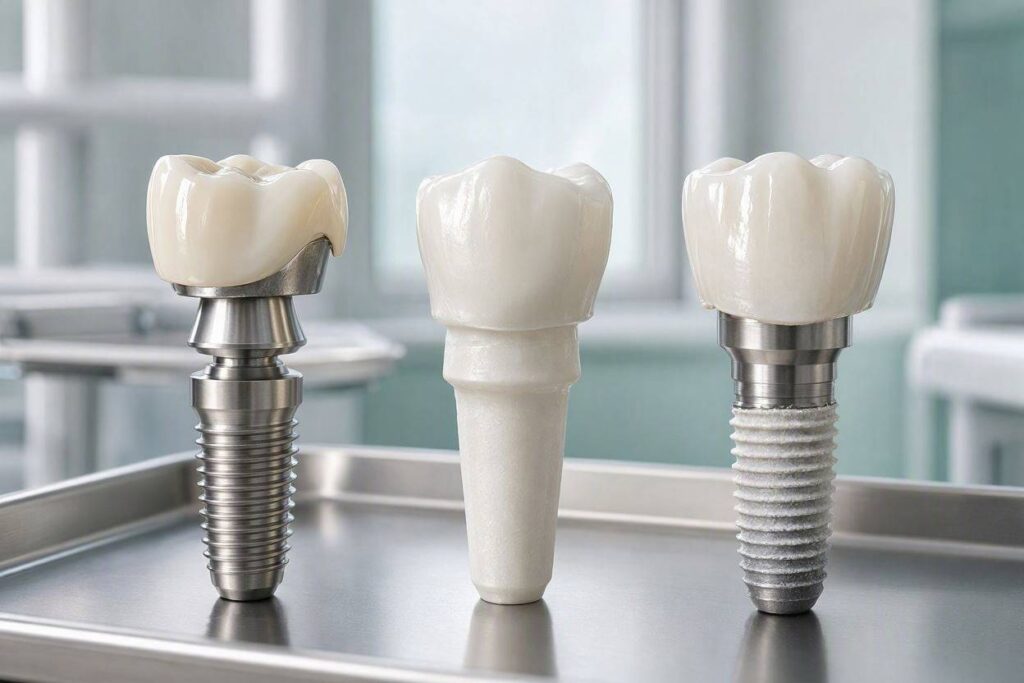
A “dental implant” is not a single piece of metal. It is a system of three distinct components:
- The Implant Fixture (The “Root”): This is the screw-shaped post that is surgically placed into the jawbone.
- The Abutment (The “Connector”): This is a small connector piece that attaches to the top of the fixture and protrudes above the gum line.
- The Crown (The “Tooth”): This is the visible, tooth-shaped restoration that is attached to the abutment.
Each of these components is made from a different material, chosen for its specific properties.
The Implant Fixture: Titanium and Zirconia
The fixture is the most critical component. It is the part that integrates with your bone. The material used here must be exceptionally biocompatible and strong.
1. Titanium and Titanium Alloys
This is the gold standard. Over 95% of all dental implants placed today are made of titanium or a titanium alloy.
- Commercially Pure (CP) Titanium: This is unalloyed titanium. It is incredibly corrosion-resistant and biocompatible. It is often used for smaller diameter implants.
- Titanium Alloy (Ti-6Al-4V): This is a blend of titanium, aluminum, and vanadium. It is significantly stronger than CP titanium. It is often used for narrower implants or implants that need to withstand high forces.
Why Titanium?
- Biocompatibility: The human body does not recognize titanium as a foreign threat. It does not trigger an immune response.
- Osseointegration: This is the magic of titanium. Bone cells love titanium. They will grow directly onto the surface of the titanium, locking the implant in place. This process, called osseointegration, is what makes implants work.
- Strength and Durability: Titanium is incredibly strong for its weight. It can withstand the forces of chewing without breaking.
- Corrosion Resistance: Titanium does not rust or corrode in the moist environment of the mouth.
2. Zirconia (Ceramic) Implants
This is a newer, metal-free alternative. Zirconia is a white ceramic material (zirconium dioxide).
Why Zirconia?
- Aesthetics: Because it is white, a zirconia implant does not show a dark metal line at the gum line. This is appealing for patients with thin gums or for implants in the front of the mouth.
- Hypoallergenic: For the very rare patient with a titanium allergy, zirconia is the alternative.
- Biocompatibility: Zirconia is also highly biocompatible and supports osseointegration.
The Drawbacks of Zirconia:
- It is more brittle than titanium and can fracture under extreme pressure.
- It is a one-piece design (the implant and abutment are fused), which limits the dentist’s options for placing the crown at the ideal angle.
- It is less commonly used and may not be offered by all surgeons.
The Abutment: Titanium, Zirconia, or Gold
The abutment is the bridge between the fixture and the crown. It is a small, precision-machined component.
- Titanium Abutments: These are the most common. They are strong, lightweight, and biocompatible. They are a reliable choice for most situations.
- Zirconia Abutments: These are used when aesthetics are paramount, particularly for front teeth. A white abutment prevents the grey show-through that can occur with a titanium abutment under a thin porcelain crown.
- Gold Abutments: Custom gold abutments are sometimes used in complex restorative cases. They offer an excellent fit and are very gentle on the surrounding tissues.
The Crown: Porcelain, Zirconia, or Metal
The crown is the part you see. It is the “tooth.” The material choice here is driven by aesthetics and function.
- Porcelain-Fused-to-Metal (PFM): A metal base covered with tooth-colored porcelain. Strong and affordable, but the metal can sometimes show as a dark line at the gum.
- All-Ceramic (Zirconia): Very strong and aesthetic. A popular choice for back teeth.
- All-Ceramic (E-max): Lithium disilicate. Excellent aesthetics and strength. A great choice for front teeth.
- Gold Alloy: Extremely durable and gentle on opposing teeth, but not aesthetic. Used for back molars.
A Summary Table of Materials
| Component | Primary Material(s) | Key Properties |
|---|---|---|
| Implant Fixture | Titanium (CP or Alloy), Zirconia | Biocompatibility, Osseointegration, Strength |
| Abutment | Titanium, Zirconia, Gold | Strength, Aesthetics, Fit |
| Crown | Porcelain, Zirconia, E-max, Gold | Aesthetics, Strength, Wear Resistance |
The Importance of Surface Technology
It is not just about the material; it is about the surface. Modern implants have specially treated surfaces designed to encourage bone growth.
The surface of a titanium implant is often roughened at a microscopic level. This can be done through sandblasting, acid etching, or anodization. This roughened surface increases the surface area for bone cells to attach to, speeding up and strengthening the process of osseointegration.
Brand Names vs. Generic
You will hear brand names like Straumann, Nobel Biocare, and Zimmer Biomet. These are the major manufacturers. They invest heavily in research and clinical trials to prove the long-term success of their implants.
There are also “value” or generic implant systems that are cheaper. While many of these are perfectly good, they may not have the same long-term track record or the same availability of replacement parts decades down the line.
Your dentist will choose a system they trust and have experience with. It is a good sign if your dentist uses a well-known, reputable brand.
Conclusion
The success of dental implants is rooted in material science. Titanium remains the undisputed king of implant fixtures due to its unique ability to fuse with bone. Zirconia offers a metal-free aesthetic alternative. The abutment and crown are carefully selected to balance strength, aesthetics, and function. By understanding these materials, you can appreciate the engineering that goes into restoring your smile.
Frequently Asked Questions (FAQ)
Q: Is titanium safe in the body?
A: Yes. Titanium is one of the most biocompatible materials known to science. It has been used safely in medical implants (like hip and knee replacements) for decades. Allergies to titanium are extremely rare.
Q: Can I have an MRI if I have a titanium dental implant?
A: Yes. Titanium is non-ferromagnetic, meaning it is not attracted to magnets. A dental implant is safe during an MRI. It will not heat up or move. It may cause a slight distortion on the image if the scan is of the head or neck area, but it is not a safety risk.
Q: Which is better: a zirconia or titanium implant?
A: For most cases, titanium is the tried-and-true standard. It is stronger and more versatile. Zirconia is an excellent choice for patients with metal sensitivities or those who are concerned about the aesthetic appearance of the gums. Discuss the pros and cons with your surgeon.
Q: Do dental implants contain nickel?
A: Generally, no. Titanium implants do not contain nickel. The abutment and crown are also typically made of nickel-free materials. If you have a nickel allergy, inform your dentist so they can select the appropriate components.
Q: Why are some implants cheaper than others?
A: The cost difference often comes down to the brand. Major manufacturers invest heavily in research, which is reflected in the price. Value brands may be clinically sound but lack the long-term data. The skill of the dentist is also a major factor in the cost.
Additional Resource:
To learn more about the science of dental implant materials, you can explore the resources provided by the International Congress of Oral Implantologists (ICOI): https://www.icoi.org/