Are Dental Implants A Sin?
When facing a major medical decision, it is common to reflect on personal values. For people of faith, questions often arise about whether a specific medical treatment aligns with their spiritual beliefs. Dental implants are no exception.
You might be wondering: Are dental implants a sin? Is altering the body God gave me an act of defiance? Am I allowed to use metal screws to replace my teeth?
The short, most common answer across mainstream religions is no, dental implants are not a sin. In fact, most faith traditions view the restoration of health and function as a moral good. However, the reasoning behind this answer requires a deeper look at religious principles regarding the body, healing, and medical intervention.
This guide will explore the theological and ethical perspectives on dental implants. We will look at how different major religions view the practice, and we will address the specific concerns that might be weighing on your conscience.
The Core Principle: Stewardship of the Body
The central argument for why medical care is acceptable in nearly every faith is the concept of stewardship. This is the belief that the human body is a gift from the Creator. We are not owners of our bodies; we are caretakers (stewards).
If you are a steward of something, you have a responsibility to maintain it. If a house is entrusted to you, it is your duty to fix the leaky roof and repair the broken windows. Letting the house fall into ruin would be an insult to the owner.
Dental implants fall under this category. They are a repair mechanism. They restore the ability to chew food, which is necessary for nutrition. They prevent infection and bone loss. They alleviate pain.
If you have a broken leg, you go to the doctor to fix it. If you have a cavity, you get a filling. If you lose a tooth, getting an implant is simply an extension of the same logic—restoring the body to its intended state of health.
The Question of “Playing God”
Some people worry that inserting a titanium screw into the jawbone is “playing God” or interfering with His design.
The theological counterpoint is that God created humans with intelligence and ingenuity. The ability to develop medical technology—from antibiotics to surgical implants—is seen by many theologians as a gift from God meant to be used. If we accept medicines derived from plants and surgical techniques performed by human hands, implants are simply a more advanced tool in the same toolkit.
The Christian Perspective
Christianity is a broad faith with many denominations, but the general consensus is that dental implants are morally permissible.
Biblical References
There is no verse in the Bible that says, “Thou shalt not replace thy teeth.” In fact, the Bible frequently emphasizes healing and restoration.
- Matthew 15:30: “Great crowds came to him, bringing the lame, the blind, the crippled, the mute and many others, and laid them at his feet; and he healed them.”
- 1 Corinthians 6:19: “Do you not know that your bodies are temples of the Holy Spirit, who is in you, whom you have received from God?”
The latter verse is often used to argue for taking care of your body. If your body is a temple, maintaining it—including your teeth—is an act of worship, not vanity.
The “Vanity” Concern
Some conservative groups might argue that cosmetic improvements are driven by pride or vanity. However, distinguishing between cosmetic and restorative is crucial.
- Cosmetic: Getting a crown on a healthy tooth just to make it look slightly straighter or whiter might be seen as vanity.
- Restorative: Replacing a missing tooth to chew food, prevent jawbone deterioration, and maintain facial structure is medical care.
Dental implants prevent serious health issues like malnutrition and chronic gum infection. According to Christian ethics, pursuing this treatment is an act of prudence and wisdom.
The Islamic Perspective
This is a very common question among Muslim patients. Islamic jurisprudence (Fiqh) has detailed guidelines regarding medical treatment.
The Ruling (Fatwa)
The overwhelming consensus among Islamic scholars is that dental implants are halal (permissible) .
Why?
- The Principle of Necessity and Need (Hajah): Islamic law permits the use of materials that might otherwise be considered “unclean” if there is a medical need. While there are questions about using certain animal products (like pig-derived bone grafts), titanium is a pure metal. It is not derived from an impure source.
- Restoring Function: The Prophet Muhammad emphasized the importance of health and seeking treatment. “Make use of medical treatment, for Allah has not made a disease without appointing a remedy for it.” (Sunan Abi Dawud).
- Avoiding Harm: Living without teeth can cause severe harm to the digestive system and overall health. Islam prohibits causing harm to oneself or allowing harm to continue unnecessarily.
The Exception: Purity in Ritual Washing
One specific concern in Islam relates to Ghusl and Wudu (ritual washing before prayer).
- Does an implant invalidate washing?
No. Scholars have ruled that because the implant is inside the tissue (osseointegrated), it does not prevent water from reaching the surface of the gums. It is unlike a removable denture, which some scholars require removal during Ghusl to allow water to reach the whole mouth. - Bone Grafts:
If a bone graft is needed (a common part of implant surgery), Muslims should verify with their dentist the source of the graft material. - Permissible: Synthetic bone, bovine (cow) bone from a halal-slaughtered source, or cadaveric (human) bone (though some scholars prefer avoiding human tissue if possible).
- Forbidden (Haram): Porcine (pig) bone. Many dentists use porcine bone grafts because they are effective and cheap. A Muslim patient must specifically request a non-porcine alternative.
The Jewish Perspective
Jewish law (Halakha) places a very high value on health and life (Pikuach Nefesh). Almost any law can be broken to save a life or preserve health.
The Mandate to Heal
The Torah states: “And he shall surely heal” (Exodus 21:19). This verse is the basis for the Jewish obligation to seek medical care. Failing to treat a medical condition is viewed as a violation of this commandment.
Dental implants fall squarely within this obligation. Preventing bone loss, allowing proper nutrition, and stopping infection are all actions that preserve health.
The Sabbath Concern
The only potential “sin” associated with dental implants in Judaism relates to the Sabbath (Shabbat). Elective surgeries are not performed on the Sabbath or major holidays. However, if the surgery is necessary, it must be scheduled for a weekday. This is a matter of timing, not a prohibition on the procedure itself.
The Eastern Religions (Hinduism, Buddhism, etc.)
These traditions generally view medical intervention as positive karma or good practice.
- Ahimsa (Non-violence): This principle teaches not to harm living beings. But dentistry is the removal of harm (decay, pain). Restoring health is an act of compassion toward oneself, which is encouraged.
- Karma: Some believe that physical ailments are a result of past karma. However, this does not preclude medical treatment. You are not “cheating” karma by fixing your teeth; you are practicing self-care.
When Could It Be Considered “Sinful”?
While the procedure itself is not a sin, the motivation or the means could be problematic for some religious frameworks.
1. Financial Neglect of Family
This is a serious concern. If you spend $30,000 on dental implants while your family is starving or you cannot pay your basic bills, the financial stewardship aspect comes into question.
- The Test: Are you prioritizing vanity over the well-being of your dependents? If a cheaper alternative (like a traditional bridge) would suffice, and the money saved could help your family, the expensive implant might be considered an unwise or even selfish use of resources.
2. Vanity and Pride
If the sole reason for the surgery is to look “perfect” or to impress others, and it leads to arrogance or fixation on physical appearance, this crosses into the territory of vanity.
- However: Even “cosmetic” reasons often have a psychological health benefit. Restoring a smile can cure depression and isolation. The line between vanity and mental health is blurry.
3. Using Forbidden Materials
As mentioned with the Islamic perspective, the source of materials matters.
- Bovine (Cow) vs. Porcine (Pig): Some Hindus avoid bovine products. Some Muslims and Jews avoid porcine products.
- Solution: Always ask your dentist exactly what is being placed in your body. You have the right to request synthetic or allograft (human donor) materials. There is always an ethical alternative available.
The Verdict
Are dental implants a sin?
In the eyes of almost all mainstream religious traditions, no. They are viewed as a legitimate use of medicine to restore the body to health. They allow you to eat, speak, and smile without pain, which is consistent with the idea of honoring the body as a temple or a gift.
The only “sin” lies in the details—ignoring your duty to provide for your family, using a donor material that violates your dietary laws out of ignorance, or allowing pride to dominate your motivations.
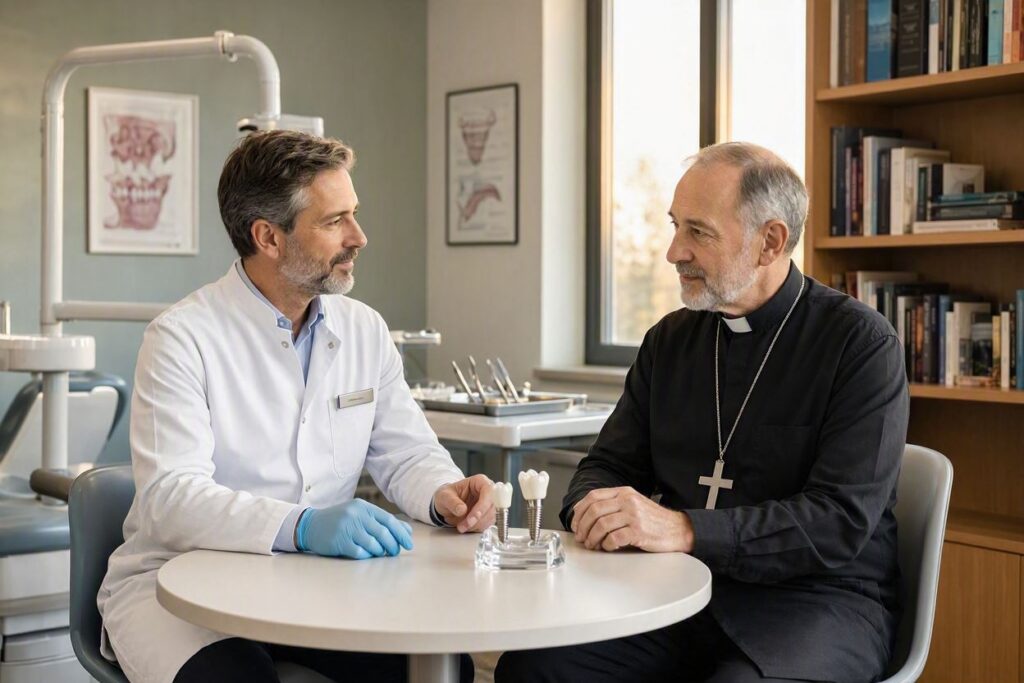
If you are concerned, speak to your religious leader (pastor, imam, rabbi, or priest). They can provide guidance specific to your faith and situation. But rest assured, the act of wanting to restore your health and function is not an act of rebellion against the divine; it is an act of gratitude for the life you have been given.
Frequently Asked Questions
Q: Are dental implants allowed in Islam if they contain titanium?
A: Yes. Titanium is a pure, synthetic metal. It is not derived from an animal source, so it is considered clean (halal).
Q: Does the Bible say anything specific about teeth?
A: The Bible mentions teeth frequently, often in the context of health or judgment (“gnashing of teeth”). It does not prohibit dental care. Proverbs 17:22 says, “A cheerful heart is good medicine,” implying that mental well-being (often linked to a healthy smile) is valued.
Q: Can I be cremated with dental implants?
A: Yes. Titanium has a very high melting point and will often survive cremation in a solid state. If the family requests the ashes to be pure, the titanium remnants can be removed with a magnet before the ashes are ground into powder.
Q: Is it wrong to use cadaver bone in a bone graft?
A: This is a matter of personal conscience. In Christianity, this is generally accepted as a form of organ donation—a gift from one human to another. In some Eastern cultures, there may be a stigma. If you are uncomfortable, ask your surgeon for synthetic bone grafting options, which are readily available.
Additional Resource:
For a deeper look at bioethics and patient rights regarding materials in medical procedures, you can visit the World Medical Association: https://www.wma.net/.