Are Dental Implants Made Entirely Of Titanium?
When you hear the word “dental implant,” you likely picture a silver metal screw. You might assume it is made of titanium. But is that the whole story? Are dental implants made entirely of titanium?
The short answer is no, not entirely. While titanium is the most common material used for the implant fixture (the part that goes into the bone), a dental implant system is actually composed of multiple parts, and some of those parts are made of different materials.
This guide will break down the anatomy of a dental implant and explain exactly what each part is made of. We will also explore the differences between titanium and zirconia implants, and why material choice matters for your health.
The Three Parts of a Dental Implant
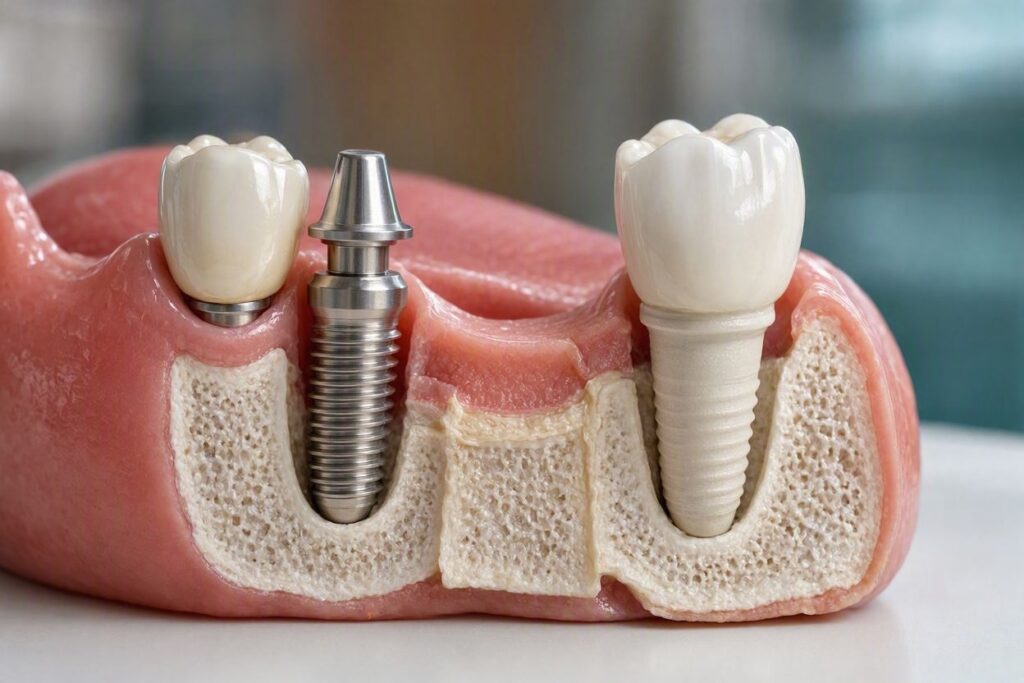
To understand the materials, you must first understand the components. A “dental implant” is not a single piece of metal. It is a system.
1. The Implant Fixture (The Root)
This is the screw that is surgically placed into the jawbone. This is what most people think of when they say “dental implant.”
Material:
- Commercially Pure Titanium (CP Ti): This is the most common material. It is unalloyed titanium, meaning it is very pure (Grade 1 to 4).
- Titanium Alloy (Ti-6Al-4V): This is titanium mixed with small amounts of aluminum and vanadium. It is stronger than pure titanium and is often used for smaller diameter implants.
- Zirconia (Ceramic): This is a white, high-strength ceramic. It is used for “metal-free” implants, often for patients with metal allergies or aesthetic concerns.
Key Point: This fixture is usually titanium. In most cases, yes, the root is titanium.
2. The Abutment (The Connector)
The abutment is the piece that screws into the implant fixture. It sticks up through the gum and holds the crown.
Material Options:
- Titanium: Very strong and reliable. The downside is that it is dark grey. If the gums are thin, this grey can show through as a shadow.
- Zirconia (Ceramic): White in color. Used for front teeth where aesthetics are critical. It eliminates the “grey line” problem.
- Gold or Gold Alloy: Rarely used today, but some dentists still prefer gold for its excellent biocompatibility and workability.
- PEEK (Polyether Ether Ketone): A high-performance plastic. Sometimes used for temporary abutments or in specific clinical situations.
Key Point: The abutment is often titanium, but frequently it is zirconia for aesthetic reasons. It is not always titanium.
3. The Crown (The Tooth)
This is the visible part. It is the fake tooth that sits on top of the abutment.
Material Options:
- Porcelain Fused to Metal (PFM): A metal base covered with white porcelain. Durable but can show a dark edge.
- Full Zirconia: A solid block of white ceramic. Very strong and aesthetic.
- Lithium Disilicate (E-max): A type of glass-ceramic. Beautiful aesthetics, often used for front teeth.
- Acrylic (Plastic): Used for temporary crowns or for the “gum” part of a full implant bridge.
Key Point: The crown is almost never titanium. It is made of ceramic or porcelain to look like a natural tooth.
The Titanium Fixture: Why It Is the Standard
Titanium has been the gold standard for dental implants for over 50 years. Why?
1. Biocompatibility
Titanium is inert. The body does not attack it. It does not rust or corrode in the wet environment of the mouth.
2. Osseointegration
This is the magic of titanium. Bone cells actually attach directly to the surface of the titanium. They form a chemical bond. This is what makes the implant rigid and secure.
3. Strength and Durability
Titanium is incredibly strong. It can withstand the forces of chewing for decades without breaking.
4. The “Alloy” Question
Some patients are concerned about the aluminum and vanadium in titanium alloy (Ti-6Al-4V). Studies have shown that the amount of these metals that leach into the body is negligible and well below safety limits. However, for patients with severe metal sensitivities, pure titanium or zirconia is available.
The Zirconia Alternative: The “Metal-Free” Option
In recent years, zirconia implants have become increasingly popular.
What is Zirconia?
Zirconia is a ceramic material (zirconium dioxide). It is white, like a natural tooth root. It is extremely hard and wear-resistant.
Why Choose Zirconia?
- Aesthetics: If you have thin gums, a titanium implant can show through as a dark shadow. Zirconia is white, so it blends in perfectly.
- Metal Allergies: A small percentage of the population has a true allergy or sensitivity to titanium. Zirconia is completely metal-free.
- Corrosion Concerns: Some patients are philosophically opposed to having metal in their body. Zirconia offers a ceramic alternative.
What Are the Downsides of Zirconia?
- Newer Technology: Zirconia implants do not have the same 50-year track record as titanium. The long-term data is still growing.
- Brittleness: Zirconia is very hard, but it can fracture under extreme stress in a way that titanium does not.
- Cost: Zirconia implants are often slightly more expensive than titanium.
The “One-Piece” vs. “Two-Piece” Design
There is also a distinction in how the implant is constructed.
Two-Piece Implants (Most Common)
- The fixture and the abutment are separate pieces.
- The dentist has more flexibility to angle the abutment.
- Most titanium implants are two-piece.
One-Piece Implants
- The fixture and the abutment are a single solid unit.
- Often used for zirconia implants (because zirconia is difficult to machine with internal threads).
- Simpler design, but less flexible for the dentist.
The Verdict
Are dental implants made entirely of titanium?
No. The implant fixture (the part in the bone) is usually titanium, but the abutment and the crown are often made of other materials, such as zirconia, porcelain, or gold.
If you see a dentist advertising “100% Titanium Implants,” they are referring to the fixture only. The tooth on top is almost certainly ceramic.
Why This Matters:
- If you have a metal allergy, you need to know that the abutment might also contain metal.
- If you are concerned about aesthetics, you need to ask for a zirconia abutment to avoid the grey line.
- If you want a completely metal-free solution, you need to specifically request a zirconia implant and a zirconia abutment and a full ceramic crown.
Always ask your dentist: “What exactly is this made of?” You have a right to know what is going into your body.
Frequently Asked Questions
Q: Can I be allergic to titanium?
A: True titanium allergy is rare, but it does exist. Symptoms include redness, swelling, and itching around the implant site. If you suspect a titanium allergy, ask for a MELISA test (a blood test for metal sensitivity) or choose a zirconia implant.
Q: Do titanium implants rust in the mouth?
A: No. Titanium forms a stable oxide layer on its surface that protects it from corrosion. It does not rust in the way iron does.
Q: Which is stronger, titanium or zirconia?
A: Titanium is more flexible and resistant to fracture. Zirconia is harder but more brittle. For most clinical situations, both are strong enough to withstand chewing forces.
Q: Will a zirconia implant look better than a titanium one?
A: It depends. If you have thick gums, the difference is minimal. If you have thin gums or receding gums, zirconia is superior because it is white and will not show a dark shadow.
Additional Resource:
For more information on dental implant materials and biocompatibility, visit the U.S. Food and Drug Administration (FDA) device database: https://www.fda.gov/.