Can Dental Implants Fall Out?
A dental implant is a titanium or zirconia post surgically embedded into the jawbone. It is designed to be a permanent, non-removable tooth root replacement. The question of whether it can fall out touches on the fundamental nature of implant dentistry. The short answer is that a healthy, successfully osseointegrated implant does not simply “fall out” like a loose tooth. However, specific components of the implant restoration can de-bond or dislodge, and a failing implant can lose its bone support to the point where it becomes mobile and is exfoliated or requires removal. This guide provides a comprehensive, detailed explanation of the scenarios in which an implant or its parts can separate from the mouth, the difference between abutment screw loosening and true implant loss, and the preventive and management strategies.
The Implant Complex: What Can Actually Come Loose
An implant restoration is a multi-component system. Three distinct interfaces exist where separation can occur. Understanding which component has failed is essential.
The Implant-Bone Interface
This is the interface between the titanium implant body and the surrounding jawbone. In a healthy, osseointegrated implant, the bone is in direct contact with the implant surface at the microscopic level. There is no fibrous tissue layer, no periodontal ligament space, and no mobility. The implant is rigidly anchored.
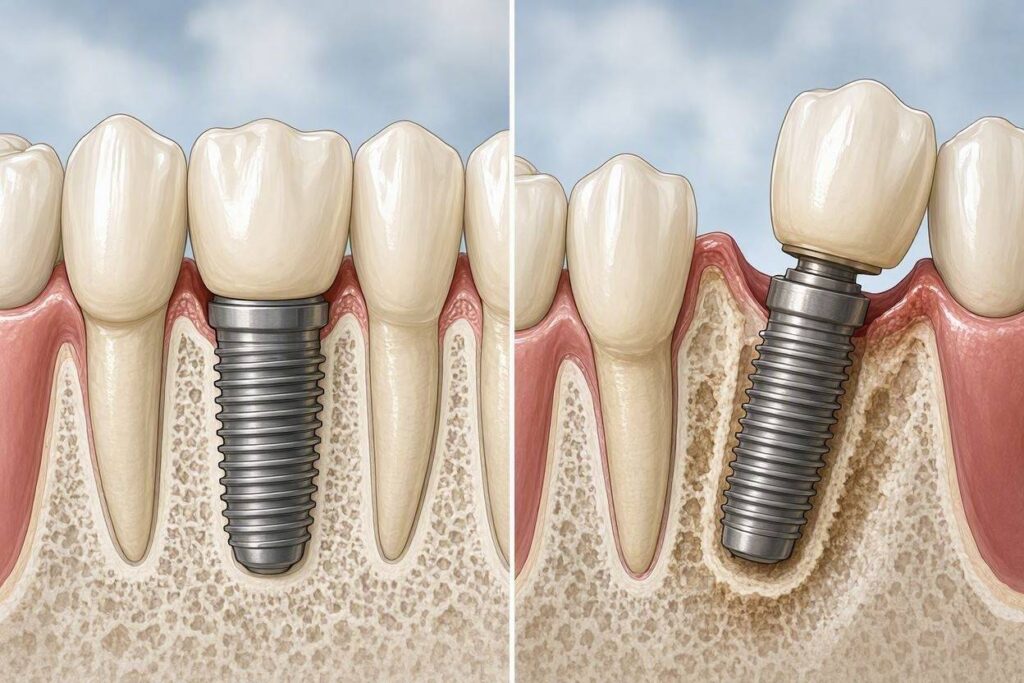
If this interface fails—meaning the bone resorbs away from the implant surface and is replaced by inflammatory granulation tissue—the implant loses its anchorage. The implant can become clinically mobile. In advanced cases, the implant can be gently elevated from the bone with minimal force. This is a true implant failure, and the implant is lost. However, even in this scenario, the implant does not spontaneously “fall out” while the patient is eating or speaking. It is gradually exfoliated as the bone support is lost, and the patient or dentist notices progressive mobility.
The Abutment-Implant Interface
The abutment is the connector that attaches to the implant body and emerges through the gum tissue. It is secured to the implant by an abutment screw. This screw is torqued to a precise specification, typically 15 to 35 Newton-centimeters.
Abutment screw loosening is the most common mechanical complication in implant dentistry. The screw can lose its preload due to micro-movement under occlusal forces, inadequate initial torque, or a misfit between the abutment and implant platform. When the screw loosens, the abutment and the attached crown become mobile. The patient feels a wiggling or clicking sensation. The crown may feel “soft” when biting.
The abutment and crown can, in fact, completely separate from the implant and come out of the mouth. This is the “implant falling out” that patients most commonly experience. The implant body remains firmly osseointegrated in the bone. The abutment and crown assembly has simply unscrewed. This is a restorative complication, not a surgical failure. It is managed by cleaning the internal connection, inspecting the abutment and screw for damage, and retorquing the screw to the correct specification. If the screw is fractured, retrieval is more complex.
The Crown-Abutment Interface
In some implant systems, the crown is a separate component from the abutment. The crown is cemented onto the abutment (cement-retained) or screwed into the abutment (screw-retained). If the cement seal fails or the prosthetic screw loosens, the crown alone can de-bond or dislodge. The abutment remains securely attached to the implant. The patient retrieves a loose crown. This is a minor restorative complication, resolved by recementation or screw tightening.
Scenarios of True Implant Loss
True implant loss means the implant body separates from the jawbone. This occurs in specific, identifiable clinical contexts.
Early Implant Failure (Failed Osseointegration)
Early failure happens within the first few weeks to months after placement, before the implant is restored with a crown. The implant fails to integrate. Instead of bone forming on the implant surface, a fibrous connective tissue capsule forms. The implant is essentially a foreign body encased in scar tissue.
Clinically, the surgeon detects mobility at a follow-up appointment. The patient may report a dull ache or a “loose” sensation. The implant does not spontaneously exfoliate, but it can be removed with minimal force, often simply unscrewed or gently elevated. The surgeon debrides the site and allows it to heal. Early failure is attributed to surgical trauma, infection, inadequate bone quality, or systemic patient factors.
Late Implant Failure Due to Peri-Implantitis
A previously successful, functioning implant can be lost years later due to peri-implantitis. The bacterial biofilm triggers a host inflammatory response that progressively destroys the supporting bone. As the bone loss advances around the implant, the implant loses its anchorage.
In the early and moderate stages of peri-implantitis, the implant remains rigidly fixed. There is no mobility. The disease is detected by probing, bleeding, pus, and radiographic bone loss, not by movement. An implant with advanced peri-implantitis, where the bone loss has reached the apical portion of the implant, can become mobile. At this point, the implant is terminally failing. The patient may feel mobility, and the dentist can demonstrate movement. The implant is removed, not because it spontaneously fell out, but because it is no longer biologically integrated and must be surgically extracted.
Implant Fracture and Component Failure
A rare but dramatic scenario is fracture of the implant body itself. This is almost always a fatigue fracture from chronic biomechanical overload. A patient with heavy bite forces, parafunctional grinding, or a cantilevered restoration can fracture the implant, typically at the level of the first thread.
When the implant fractures, the coronal fragment is mobile or completely separated, while the apical fragment remains osseointegrated in the bone. The patient may feel a sudden looseness or notice that a piece of the implant has come out. The mobile fragment is retrieved. The embedded fragment is managed as described earlier. This is the scenario most closely matching “the implant fell out.” It is, however, a material failure, not a biological rejection.
What Prevents an Implant From Falling Out
Understanding the mechanisms of retention reinforces why implants are so reliable when properly executed.
Primary Stability
At the time of surgical placement, the implant achieves mechanical stability by engaging the cortical bone of the osteotomy walls. The surgeon measures the insertion torque. A torque of 30 to 50 Newton-centimeters indicates adequate primary stability. This mechanical interlocking prevents micromotion during the critical early healing phase.
Secondary Stability (Osseointegration)
Over the ensuing weeks, the body remodels the bone at the implant surface. New bone is deposited directly onto the titanium oxide layer. The mechanical interlock is replaced by a biological bond. Secondary stability increases as primary stability naturally dips during bone remodeling. After 3 to 6 months, the implant is osseointegrated. The bone is bonded to the implant. At this stage, removing the implant requires cutting the bone-implant interface with a trephine bur or applying significant reverse torque. The implant is not going to fall out from normal chewing forces.
Prosthetic Passivity and Occlusal Management
A well-designed implant restoration delivers occlusal forces along the long axis of the implant. Lateral, off-axis forces are minimized. The occlusion is adjusted so that the implant crown experiences lighter contact than the natural teeth during heavy clenching. A night guard is fabricated for patients with bruxism. These measures protect the implant from overload, abutment screw loosening, and component fracture.
Management of a Loose or Dislodged Implant Component
If you feel something loose in your mouth near your implant, the immediate steps are critical.
Do Not Panic and Do Not Force It
If the crown and abutment are loose but still partially attached, do not wiggle or pull on them. You may damage the internal connection of the implant or strip the screw threads. If the restoration comes out completely, retrieve it and store it safely. Do not attempt to reinsert it or glue it back in place.
Call Your Implant Dentist Immediately
A loose implant component is not a medical emergency, but it is a dental urgency. The implant platform is exposed to the oral environment, and bacteria can colonize the internal connection. The dentist will see you as soon as possible, typically within a few days. Until the appointment, keep the area clean by gently rinsing with warm salt water. Avoid chewing on that side.
The Dentist’s Intervention
The dentist will remove the loose restoration, if still partially in place, and thoroughly clean and inspect the implant internal connection. The abutment and screw are examined under magnification for damage or distortion. If the screw is intact, the dentist will decontaminate the implant well with chlorhexidine, dry the connection, and retorque a new or the existing screw to the manufacturer’s specification. If the screw threads in the implant body are stripped, the implant may be non-restorable and require removal. If the screw is fractured, retrieval is attempted. After re-torquing, the access hole is sealed, and the occlusion is carefully checked and adjusted.
Conclusion
A successfully osseointegrated dental implant does not fall out; the implant body is biologically bonded to the jawbone and requires surgical force for removal. What can loosen or dislodge is the abutment and crown assembly when the abutment screw loses its preload—a common mechanical complication that is managed by retorquing the screw in a brief office visit. True implant loss occurs only through early failure of osseointegration, late failure from advanced, untreated peri-implantitis, or rare implant body fracture from biomechanical overload, all of which are detectable by the dentist at maintenance visits before the implant reaches the point of spontaneous exfoliation.
Frequently Asked Questions
I felt my implant crown move. Is the implant falling out?
Almost certainly not. The movement you feel is most likely an abutment screw that has loosened. The implant body is still rigidly fixed in the bone. The crown and abutment are wiggling as a unit. This is a common, fixable problem. Call your dentist for an appointment. Do not ignore it, as a loose screw can eventually fracture.
Can I swallow my implant if it falls out while I am sleeping?
The implant body itself will not fall out while you sleep; it is embedded in bone. A small component like a loosened healing abutment or a prosthetic screw access cover could dislodge. These are small enough to be swallowed, though this is rare. If you notice a missing component, inform your dentist. A swallowed small titanium component typically passes through the gastrointestinal tract without incident, but your dentist will want to document it.
My implant feels fine, but my dentist says I have bone loss. Can it fall out later?
Yes, if the bone loss is due to progressive, untreated peri-implantitis. An implant with significant bone loss can remain stable for a period, but the disease process must be halted. If the bone loss continues, the implant will eventually lose its anchorage and become mobile. This is why regular professional maintenance with probing and radiographs is non-negotiable. Early intervention can arrest the disease and save the implant.
Is a loose implant covered under warranty?
Many implant manufacturers offer a limited warranty that covers implant fixture fracture. The warranty typically provides a replacement implant at no cost, but it does not cover the surgical fee for removal and replacement. Some dental practices offer their own warranty on the implant restoration, covering abutment screw loosening or crown de-bonding for a defined period. This is a practice policy, not a manufacturer warranty. Ask your implant dentist about their complication policy before treatment.
Additional Resource
The Academy of Osseointegration provides a patient education portal at aoinfo.net that explains the science of osseointegration and the factors that contribute to long-term implant health. Understanding the biological basis of the bone-implant bond reinforces the message that a properly integrated implant is an extraordinarily stable, permanent structure that requires surgical intervention to remove.