Are Shorter Dental Implants Cheaper?
The cost of dental implants is a major barrier for many people. When exploring options, you might come across the term “short implants.” The name itself suggests a smaller version of the standard implant. This naturally leads to a very practical question: “Are shorter dental implants cheaper?” The answer is more nuanced than you might think. While the implant itself might cost marginally less, the overall treatment cost may not be significantly lower. In fact, the real value of a short implant is not financial; it is biological. This guide will explain what short implants are, when they are used, and whether they actually save you money.
What Exactly Is a Short Dental Implant?
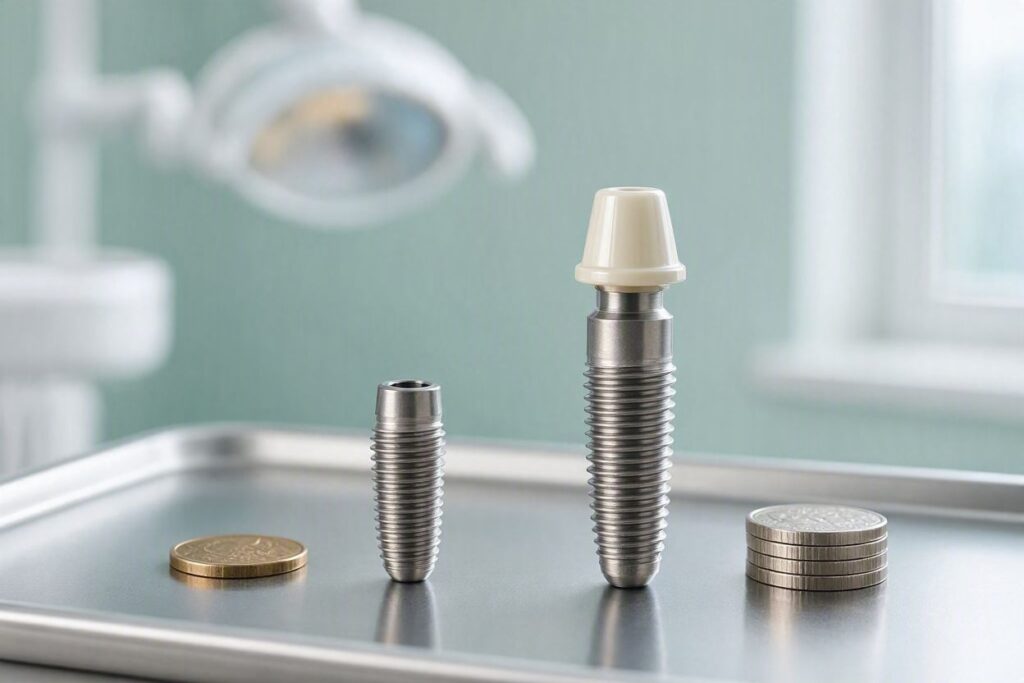
In dentistry, size matters. A standard dental implant is typically between 10 and 15 millimeters long. The exact length depends on where it is going in your mouth and the amount of bone you have.
A short dental implant is generally defined as an implant that is less than 10 millimeters in length. Most short implants are between 5 and 8 millimeters long. They are often wider in diameter than standard implants. This increased width helps them achieve stability despite their shorter length.
Think of a standard implant as a long wood screw and a short implant as a thick, wide bolt. They both hold things in place, but they do it in different ways.
Why Would a Dentist Use a Short Implant?
The primary reason for using a short implant is to avoid a more invasive surgery: the bone graft.
The Problem of Bone Loss
When you lose a tooth, the bone in that area begins to shrink. This is a natural process called resorption. If too much bone is lost, there is not enough height to place a standard 10mm or 12mm implant.
The Traditional Solution: Bone Grafting
For years, the solution was to rebuild the bone. This involves a bone graft. The dentist adds donor bone or synthetic material to your jaw. You then wait 4 to 6 months for this new bone to heal and integrate before you can get your standard implant. This adds time, cost, and a second surgical site to the process.
The Alternative: A Short Implant
A short implant can be placed directly into the remaining bone, bypassing the need for a bone graft altogether. This is particularly useful in the upper back jaw (near the sinus cavity) or the lower back jaw (near the nerve canal). These are areas prone to significant bone loss. By using a short implant, the dentist can safely place it without getting too close to these critical structures.
The Cost Comparison: Short Implant vs. Standard Implant with Graft
Now, let’s address the central question: cost. Here is a comparison of the financial picture.
| Procedure | Components | Estimated Total Cost | Time to Completion |
|---|---|---|---|
| Standard Implant + Bone Graft | Bone graft surgery, graft material, healing period (4-6 months), standard implant, abutment, crown | $4,500 – $8,500+ | 8-12 months |
| Short Implant (No Graft) | Short implant, abutment, crown | $3,500 – $6,000+ | 3-6 months |
As you can see, the short implant procedure is almost always cheaper than the combined cost of a bone graft and a standard implant. The savings come not from the implant hardware itself, but from avoiding the bone graft surgery.
The surgical fee for a bone graft can range from $500 to $3,000 or more, depending on the complexity and the amount of material needed. When you choose a short implant, you eliminate this cost entirely. You also save on the cost of a second surgical visit and the extended healing time.
Is the Implant Post Itself Cheaper?
This is where the distinction is important. If you ask a supplier for the price of a short titanium screw versus a long one, the price difference is negligible. The raw material cost is nearly identical. A 6mm implant and a 12mm implant from the same manufacturer will have a similar price tag.
Therefore, a dentist will not charge you significantly less for a short implant just because it is shorter. The savings you realize are on the procedure, not the part. If you are comparing a short implant to a standard implant in an area with plenty of bone (where no graft is needed), there will be almost no cost difference between the two.
The Long-Term Value Question
Is a short implant as good as a standard one? This is the more important question than cost. For many years, dentists were skeptical. The shorter length was thought to compromise stability.
Modern research, however, has changed this view. Studies show that short implants with wider diameters can have success rates equal to standard implants, provided they are placed correctly. The key is the surface area. A wider implant has more surface area for the bone to fuse to, compensating for the lack of length.
However, short implants are not for everyone. They require a certain width of bone. If your bone is thin and short, even a wide, short implant will not work. Your dentist must assess the quality and quantity of your bone carefully with a 3D scan.
The “Cheaper” Pitfalls to Avoid
When searching for a cheaper dental implant solution, be careful. The market is full of options, and not all of them are good. Some clinics advertise “mini implants” or “cheap short implants” as a fix for everything.
Mini implants are different from short implants. They are much thinner (less than 3mm in diameter) and are designed primarily to stabilize dentures, not to support individual teeth. If a clinic suggests using mini implants to replace individual back teeth, be cautious. They may not be able to withstand the heavy forces of chewing and are more prone to fracture.
The goal is not to find the cheapest hardware. The goal is to find the most conservative, predictable, and long-lasting solution for your specific problem.
A Surgeon’s Perspective
“I love short implants because they are patient-friendly. They allow me to avoid grafting in many cases. For the patient, that means less pain, less swelling, less time in the chair, and yes, a lower total cost. But it is not about the price of the screw; it is about saving them from a surgery they don’t need.” – Dr. Michael Chen, DDS, MS
Important Notes for Readers
- Get a 3D Scan: If you are told you need a bone graft, always ask if a short implant is an option. A 3D cone beam CT scan is essential for making this determination.
- Experience Matters: Placing short implants requires skill. The margin for error is smaller. Ask your dentist how many short implants they place per year.
- Do Not Compromise on Quality: If you are a candidate for a short implant, choose a reputable brand. Do not let a dentist use a “no-name” implant just to shave a few dollars off the price.
- The Real Savings: The real savings with short implants is avoiding the bone graft. If you do not need a graft, a short implant and a standard implant will cost about the same.
The Bottom Line
So, are shorter dental implants cheaper? The implant post itself costs about the same as a standard one. However, the overall treatment can be significantly cheaper because a short implant often allows you to avoid a costly and time-consuming bone graft procedure. The true value of a short implant is not a bargain-basement price tag, but the ability to achieve a stable, long-lasting result with a less invasive, faster, and more cost-effective treatment plan. Discuss with your dentist whether your anatomy makes you a candidate for this modern approach.
Frequently Asked Questions (FAQ)
Q: What is the success rate of short dental implants?
A: Modern studies show that short implants (with a wide diameter) have success rates of 90-95%, which is comparable to standard implants placed in grafted bone. Proper case selection and surgical technique are critical factors.
Q: Can I get a short implant in the front of my mouth?
A: Short implants are generally not recommended for front teeth. The forces in the front are different. Short implants are best suited for back teeth (premolars and molars) where the chewing forces are more vertical.
Q: Will a short implant last as long as a regular one?
A: Yes, if it is properly placed and maintained. The key to longevity is the health of the surrounding bone and gums, which is the same for any implant. Good oral hygiene is essential.
Q: Does it hurt more to get a short implant?
A: No. The surgical procedure is very similar. In fact, because it often eliminates the need for a bone graft, the overall experience may be less painful with a shorter recovery time.
Additional Resource
For a technical overview of the research on short dental implants, you can consult the Journal of Oral Implantology: https://meridian.allenpress.com/joi