Who Invented The Dental Implant?
The dental implant is a marvel of modern medicine. It is a testament to human ingenuity and the relentless pursuit of better health. But this incredible technology did not appear overnight. It is the result of centuries of experimentation, failure, and breakthrough. This leads to a fascinating question: “Who invented the dental implant?” The answer is not a single name. It is a story that spans ancient civilizations, accidental discoveries, and the pioneering work of a Swedish orthopedic surgeon. This guide will trace the history of the dental implant, from its crude beginnings to the sophisticated devices used today.
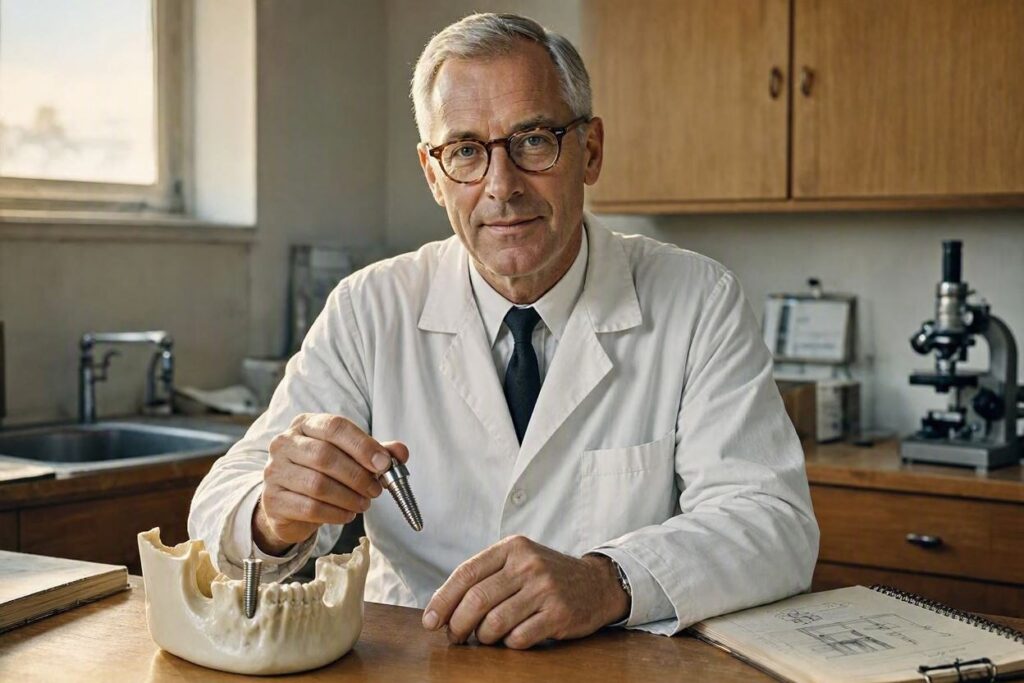
Ancient Attempts: The Earliest Experiments
The desire to replace missing teeth is as old as humanity itself. Archaeologists have found evidence of early attempts at tooth replacement dating back thousands of years.
1. Ancient China (2000 BC): Evidence suggests that the ancient Chinese used carved bamboo pegs to replace missing teeth. These were tapped into the jawbone.
2. Ancient Egypt (1000 BC): Egyptian mummies have been found with transplanted teeth. Some mummies have gold wire ligatures holding replacement teeth (often from donors or slaves) to the adjacent natural teeth. It is unclear if these were placed during life or after death for burial rituals.
3. The Mayans (600 AD): This is perhaps the most remarkable ancient discovery. In 1931, archaeologists in Honduras found a Mayan mandible (jawbone) dating back to around 600 AD. The jawbone had three missing incisors replaced by pieces of shell shaped like teeth. Remarkably, X-rays showed that bone had grown around the shells. This suggests these early implants were functional and had integrated with the bone. This was osseointegration occurring 1,400 years before the term was even invented.
4. Ancient Rome and Europe: Historical records describe attempts to implant teeth made of iron, gold, and even teeth from animals or cadavers. These attempts almost always failed due to infection, rejection, or the inability of the materials to fuse with bone.
The Modern Era: The Problem of Rejection
The modern history of implants begins in the early 20th century. Scientists and dentists were experimenting with various metals and materials. They faced a fundamental problem: the body rejected the foreign object.
1. The Vitallium Breakthrough (1930s): Two brothers, Dr. Alvin and Dr. Moses Strock, began experimenting with a new metal alloy called Vitallium (a cobalt-chromium alloy). They used it to create implant posts. They placed one of the first successful endosseous (within the bone) implants in 1937. This was a major step forward, proving that a metal implant could be tolerated by the body.
2. The Subperiosteal Implant (1940s-50s): Dr. Gustav Dahl in Sweden developed the subperiosteal implant. This was a metal framework that sat on top of the bone, under the gum. It did not go into the bone. This was used for patients with severe bone loss who could not wear dentures. While it provided some stability, it was not a true root replacement and had a high long-term failure rate.
3. The Blade Implant (1960s): Dr. Leonard Linkow, an American dentist, developed the blade implant. This was a flat, blade-shaped piece of metal that was inserted into a groove cut into the jawbone. It was a significant improvement and was widely used for decades. However, it was prone to failure over time and was eventually superseded.
The Accidental Discovery: The Birth of Osseointegration
The single most important event in the history of dental implants was an accident. It happened in a laboratory in Sweden in the 1950s.
Per-Ingvar Brånemark: He was a Swedish orthopedic surgeon and researcher. He was studying blood flow in bone tissue. To do this, he inserted small titanium cylinders (optical chambers) into the leg bones of rabbits.
When it came time to remove the chambers, he made a startling discovery. The titanium had fused so completely with the bone that it could not be removed. The bone had grown directly onto the metal surface. He called this phenomenon “osseointegration.”
Brånemark realized the immense potential of this discovery. He shifted his research focus. He saw that titanium was unique. It was not rejected by the body. Instead, the body accepted it as if it were its own tissue.
The First Human Patient (1965): Brånemark placed the first titanium dental implant in a human volunteer named Gösta Larsson in 1965. Larsson had severe jaw deformities and missing teeth. He received four implants to support a full bridge. The implants were successful. Larsson lived with them for over 40 years, until his death.
The Commercialization and Refinement
Brånemark’s discovery revolutionized dentistry. However, it took time to gain acceptance.
1. Initial Skepticism: The dental community was initially skeptical. They did not believe that metal could truly fuse with bone. Brånemark faced years of resistance before his research was accepted.
2. The Nobelpharma Era (1980s): Brånemark partnered with a Swedish company to develop and market his implant system. The company was later named Nobelpharma (now Nobel Biocare). The first commercial titanium implants became available in the 1980s.
3. The Toronto Conference (1982): This was a turning point. Brånemark presented his decades of research to a gathering of leading dental professionals. The evidence was overwhelming. The dental world embraced the concept of osseointegration.
4. The Evolution of Design: The original Brånemark implant was a machined titanium screw. It was placed in a two-stage procedure (buried under the gum, then uncovered later). Since then, the design has evolved significantly. Researchers discovered that a roughened surface texture promotes faster and stronger bone integration. Modern implants have specialized surfaces, varying thread designs, and internal connections.
Other Key Contributors
While Brånemark is rightly credited as the “father of modern dental implantology,” others made important contributions.
- Dr. André Schroeder: A Swiss researcher who developed a different implant system and contributed to our understanding of the biology of osseointegration.
- Dr. Willi Schulte: A German researcher who developed the Tübingen implant.
- Dr. Richard Skalak: An engineer who helped develop the concept of the “biomechanical” design of implants.
The Modern Landscape: Titanium and Zirconia
Today, patients have a choice of materials.
1. Titanium: This remains the gold standard. It is strong, lightweight, and has decades of proven success. Most implants today are made of a titanium alloy (Ti-6Al-4V) for added strength.
2. Zirconia (Ceramic): As discussed in a previous article, zirconia implants are a metal-free alternative. They are white in color and offer excellent biocompatibility. They are a newer option but are gaining popularity.
A Historical Perspective
“Brånemark’s contribution was not just inventing a device. He discovered a biological principle. He taught us that the body and a piece of titanium can become one. That is a profound concept that changed medicine, not just dentistry.” – Dr. Alan Brown, Dental Historian
Important Notes for Readers
- The Principle Matters More Than the Man: While Brånemark is the key figure, the success of modern implants is due to the work of thousands of researchers and clinicians who refined his work.
- The “Invention” Is Ongoing: The dental implant continues to evolve. New surfaces, new materials, and new digital techniques are constantly being developed.
- Choose a Proven System: When getting an implant, choose a reputable brand with a long track record. The success of your implant depends on the quality of the engineering and the research behind it.
The Bottom Line
Who invented the dental implant? The answer is not one person. The ancient Mayans placed early implants. The Strock brothers pioneered metal implants. But it was Per-Ingvar Brånemark who made the defining breakthrough. His accidental discovery of osseointegration in the 1950s, and his first human application in 1965, laid the foundation for the modern dental implant. His work transformed a field plagued by failure into one defined by unprecedented success, giving millions of people a permanent solution for missing teeth.
Frequently Asked Questions (FAQ)
Q: When was the first successful titanium dental implant placed?
A: The first titanium dental implant was placed by Per-Ingvar Brånemark in a human patient named Gösta Larsson in 1965.
Q: What does “osseointegration” mean?
A: Osseointegration is the direct structural and functional connection between living bone and the surface of a load-bearing artificial implant. It is the biological process that makes dental implants stable and permanent.
Q: Are implants today the same as Brånemark’s original design?
A: No. The basic principle is the same (a titanium screw placed in the bone), but the design has evolved significantly. Modern implants have roughened surfaces, improved thread patterns, and internal connections that make them more reliable and faster to heal.
Q: Did Brånemark profit from his discovery?
A: Yes. He partnered with a Swedish company that became Nobel Biocare, one of the largest implant manufacturers in the world. His work had a significant commercial impact.
Additional Resource
For a detailed biography and the scientific work of Per-Ingvar Brånemark, you can visit the Brånemark Osseointegration Center: https://www.branemark.se/