What Kind Of Dentist Can Do An Implant?
A dental implant is a surgical device placed into the jawbone. The restoration placed on top of the implant is a prosthetic crown, bridge, or denture. These two phases—surgical and restorative—require different but overlapping skill sets. Consequently, multiple types of dentists can be involved in the implant process. Understanding the training, scope of practice, and expertise of each type of dentist helps you make an informed choice about who will place your implant and who will restore it. This guide provides a detailed, unbiased explanation of every dental professional who performs implant procedures, the credentials to look for, and the practice models that exist.
The Core Distinction: Surgical Placement vs. Restorative Phase
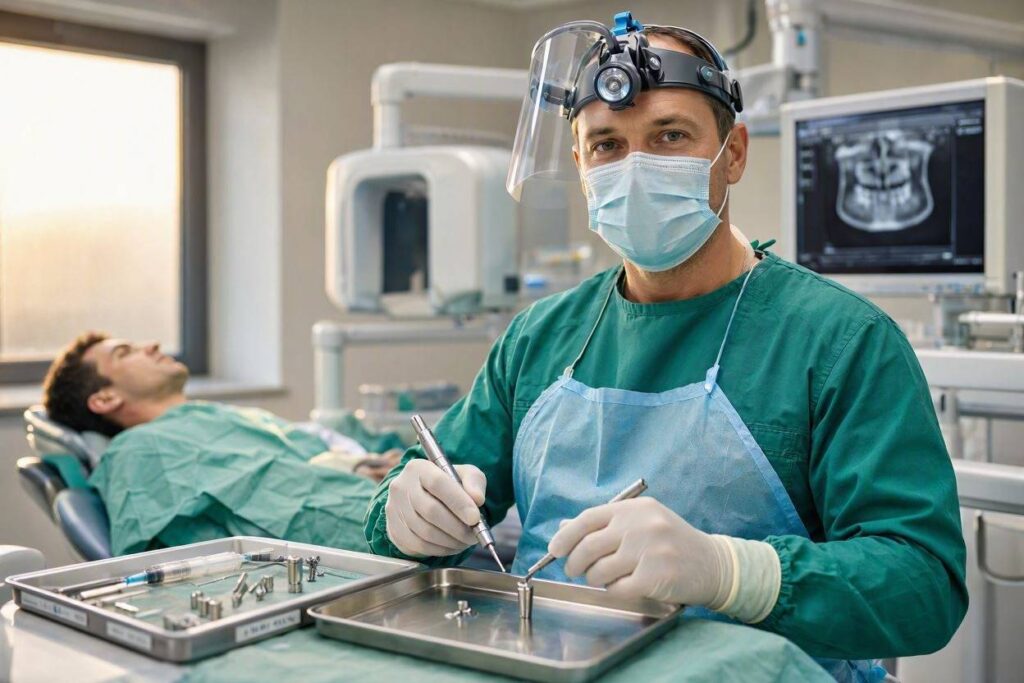
The implant process separates into two distinct clinical phases. The surgeon places the implant body into the jawbone. After a healing period, the restorative dentist attaches the abutment and fabricates the crown, bridge, or denture. One dentist can perform both phases, or two different dentists can collaborate.
When evaluating a provider, ask whether they perform the surgical placement, the restoration, or both. Some dentists are highly skilled in both phases. Others focus on one phase and refer to a specialist for the other. Both models can produce excellent results. The key is that the professional performing each phase has the appropriate training and experience for your specific case complexity.
General Dentists Who Place Implants
A general dentist is a Doctor of Dental Surgery (DDS) or Doctor of Dental Medicine (DMD) who has completed four years of dental school. Implant placement is not a dental specialty; it is a procedure. Legally, any licensed dentist may place dental implants. The scope of practice is determined by the state dental board, and all 50 states permit general dentists to place implants.
The Range of Training
The training a general dentist receives in implant surgery during dental school is foundational but limited. Most dental schools provide preclinical implant education and exposure to implant planning, but relatively few graduates place implants independently without additional post-graduate training.
The general dentist who routinely places implants has invested in substantial continuing education. This training ranges from weekend courses sponsored by implant manufacturers to year-long, comprehensive university-based mini-residency programs. The American Academy of Implant Dentistry (AAID) and the International Congress of Oral Implantologists (ICOI) offer structured educational pathways and credentialing examinations for general dentists.
A well-trained, experienced general dentist can successfully place straightforward implants: a single posterior implant in abundant bone, an anterior implant with an intact ridge, or simple immediate placements. The general dentist’s advantage is that they often perform both the surgical and restorative phases, providing continuity of care in a single office.
When a General Dentist Should Refer
An ethical general dentist recognizes the limits of their training and experience. Complex cases should be referred to a specialist. These include implants requiring significant bone grafting, sinus lifts, full-arch implant reconstructions, implants in the aesthetic zone with high aesthetic demands, implants in patients with significant medical comorbidities, and cases involving nerve proximity or other anatomical risks. A general dentist who never refers any implant case to a specialist is a potential red flag.
Oral and Maxillofacial Surgeons
An oral and maxillofacial surgeon (OMS) is a dental specialist who has completed a four- to six-year hospital-based surgical residency program after dental school. This residency includes rotations in internal medicine, general surgery, anesthesiology, otolaryngology, and plastic surgery. Oral surgeons are the only dental specialists who are licensed to administer deep sedation and general anesthesia in all states.
Oral surgeons are the definitive specialists for complex implant surgery. Their training encompasses the full spectrum of hard and soft tissue reconstruction. They routinely perform bone block grafts harvested from the iliac crest, tibia, or calvarium. They manage maxillofacial trauma, pathology, and orthognathic surgery. Implant placement in severely resorbed jaws, in conjunction with nerve lateralization, or in previously irradiated bone falls squarely within the oral surgeon’s scope.
Oral surgeons often work in a referral model. The general dentist or prosthodontist restores the implant, and the oral surgeon performs the surgical phase. However, some oral surgeons maintain in-house restorative dentists or limit their practice to surgery only. If your case involves significant bone deficiency, the need for sedation, or complex medical factors, an oral surgeon is the most appropriate specialist for the surgical phase.
Periodontists
A periodontist is a dental specialist who has completed a three-year residency in periodontology and implant surgery after dental school. The specialty focuses on the supporting structures of the teeth: the gums, periodontal ligament, and alveolar bone. Periodontists are experts in the biology of the soft tissue and bone interface.
The periodontist’s implant training emphasizes the osseointegration process, soft tissue management, and the prevention and treatment of peri-implant disease. Periodontists are highly skilled in creating a stable, keratinized, aesthetic soft tissue frame around implants. They perform connective tissue grafts, free gingival grafts, and ridge preservation with precision.
Periodontists are an excellent choice for implants in the aesthetic zone, where the soft tissue contour and papilla preservation are paramount. They also manage implant patients with a history of periodontal disease, who are at elevated risk for peri-implantitis. Periodontists typically provide both the surgical placement and the long-term professional maintenance of the implant. Many periodontists also restore implants, though others prefer to focus on the surgical phase and collaborate with a restorative dentist.
Prosthodontists
A prosthodontist is a dental specialist who has completed a three-year residency in prosthodontics after dental school. Prosthodontics is the specialty of restoring and replacing teeth. The prosthodontist is the master architect of the implant treatment plan. They design the final restoration, determine the ideal three-dimensional implant positions based on the prosthetic outcome, and fabricate the surgical guides that the surgeon uses.
While prosthodontists are primarily restorative specialists, many prosthodontists are also trained and highly experienced in implant surgery. A prosthodontist who places and restores implants offers the advantage of prosthetic-driven treatment from start to finish. The implant is placed not where the bone is most abundant, but where the final tooth needs to be. If the bone is inadequate, the prosthodontist plans the grafting accordingly.
For complex full-mouth reconstructions, implant-supported overdentures, and fixed full-arch bridges (All-on-4), a prosthodontist is the ideal restorative lead. They coordinate the surgical and laboratory phases and are responsible for the final aesthetic and functional outcome. The American College of Prosthodontists certifies prosthodontists through a rigorous examination process.
Credentialing Organizations and Board Certification
Board certification is a voluntary, advanced credential that signifies a dentist has met rigorous standards of knowledge and clinical skill beyond the minimal requirements for licensure.
American Board of Oral and Maxillofacial Surgery (ABOMS)
An oral surgeon who is board-certified by the ABOMS has passed comprehensive written and oral examinations and submitted surgical cases for peer review. Board certification is a mark of distinction.
American Board of Periodontology (ABP)
A periodontist certified by the ABP is a Diplomate of the American Board of Periodontology. This certification requires passing a comprehensive written and oral examination covering all aspects of periodontology and implant surgery.
American Board of Prosthodontics (ABP)
A prosthodontist certified by the American Board of Prosthodontics has passed rigorous written and oral examinations and submitted complex restorative cases for evaluation. This is the highest credential in the specialty.
American Academy of Implant Dentistry (AAID) Credentialing
The AAID offers a pathway for general dentists and specialists to obtain Fellowship (FAAID) and Diplomate (D-AAID) status in implant dentistry. The AAID Diplomate examination is a comprehensive, board-level examination in all aspects of implant dentistry. An AAID Diplomate has demonstrated a high level of proficiency in both the surgical and restorative phases of implant treatment. The AAID is not a recognized dental specialty, but its credentialing program is rigorous.
International Congress of Oral Implantologists (ICOI) Credentialing
The ICOI offers Fellowship and Diplomate credentials. The requirements are less stringent than the AAID, but the credential still indicates a commitment to implant education.
The Team Approach: Who Does What?
In a team-based model, the patient benefits from the specialized expertise of multiple practitioners. The process typically unfolds as follows.
The Restorative Dentist’s Role
The restorative dentist—a general dentist or a prosthodontist—is the quarterback. They conduct the initial examination, diagnose tooth loss, and develop the overall treatment plan. They design the final restoration in the ideal position, from which a surgical guide is fabricated. After the surgeon places the implant and the healing period is complete, the restorative dentist takes the final impression and delivers the final crown, bridge, or denture. The restorative dentist is the patient’s long-term dental home for maintenance.
The Surgeon’s Role
The surgeon—an oral surgeon, periodontist, or surgically trained general dentist—performs the implant placement surgery. They review the CBCT scan, execute the surgical guide placement, perform any necessary bone and soft tissue grafting, and manage postoperative healing. The surgeon ensures that the implant is placed in the correct position at the correct depth and angulation to support the planned restoration.
The Dental Laboratory Technician
The invisible team member is the dental laboratory technician. The technician fabricates the surgical guide and the final crown or bridge based on the restorative dentist’s prescription. The technician’s skill directly influences the aesthetic quality and precision of fit of the final restoration.
Choosing the Right Dentist for Your Implant
The selection process involves direct, specific questions. Do not rely on website marketing alone.
Questions to Ask During the Consultation
- “What is your specific training in implant dentistry?” Look for a completed university-based residency (oral surgery, periodontology, prosthodontics) or a comprehensive, credentialed implant training program (AAID Diplomate).
- “How many implant procedures similar to mine have you completed?” The answer should be a confident, specific number, not a vague reassurance.
- “Do you place and restore the implant, or do you work with a team?” Understand who will perform each phase.
- “May I see before-and-after photographs of your own patients with cases similar to mine?” Evaluate the aesthetic quality of their work, particularly in the visible smile zone.
- “What type of anesthesia do you offer, and are you licensed to provide it?” For surgical phases, verify that the provider can offer the level of sedation you desire.
- “What is your complication rate, and how do you manage failures?” A competent clinician openly discusses risks and has a clear protocol for managing adverse outcomes.
Red Flags
Be cautious of the practitioner who guarantees an implant will “last a lifetime” without any discussion of maintenance and risks. Be wary of heavily discounted implant advertisements that quote a single, low price without a comprehensive diagnostic workup. An implant is a medical device, not a commodity. The consultation should be thorough, unrushed, and include a review of a CBCT scan.
Conclusion
Dental implants can be placed by general dentists, oral and maxillofacial surgeons, periodontists, and prosthodontists, each with distinct training emphases—surgeons specialize in bone and soft tissue reconstruction, periodontists in the biological interface, and prosthodontists in the prosthetic-driven restoration. The ideal provider for straightforward cases is a general dentist with comprehensive implant continuing education, while complex cases involving significant grafting, full-arch reconstruction, or medical comorbidities are best managed by an oral surgeon or a team approach led by a prosthodontist. A thorough consultation that explores training credentials, case experience, and the specific surgical-restorative workflow is the foundation for a successful implant outcome.
Frequently Asked Questions
Can my regular dentist place my implant?
If your regular dentist has completed substantial post-graduate implant training and routinely places implants in cases similar to yours, the answer is yes. A straightforward single posterior implant is well within the scope of a trained general dentist. Ask about their specific implant education, the number of implants they place per year, and whether they use CBCT-guided surgery.
Is it better to have one dentist do both the surgery and the crown?
There are advantages to a single provider: continuity of care, a single point of responsibility, and seamless communication between the surgical and restorative phases. The model works well when the dentist is highly skilled in both phases. The team approach, with a surgical specialist and a restorative dentist, brings two expert perspectives to the case. Both models are valid. The quality of the individual clinicians matters more than the specific model.
What is the difference between an AAID Diplomate and a board-certified oral surgeon?
A board-certified oral surgeon (Diplomate of the ABOMS) has completed a hospital-based surgical residency and is certified in the full scope of oral and maxillofacial surgery. An AAID Diplomate has passed a rigorous, board-level examination in implant dentistry but may be a general dentist or a specialist. The AAID credential signifies comprehensive implant knowledge in both surgery and restoration, but it does not equate to a surgical specialty residency. Both credentials represent a high level of achievement in their respective pathways.
Should I see a specialist if I have gum disease and need an implant?
Yes. A periodontist is the specialist best equipped to manage a patient with a history of periodontal disease who needs an implant. The periodontist will assess the entire periodontal condition, treat any active disease, and ensure that the implant is placed in a stable, healthy environment. They will also provide the ongoing maintenance that is critical to preventing peri-implantitis in a susceptible patient.
Additional Resource
The American Board of Dental Specialties, recognized by the American Dental Association, maintains a searchable directory of board-certified dental specialists at abds.org. You can verify the board certification status of oral surgeons, periodontists, and prosthodontists. This is the most authoritative source for confirming that a practitioner has met the highest standards in their specialty.