Are Dental Implants Better Than Dentures?
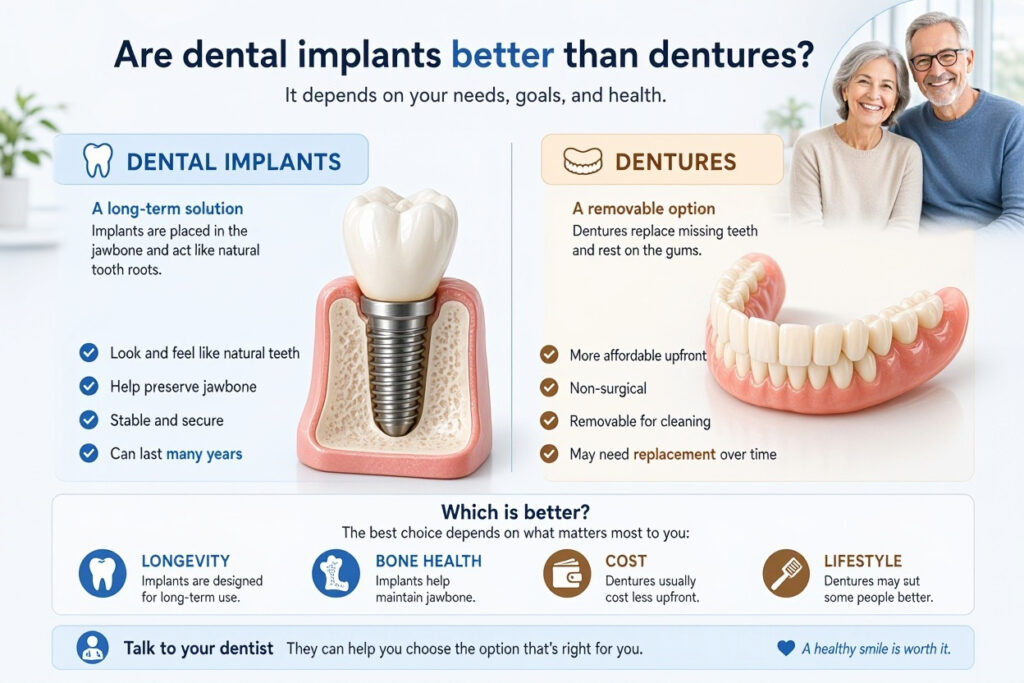
If you’re missing teeth, you face a choice: dentures or implants. Both restore your smile, but they work very differently. Dentures are removable appliances that sit on your gums. Implants are surgically placed titanium posts that function like natural tooth roots.
Which is better? The answer isn’t simple—it depends on your health, budget, lifestyle, and preferences. This article compares implants and dentures across every important dimension, helping you make an informed choice.
Understanding the Options
What Are Dentures?
Dentures are removable prosthetic devices that replace missing teeth. They come in two main types:
Full Dentures
Replace all teeth in an arch (upper or lower). They rest on your gums and are held in place by suction, adhesive, or both.
Partial Dentures
Replace some missing teeth and attach to remaining natural teeth with metal clasps. They’re removable for cleaning.
What Are Dental Implants?
Implants are titanium posts surgically placed in your jawbone. They fuse with bone through osseointegration and support artificial teeth. Implants can replace single teeth, multiple teeth, or all teeth (implant-supported dentures).
Implant-Supported Dentures: A Hybrid Option
This option combines both approaches. Dentures attach to implants, providing the stability of implants with the affordability of dentures. They snap onto implant abutments and are removable for cleaning—or fixed permanently, depending on the design.
Head-to-Head Comparison
Appearance
Dentures:
Modern dentures look natural, but they can appear slightly artificial. The gum-colored base may look bulky, and teeth may seem uniform. Dentures can also slip, causing unnatural movement.
Implants:
Implants look completely natural. They’re custom-made to match your teeth. No bulky base, no slipping—just a beautiful, confident smile.
Winner: Implants
Comfort
Dentures:
Dentures rest on gums, causing sore spots, irritation, and discomfort—especially when new. They can loosen over time, requiring adjustments or adhesive. Many denture wearers experience ongoing comfort issues.
Implants:
Implants feel like natural teeth. No sore gums, no slipping, no adhesive. Once healed, most patients forget they have implants.
Winner: Implants
Stability
Dentures:
Dentures can slip when eating, speaking, or laughing. Adhesive helps, but it’s not foolproof. Loose dentures are a common complaint.
Implants:
Implants are fixed in your jaw. They don’t move, slip, or click. You can eat, speak, and laugh with complete confidence.
Winner: Implants
Eating
Dentures:
Denture wearers often avoid hard, crunchy, or sticky foods. Biting into apples or corn on the cob becomes challenging. Food can get trapped under dentures.
Implants:
Enjoy all your favorite foods. Implants function like natural teeth, so you can bite, chew, and enjoy without restriction.
Winner: Implants
Speech
Dentures:
Dentures can affect pronunciation, especially for “s” and “th” sounds. They may click or slip when speaking.
Implants:
Implants don’t affect speech. You’ll speak clearly and confidently.
Winner: Implants
Bone Health
Dentures:
Dentures don’t stimulate bone. Without stimulation, jawbone shrinks over time, changing facial appearance and causing dentures to loosen. This bone loss continues as long as you wear dentures.
Implants:
Implants stimulate bone, preventing shrinkage. This preserves your facial structure and jaw health.
Winner: Implants
Longevity
Dentures:
Dentures last 5-10 years before needing replacement. They require relines and repairs along the way.
Implants:
Implants last 25 years or longer—often a lifetime. Crowns may need replacement after 10-15 years, but the implant remains.
Winner: Implants
Cost
Dentures:
Lower upfront cost ($1,000-$3,000 for full dentures). But replacement every 5-10 years adds up.
Implants:
Higher upfront cost ($3,000-$6,000 per implant). But long-term value is excellent.
Winner: Dentures (upfront), Implants (long-term)
Maintenance
Dentures:
Require daily removal for cleaning. Need adhesives, soaking, and careful handling. Professional adjustments are common.
Implants:
Brush and floss like natural teeth. No removal, no adhesives. Regular dental checkups needed.
Winner: Implants
Surgery
Dentures:
No surgery required. Non-invasive.
Implants:
Require surgery. Healing time and risks involved.
Winner: Dentures
Table: Complete Comparison
| Feature | Dentures | Implants | Winner |
|---|---|---|---|
| Appearance | Good | Excellent | Implants |
| Comfort | Fair | Excellent | Implants |
| Stability | Fair | Excellent | Implants |
| Eating | Fair | Excellent | Implants |
| Speech | Fair | Excellent | Implants |
| Bone preservation | No | Yes | Implants |
| Longevity | 5-10 years | 25+ years | Implants |
| Upfront cost | Low | High | Dentures |
| Long-term cost | Higher | Lower | Implants |
| Maintenance | Daily removal | Normal hygiene | Implants |
| Surgery | None | Required | Dentures |
“For most patients who qualify, implants are the superior choice. But dentures remain a viable option for those who can’t have surgery or prefer a non-surgical approach.” — Dr. Robert Langdon, Oral Surgeon
When Dentures Make Sense
Dentures Might Be Better If…
You Can’t Have Surgery
Certain health conditions make surgery risky. Dentures don’t require surgery.
You Have Severe Bone Loss
Without sufficient bone for implants, dentures may be your only option. (Though bone grafting can sometimes help.)
Budget Is Very Tight
Dentures cost significantly less upfront. If implants are out of reach financially, dentures restore function and appearance.
You Prefer a Non-Invasive Option
Some patients prefer to avoid surgery. Dentures offer a non-surgical solution.
You Have Extensive Tooth Loss
For complete tooth loss, implant-supported dentures offer a middle ground—more affordable than all implants, more stable than traditional dentures.
The Denture Advantage
Dentures have served patients well for generations. Modern dentures look better and fit better than ever. With implants, or even just good technique and adhesive, they can work well for many people.
When Implants Are the Clear Winner
Implants Are Better If…
You Want a Permanent Solution
Implants are designed to last a lifetime. Dentures need replacement every 5-10 years.
You Value Comfort and Stability
Implants feel like natural teeth. No slipping, no sore gums, no adhesives.
You Want to Eat Normally
Implants allow you to enjoy all foods without restriction.
You Want to Preserve Bone
Implants prevent jawbone loss. Dentures accelerate bone loss.
You’re a Good Surgical Candidate
With good health and sufficient bone, implants offer superior outcomes.
You Want to Protect Adjacent Teeth
Implants don’t require grinding down healthy teeth like bridges do. For partial tooth loss, they’re the most conservative option.
The Implant Advantage
Implants represent the gold standard in tooth replacement. They offer unmatched stability, comfort, and longevity. For patients who qualify, they’re the best investment in oral health and quality of life.
The Middle Ground: Implant-Supported Dentures
Best of Both Worlds?
Implant-supported dentures attach to implants, providing stability without the cost of full implant restoration.
How They Work:
2-4 implants support a full denture. The denture snaps onto the implants, staying firmly in place.
Advantages:
- More stable than traditional dentures
- More affordable than full implant restorations
- Preserves some bone (implants stimulate bone)
- Removable for cleaning (for removable versions)
Disadvantages:
- Still a denture (some bulk, some maintenance)
- Requires surgery (though less than full implants)
- Not as stable as fixed implants
Cost Comparison
| Option | Cost Range |
|---|---|
| Traditional Dentures | $1,000 – $3,000 |
| Implant-Supported Dentures | $6,000 – $15,000 |
| Full Implant Restoration | $20,000 – $40,000 |
Implant-supported dentures offer a middle path—more expensive than traditional dentures, but much less than full implants.
Note: Implant-supported dentures are a great option for patients who want stability but can’t afford full implant restorations.
Real Patient Experiences
Sarah’s Story
“I wore dentures for 10 years. I hated them. They slipped when I ate, clicked when I talked, and I always worried about them falling out. I finally invested in implants and wish I’d done it sooner. I feel like myself again.”
James’s Story
“I couldn’t afford implants, so I got dentures. They took some getting used to, but with adhesive and practice, I manage fine. I eat most foods and speak clearly. Dentures work for my budget.”
Margaret’s Story
“I have medical issues that make surgery risky. Dentures were my only option. They’re not perfect, but they let me smile, eat, and live my life. I’m grateful for that.”
Robert’s Story
“I got implant-supported dentures after years of struggling with regular dentures. It’s a game-changer. They stay in place, I can eat better, and I feel more confident. Not as expensive as full implants, but way better than traditional dentures.”
Making Your Decision
Questions to Ask Yourself
- Can I afford the upfront cost of implants?
- Am I a good candidate for surgery?
- How important is comfort and stability to me?
- Am I willing to care for dentures daily?
- What’s my priority—lowest cost or best outcome?
Questions to Ask Your Dentist
- Am I a candidate for implants?
- What are the pros and cons of each option for my situation?
- What’s the total cost, including all appointments and maintenance?
- How long will each option last?
- What are the risks of each option?
The Bottom Line
Implants are generally better than dentures in terms of comfort, stability, longevity, and bone preservation. But dentures remain a valid option for patients who can’t have surgery, can’t afford implants, or prefer a non-invasive approach.
The “best” choice depends on your individual circumstances. Discuss both options with your dentist to make an informed decision.
Frequently Asked Questions
Are implants always better than dentures?
Not always. Implants are superior for comfort, stability, and longevity, but dentures are better for patients who can’t have surgery or can’t afford implants. The best choice depends on your situation.
Can I switch from dentures to implants?
Yes. Many patients transition from dentures to implants. Your dentist assesses bone health and plans treatment accordingly. Bone grafting may be needed if bone has shrunk from denture wear.
Are implant-supported dentures as good as full implants?
They’re more stable than traditional dentures but less stable than full implant restorations. They’re a middle ground—more affordable than full implants, more stable than regular dentures.
Do dentures cause bone loss?
Yes. Dentures don’t stimulate bone, so the jaw shrinks over time. This changes facial appearance and causes dentures to loosen. Implants prevent this bone loss.
How long do dentures last compared to implants?
Dentures last 5-10 years before needing replacement. Implants last 25 years or longer—often a lifetime.
Are dentures uncomfortable?
Many denture wearers experience sore spots, irritation, and instability. Modern dentures fit better, but they’re still removable appliances that rest on gums. Implants eliminate these issues.
Can I eat normally with dentures?
Denture wearers often avoid hard, crunchy, or sticky foods. Implants allow you to eat anything you want.
Which option is more cost-effective?
Upfront, dentures are cheaper. Long-term, implants are more cost-effective because they last decades and require less maintenance.
Can I get implants if I’ve worn dentures for years?
Often, yes. Your dentist assesses bone quality. Some patients need bone grafting first. Many long-time denture wearers successfully transition to implants.
What if I can’t afford either option?
Discuss all options with your dentist. Some dental schools offer reduced-cost services. Financing and payment plans can help. Don’t sacrifice your oral health—explore all possibilities.
Conclusion
Dental implants outperform dentures in most categories—comfort, stability, eating, speech, bone preservation, and longevity. But dentures remain a valuable option for patients who can’t have surgery or prefer a non-surgical approach.
In summary: Dental implants are generally better than dentures for most patients, offering superior comfort, stability, natural appearance, and bone preservation that dentures can’t match. However, dentures remain a viable choice for those who can’t undergo surgery, have severe bone loss, or need the most affordable option. Implant-supported dentures offer a middle ground, combining stability with affordability. Discuss both options with your dentist to determine the best choice for your unique situation.
Additional Resource
Compare treatment options at the American College of Prosthodontists at www.gotoapro.org.