Are Dental Implants Permanent?
The Permanence Question
When you invest in dental implants, you want to know they’ll last. The word “permanent” gets thrown around a lot in implant dentistry—but what does it really mean? Are implants truly permanent, or will they eventually need replacement?
This article explores the truth about implant permanence. We’ll examine what “permanent” really means in dental terms, what factors affect longevity, and what you can do to keep your implants for life.
Defining “Permanent” in Dental Terms
What Dentists Mean
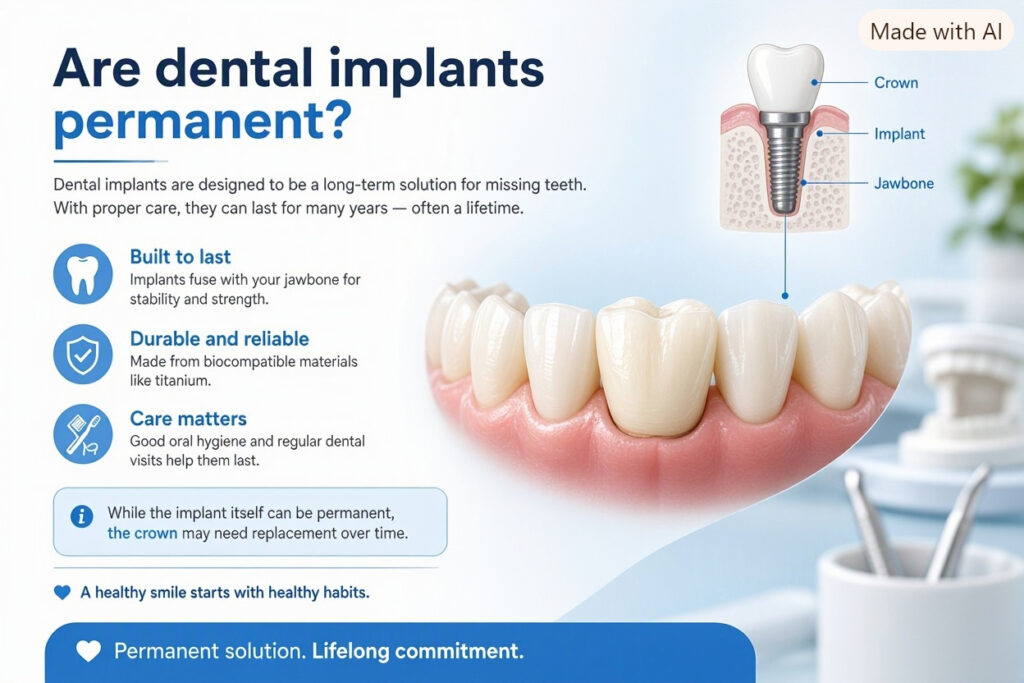
When dentists call implants “permanent,” they mean the implant fixture (the titanium post) is designed to last a lifetime. Unlike dentures you remove daily or bridges that need replacement every 10-15 years, implants integrate with your jawbone and remain in place.
However, “permanent” doesn’t mean “indestructible.” Implants can fail, and parts like crowns may need replacement. Let’s break down the components.
The Components and Their Lifespans
Implant Fixture (Screw)
- Lifespan: Potentially lifetime
- Replaceable: Rarely necessary
- Permanent: Yes, if successful
Abutment (Connector)
- Lifespan: 10-15 years typically
- Replaceable: Yes, if worn or loose
- Permanent: Semi-permanent
Crown (Visible Tooth)
- Lifespan: 10-15 years
- Replaceable: Yes, due to wear
- Permanent: Not technically permanent, but long-lasting
Gum Tissue
- Lifespan: Requires ongoing care
- Replaceable: Can recede; monitored during checkups
- Permanent: Needs maintenance
“The implant itself is permanent. The crown may need replacement after a decade or two, just like a natural tooth might need a crown. But the foundation—that titanium post—is designed to last a lifetime.” — Dr. Michael Torres, Periodontist
What Makes Implants “Permanent”?
Osseointegration: The Biological Bond
Implants achieve permanence through osseointegration—the process where bone grows around the titanium post. This creates a bond stronger than any mechanical attachment. The implant literally becomes part of your jaw.
Once osseointegration completes, the implant is locked in place. It doesn’t loosen or move like a denture. It’s a fixed part of your anatomy.
The Titanium Advantage
Titanium is uniquely suited for permanent implantation:
- Biocompatible: Your body accepts it without rejection
- Corrosion-resistant: Doesn’t degrade in the oral environment
- Strong: Withstands chewing forces for decades
- Proven: Used in medical implants for over 50 years
No other material has this track record for permanence.
What Causes Implants to Fail?
Understanding Failure
While implants are designed to be permanent, they can fail. Understanding why helps you prevent problems.
Early Failure (First Year)
Failed Osseointegration
Sometimes bone doesn’t bond properly. This can result from poor bone quality, infection, or excessive force during healing. Early failure occurs in 1-5% of implants.
Infection
Surgical site infections can prevent healing. Proper post-surgical care minimizes this risk.
Insufficient Bone
Inadequate bone density prevents secure integration. Bone grafting beforehand solves this problem.
Late Failure (Years Later)
Peri-implantitis
This gum infection around implants is the most common cause of late failure. It destroys bone support, eventually causing implant loss. Good hygiene prevents this.
Bite Problems
Excessive force from grinding or misaligned bite stresses implants. Night guards and bite adjustments protect them.
Trauma
Accidents or injuries can damage implants. Sports guards prevent this.
Systemic Health Changes
New health conditions or medications can affect implant stability. Regular dental visits catch changes early.
Table: Failure Causes and Prevention
| Failure Cause | Timing | Prevention |
|---|---|---|
| Failed osseointegration | 1-6 months | Proper planning, healthy bone |
| Infection | First weeks | Antibiotics, hygiene |
| Peri-implantitis | Years | Excellent oral care, checkups |
| Bite problems | Years | Night guard, bite adjustment |
| Trauma | Any time | Sports guards, caution |
Important Note: Most implant failures are preventable. Proper planning, skilled surgery, good hygiene, and regular dental visits dramatically improve success rates.
Making Implants Last a Lifetime
Daily Habits
Brushing
Brush twice daily with a soft-bristled brush. Pay special attention to the gum line around implants.
Flossing
Use implant-specific floss or interdental brushes daily. These clean areas regular floss misses.
Rinsing
Antibacterial, alcohol-free mouthwash helps control bacteria.
Avoiding Hard Objects
Don’t chew ice, pens, or hard candy. Don’t use teeth as tools.
Professional Care
Regular Checkups
Visit your dentist every six months. Professional cleanings and exams catch problems early.
X-rays
Periodic imaging monitors bone health around implants.
Early Intervention
Report any symptoms immediately. Early treatment saves implants.
Lifestyle Factors
- Don’t smoke (or quit if you do)
- Wear a night guard if you grind your teeth
- Maintain a healthy diet
- Control systemic health conditions
- Protect implants during sports
Table: Lifetime Care Checklist
| Activity | Frequency | Purpose |
|---|---|---|
| Brushing | Twice daily | Remove plaque |
| Flossing | Daily | Clean between teeth |
| Antibacterial rinse | Daily | Control bacteria |
| Professional cleaning | Every 6 months | Deep cleaning |
| Dental exam | Every 6 months | Monitor health |
| Night guard | Nightly (if grinding) | Protect from force |
| Smoking cessation | Ongoing | Improve success |
Implants vs. Natural Teeth
How Do They Compare?
| Feature | Dental Implants | Natural Teeth |
|---|---|---|
| Tooth decay | No | Yes |
| Root canals | Never needed | Sometimes needed |
| Gum disease | Possible (peri-implantitis) | Possible (periodontitis) |
| Bone stimulation | Yes | Yes |
| Lifespan | 25+ years to lifetime | Varies; can last lifetime with care |
| Sensitivity | None (no nerve) | Can be sensitive |
The Advantage
Implants avoid tooth decay entirely. There’s no enamel to wear down, no nerve to become sensitive. As long as gum health and bone support remain stable, implants can outlast natural teeth.
When Implants Need Replacement
Is Replacement Common?
While many implants last a lifetime, some need replacement. Reasons include:
- Fractured implant (very rare)
- Severe peri-implantitis with significant bone loss
- Traumatic injury
- Failed osseointegration from the start
- Changes in medical status
The Replacement Process
If an implant fails, your dentist:
- Removes the failed implant
- Allows the site to heal
- Assesses bone quality
- May perform bone grafting
- Places a new implant after healing
This process takes several months but typically succeeds. Many dentists stand behind their work and offer warranties.
Crown Replacement
More commonly, the crown needs replacement while the implant remains. Crowns experience wear and may chip or fracture after 10-15 years. Replacement is straightforward and much less expensive than the initial implant.
The “Permanent” Promise
What Dentists Guarantee
Most dentists offer warranties on their implant work:
- 1-5 years: Common warranty period for surgical work
- Lifetime: Some premium implant brands warranty the fixture itself
- Crown warranty: Typically 1-3 years
Read warranty terms carefully. They usually cover implant failure, not crown wear or hygiene-related problems.
Realistic Expectations
A successful implant with good care can last decades. Many patients in their 70s and 80s have implants placed 20+ years ago that still function perfectly.
However, no dentist can promise absolute permanence. Health changes, accidents, or poor hygiene can affect even the best-placed implants. “Permanent” means designed for long-term success with proper care—not guaranteed for life regardless of circumstances.
“I tell patients implants are a long-term solution, not a forever guarantee. With excellent care, most will last decades. But you have to do your part.” — Dr. Jennifer Adams, Implant Dentist
Frequently Asked Questions
Are dental implants truly permanent?
The implant fixture is designed to last a lifetime and often does. The crown may need replacement after 10-15 years. With proper care, most implants remain functional for decades.
How often do implants need replacement?
Implant failure occurs in 1-5% of cases. Most implants never need replacement. Crowns may need replacement after 10-15 years due to wear.
Can an implant last 50 years?
Yes, some implants have lasted 40+ years. Longevity depends on oral hygiene, health, and regular dental care. Many patients keep implants for life.
What causes implants to fail years later?
Peri-implantitis (gum infection), bite problems, trauma, and systemic health changes are common causes. Regular dental visits catch problems early.
Do implants require special care?
Implants need daily brushing, flossing, and regular professional cleanings. They’re not “set it and forget it”—they need maintenance like natural teeth.
Can I get a new implant if mine fails?
Yes, in most cases. Your dentist removes the failed implant, allows healing, and may place a new one. Bone grafting may be needed first.
Are implant crowns permanent?
No. Crowns wear over time and may need replacement after 10-15 years. The implant underneath usually remains stable.
Do dentists guarantee implants for life?
Most offer limited warranties (1-5 years on surgical work). Some implant brands have lifetime warranties on the fixture. Crowns are typically warranted for 1-3 years.
What happens if I don’t care for my implant?
Poor hygiene leads to peri-implantitis, which can destroy bone and cause implant loss. Good care is essential for permanence.
Can implants last longer than natural teeth?
Sometimes, yes. Implants don’t decay. With excellent hygiene and bone health, implants can outlast natural teeth that might be lost to decay or gum disease.
Conclusion
Dental implants are designed for permanence—the titanium fixture can last a lifetime with proper care. While crowns may need replacement after 10-15 years, the implant itself often remains stable for decades.
In summary: Dental implants are considered permanent because the titanium fixture integrates with your jawbone and is designed to last a lifetime, though the crown may need replacement after 10-15 years. Success depends on excellent oral hygiene, regular dental visits, avoiding smoking, and protecting implants from excessive force. While no dentist can guarantee absolute permanence, most implants with proper care last decades and often for life.
Additional Resource
Learn more about implant maintenance at the Academy of Osseointegration at www.osseo.org.