Best Mouthwash for Dental Implants
Mouthwash can be a valuable addition to your dental implant care routine—but not all rinses are created equal. Some ingredients support healing and protect implants, while others may cause irritation or dryness.
This article helps you navigate the options and choose the best mouthwash for your dental implants.
The Role of Mouthwash in Implant Care
Mouthwash is not a replacement for brushing and flossing, but it offers benefits:
- Reduces bacteria: Antimicrobial rinses help control bacterial populations in the mouth.
- Freshens breath: Mouthwash provides a clean, fresh feeling.
- Soothes tissues: Some rinses contain ingredients that calm irritated gums.
- Reaches difficult areas: Liquid can reach areas that brushing and flossing miss.
For implant patients, mouthwash can be particularly helpful during the healing phase and for ongoing maintenance.
Key Ingredients to Look For
When choosing a mouthwash for dental implants, consider these ingredients.
Alcohol-Free Formulas
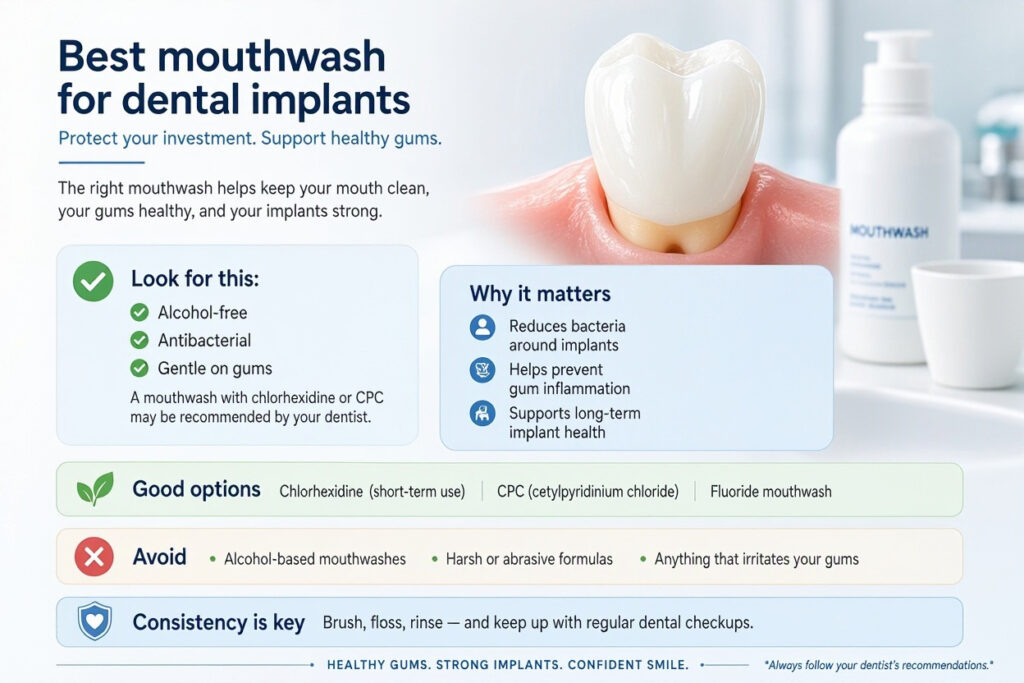
This is the most important consideration. Alcohol-based mouthwashes can dry out the mouth, irritate gum tissue, and slow healing. Alcohol-free formulas are gentler and better suited for implant patients.
Chlorhexidine (Short-Term Use)
Chlorhexidine is a powerful antimicrobial agent often prescribed after implant surgery or for treating peri-implant mucositis. It is effective but should only be used short-term (typically 1-2 weeks) because long-term use can cause staining, altered taste, and calculus buildup.
Essential Oils
Rinses containing essential oils (such as eucalyptol, menthol, thymol, and methyl salicylate) provide antimicrobial benefits without alcohol. Examples include alcohol-free versions of popular brands.
Fluoride
Fluoride helps protect natural teeth from decay. While it does not affect implants directly, it supports the health of surrounding natural teeth.
Cetylpyridinium Chloride (CPC)
CPC is an antimicrobial agent found in many alcohol-free rinses. It helps reduce plaque and gingivitis.
Hydrogen Peroxide
Low-concentration hydrogen peroxide rinses can help clean and soothe tissues. They are sometimes recommended during healing.
Aloe Vera and Herbal Extracts
Some natural rinses contain aloe vera, chamomile, or other soothing ingredients. These can calm irritated tissues but may not provide strong antimicrobial action.
Ingredients to Avoid
Alcohol
As mentioned, alcohol can dry the mouth and irritate tissues. Avoid high-alcohol rinses, especially during healing and for long-term use.
Harsh Chemicals
Some rinses contain ingredients that may irritate sensitive tissues. Read labels carefully and choose gentle formulas.
Sugars and Artificial Sweeteners
Sugar feeds bacteria. Most mouthwashes are sugar-free, but check labels. Some artificial sweeteners may cause sensitivity in certain individuals.
Abrasive Particles
Some whitening rinses contain abrasive particles that could scratch implant crowns. Avoid these.
Comparison Table: Mouthwash Types for Implant Patients
| Type | Key Ingredients | Benefits | Considerations |
|---|---|---|---|
| Alcohol-free antimicrobial | Essential oils, CPC | Reduces bacteria, gentle | Good for daily use |
| Chlorhexidine | Chlorhexidine gluconate | Strong antimicrobial | Short-term use only |
| Fluoride rinse | Sodium fluoride | Protects natural teeth | Does not affect implants |
| Hydrogen peroxide | Dilute H2O2 | Cleans, soothes | Use as directed |
| Herbal/natural | Aloe, chamomile | Soothing | May be less antimicrobial |
| Prescription rinses | Various | Targeted treatment | Follow dentist’s instructions |
When to Use Mouthwash
During Healing
After implant surgery, your dentist may prescribe a chlorhexidine rinse to prevent infection. Follow instructions carefully—typically rinse gently twice daily for 1-2 weeks.
Daily Maintenance
For ongoing care, use an alcohol-free antimicrobial rinse once or twice daily. Rinse for 30-60 seconds, then spit out. Do not swallow.
Before Procedures
Some dentists recommend rinsing before dental appointments to reduce bacterial load.
When You Cannot Brush
If you are unable to brush after a meal, a quick rinse can help remove loose debris and freshen breath until you can brush.
How to Choose the Right Mouthwash
Consult Your Dentist
Your dentist knows your specific situation and can recommend products based on your needs. Ask for guidance, especially if you have sensitive gums or a history of peri-implantitis.
Read Labels Carefully
Look for alcohol-free formulas with proven antimicrobial ingredients. Avoid products with harsh chemicals or abrasives.
Consider Your Goals
Are you looking for daily maintenance, treatment of inflammation, or breath freshening? Different products serve different purposes.
Test for Sensitivity
If you have sensitive gums, try a small amount first to ensure the product does not cause irritation.
Tips for Using Mouthwash Effectively
- Measure the correct amount: Follow label instructions—usually 15-20 ml.
- Rinse for the recommended time: Typically 30-60 seconds.
- Do not rinse with water afterward: This washes away the active ingredients.
- Do not eat or drink for 30 minutes: Allow the ingredients to work.
- Use consistently: Mouthwash works best as part of a regular routine.
“Mouthwash is a supplement, not a substitute. I remind my patients that no rinse can replace the mechanical action of brushing and flossing. Think of mouthwash as the icing on the cake.” — Dr. Michael Thompson, DDS
Conclusion
The best mouthwash for dental implants is an alcohol-free antimicrobial formula that supports gum health without causing irritation. During healing, your dentist may prescribe a chlorhexidine rinse for short-term use. For daily maintenance, choose a gentle, effective product and use it consistently alongside brushing and flossing.
FAQ: Mouthwash for Dental Implants
Can I use regular mouthwash with dental implants?
Yes, but choose alcohol-free formulas to avoid dryness and irritation. Avoid rinses with abrasive particles.
Is chlorhexidine safe for long-term use?
Chlorhexidine is generally safe for short-term use (1-2 weeks). Long-term use can cause staining and other side effects. Use only as directed by your dentist.
Can mouthwash replace flossing?
No. Mouthwash cannot remove plaque from between teeth. Flossing is essential for implant health.
What if mouthwash burns my gums?
Burning may indicate alcohol content or sensitivity to an ingredient. Switch to a gentler, alcohol-free formula.
Should I use mouthwash before or after brushing?
Most dentists recommend using mouthwash after brushing and flossing to maximize its effects. Do not rinse with water afterward.
Additional Resource: For a list of ADA-approved mouthwashes, visit the American Dental Association: https://www.ada.org.