How Long After Dental Implants Can They Be Installed?
The question contains a paradox that reveals a common misunderstanding about dental implant treatment. Dental implants are not installed after something else. They are the thing that is installed first, the foundation upon which teeth are built. What patients are usually asking when they pose this question is how long after tooth extraction can dental implants be placed, or how long after implant placement can the final teeth be attached. The timing of implant placement relative to tooth loss and the timing of tooth attachment relative to implant placement are both critical questions that determine the duration, success, and complexity of treatment. Understanding the different timelines, the factors that influence them, and the trade-offs involved in each approach empowers patients to make informed decisions about their implant treatment.
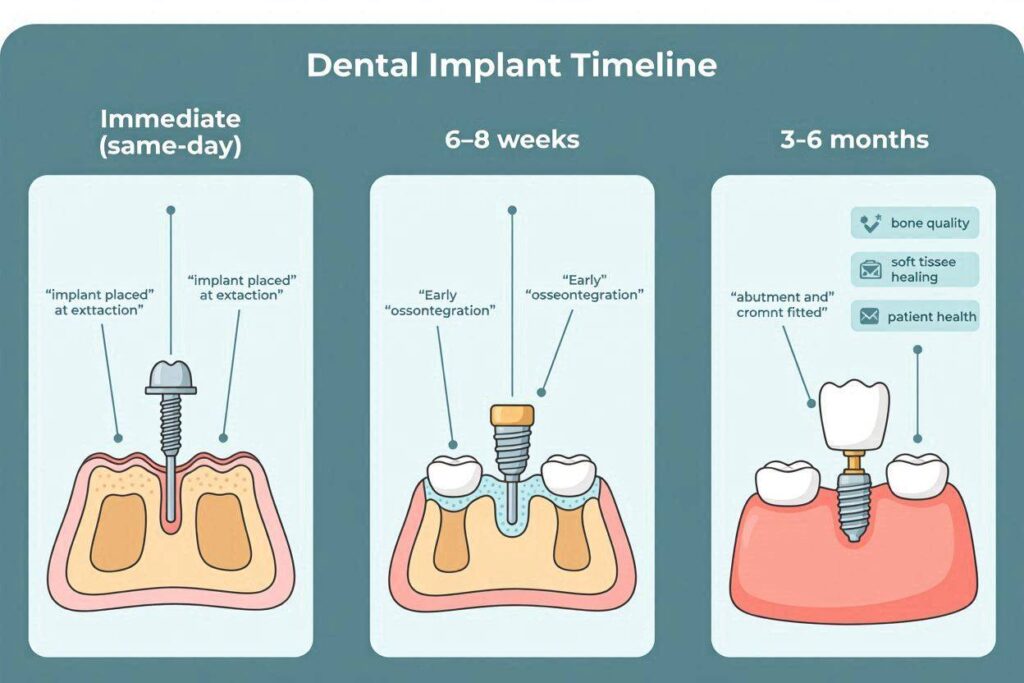
Clarifying the Question: What Is Being Installed When
The confusion in the question reflects a broader confusion about the sequence of implant treatment. Clarifying the terminology and the sequence is the first step to understanding the timelines.
The Implant Is the Foundation
The dental implant is the titanium or zirconia post that is surgically placed into the jawbone. It serves as the artificial tooth root, the foundation for the visible tooth that will eventually be attached. The implant is the first component placed in the sequence of treatment, not the last.
When patients ask how long after dental implants can they be installed, they are often asking about the timing of implant placement relative to tooth extraction. In other words, how long after a tooth is removed can the implant be placed? This is a question about the sequence of the surgical phase.
Alternatively, patients may be asking about the timing of the visible tooth, the crown, relative to implant placement. How long after the implant is placed can the new tooth be attached? This is a question about the duration of the healing phase before restoration.
Both interpretations of the question are addressed here, moving through the complete timeline from tooth loss to final restoration.
Timeline One: From Tooth Extraction to Implant Placement
The timing of implant placement relative to tooth extraction is one of the most important decisions in implant treatment planning. Several distinct approaches exist, each with different advantages, limitations, and timelines.
Immediate Implant Placement
Immediate implant placement refers to placing the dental implant into the extraction socket at the same appointment as the tooth removal. This approach compresses the surgical timeline by combining extraction and implant placement into a single procedure.
The ideal candidate for immediate placement has an extraction site with intact bony walls, particularly the buccal bone plate on the cheek side. There must be no active infection at the extraction site, as bacteria compromise osseointegration. Adequate bone beyond the socket apex must exist to provide primary stability for the implant.
Immediate placement offers several advantages. It preserves bone and soft tissue architecture better than delayed approaches because the implant occupies the socket and provides mechanical stimulation during healing. It reduces the total number of surgical procedures from two to one. It shortens the overall treatment timeline by eliminating the separate extraction healing period of three to four months.
The disadvantages include a higher risk of implant failure if the site is infected or if primary stability cannot be achieved. The implant may not be ideally positioned for the final restoration because the extraction socket dictates the implant position to some degree. Additional grafting may still be needed if the socket walls are deficient.
Immediate placement is most successful for single-rooted teeth in the anterior region, where the socket anatomy is favorable and esthetic preservation is paramount. Molar sites with multiple roots and intervening bone present greater challenges.
Early Implant Placement
Early implant placement occurs four to eight weeks after tooth extraction. This approach allows soft tissue healing over the extraction site while placing the implant before significant bone resorption has occurred.
The soft tissue healing that occurs during the four to eight-week waiting period provides improved wound closure at the time of implant placement. The extraction socket is no longer an open wound, reducing the risk of bacterial contamination during implant surgery. The soft tissue has matured, providing better conditions for surgical flap management.
Bone resorption during this short waiting period is minimal. The implant can still be placed into the healing socket, capturing many of the bone preservation benefits of immediate placement while reducing some of the risks.
Early placement is appropriate when the extraction site had some infection that has resolved during the waiting period, or when soft tissue healing is desired before implant surgery. It is a compromise between the bone preservation advantages of immediate placement and the safety advantages of delayed placement.
Delayed Implant Placement
Delayed implant placement occurs three to four months after tooth extraction, after complete hard and soft tissue healing. The extraction socket has filled with new bone, and the overlying gum tissue is mature.
This approach provides the most predictable surgical environment. The bone has healed fully, and the surgeon can assess the healed ridge dimensions and plan implant placement precisely. There is no extraction socket to dictate implant position. The risk of infection from the extraction site is eliminated.
The disadvantage is that significant bone resorption has occurred during the healing period. The alveolar ridge has lost both width and height compared to the pre-extraction state. Bone grafting is more likely to be needed with delayed placement than with immediate or early placement.
Delayed placement is the traditional approach and remains appropriate when the extraction site was significantly infected, when the patient’s healing capacity is compromised, or when bone grafting at the time of extraction is planned as a staged procedure.
Late Implant Placement
Late implant placement occurs years after tooth extraction, in a site that has been edentulous for an extended period. The bone has resorbed significantly, and the ridge is atrophic compared to its original dimensions.
Late placement almost always requires bone grafting to rebuild the ridge before or at the time of implant placement. The bone loss that occurs over years without the mechanical stimulation of a tooth root is substantial and progressive.
The surgical challenges of late placement are greater. Critical anatomical structures, including the inferior alveolar nerve in the lower jaw and the maxillary sinus in the upper jaw, may be closer to the ridge surface due to bone loss. The available bone may be insufficient for standard implant sizes.
Despite these challenges, late placement is the reality for most patients seeking dental implants. The tooth has been missing for months or years, and the bone has resorbed. Modern grafting techniques reliably rebuild the necessary bone volume, though the treatment timeline is extended.
Summary of Extraction-to-Implant Timelines
| Placement Type | Timing After Extraction | Advantages | Disadvantages |
|---|---|---|---|
| Immediate | Same day | Preserves bone, single surgery, shortest timeline | Higher failure risk, position dictated by socket |
| Early | 4-8 weeks | Soft tissue healing, reduced bone loss | Two surgeries, moderate timeline |
| Delayed | 3-4 months | Most predictable, infection resolved | Significant bone loss, grafting often needed |
| Late | Years | N/A (necessity) | Extensive bone loss, grafting required |
Timeline Two: From Implant Placement to Final Crown
Once the implant is placed, a healing period is required before the final tooth can be attached. The duration of this period depends on the implant location, the bone quality, and the loading protocol chosen.
Traditional Loading Protocol
The traditional loading protocol allows complete osseointegration before the implant is loaded with a functional restoration. The implant heals undisturbed for three to six months, depending on the jaw location.
In the lower jaw, where bone is typically denser and heals faster, the traditional healing period is three to four months. In the upper jaw, particularly the posterior maxilla where bone is less dense, the healing period is four to six months.
During this healing period, the implant is protected from loading. The patient does not chew on that side. If a healing abutment is present, it protrudes through the gum but does not contact the opposing teeth. If the implant was buried under the gum, it is completely protected.
The traditional protocol is the most conservative and predictable approach. It is appropriate for most patients and most implant sites. The waiting period, while requiring patience, protects the implant during the vulnerable osseointegration phase.
Early Loading Protocol
Early loading places a functional restoration on the implant at six to eight weeks after placement in the lower jaw, or eight to twelve weeks in the upper jaw. This protocol assumes that sufficient osseointegration has occurred during this shortened period to support functional loading.
Early loading requires good primary stability at implant placement, good bone quality, and careful occlusal management of the restoration. The implant must have achieved stability above specific thresholds measured by resonance frequency analysis or insertion torque.
The advantage of early loading is a shortened treatment timeline. The patient receives the final tooth weeks to months earlier than with the traditional protocol. The disadvantage is a slightly higher risk of implant failure compared to traditional loading, particularly in compromised bone.
Immediate Loading Protocol
Immediate loading, sometimes called same-day teeth, places a functional or non-functional temporary restoration on the implant at the same appointment as implant placement or within 48 hours.
Immediate loading requires excellent primary stability, typically defined as insertion torque above 35 Newton-centimeters and an implant stability quotient above 60. The bone quality must be good to excellent. The restoration must be carefully adjusted to eliminate occlusal contacts during the healing period.
The temporary restoration provides immediate esthetics and some function, which is highly valued by patients, particularly in the anterior region. However, the implant is vulnerable during osseointegration, and the patient must follow strict dietary restrictions and avoid loading the implant.
The final restoration is fabricated after osseointegration is confirmed, typically at three to six months. The immediate loading provides the temporary tooth, not the final crown. Some patients misunderstand this and expect the final crown to be placed immediately.
Immediate loading of single implants carries higher risk than traditional loading. It is most successful for full-arch restorations where multiple implants are splinted together, distributing forces and improving the loading environment.
Immediate Restoration vs. Immediate Loading
A distinction exists between immediate restoration and immediate loading. Immediate restoration places a temporary crown that is designed to be non-functional, with no contact with the opposing teeth in centric occlusion or excursive movements. This provides esthetics without loading the implant.
Immediate loading places a temporary crown that contacts the opposing teeth and participates in function, though typically with lighter contact than the final restoration.
Non-functional immediate restoration carries less risk than immediate loading because the implant is not subjected to chewing forces during healing. It is appropriate for anterior implants where esthetics are the primary concern and the patient can avoid biting on the temporary.
Summary of Implant-to-Crown Timelines
| Loading Protocol | Time to Restoration | Requirements | Risk Level |
|---|---|---|---|
| Traditional | 3-6 months | Standard healing | Lowest |
| Early | 6-12 weeks | Good primary stability, good bone | Slightly higher |
| Immediate (non-functional) | Same day | Excellent primary stability | Moderate |
| Immediate (functional) | Same day | Excellent primary stability, splinted | Higher |
Factors That Influence the Timeline
The appropriate timeline for a specific patient depends on multiple factors that the treatment team evaluates during planning.
Bone Quality and Quantity
Bone density at the implant site is the most important factor determining healing time. Dense cortical bone in the anterior mandible heals faster and provides better primary stability than the soft cancellous bone of the posterior maxilla.
Patients with good bone quality and quantity have more options for accelerated protocols. Patients with compromised bone require longer healing times and more conservative loading protocols to ensure successful osseointegration.
Bone grafting at the time of implant placement extends the healing timeline because both the graft and the implant-bone interface must mature. The implant healing is governed by the graft healing timeline, which is typically four to nine months.
Primary Stability
Primary stability, the mechanical engagement of the implant with the bone at the time of placement, is a critical determinant of when the implant can be loaded. Higher primary stability allows earlier loading.
The surgeon measures primary stability through insertion torque and resonance frequency analysis. Values above established thresholds are required for accelerated loading protocols. If primary stability falls below these thresholds, traditional healing timelines are used.
Patient Health and Habits
Systemic conditions that impair healing, including uncontrolled diabetes, immunocompromised states, and certain medications, require more conservative timelines. The implant needs more time to achieve osseointegration when the healing environment is compromised.
Smoking significantly impairs healing and increases implant failure risk. Smokers should have longer healing periods before loading, and some surgeons will not offer accelerated protocols to smokers regardless of other factors.
The Surgeon’s Judgment
Ultimately, the decision about when to load an implant rests with the surgeon, who evaluates all factors including bone quality, primary stability, patient health, and the specific implant system being used. The surgeon’s experience and clinical judgment are the final arbiters of the appropriate timeline.
Patients may request accelerated protocols, but the surgeon should not compromise the implant’s prognosis to accommodate patient impatience. The waiting period, while frustrating, protects the significant investment in implant treatment.
The Complete Timeline: Extraction to Final Crown
Putting both timelines together provides the complete picture of implant treatment duration from tooth loss to final restoration.
Immediate Placement With Traditional Loading
If an implant is placed immediately at the time of extraction and allowed to heal with the traditional protocol, the complete timeline from extraction to final crown is approximately three to six months. The extraction and implant placement occur in one appointment, and the healing period follows.
Immediate Placement With Immediate Restoration
If an implant is placed immediately and a non-functional temporary crown is placed at the same appointment, the patient has an esthetic tooth immediately. However, the final crown is still fabricated after three to six months of healing. The total treatment time to final restoration is the same as with traditional loading. The difference is that the patient has a visible tooth during the healing period.
Delayed Placement With Traditional Loading
If an implant is placed three to four months after extraction and allowed to heal with the traditional protocol, the complete timeline from extraction to final crown is approximately six to ten months. The extraction healing period and the implant healing period are sequential.
Late Placement With Bone Grafting
If an implant is placed years after extraction and bone grafting is required, the complete timeline can extend to twelve to eighteen months or longer. The bone graft must heal for four to nine months before the implant can be placed. The implant then heals for three to six months before restoration.
Special Considerations for Full-Arch Restorations
Full-arch implant restorations, replacing all teeth on an arch, have specific timing considerations that differ from single implant treatment.
All-on-4 and Similar Protocols
The All-on-4 treatment concept and similar protocols typically involve extraction of remaining teeth, placement of four to six implants, and attachment of a fixed provisional prosthesis, all in a single surgical appointment.
The patient leaves the appointment with a fixed set of temporary teeth supported by the implants. This provisional prosthesis provides function and esthetics during the osseointegration period.
The definitive prosthesis is fabricated after three to six months of healing. The patient returns for impressions, try-in, and delivery of the final prosthesis, which replaces the provisional.
The immediate function aspect of these protocols is possible because the implants are splinted together, distributing forces and improving the loading environment. Single implants cannot be loaded immediately with the same level of predictability.
Staged Full-Arch Treatment
Some full-arch cases are treated with a staged approach. The implants are placed and allowed to heal with a traditional protocol. The patient wears a removable denture during healing, relieved over the implant sites to prevent loading.
The definitive prosthesis is fabricated after osseointegration is confirmed. This staged approach takes longer but avoids the risks associated with immediate loading. It is appropriate for patients with compromised bone or other risk factors.
Conclusion
Dental implants can be placed at varying intervals after tooth extraction: immediately at the same appointment, early at four to eight weeks, delayed at three to four months, or late after years, with the choice depending on the extraction site condition, presence of infection, and bone volume. After implant placement, the final crown can be attached following traditional loading at three to six months, early loading at six to twelve weeks, or immediate restoration on the same day, with the timeline determined by bone quality, primary stability, and patient factors. The complete treatment from extraction to final crown ranges from approximately three to six months for immediate placement with traditional loading to twelve to eighteen months or longer for late placement requiring bone grafting. Accelerated protocols offer shorter treatment times but require excellent bone and primary stability, while traditional protocols provide the most predictable outcomes for most patients.
Frequently Asked Questions
Can I get an implant the same day my tooth is pulled?
Yes, in many cases. Immediate implant placement is appropriate when the extraction site has intact bony walls, no active infection, and adequate bone beyond the socket for primary stability. Your surgeon evaluates these factors at the time of extraction and determines whether immediate placement is appropriate.
Why do I have to wait months for the crown?
Osseointegration, the biological fusion of bone to the implant surface, requires three to six months. Loading the implant with a functional crown before osseointegration is complete risks fibrous encapsulation instead of bone fusion, causing implant failure. The waiting period protects the implant during this vulnerable healing phase.
Can I get a temporary tooth during the healing period?
Yes. Several options exist including a removable temporary partial denture, a temporary fixed bridge bonded to adjacent teeth, or an immediate temporary crown on the implant if conditions allow. The temporary provides esthetics while the implant heals. Your dentist will recommend the appropriate option for your situation.
How soon can I eat normally after implant placement?
Soft foods are recommended for the first week after surgery. You should avoid chewing on the implant side for the entire osseointegration period, typically three to six months, or as directed by your surgeon. Normal eating can resume after the final crown is placed and you have adapted to it.
Does bone grafting add time to the process?
Yes. Bone grafting adds four to nine months to the overall timeline, depending on the graft type and size. The graft must mature before an implant can be placed into it. Grafting is performed either before implant placement as a separate procedure or at the time of extraction with a subsequent waiting period.
What happens if I do not have enough bone for implants?
Bone grafting procedures can rebuild the bone needed for implant placement. The type of graft depends on the bone deficiency. Ridge augmentation rebuilds width or height. Sinus lifts rebuild bone in the upper back jaw. These procedures extend the treatment timeline but make implant placement possible for most patients.
Are same-day teeth as strong as implants that heal longer?
Same-day teeth refers to immediate loading of the implant, not immediate completion of treatment. The temporary tooth placed immediately is not as strong as the final crown and should not be used for heavy chewing. The final crown, placed after osseointegration is complete, is the same regardless of whether a temporary was placed immediately or not.
Can multiple implants be placed at the same time?
Yes. Multiple implants placed during the same surgical session heal concurrently, not sequentially. The total healing time is the same as for a single implant, not multiplied by the number of implants. The surgical appointment is longer, but the overall treatment timeline is not extended.
Additional Resource
American Academy of Implant Dentistry: Treatment Options and Timelines
https://www.aaid.com/patient_education/treatment_options.html