Best Floss for Dental Implants
Flossing around dental implants requires more care than flossing around natural teeth. The wrong technique or product can damage the delicate implant-gum seal, while the right approach keeps bacteria at bay and protects your investment.
This article explores the best floss options for dental implants, explains how to use them correctly, and helps you choose the right product for your specific situation.
Why Flossing Around Implants Is Different
Natural teeth connect to gums via a periodontal ligament—a soft tissue attachment that allows slight movement. Implants lack this ligament. Instead, they integrate directly with bone, and the gum tissue forms a seal around them.
This anatomical difference means:
- Implants do not have the same defensive mechanisms as natural teeth
- The implant-gum seal is more vulnerable to disruption
- Bacteria can more easily penetrate deeper around implants if hygiene is poor
Proper flossing removes plaque from the critical area where the implant meets the gum, preventing peri-implant mucositis and peri-implantitis.
Types of Floss for Dental Implants
Several floss options exist, each with advantages and considerations.
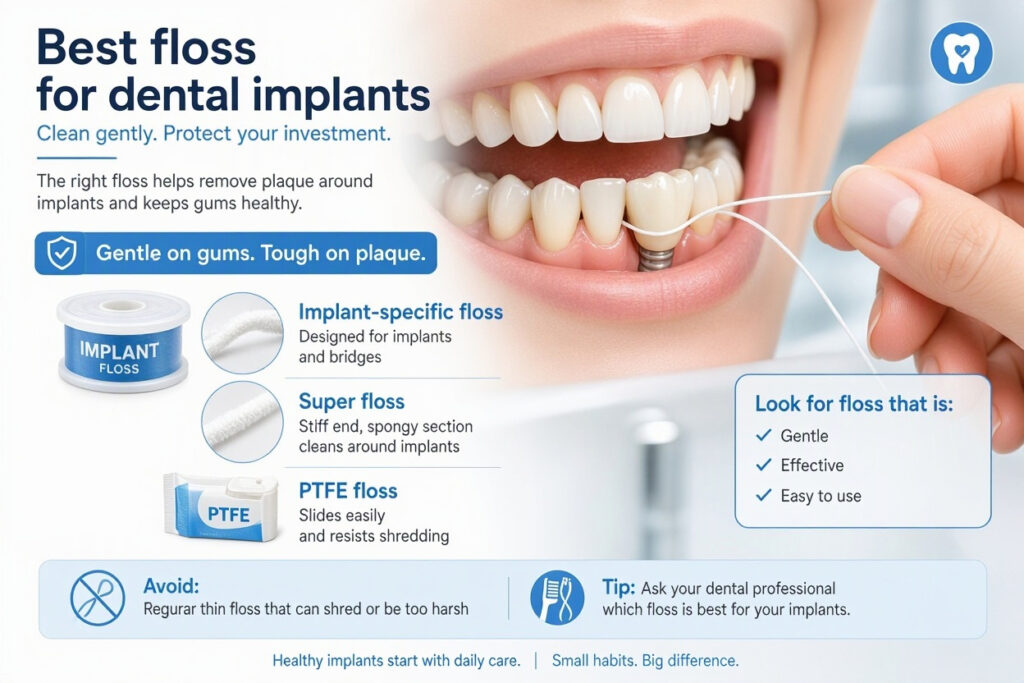
Implant-Specific Floss
Products like implant-specific floss are designed with wider, thicker threads that gently clean around implant margins without shredding or catching. These flosses often have a stiff end for threading under bridges.
Pros:
- Designed specifically for implant anatomy
- Gentle on tissues
- Effective at removing plaque
Cons:
- Less widely available than regular floss
- May be more expensive
Superfloss
Superfloss features three distinct sections: a stiffened end for threading, a spongy middle section for cleaning under bridges, and regular floss for tight spaces. It is excellent for implant-supported bridges.
Pros:
- Versatile for different restoration types
- Effective under bridges
- Easy to thread
Cons:
- Bulkier than regular floss
- Requires practice to use efficiently
Waxed Floss
Waxed floss glides more easily between teeth and is less likely to shred. It can work for implant patients with single crowns and tight contacts.
Pros:
- Smooth and comfortable
- Widely available
- Affordable
Cons:
- Not ideal for bridges or wide spaces
- May not clean as thoroughly around implant margins
Unwaxed Floss
Unwaxed floss provides more friction and can clean more effectively in some situations, but it is more prone to shredding.
Pros:
- Good cleaning action
- Affordable
Cons:
- Shreds easily
- Can be rough on gums
Water Flossers (Oral Irrigators)
Water flossers use a pulsating stream of water to remove plaque and food particles. They are excellent adjuncts for implant care, especially for patients with bridges or dexterity challenges.
Pros:
- Easy to use
- Effective for bridges and hard-to-reach areas
- Gentle on gums when used correctly
Cons:
- Does not replace traditional floss entirely
- Requires access to water and electricity
- Some models are noisy
Interdental Brushes
While not technically floss, interdental brushes are small, cone-shaped brushes that clean between teeth and around implants. They are highly effective for patients with wider spaces.
Pros:
- Excellent cleaning action
- Easy to use
- Reusable
Cons:
- Not suitable for tight contacts
- Requires correct size selection
Comparison Table: Floss Options for Dental Implants
| Product | Best For | Ease of Use | Effectiveness | Cost |
|---|---|---|---|---|
| Implant-specific floss | Single implants, general use | Moderate | High | Moderate |
| Superfloss | Implant bridges | Moderate | High | Moderate |
| Waxed floss | Single crowns, tight contacts | Easy | Moderate | Low |
| Unwaxed floss | General use | Moderate | Moderate | Low |
| Water flosser | Bridges, dexterity issues | Easy | High (as adjunct) | Moderate-High |
| Interdental brushes | Wide spaces | Easy | High | Low-Moderate |
How to Floss Around Dental Implants Correctly
Proper technique is as important as the product you choose.
Step-by-Step Guide
- Wash your hands before flossing.
- Cut an appropriate length of floss—about 18 inches for traditional floss.
- Wrap the floss around your middle fingers, leaving a few inches to work with.
- Gently slide the floss between the implant and adjacent tooth. Do not snap it into place.
- Curve the floss around the implant in a C-shape.
- Move the floss gently up and down along the implant surface, going slightly below the gumline without forcing.
- Use a fresh section of floss for each implant or tooth.
- Rinse after flossing to remove loosened debris.
Tips for Success
- Be gentle; avoid aggressive sawing motions
- Do not force floss into tight spaces
- If floss shreds, try a different product
- Ask your hygienist to demonstrate proper technique
Special Considerations for Implant Bridges
Implant-supported bridges require special cleaning underneath the prosthetic. Superfloss or a water flosser is essential for these areas.
Using Superfloss Under a Bridge
- Thread the stiff end under the bridge
- Pull the spongy section through
- Move the spongy section back and forth to clean underneath
- Use the regular floss section for adjacent teeth
Using a Water Flosser Under a Bridge
- Fill the reservoir with warm water
- Set the pressure to a comfortable level
- Aim the tip under the bridge
- Move along the entire length of the restoration
Common Mistakes to Avoid
- Snapping floss: This can damage the implant-gum seal
- Using metal instruments: These can scratch implant surfaces
- Skipping flossing: Even if you brush perfectly, flossing is essential
- Using too much pressure with water flossers: This can irritate gums
- Ignoring bleeding: Persistent bleeding signals a problem
“I tell my patients that flossing around implants is like brushing a delicate flower—you need to be thorough but gentle. The goal is to clean without damaging.” — Dr. Emily Rodriguez, DDS, Periodontist
Conclusion
The best floss for dental implants depends on your specific restoration and needs. Implant-specific floss, superfloss, water flossers, and interdental brushes all have roles. Choose the product that fits your situation, learn proper technique, and floss daily. Combined with regular professional cleanings, this approach protects your implants for the long term.
FAQ: Floss for Dental Implants
Can I use regular floss on dental implants?
Yes, but be gentle. Avoid snapping floss against the gumline. Some patients prefer implant-specific products for added safety.
Is a water flosser better than traditional floss for implants?
Water flossers are excellent adjuncts but should not replace traditional flossing entirely. Many dentists recommend using both.
How often should I floss around implants?
Daily. Flossing once a day, preferably before bedtime, removes plaque that accumulates between teeth and around implants.
What if my floss keeps shredding?
Shredding may indicate rough implant margins or tight contacts. Try waxed floss, implant-specific floss, or consult your dentist.
Can flossing damage my implant?
When done correctly, flossing does not damage implants. Aggressive snapping or using sharp instruments can cause harm. Be gentle and use appropriate products.
Additional Resource: For flossing demonstrations, visit the American Dental Association’s website: https://www.ada.org.